
- 会社概要

- 当社のサービス
- あなたの業界
- リソース
- ニュース&ブログ
For a product entering both the EU and US markets, CE and FCC work should usually be planned in parallel after the product design, components, radio functions, power system, labels, and intended use are frozen. CE marking and FCC authorization answer different legal systems, so the sequence should be driven by product design readiness and test scheduling, not by treating one mark as a substitute for the other.
Importers often ask whether CE comes before FCC or FCC comes before CE. The question sounds chronological, but the better answer is architectural. First define the product. Then identify EU directives or regulations and US FCC equipment authorization needs. Then schedule testing, technical documentation, labeling, declaration, responsible-party information, and production controls so both markets are covered before shipment.
CE marking is a European conformity mark used when applicable EU legislation requires it. FCC authorization is a US requirement for radio frequency devices and other equipment under FCC rules. A product with Bluetooth, Wi-Fi, cellular, switching power supply, electronics, charger, or digital circuitry may need FCC analysis. A product entering the EU may need CE under relevant EU rules depending on product type.
- Do first: freeze product design, radio modules, power supply, components, claims, labels, and intended use.
- Plan CE: identify applicable EU legislation, conformity assessment, technical file, EU declaration, and CE label needs.
- Plan FCC: identify whether certification or Supplier's Declaration of Conformity applies, responsible party, test reports, and FCC labeling needs.
- Decision rule: run CE and FCC evidence planning in parallel; release only when both market files match the produced goods.
The Direct Answer
Neither CE nor FCC should automatically come first. Product definition comes first; CE and FCC evidence paths should then run in parallel for the markets where the product will be sold.
The European Commission explains CE marking as the manufacturer's indication that a product meets EU requirements and can move freely within the European Economic Area when CE marking applies. Source: European Commission CE marking.
The European Commission conformity-assessment guidance explains that conformity assessment checks whether specified product requirements are fulfilled before products are placed on the market. Source: EU conformity assessment.
FCC equipment authorization rules are found in 47 CFR Part 2, Subpart J, including certification and Supplier's Declaration of Conformity pathways. Source: eCFR FCC equipment authorization rules.
FCC marketing rules also restrict marketing of radio frequency devices before the appropriate equipment authorization conditions are met. Source: 47 CFR 2.803 marketing rule.
The practical importer question is not which logo is printed first. It is whether the product being manufactured is the same product that was assessed, tested, documented, labeled, and authorized for each destination. That is where design control, lab coordination, and inspection all meet.
CE vs FCC At A Glance
CE and FCC are different evidence systems, even when the same product needs both.
| Topic | CE Marking | FCC Authorization | Importer Control |
|---|---|---|---|
| Market | EU/EEA product compliance where applicable | US radio frequency device rules | Identify destination before production |
| Core question | Does the product meet applicable EU requirements? | Is the RF or digital device authorized under FCC rules? | Map requirements by product function |
| Evidence | Technical file, conformity assessment, declaration, labels | Test report, certification or SDoC file, labels, responsible party | Keep market-specific evidence files |
| Label risk | Wrong CE use, missing required information, unsupported declaration | Wrong FCC ID, missing SDoC info, unapproved changes | Approve artwork and label placement |
| Change risk | Component or design changes may affect conformity | Radio module, antenna, circuitry, or enclosure changes may affect authorization | Control supplier changes before shipment |
The table shows why one path does not replace the other. CE evidence may not answer FCC questions. FCC authorization may not prove EU conformity. If the product enters both markets, the buyer should plan two evidence files that share product data but satisfy different legal requirements.
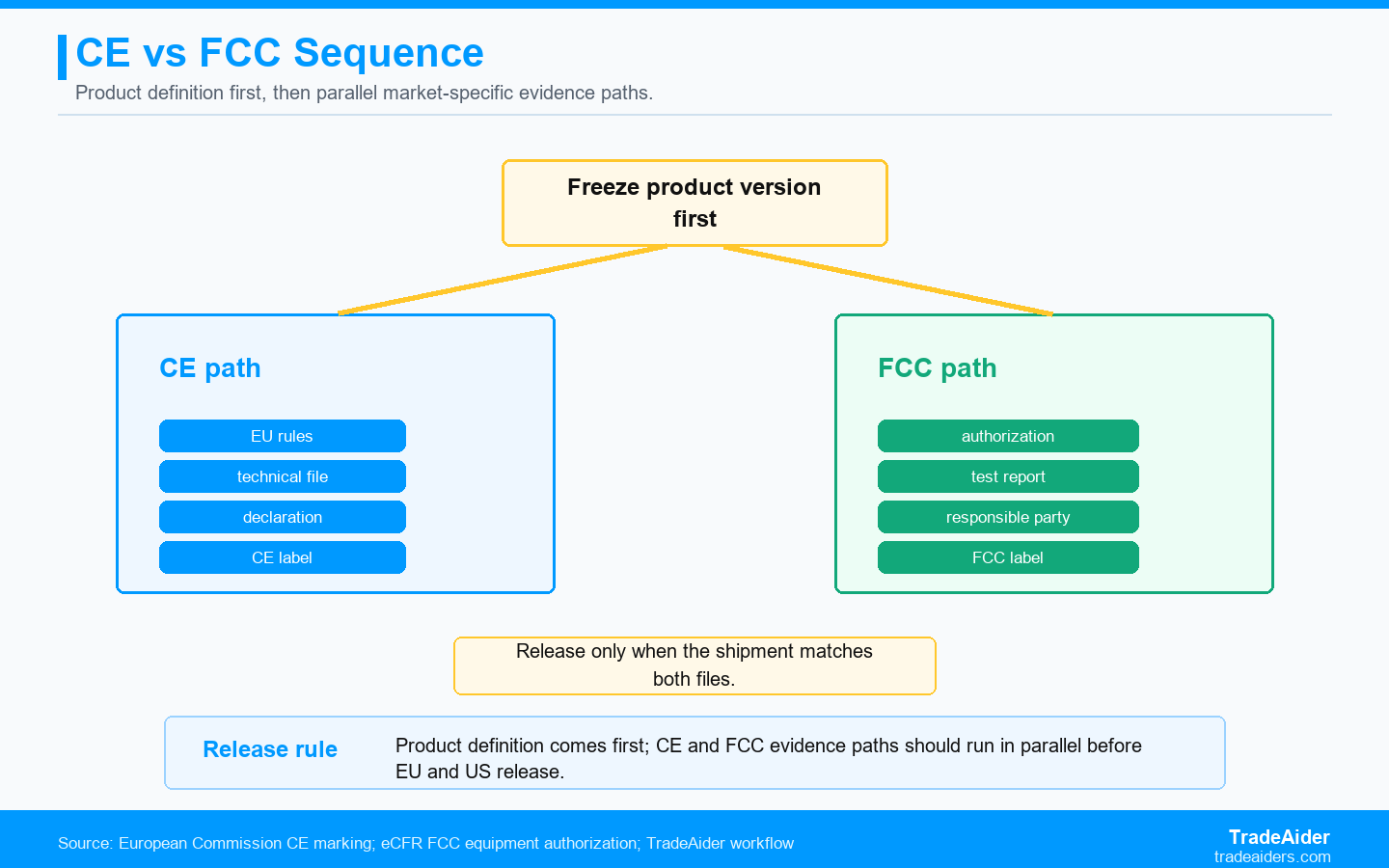
Product definition comes first; CE and FCC evidence paths should run in parallel before EU and US release.
Why Product Definition Comes First
Testing too early can waste money if the product keeps changing.
Before scheduling CE or FCC work, the buyer should define the final product version. That includes model number, enclosure, radio module, antenna, firmware where relevant, battery, charger, PCB, power supply, materials, accessories, labels, packaging, claims, and intended use. If any critical element changes after testing, the evidence may need review or retesting.
This is especially important for electronics and connected products. A small component change can affect electromagnetic compatibility, radio performance, safety, labeling, or documentation. A supplier may propose a substitute module or antenna during production because of availability or cost. Without change control, the buyer may ship a product that no longer matches the file.
The buyer should also decide whether the same product version will be sold in both markets. Sometimes the EU and US versions need different plugs, labels, warnings, documentation, language, packaging, or technical configurations. If versions differ, each version needs its own release control.
How CE Planning Works
CE planning starts by identifying which EU requirements apply.
CE marking is not a generic quality badge. It belongs only where EU legislation requires it, and it represents the manufacturer's responsibility that the product meets applicable EU requirements. Depending on the product, the buyer may need to address directives or regulations related to electrical safety, electromagnetic compatibility, radio equipment, machinery, toys, personal protective equipment, medical devices, or other product categories.
CE work may include identifying harmonised standards, performing conformity assessment, compiling a technical file, preparing an EU declaration of conformity, applying CE marking, and ensuring instructions, safety information, importer details, and labels are appropriate. Some products require notified body involvement; others can follow manufacturer self-assessment depending on legislation and risk.
For importers, the operational question is whether the factory can produce the same version that the technical file describes. The file is not useful if production labels, components, packaging, or instructions drift away from it.
How FCC Planning Works
FCC planning starts by identifying the authorization path for the device.
The FCC path depends on the device. Some products require certification, often with an FCC ID. Others may use Supplier's Declaration of Conformity. Radio modules, intentional radiators, unintentional radiators, power supplies, antennas, and digital circuitry all need careful classification. The responsible party and test evidence matter.
FCC planning should happen before packaging artwork and mass production because labels, user manual statements, FCC ID, SDoC information, and responsible-party details may need to appear on the product, packaging, or instructions. If the buyer discovers this after production, rework can be expensive.
The buyer should also control radio modules and antennas. A supplier may swap a module, antenna, enclosure, or PCB layout in a way that affects authorization. If the product uses a pre-certified module, integration conditions still matter. The product should be reviewed as sold, not only as a component.
Which Comes First In A Real Project?
The best sequence is parallel planning, then market-specific release gates.
The practical sequence is: freeze design, classify the product for EU and US rules, confirm standards and test plans, collect supplier component evidence, test or assess the final version, prepare CE and FCC files, approve labels and manuals, inspect production against the approved files, then release market-specific inventory.
Testing schedules may overlap. A lab or compliance consultant may coordinate EMC testing relevant to both markets while still producing separate evidence for CE and FCC needs. The buyer should not assume one test report automatically satisfies both systems, but good planning can reduce duplicated work.
If the product is already certified for one market, the buyer should still do a gap review for the other market. A CE file can provide useful product information, but it does not prove FCC authorization. An FCC report can support technical understanding, but it does not create a CE declaration. Treat the existing file as input, not as completion.
Where TradeAider Fits In CE and FCC Release Control
TradeAider fits by checking that the shipment matches the approved market files.
TradeAider can use Pre-Shipment Inspection to verify model number, labels, manuals, packaging, warning text, plug version, accessory set, carton marks, and visible construction against CE and FCC release files before goods leave the factory.
For electronics or dual-market launches, During Production Inspection can check whether approved components, labels, and packaging are being used before the whole lot is packed. Factory audit service can also review supplier change-control discipline when compliance risk is recurring.
SPAR Scenario: One Product, Two Market Files
The importer needed two release gates, not one logo decision.
Situation: An importer sources a Bluetooth consumer device for both EU and US sales. The supplier says the product has CE and FCC documents from a previous buyer.
Problem: The current order uses a modified enclosure, a new accessory cable, updated packaging, and different manuals. The FCC ID belongs to a module, and the CE declaration references an old model number.
Action: The importer asks a compliance specialist to review CE and FCC needs, updates market-specific files, and uses TradeAider to inspect labels, manuals, model numbers, packaging, and visible components before release.
Result: The buyer avoids printing one global package that is wrong for both markets. EU and US shipments are released only after the physical goods match each market file.
Action Card: Dual-Market CE/FCC Checklist
Build two evidence files from one controlled product version.
- Freeze product design, module, antenna, power supply, labels, manuals, and packaging before final testing.
- Map EU CE requirements and US FCC authorization needs separately.
- Confirm whether certification, SDoC, notified body, or self-assessment pathways apply.
- Approve CE and FCC label artwork before printing packaging or manuals.
- Inspect production against the exact EU and US release files before shipment.
A buyer should also decide how inventory will be separated. If EU and US versions use different labels, warnings, manuals, plugs, or packaging, cartons and packing lists should make the destination clear. Mixed market inventory can create receiving, relabeling, and compliance problems.
The buyer should keep a version matrix that connects model, market, test report, declaration, FCC ID or SDoC file, label artwork, manual version, supplier batch, and inspection report. This matrix becomes valuable when a marketplace, distributor, customs broker, or regulator asks what evidence supports the product.
For launch timing, do not let marketing pressure force production before evidence is ready. The cost of reprinting labels, repacking cartons, or holding inventory can exceed the time saved by rushing. Compliance planning should sit inside the production calendar, not after it.
If your product is entering both EU and US markets, send TradeAider the product files, market plan, CE/FCC documents, label artwork, and shipment schedule. The next step is to ask TradeAider to verify the produced shipment against both market release files.
Frequently Asked Questions
Does CE approval cover FCC?
No. CE marking and FCC authorization belong to different regulatory systems. One file may inform the other, but it does not automatically satisfy the other market.
Should CE or FCC testing happen first?
Freeze the product first, then plan CE and FCC evidence in parallel. Testing order depends on lab schedule, product risk, and market launch plan.
Can I print CE and FCC labels before testing is complete?
Do not print final labels until the correct evidence path, identifiers, warnings, and responsible-party information are confirmed for the product version.
What should inspection verify for CE/FCC products?
Inspection should verify model number, label artwork, manuals, warning text, plug version, packaging, visible components, accessories, carton marks, and market destination.
関連記事


TradeAiderサービスでビジネスを成長させる
下のボタンをクリックして、TradeAiderサービスシステムに直接入ります。予約から支払い、報告書の受け取りまでの簡単な手順は操作が簡単です。

