
- 会社概要

- 当社のサービス
- あなたの業界
- リソース
- ニュース&ブログ
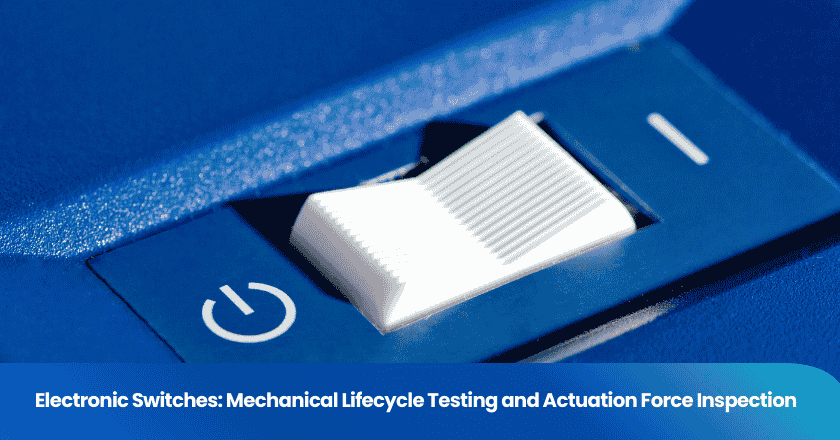
A faulty switch rarely announces itself during production. It announces itself six weeks later — when a customer files a return because a button stops responding after two months of normal use, or when a device locks up because a tactile switch's contact resistance has crept past the threshold of reliable closure. For buyers sourcing electronic products from Chinese factories, switch quality is one of the easiest defects to miss on a visual inspection and one of the most expensive to discover post-shipment.
This guide explains the two core inspection disciplines for electronic switches — mechanical lifecycle testing and actuation force measurement — covering what they test, what acceptable thresholds look like, and how a third-party pre-shipment inspection catches the failures that factory self-inspection routinely misses.
Key Takeaways
- Mechanical lifecycle testing simulates the full operational lifespan of a switch in hours, not years — typically 100,000 to 1,000,000+ actuation cycles depending on the application.
- Actuation force inspection measures the grams-force required to depress a switch; acceptable ranges are 50–500g depending on switch type, with variation across a batch exceeding ±25% being a defect signal.
- Contact resistance after cycling is the key output metric — an increase of more than 0.5 ohms through rated lifetime indicates wear-related degradation and pending field failure.
- Third-party pre-shipment inspection that includes functional switch testing catches these defects before goods leave the factory, when correction is still possible.
Why Electronic Switch Quality Failures Slip Through
The Hidden Nature of Mechanical Wear
Electronic switches look identical whether they will last 50,000 cycles or 500,000. Visual inspection cannot distinguish a switch with a worn contact dome from a new one; the failure only becomes measurable under repeated actuation or precise force measurement. This is why switch quality problems are disproportionately found in post-market returns and warranty claims rather than incoming inspection — buyers are relying on a test method that cannot see the failure mode.
For global importers sourcing consumer electronics, remote controls, industrial control panels, or any product with physical buttons, this gap creates real financial exposure. A batch of 5,000 units with underperforming switches generates returns, replacement shipments, negative reviews, and — for Amazon FBA sellers — account health risk that no post-arrival fix can address.
What Factories Typically Check (and What They Skip)
Standard factory QC for switches usually covers continuity testing — confirming the circuit opens and closes — and basic visual inspection for solder joint quality. What most factories do not routinely perform is lifecycle endurance testing on production samples, actuation force measurement with a calibrated force gauge, or contact resistance tracking across a full test cycle. These tests require specialized equipment, time, and trained operators; they are cost-justified for product development but rarely built into production-line QC for commodity components.
Third-party inspection fills this gap specifically because an independent inspector is focused on the buyer's acceptance criteria, not the factory's production throughput. For a deeper grounding in how electronics quality control should work across the full production stage, TradeAider's ultimate guide to electronics quality control covers the full spectrum from raw material to finished goods.
Mechanical Lifecycle Testing: How It Works
The Principle: Accelerated Fatigue Simulation
Mechanical lifecycle testing compresses years of real-world switch use into a laboratory test session. An automated actuator presses the switch at a controlled force and speed, counting cycles while monitoring for any degradation in electrical performance. The goal is to verify that the switch meets its rated operational lifespan before it leaves the factory.
Automated lifecycle test equipment can execute 1,000,000 actuation cycles in under 8 hours, generating force-versus-position data at each interval. The test records not just whether the switch continues to operate, but how its force characteristics and contact resistance evolve over its rated life.
Industry Lifecycle Standards by Application
The minimum cycle count for a lifecycle test depends heavily on the application. Industry standards for consumer electronics push-button switches set a baseline of 100,000 cycles. Industrial automation applications raise that bar significantly — switches on production line control panels are routinely tested to 1,000,000 cycles or more to reflect the high-frequency operational demands of their environment. Automotive switches, subject to ISO 26262 functional safety requirements, face additional environmental stress testing layered on top of the basic mechanical endurance cycle.
The table below summarizes typical lifecycle targets by application category:
| Application | Typical Lifecycle Target | Key Monitoring Parameter |
|---|---|---|
| Consumer electronics (remotes, gadgets) | 100,000 cycles | Contact resistance, tactile feel |
| Medical devices | 300,000–500,000 cycles | Force consistency, EMI resistance |
| Industrial automation controls | 1,000,000+ cycles | Force, resistance, tactile ratio |
| Automotive dashboard controls | 1,000,000+ cycles + ISO 26262 | Functional safety, vibration resistance |
What Lifecycle Testing Monitors During the Run
A lifecycle test that simply counts cycles to failure misses the most actionable data. Quality-grade lifecycle testing monitors switch performance continuously throughout the run, tracking contact resistance at intervals, actuation force evolution, and electrical contact bounce duration. Published membrane switch testing standards specify that contact resistance should not increase by more than 0.5 ohms over the rated lifetime — any greater increase signals contact surface degradation that will produce intermittent failures in the field. Contact bounce duration should remain under 5 milliseconds throughout the test run; bounce exceeding that threshold causes multiple signal interpretations in digital circuits, producing ghost inputs that are nearly impossible to diagnose remotely.
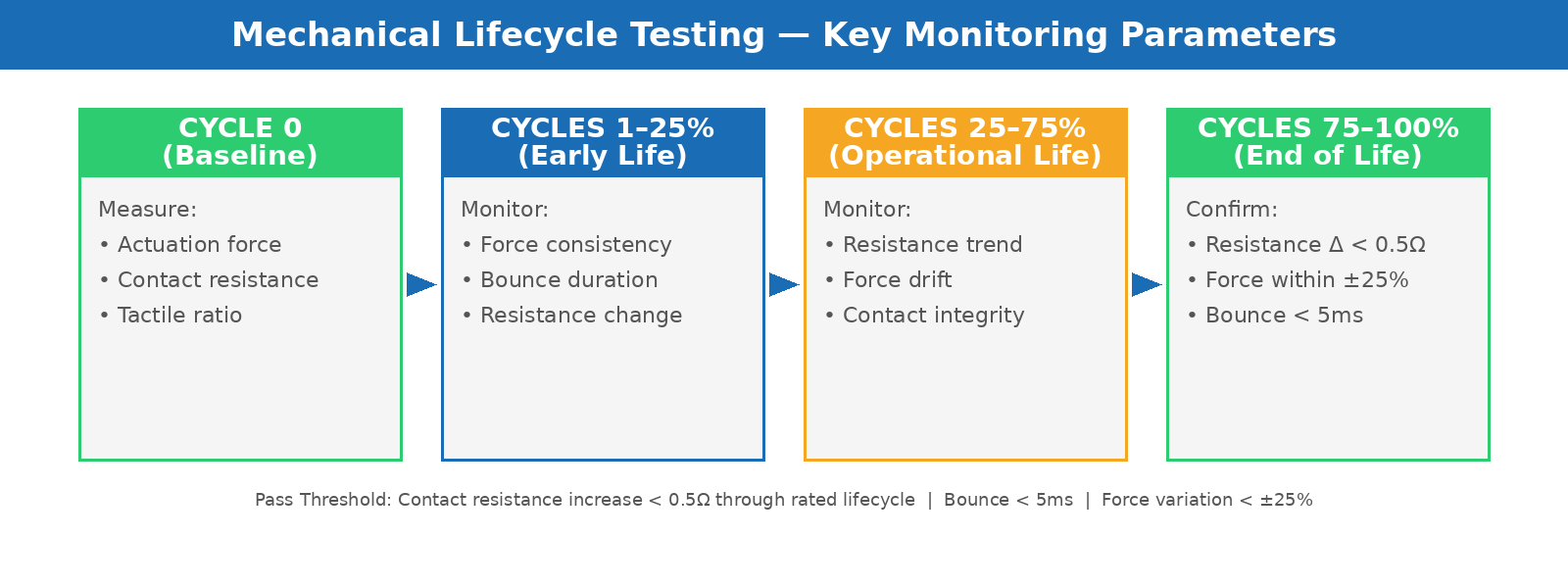
Figure 1: Key monitoring parameters across a mechanical lifecycle test — contact resistance and actuation force are tracked from cycle 0 to the rated lifecycle endpoint.
Actuation Force Inspection: The Specification and the Tolerance
What Actuation Force Measures
Actuation force is the grams-force (gf) required to depress a switch to electrical contact closure. It is the number that determines whether a button feels right or wrong to the end user — too light and it triggers accidentally; too heavy and it feels broken or fatigues the operator. For buyers, actuation force is both a functional specification and a quality consistency metric.
Industry actuation force ranges run from approximately 50 grams for light-touch consumer switches to 250 grams or more for industrial pushbuttons designed for gloved hands. Membrane switches typically require 150–500 grams of peak actuation force depending on design. The precise target is set by the product specification; the inspection task is to verify that production units match that specification and that variation across sampled units stays within acceptable tolerances.
Force-Displacement Curves and Tactile Ratio
A single force reading is less informative than a complete force-displacement curve — a graph of the force applied against the distance traveled as the switch is pressed. This curve reveals the tactile ratio: the relationship between peak (pre-click) force and post-click contact force. A tactile ratio above 0.4 is the threshold for perceptible positive feedback; below that, users experience the switch as mushy or unresponsive. Force-displacement testing equipment analyzes free height, tactile ratio, and actuation force simultaneously, providing the complete mechanical fingerprint of a switch sample.
For buyers, the practical inspection checkpoint is not just whether mean actuation force meets spec — it is whether unit-to-unit variation stays within ±25% of the specified center value. Center-to-edge variation within a single switch area should also remain within ±25%. Batches with wider variation produce inconsistent user experience across units and often indicate incoming component quality issues or press tooling wear at the factory.
What Actuation Force Shifts Indicate
Rising actuation force over a lifecycle test points to lubricant degradation or mechanical wear in the switch mechanism. Falling actuation force points to dome fatigue or compression set in elastomeric actuators — the switch becomes progressively easier to press as the return force diminishes, eventually reaching a state where it no longer reliably resets. Both failure modes show up clearly in force-displacement monitoring long before the switch reaches catastrophic failure, giving inspectors an early warning signal that the component batch is approaching its service limit faster than rated.
How Pre-Shipment Inspection Applies These Tests
What a Third-Party Inspector Does Differently
A pre-shipment inspection for electronic products with switches should go beyond visual checks and basic continuity testing. An effective inspection protocol for switch quality includes random sampling of production units for functional actuation testing (confirming electrical make/break under controlled pressing), visual and dimensional checks of switch travel and seating, contact resistance measurement on sampled units, and where possible, a short-form lifecycle stress test on a subset of samples — typically 10,000–20,000 cycles — to screen for early-life degradation that would not survive full production use.
This approach directly addresses the failure modes that factory self-inspection misses: a batch where 8% of units have actuation force 40% above spec, or where contact resistance on 5% of samples already shows the wear signature of a much shorter lifecycle. Those defects do not appear in a pass/fail continuity check. They appear in a force gauge reading and a resistance measurement — tests that take minutes per sample but prevent months of post-market returns.
TradeAider's pre-shipment inspection service includes an online real-time report accessible to the buyer during inspection, allowing buyers to redirect inspection focus to specific components — including switch testing depth — mid-audit when concerns emerge.
Connecting Switch Inspection to Your Defect Classification
Under AQL-based inspection, switch failures need to be correctly classified to drive the right accept/reject decision. An actuation force measurement 5% outside spec on a consumer remote control is likely a minor defect. An actuation force measurement 40% outside spec, or a contact resistance reading showing mid-life degradation at zero cycles, is a critical defect that warrants hold and supplier corrective action before any units ship. Pre-shipment inspection that includes switch functional testing gives buyers the data to make that classification correctly, rather than discovering it through customer returns.
For Amazon FBA sellers, this matters doubly: a product that generates a defect-related return spike risks inventory removal and account flags. TradeAider's Amazon FBA inspection solutions are specifically designed to catch these component-level failures before goods ever reach a fulfillment center.
Buyers who want to understand how quality standards apply across the full electronics category — not just switches — can review TradeAider's guide on consumer electronics quality inspection standards.
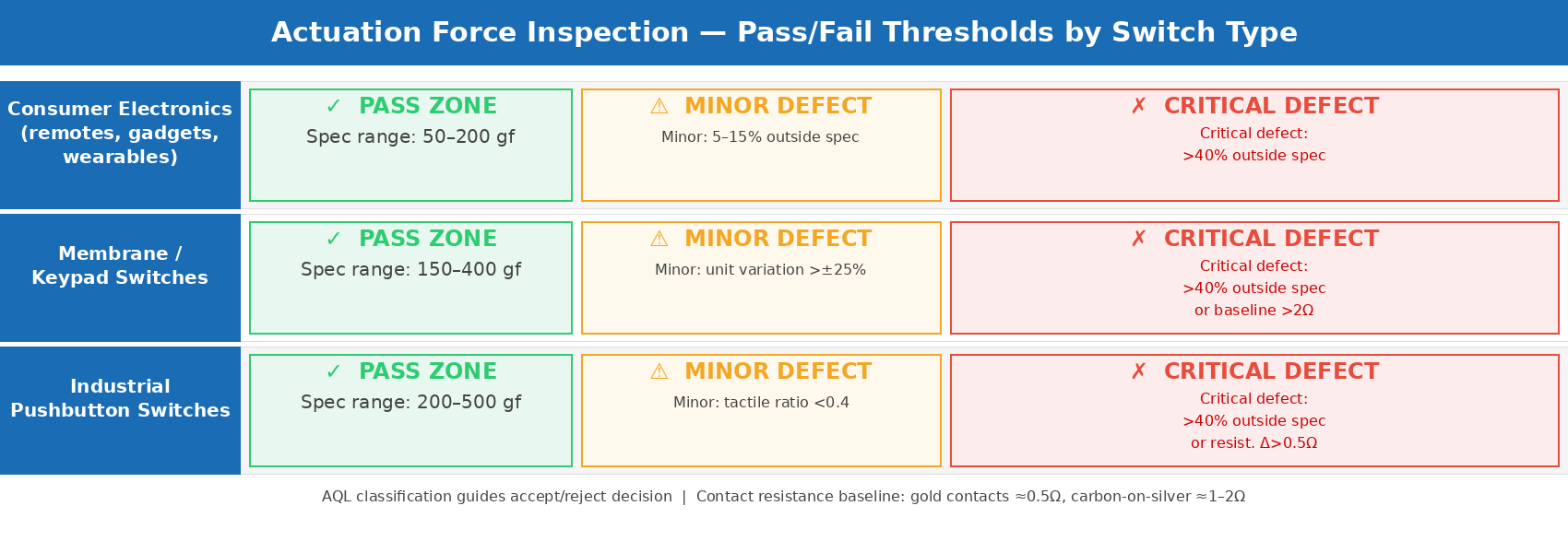
Figure 2: Actuation force ranges by switch application — and the inspection thresholds that define minor versus critical defect classification.
Environmental Testing: The Context That Lifecycle Numbers Ignore
Temperature, Humidity, and Ingress Effects
A switch that passes 100,000 cycles at room temperature in a clean lab may fail at 30,000 cycles after 48 hours of humidity cycling. Environmental stress testing for switches — thermal cycling, IP ingress testing, and salt spray exposure — creates the context that accelerated lifecycle numbers cannot capture. For products destined for outdoor use, food service, or humid tropical markets, environmental qualification is not optional; a switch that meets lifecycle specs in controlled conditions but degrades rapidly in field humidity generates the same return problem as a switch that fails the basic lifecycle test.
For buyers sourcing through Chinese factories, environmental qualification is typically conducted at the design approval stage, not during production inspection. The pre-shipment inspection role is to confirm that production units match the qualified design — same component, same assembly process, same IP sealing — rather than re-running full environmental qualification on each batch. Component substitution is a common supply chain risk: a factory that qualified its product with a name-brand switch dome may substitute a lower-specification domestic equivalent when that component goes on allocation. Pre-shipment inspection that includes switch make/model verification and a short functional test catches that substitution before it ships.
Safety Standards: IEC 60950-1 and Beyond
For switches in information technology equipment and consumer electronics, IEC 60950-1 and IEC 60335-1 set the safety framework — covering insulation resistance, dielectric strength, and earth continuity for mains-connected products. These are certification-level tests conducted by accredited labs, not field inspection tests. What pre-shipment inspection can verify is that production units carry the correct certification marks and that the switch assemblies match the certified design — any deviation from the certified design documentation is a compliance risk that should be flagged before shipment, not discovered during a market surveillance audit at the destination port.
Frequently Asked Questions
What is the minimum lifecycle cycle count that should be specified for consumer electronics switches?
For general consumer electronics, 100,000 mechanical actuations is the industry baseline minimum for switch lifecycle ratings. This represents roughly five to ten years of typical consumer use for a device accessed several times daily. For products in higher-use categories — smart home controls, gaming peripherals, or any product marketed on durability — specifying 300,000 to 500,000 cycles in your product specification and requiring lifecycle test data from your supplier is reasonable and increasingly expected by quality-conscious buyers.
How do I include actuation force testing in a pre-shipment inspection?
Actuation force testing should be specified in your inspection checklist as a functional test item with explicit pass/fail thresholds drawn from your product specification. Provide the inspector with the nominal force value, the acceptable tolerance band (typically ±20–25% for consumer applications), and the sample size. The inspector measures force using a calibrated force gauge on randomly selected samples and records both the mean and range — batch uniformity is as informative as the mean value itself.
Can switch failures be detected during production rather than at pre-shipment?
Yes — a during-production inspection (DPI) conducted while assembly is still underway allows actuation and contact resistance checks on assembled units before the full batch is committed. This is particularly useful for high-value or complex products where late-stage defect discovery is expensive. TradeAider's during-production inspection service provides real-time reporting that allows buyers to flag switch quality concerns and request corrective action before production completes.
What contact resistance value indicates a failing switch?
New switches should exhibit contact resistance of 0.5–2 ohms depending on contact material, with gold-plated contacts at the lower end. A contact resistance reading above 2 ohms on a new, uncycled switch in a consumer application, or any unit showing resistance increase greater than 0.5 ohms after a short-form lifecycle stress test, indicates a contact quality issue that warrants rejection and supplier corrective action.
Defective switches in a finished product shipment cannot be fixed at the warehouse — they require rework at source, re-inspection, and delayed delivery. TradeAider's pre-shipment inspection service covers functional switch testing as part of a comprehensive electronics QC protocol, with an official report delivered within 24 hours and real-time inspection visibility for buyers. Contact TradeAider to discuss your electronics inspection requirements or use the Inspection Charge Calculator to estimate costs for your next shipment.
関連記事


TradeAiderサービスでビジネスを成長させる
下のボタンをクリックして、TradeAiderサービスシステムに直接入ります。予約から支払い、報告書の受け取りまでの簡単な手順は操作が簡単です。

