
- 会社概要

- 当社のサービス
- あなたの業界
- リソース
- ニュース&ブログ
A Walmart product inspection checklist should not be a generic QC form; it should prove that the product, packaging, labels, documents, and retail-readiness evidence can survive a real retailer release decision. The practical answer is to inspect the risks that can still be changed, record the evidence that proves conformity, and decide whether to release, hold, sort, rework, test, or reinspect before the shipment moves beyond buyer control.
Key Takeaways
- Start with Walmart and buyer requirements: the checklist should reflect item setup, product category, packaging, labeling, compliance, and supplier instructions.
- Check both product and retail readiness: workmanship, function, safety evidence, barcode, labels, cartons, counts, and documents all affect release.
- Use category-specific compliance evidence: children's products, regulated goods, electrical items, food-contact products, and private-label items may need extra proof.
- Do not imply approval from inspection alone: inspection supports the buyer's release decision, but suppliers remain responsible for meeting Walmart and legal requirements.
What a Walmart Product Inspection Checklist Must Prove
Walmart supplier requirements direct suppliers to review the standards, obligations, and expectations that apply to the products they supply. That is the right starting point for a checklist. The inspection form should not merely ask whether the product looks good. It should ask whether the product and shipment evidence match the buyer's Walmart-facing requirements.
Walmart's compliance areas reference product safety, consumer protection, accurate labels and product listings, testing where required, documentation, and trade-related information. A practical inspection checklist should therefore connect product condition with retail and compliance evidence. If the checklist checks only scratches and carton damage, it is too narrow for a retailer-bound order.
ISO/IEC 17020:2026 supports the broader inspection principle: competent and consistent inspection determines conformity against specified requirements. For a Walmart-bound shipment, the specified requirements may include the buyer's product file, PO, packaging artwork, barcode data, carton marks, label claims, test reports, and category rules.
Core Checklist for Walmart-Bound Products
A useful Walmart product inspection checklist should be built from proof groups. Each group answers a release question the buyer may need before the shipment leaves the factory.
| Proof Group | What to Check | Evidence to Capture | Why It Matters |
|---|---|---|---|
| Item identity | SKU, model, color, size, quantity, PO match | Product photos, count, labels, carton range | Prevents wrong-item or mixed-SKU shipment |
| Workmanship and function | Appearance, assembly, performance, accessories | AQL result, defect photos, function notes | Confirms product conformity |
| Packaging | Retail pack, master carton, inserts, protection, case pack | Artwork photos, carton marks, packing method | Supports receiving and shelf readiness |
| Barcode and labels | UPC, item label, warnings, country of origin, claims | Scan proof, label close-ups, mismatch notes | Protects listing and compliance accuracy |
| Safety and compliance evidence | Testing, certifications, age grade, warnings, restricted claims | Document match and report references | Reduces legal and retailer risk |
| Shipment release | Packed quantity, carton condition, lot identity, exceptions | Carton range, sample spread, release action | Supports ship, hold, sort, or correct decision |
The checklist should be customized by category. A textile order may need fiber content, care label, color, stitching, size, and packaging checks. An electrical item may need function, rating label, plug, manual, warning marks, and test-document review. A children's product may need tracking label and certification evidence. A food-contact item may need material and labeling proof.
The table also shows why a Walmart-bound inspection cannot be reduced to final appearance. A product can pass a factory appearance check and still fail a retail receiving expectation because the barcode does not scan, carton quantity is wrong, warning label is missing, or the document file does not match the item.
Use Walmart Requirements Without Overclaiming the Inspection Role
Walmart's audits, certifications, and testing resources make clear that some categories and programs can involve testing, certification, or audit expectations. A field inspection can review whether the expected documents are present and match the inspected product, but it should not pretend to replace laboratory testing, certification decisions, or Walmart's own supplier approval process.
For children's products sold in the United States, the Consumer Product Safety Improvement Act and CPSC rules can create certification and testing obligations. The CPSC tracking label guidance also explains tracking-label requirements for children's products. A Walmart product inspection checklist should flag such category-specific proof, but the buyer should still confirm the legal and retailer requirements that apply to the product.
This distinction protects the buyer. Inspection can find mismatches, missing labels, weak packaging, visible defects, wrong cartons, non-scanning barcodes, and missing evidence. It cannot grant Walmart acceptance, legal compliance, or category certification by itself.
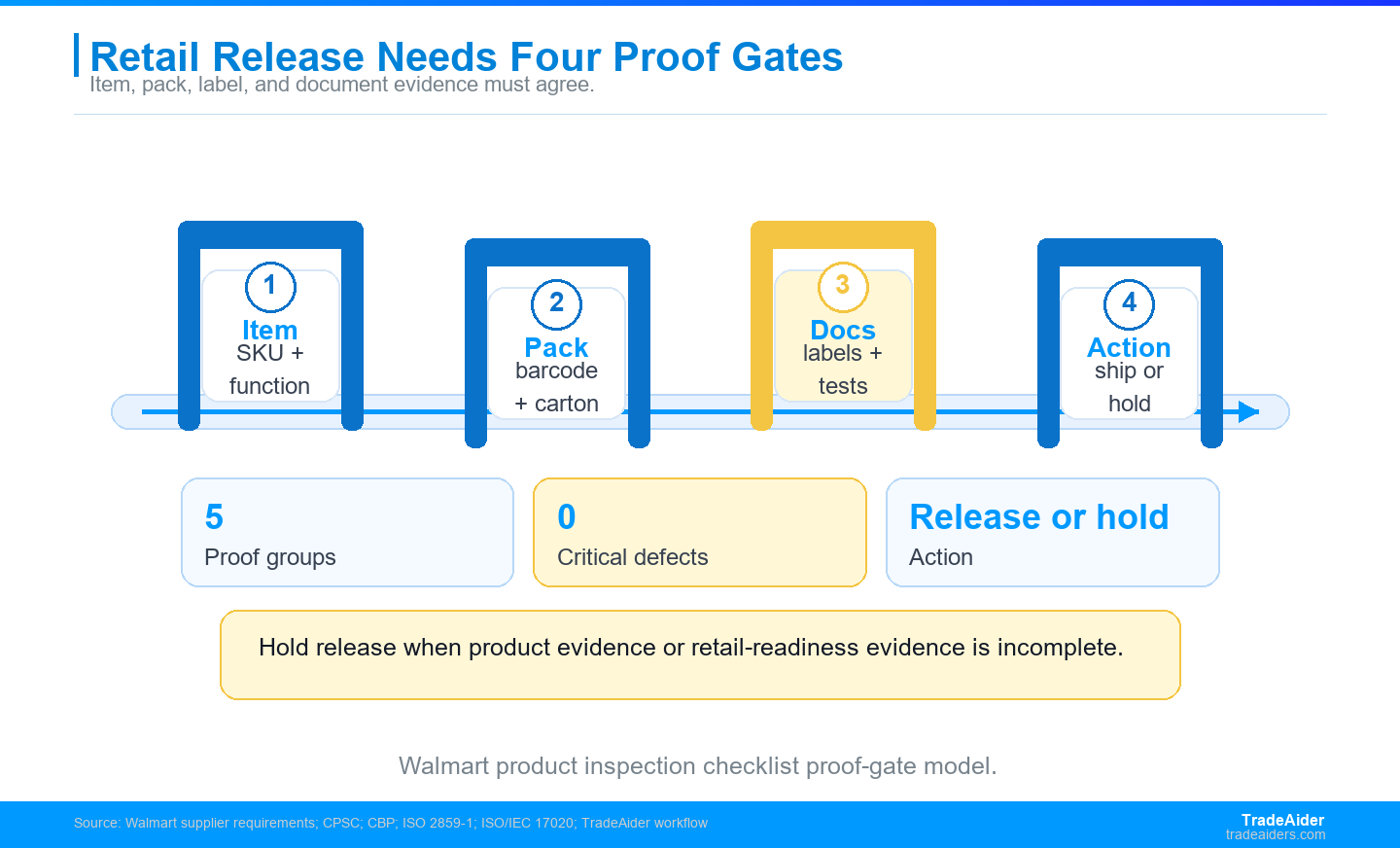
A Walmart product inspection checklist should connect item, packaging, label, document, and release evidence before the buyer releases the shipment.
Product evidence is not the same as retail approval
Inspection evidence supports the buyer's decision to release, hold, correct, or escalate. It is not a retailer approval certificate. The buyer should keep supplier agreements, item setup data, Walmart requirements, laboratory documents, and shipment evidence aligned. If any of those records conflict, the checklist should escalate the issue rather than bury it under a generic pass. For example, a product can match the approved sample but still have a carton mark, warning label, barcode, or test-report mismatch. The report should name that mismatch as a release risk because retail readiness depends on the whole file agreeing.
Retail readiness must be checked at carton level
A Walmart-bound shipment often fails commercially at the carton, label, or data level rather than the product surface. Carton range, PO, SKU, case pack, barcode, destination marks, warning labels, and packing method should be visible in the report. If cartons are inaccessible or not packed, the report should say so clearly. Sample spread matters because 1 correct master carton does not prove that every pallet, SKU, color, or case-pack configuration is correct. The inspector should photograph representative carton sides and flag any inaccessible packed quantity before the buyer treats the shipment as retail-ready.
Sampling and Defect Severity for Retail Shipments
AQL sampling can be useful for Walmart-bound inspections when the lot is defined and the product requirement is inspectable. ISO 2859-1:2026 provides AQL-indexed sampling schemes for lot-by-lot inspection by attributes, and ASQ distinguishes attributes and variables sampling. The buyer should decide which findings are critical, major, or minor before inspection starts.
Critical defects often include safety, legal, severe function, or prohibited-condition issues. Major defects may include wrong SKU, non-function, incorrect labeling, packaging failure, barcode problems, missing accessories, or visible defects that affect saleability. Minor defects may include small cosmetic deviations that do not affect use or retail acceptance. Category and buyer rules should decide the exact classification.
Retail shipments also need sample spread. If the sample comes from only one carton or one pallet, the inspection may miss mixed-SKU, labeling, or case-pack issues elsewhere in the shipment. The report should identify carton numbers, SKU coverage, size or color distribution, and any inaccessible goods.
Documentation and Import Evidence
CBP basic import guidance and CBP reasonable care guidance are useful reminders that importers are responsible for accurate import information and reasonable care. For Walmart-bound goods, inspection should not ignore origin labels, product descriptions, carton marks, quantities, and documents that may affect import or receiving accuracy.
The inspection report should not become a customs filing, but it can catch practical mismatches: country-of-origin label missing, item description inconsistent with PO, carton count different from packing list, SKU label not matching product, or label claims not supported by the document file. These issues are easier to correct before the shipment leaves the factory than after a retailer receiving problem.
For private-label or regulated goods, the buyer should keep the checklist tied to the approved artwork, warning-language file, testing record, product manual, packaging specification, and item setup data. Any mismatch should be reported as a release risk, not treated as a harmless formatting issue.
Scenario Estimate: Retail-Readiness Gaps Are Small Until They Are Not
Consider a 20,000-unit order where 1 percent of units have a label or barcode issue. On the factory floor, 200 affected units may look like a small exception. In a retail channel, the same issue can affect receiving, shelf readiness, inventory accuracy, returns, customer service, and supplier scorecard discussions.
The checklist should therefore protect the buyer from shipping a lot that is physically good but commercially unready. A good report does not simply say product appearance passed. It shows whether the item, packaging, labels, cartons, documents, and compliance evidence agree with the retailer-facing requirements.
Calculated from a 20,000-unit retail order, a 1 percent labeling issue equals 200 units that can create receiving, shelf, or customer-service problems. Calculated from 200 affected units at USD 0.46 per relabel action, the direct handling exposure equals USD 92 before freight, return, or retailer penalties. Calculated from 5 retail proof groups, item identity, packaging, barcode, compliance, and test evidence, 5 groups equal 5 failure paths even when workmanship looks acceptable. Calculated from a 0 critical-safety-defect rule, 0 allowed critical-safety defects plus 1 safety-related failure equals 1 lot hold regardless of cosmetic results. Calculated from a 48-hour shipment deadline, 48 hours equals 2 days of remaining leverage before final loading becomes the wrong moment to find missing retail evidence. Calculated from 4 Walmart-facing files, PO, item setup, artwork, and test record, 4 files equal 4 comparison points before release. Calculated from 2 SKUs across 3 carton ranges, 2 x 3 equals 6 sample-spread checks to reduce mixed-carton risk.
Where TradeAider Fits
TradeAider can help buyers structure Walmart-bound inspections around both product conformity and retail readiness. In pre-shipment inspection, the shipment should be completed and substantially packed so barcode, carton, label, count, and packaging evidence can be checked before release. In during-production inspection, buyers can catch label, packaging, or function issues before the full lot is packed incorrectly.
For new suppliers or higher-risk programs, pre-production inspection can confirm approved samples, packaging files, label references, test-document readiness, and production setup before output begins. Where hidden safety or compliance claims matter, add product testing or document review. The goal is not to claim Walmart approval. The goal is to give the buyer a stronger release file before shipment.
Practical Walmart Product Inspection Checklist
Before inspection, prepare the PO, approved sample, item setup data, packaging artwork, label files, testing or certification documents, carton requirements, and defect classification rules. Then make sure the report answers both product and retail-readiness questions.
- Confirm SKU, model, color, size, quantity, PO, carton range, and mixed-assortment rules.
- Check workmanship, function, accessories, manuals, inserts, and visible safety concerns.
- Verify packaging artwork, retail pack, master carton, case pack, carton marks, and protection.
- Scan barcodes and photograph labels, warnings, claims, country-of-origin marks, and tracking labels where relevant.
- Match testing, certification, audit, or compliance evidence to the inspected item and lot.
- State release, hold, sort, rework, replacement, testing, or escalation action clearly.
For retailer-bound orders where one label or carton mistake can delay release, buyers can contact TradeAider to structure the checklist around product, packaging, document, and shipment evidence.
Frequently Asked Questions
What should a Walmart product inspection checklist include?
A Walmart product inspection checklist should include item identity, workmanship, function, accessories, packaging, barcode, labels, carton marks, quantity, document match, safety evidence, and shipment release action. The checklist should be customized by product category. A generic QC form is not enough when retail readiness, labels, and compliance evidence affect acceptance.
Can inspection guarantee Walmart approval?
Inspection cannot guarantee Walmart approval because approval depends on supplier obligations, item setup, category requirements, retailer processes, testing, certifications, and legal compliance. Inspection supports the buyer's release decision by finding visible defects, mismatches, missing evidence, and shipment risks before goods leave the factory. It should not be described as a retailer approval certificate.
Why are barcode and label checks important for Walmart shipments?
Barcode and label checks are important because a product can look acceptable but still create receiving, shelf, inventory, or customer-service problems if retail data is wrong. The inspection report should show scan evidence, label close-ups, carton marks, country-of-origin labels, warnings, and any mismatch against the buyer's approved files or PO.
When should Walmart-bound goods be inspected?
Walmart-bound goods are usually strongest at pre-shipment inspection when production is completed and packing is substantially ready, because product, label, carton, and barcode evidence can be reviewed together. During-production and pre-production checks are useful for new products, new suppliers, label changes, packaging changes, or higher-risk categories where late correction would be costly.

関連記事



TradeAiderサービスでビジネスを成長させる
下のボタンをクリックして、TradeAiderサービスシステムに直接入ります。予約から支払い、報告書の受け取りまでの簡単な手順は操作が簡単です。

