
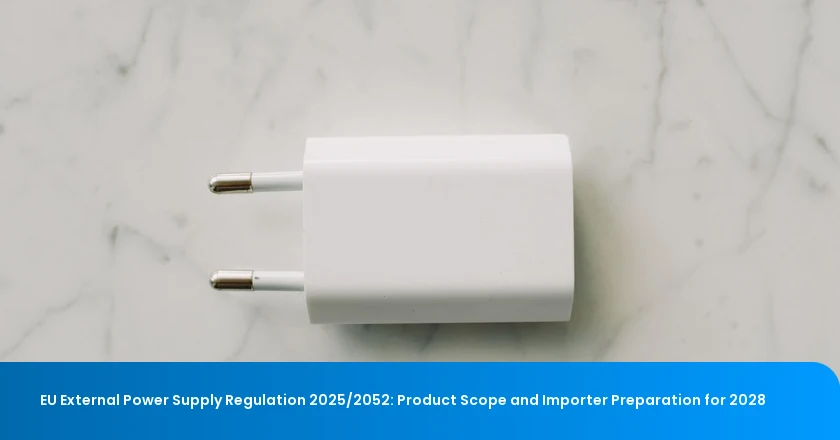
EU importers should screen each purchased power-supply model against Regulation (EU) 2025/2052, then separately check scope exclusions, interoperability exceptions and transition conditions. The regulation generally applies from 14 December 2028. A supplier’s “high power,” “spare part” or “non-USB” description does not establish an exemption. Start with the actual adapter, its intended product and its technical records; use that assessment to plan design changes, testing and documentation before the affected units are placed on the EU market.
Regulatory position checked: October 30, 2026. External power supplies need model-level assessment. Wireless charging equipment and USB Type-C cables are also covered by the regulation, but require separate technical assessments.
Three decisions before approving an EPS order
- Classify the actual model under the new scope; the former 250 W ceiling no longer settles the question.
- Document the precise exception or transition route and continue checking duties that remain applicable.
- Approve a controlled model revision and supporting evidence before relying on shipment inspection.
Which purchased products fall within the new scope?
The EPS definition in Article 2(1) of Regulation (EU) 2025/2052 includes a separate enclosure, single-phase AC input, a separate consumer-product primary load and nameplate output not exceeding 60 V DC or 42.4 V peak AC; it covers supply with or without the powered product. Read the relevant regulation provisions.
An external power supply (EPS) is the separate unit that converts mains electricity for the product it powers. A device sold as a “charger” may be an EPS when it supplies a product with an internal charging circuit. A battery charger with dedicated circuitry regulating battery charging is a different category. Classify the function and configuration before choosing the applicable requirements.
The new definition has no general 250 W output-power ceiling. The previous Regulation (EU) 2019/1782 used that ceiling and a narrower household-and-office equipment scope. A supplier’s old “outside scope” conclusion therefore needs a fresh review. High wattage alone does not exclude an EPS under the new rule.
| Screening question | Record for the purchased model | Next action |
|---|---|---|
| Single-phase AC input and a separate consumer-product load? | Input specification, powered-product identity and intended-use information | If yes, continue the EPS screen; if unclear, request the circuit/function description. |
| Separate enclosure and removable or hard-wired connection? | Adapter photos, drawings and connection details | A fixed output cable does not by itself put an EPS outside scope. |
| Within the output-voltage definition? | All nameplate output voltages and operating profiles | Compare with 60 V DC or 42.4 V peak AC; escalate an incomplete profile list. |
| Sold alone or bundled? | Adapter model linked to every affected retail SKU | Assess the adapter either way; the retail bundle does not settle its status. |
Record the result as “in scope,” “excluded with supporting provision,” or “pending evidence.” An EPS screen that fails a definition criterion does not settle whether a different product category or another EU law applies. Keep that follow-up question assigned to the technical or compliance owner.
Separate scope exclusions from interoperability exceptions
Article 1(2) scope exclusions and Annex II point 3(c) interoperability exceptions have different effects: an AC-DC EPS exempt from interoperability can remain subject to other applicable ecodesign requirements. European Commission guidance.
First review the regulation-wide exclusions. These include uninterruptible power supplies; specified lighting control gear; autonomous-appliance docking stations; and EPS designed, tested and marketed exclusively for medical devices or means of transport. Products whose converted power primarily serves their own internal load are also excluded. The lighting provisions contain qualifications, including a battery-operated-product exception, so a generic “lighting adapter” label is insufficient.
Next, assess interoperability: the ability to use a compatible supply across products. Annex II requires an AC-DC EPS to be interoperable unless a listed exception applies. An interoperable EPS needs at least one USB Type-C or USB Power Delivery (USB-PD) port, with the specified port operation, maximum-output allocation and detachable Type-C cable arrangement. A familiar barrel connector is a design feature, not an exception.
| Route or example | What the condition affects | Evidence to retain |
|---|---|---|
| Exclusive medical-device or transport use | Potential exclusion from this regulation under Article 1(2) | Exact end product, design/testing basis and consistent exclusive-use marketing. |
| Output power greater than 100 W | An interoperability exception, not a general scope exclusion | Model nameplate power and technical specification; continue other applicable checks. |
| Output voltage higher than 48 V; maximum voltage no more than 4.5 V; or voltage above 20 V with power below 25 W | Separate numerical interoperability exceptions | Full output-profile list; check the exact inequality, not a rounded catalogue value. |
| User-selectable EPS, Power over Ethernet injector or charging cradle | Listed interoperability exceptions | Function, configuration and technical evidence matching the defined product. |
| Exclusive fixed-building installation or a qualifying wet-environment product | Conditional interoperability exceptions | Installation/use instructions and supporting design/testing records; wet use requires the specified IPX3-or-higher basis. |
| Other special-use products | Only the exact Annex II 3(c) condition | Review the complete list, including toys, qualifying power tools, audio equipment, special peak-demand products and analogue-line phones. |
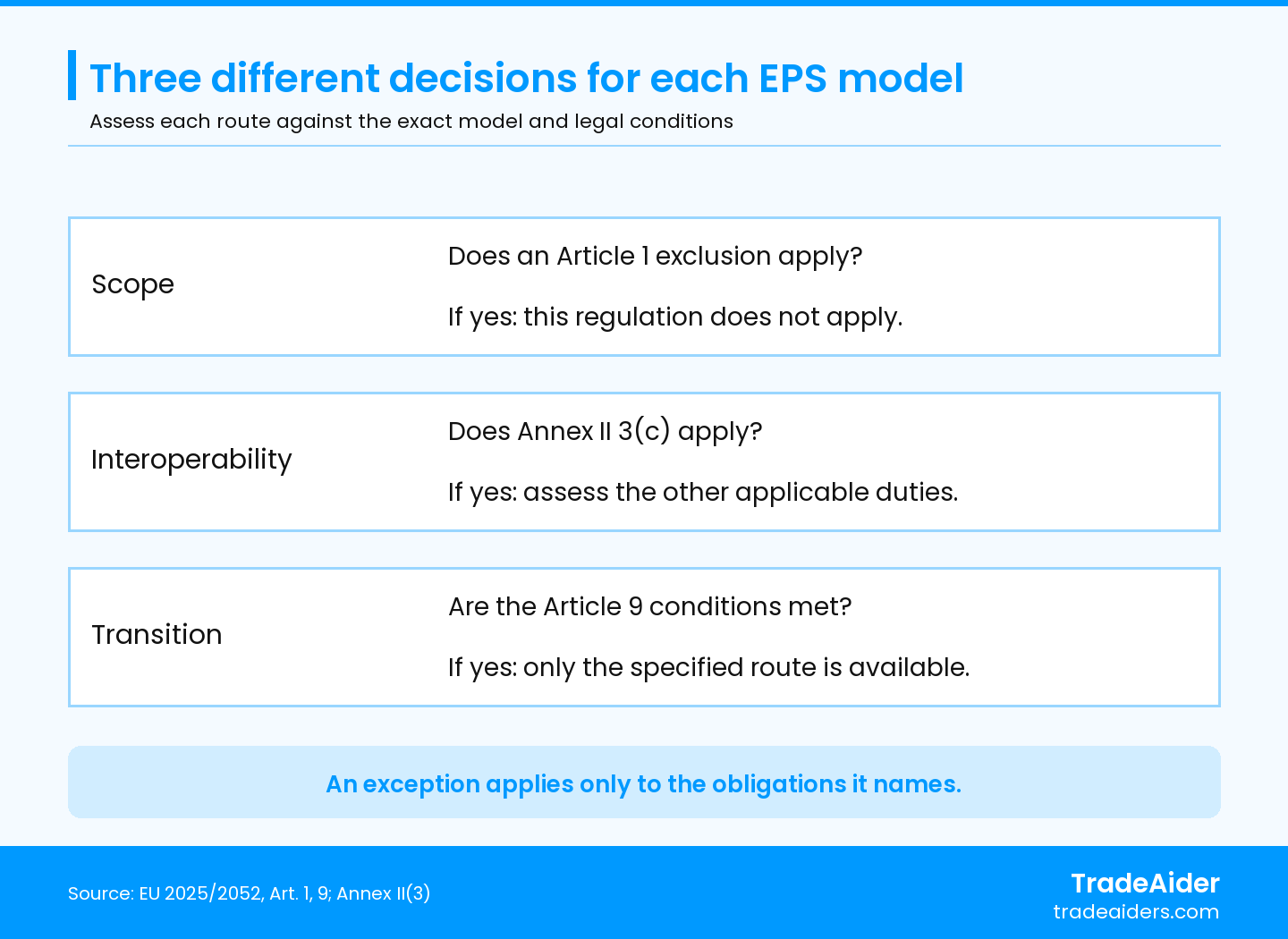
Check scope first, then interoperability and transition conditions. An interoperability exception does not remove other applicable ecodesign duties.
The table is a screening aid, not the complete exception text. Where the rule says “designed, tested and marketed” for exclusive use, a supplier letter addresses only part of the evidence. Ask engineering to match the design and test records to that claim, and check that the sales literature does not advertise unrestricted use. If the records disagree, keep the exception pending.
After classification, translate the result into the order’s approved references. TradeAider’s inspection standards explain the inspection criteria context; the buyer still needs to specify the model, drawings, markings and acceptance requirements that apply to this order.
What changes should suppliers prepare?
Annex II sets differentiated efficiency, no-load, output-performance, interoperability and information requirements; its energy-efficiency tables do not establish one universal 67% threshold for every EPS. European Commission guidance.
Ask the supplier to map the model to the applicable efficiency table and test conditions. No-load consumption concerns a supply connected to mains without supplying its primary load. Active efficiency concerns conversion while supplying a load. Adaptive and multiple-output models require attention to their actual operating profiles; a headline efficiency value without its conditions cannot establish conformity.
Prepare three connected work packages. Engineering should confirm the port configuration, output ratings and applicable performance and surge-resistibility requirements. The testing owner should identify the required methods, configurations and results. The documentation owner should update the nameplate, instructions, free-access product information and technical file so they describe the same model revision.
Interoperable EPS also need the Common Charger logo and applicable port information. The logo belongs to qualifying interoperable EPS; it is not a generic badge to add to every adapter or powered device. Use the specified artwork and power value after confirming eligibility. A packaging artwork approval should therefore follow the technical decision, not substitute for it.
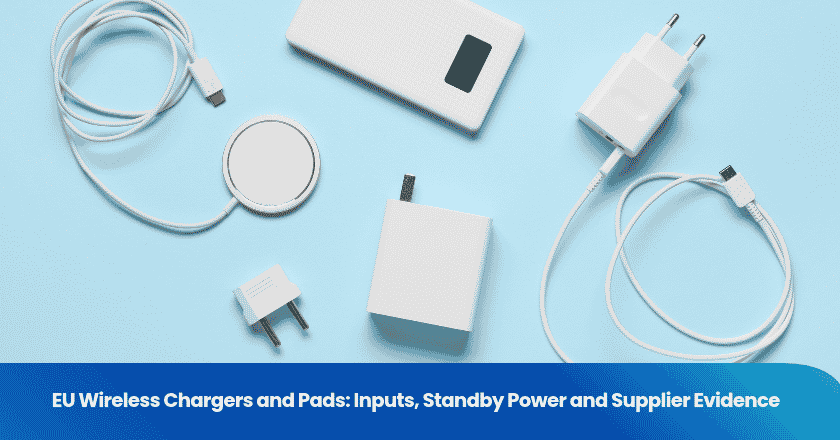
For purchasing, the useful deliverable is a dated change list: affected model and revision, requirement, proposed modification, validation evidence and first order using the new version. Ask whether a port, firmware or internal component change also affects the powered product, accessory set, instructions or other applicable product rules. Keep wireless standby and cable-loss testing in their own product assessments rather than assuming an EPS report covers the complete bundle.
Use the correct transition route and deadline
Regulation (EU) 2025/2052 generally applies from 14 December 2028. Article 9 provides conditional spare-part treatment until 14 December 2033, an energy-efficiency transition for EPS with a USB-PD port above 100 W until 14 December 2030, and early-compliance recognition for EPS placed on the market between 14 December 2025 and 14 December 2028. EUR-Lex summary.
| Route | Conditions and limit | Purchasing consequence |
|---|---|---|
| General application: December 14, 2028 | New requirements apply, subject to the specific transition provisions. | Plan affected units by their actual EU market-placement event, not simply the factory completion date. |
| Early compliance: December 14, 2025–December 14, 2028 | EPS meeting the new regulation are considered compliant with Regulation 2019/1782. | Check the complete new requirements claimed; a new connector alone is insufficient. |
| USB-PD above 100 W: until December 14, 2030 | The specified previous energy-efficiency requirements continue instead of the new Annex II point 1 requirements. | Do not extend this relief to every other requirement or to every high-power supply. |
| Qualifying spare-part EPS: until December 14, 2033 | The definition and both Article 9(1) conditions must be satisfied. | Keep replacement-model, compatibility, range-review and required packaging/website evidence. |
The spare-part route is particularly easy to overstate. Article 2 defines a spare-part EPS as a non-interoperable EPS intended solely to replace an EPS placed on the market before December 14, 2028. Article 9 also requires that the manufacturer’s, importer’s or authorized representative’s range contains no usable supply compliant with the new regulation except for interoperability. This is a specific availability condition, not permission to call remaining stock “spares.”
The required packaging and free-access website statement identifies exclusive spare-part use, the replaced EPS model and the powered products. Preserve the required wording from Article 9(1)(b) in the approved artwork. If the replacement identity, product compatibility or range assessment is missing, do not plan an order around that transition until the responsible compliance owner resolves it.
Transition eligibility is a model-and-transaction question; batch sampling is a separate decision. When planning shipment checks, the AQL calculator can help select a sample under the agreed inspection plan. A sampling acceptance result does not establish that the model qualifies for a regulatory transition.
Build a model-level supplier evidence file
Article 4 requires relevant declared parameters, product information and calculation details and results in technical documentation, and a list of equivalent models with their identifiers. Read the relevant regulation provisions.
Build one controlled record per purchased model, with links to genuinely covered variants. The following worksheet can be copied into the supplier request. Enter file names and revisions in the evidence column rather than accepting an unqualified “compliant” response. Assign a person to resolve each pending row before the decision that depends on it.
| Record or decision | Evidence to enter | Reviewer and action if missing |
|---|---|---|
| Model identity and scope | Model ID: ___; revision: ___; powered products: ___; definition/exclusion conclusion: ___ | Engineering/compliance: obtain complete ratings, function and intended-use records. |
| Interoperability or exact exception | Port/profile drawing: ___; exception provision: ___; design/test/marketing references: ___ | Engineering: validate every condition; do not infer exemption from the connector alone. |
| Performance and information | Test report/configuration: ___; applicable limits: ___; nameplate/manual/website revisions: ___ | Technical owner: reconcile measured, declared and published values. |
| Transition, if claimed | Route/date: ___; supporting product history: ___; replacement and range records: ___ | Compliance: verify the complete route before purchasing relies on it. |
| Equivalent models and changes | Covered IDs: ___; technical-equivalence basis: ___; latest change assessment: ___ | Engineering: explain any design calculation or extrapolation and its verification. |
| Order inspection references | PO/SKU/model: ___; approved sample/artwork: ___; agreed checks and report recipient: ___ | Buyer/quality: resolve reference conflicts and agree how unfinished checks will be reported. |
Keep the model-level technical assessment separate from the inspection report for a particular order. Link them through model identifiers, controlled drawings and revisions. If the supplier changes an internal design but keeps the same sales name, the purchasing record should trigger a technical review rather than silently carrying the previous report forward.
Plan the work back from EU market placement
The EU Blue Guide treats placing on the market as the first making available of an individual product on the Union market; manufacturing or ordering a model before a deadline is not the same event. EU Blue Guide, sections 2.2–2.3.
Work backward from the intended market-placement event with the importer’s compliance and logistics teams. Keep evidence of the relevant supply arrangement and completed units; do not use a purchase-order date or a vessel-departure date as an automatic legal cutoff. Where the transaction is unclear, resolve it before committing to a transition-based shipment plan.
Start portfolio screening now, then prioritize models with undocumented exceptions, required connector changes or incomplete performance evidence. Before the next design freeze, agree the selected configuration, affected powered products and required validation. Before repeat-order approval, close the documentation gaps and identify which revisions the factory will actually build. Before shipment, give the inspector the same controlled references used by purchasing and engineering.
Illustrative example: An importer plans a 2029 EU launch using a 24 V, 36 W barrel-output adapter. The supplier says the barrel plug proves it is exempt. That feature establishes no exception. The voltage-and-power exception for output above 20 V requires power below 25 W, so those stated ratings do not satisfy it. Engineering must assess the remaining conditions and applicable requirements.
If the adapter is instead designed, tested and marketed exclusively for a qualifying fixed-wall product, the importer should request the installation, design, test and marketing evidence before recording an interoperability exception. It would still assess the other applicable duties. With no supporting records, the worksheet stays “pending”; it does not turn into approval. This example illustrates the decision process and is not a TradeAider client case.
Once the model and revision are approved, schedule pre-shipment inspection to compare the actual order with the agreed references. For PSI, the order quantity should be 100% complete and at least 80% packed for export; the latter threshold concerns packing. Allow time for corrective action when the inspected goods differ from the approved version.
What a shipment inspection can verify
A pre-shipment inspection checks agreed characteristics of the actual order; it does not by itself replace the applicable ecodesign conformity assessment or establish compliance with every EU product rule.
Useful agreed checks can include model identity, visible port configuration, nameplate and packaging information, supplied accessories, workmanship, packing and specified functional checks. Record unavailable documents, inaccessible features and tests that could not be completed. A visible marking check cannot establish the accuracy of an efficiency declaration or a supplier’s exclusive-use exception.
The European Commission’s CE-marking guidance explains the manufacturer’s responsibility for conformity assessment, the technical file and declaration of conformity, alongside importer and distributor responsibilities. A CE mark is not evidence of EU-authority approval. Use the technical assessment to establish applicable obligations and the shipment report to identify observed order-level findings.
If the inspected adapter has a different port or model marking from the approved reference, record the actual identity and photograph the discrepancy. Ask the buyer to identify the affected quantities and decide whether to hold them while engineering reviews the difference. A corrected carton label cannot resolve an internal-design mismatch. Request supplier corrective evidence, update the controlled reference only after technical approval, and arrange any necessary reinspection or additional testing. The buyer’s disposition should distinguish the observed discrepancy from the still-unverified regulatory effect.
For an initial inquiry, send TradeAider the product and order information you already have, the factory, destination, intended timing and known concerns. Identify the overseas report recipient and any acceptance requirements. Before inspection, agree the technical references, sampling, checks, available equipment and how limitations will be recorded. Contact our team to discuss a suitable scope and an inspection report of the agreed checks and findings.
FAQ
Does this regulation replace the radio equipment common charger rules?
No. The ecodesign regulation and radio equipment charging rules address different product scopes, so each applicable regime needs its own review. A compliant adapter does not by itself establish that a powered radio product meets its own charging-interface or other requirements. Ask the technical owner to map the adapter and powered device separately, then reconcile the bundle’s specifications.
Does an industrial label automatically exclude a power supply?
No. The consumer-product definition includes reasonably foreseeable consumer use, so a catalogue label alone cannot establish that the model falls outside scope. Review who can use the product, how it is marketed and the actual intended application. If the conclusion depends on exclusive use, preserve the supporting design, testing and marketing evidence instead of relying on a label.
Can one supplier report cover several adapter model numbers?
Only when the evidence genuinely covers their relevant technical characteristics; a model-number list alone does not demonstrate that every variant has been assessed. Article 4 requires equivalent-model identifiers and additional details where information comes from another model or calculation. Ask what differs between variants and how the manufacturer verified the calculation or extrapolation before accepting that report coverage.

関連記事


TradeAiderサービスでビジネスを成長させる
下のボタンをクリックして、TradeAiderサービスシステムに直接入ります。予約から支払い、報告書の受け取りまでの簡単な手順は操作が簡単です。