
- 会社概要

- 当社のサービス
- あなたの業界
- リソース
- ニュース&ブログ

When a quality problem is discovered after goods arrive, the importer should quarantine affected inventory, preserve evidence, classify the defects, notify the supplier quickly, calculate the loss, and negotiate a remedy using documents rather than emotion. The strongest dispute file connects arrival photos, cartons, batch records, inspection history, purchase terms, defect samples, and a clear requested action.
Post-arrival quality problems are painful because the best control point has already passed. The goods may be in the buyer's warehouse, at Amazon FBA, at a retailer, with a distributor, or already in customer hands. The supplier may say the goods were fine before shipment. The buyer may feel angry and rushed. The first response should be evidence discipline, not emotional messaging.
This guide is practical rather than legal advice. Contract law, governing law, warranty terms, insurance, carrier liability, and Incoterms can change the available remedies. But in almost every quality dispute, the buyer's leverage improves when the evidence is organized quickly and the supplier receives a specific, documented notice.
- Immediate action: quarantine affected goods and stop mixing defective units with clean inventory.
- Evidence action: photograph cartons, labels, batch marks, defects, sample counts, and arrival condition.
- Supplier action: send a timely written notice with defect categories, quantities, and requested remedy.
- Future action: turn the dispute into CAPA, reinspection rules, and stronger pre-shipment controls.
The Direct Answer
After goods arrive with quality problems, preserve the lot, build a defect evidence file, notify the supplier quickly, connect the problem to contract requirements, and negotiate remedy plus prevention.
UNCITRAL describes the CISG as a modern uniform regime for international sale-of-goods contracts that balances buyer and seller interests and supports certainty in commercial exchange. Source: UNCITRAL CISG overview.
CISG article text makes examination of goods and notice of lack of conformity important in international sales disputes. Source: CISG authentic English text.
ICC Incoterms 2020 guidance distinguishes delivery, risk, and cost responsibilities, which can matter when the supplier argues that damage happened after risk transferred. Source: ICC Incoterms 2020 Q&A.
The buyer should not treat these sources as a substitute for legal counsel. Their practical value is to remind importers that timing, notice, delivery terms, and evidence matter. If the buyer waits weeks before documenting defects, mixes inventory, or sends vague complaints, the dispute becomes harder.
Step-By-Step Dispute Workflow
The first 48 hours after discovery should be organized around evidence preservation.
| Step | What To Do | Why It Matters | Output |
|---|---|---|---|
| 1. Quarantine | Separate affected cartons, SKUs, and batches | Prevents evidence contamination | Hold list and inventory map |
| 2. Photograph | Capture carton, label, batch, defect, and arrival condition | Shows identity and condition | Photo evidence pack |
| 3. Count | Sample and estimate affected quantity | Turns complaint into measurable claim | Defect rate and loss estimate |
| 4. Compare | Match defects to PO, spec, sample, inspection report, and contract | Shows nonconformity | Claim basis |
| 5. Notify | Send supplier a written notice with evidence and requested remedy | Preserves negotiation leverage | Supplier notice |
| 6. Prevent | Agree CAPA, reinspection, and next-shipment controls | Stops recurrence | Corrective-action plan |
The buyer should avoid destroying evidence too early. If goods must be repacked, sorted, sold at discount, or disposed of, preserve representative samples and photos first. If the problem may involve safety or compliance, escalate quickly and avoid releasing affected units until the risk is understood.
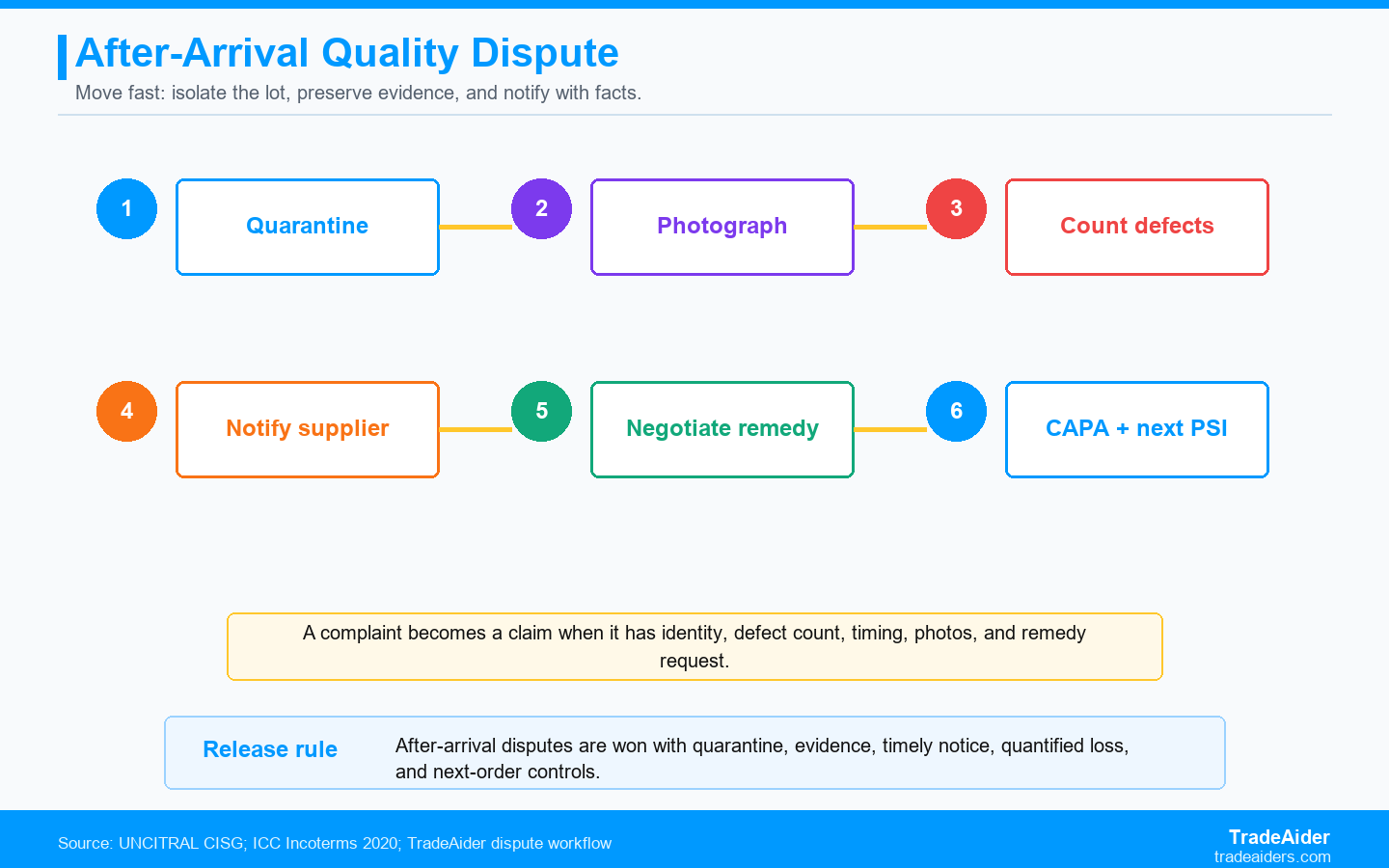
After-arrival disputes are won with quarantine, evidence, timely notice, quantified loss, and next-order controls.
Step 1: Quarantine And Map The Inventory
Do not let defective and clean units become indistinguishable.
The buyer should separate affected goods by SKU, carton number, batch mark, pallet, warehouse location, receipt date, supplier, and PO. If inventory is already at a fulfillment center, the buyer should request available receiving, removal, return, or damage records. If goods are with a retailer or distributor, ask them to preserve samples and photos before they relabel or dispose of stock.
Inventory mapping matters because suppliers often challenge scope. They may accept that a few pieces are defective but reject the idea that the whole lot is affected. A clear map shows whether defects are isolated to one SKU, carton group, production date, color, size, or component. That helps both negotiation and root cause analysis.
The buyer should also stop automatic replenishment if the issue may affect customers. Continuing to sell defective units while building a claim can increase refunds, reviews, chargebacks, or safety exposure. Commercial pressure should not override evidence preservation.
Step 2: Build The Evidence File
A complaint is not a claim until it is supported by evidence.
The evidence file should include purchase order, invoice, packing list, bill of lading or air waybill, arrival records, warehouse receiving notes, pre-shipment inspection report if any, approved sample photos, product specification, label files, carton marks, and customer complaints. The buyer should add defect photos with scale, SKU, carton identity, and date.
Sampling after arrival should be structured. The buyer should record how many units were checked, from which cartons, and how many defects were found. If the defect appears in every carton, the buyer can show a broader pattern. If it appears only in one carton group, the buyer can negotiate a targeted remedy.
The defect description should be specific. Wrong color, missing accessory, failed function, cracked housing, weak adhesive, wrong label, damaged carton, mold, odor, or measurement out of tolerance is better than poor quality. Suppliers can act on physical descriptions; they can deflect vague frustration.
Step 3: Notify The Supplier Quickly And Specifically
The supplier notice should be timely, factual, and remedy-oriented.
A useful notice includes the PO, SKU, lot, affected quantity, defect categories, photos, sample count, arrival date, discovery date, contract requirement, and requested remedy. The buyer should ask the supplier to respond by a defined deadline and propose root-cause analysis. The tone should be firm but factual.
The requested remedy may include replacement parts, replacement goods, refund, credit note, discount, rework cost, sorting cost, freight support, disposal support, future order credit, or supplier-funded reinspection. The right remedy depends on severity, contract terms, supplier relationship, and commercial urgency.
Do not bury the supplier in hundreds of unorganized photos. Send a structured evidence pack with captions and a summary table. If the supplier needs more evidence, keep the full file ready. Clarity often produces a faster response than anger.
Step 4: Separate Product Defect From Transit Damage
The dispute path changes if damage happened after delivery or during transport.
If goods arrive crushed, wet, moldy, or visibly damaged, the buyer should preserve carton and pallet condition evidence. Carrier records, container photos, seal records, unloading photos, warehouse receiving notes, and insurance notice may matter. Supplier liability and carrier liability can overlap, so early evidence is critical.
Incoterms can affect risk transfer, but they do not automatically answer every quality question. A manufacturing defect that existed before shipment is different from damage caused by transport after risk transferred. A carton that was weak because the supplier used poor packaging may also create a supplier issue even if the damage appeared during transit. The buyer should analyze root cause, not only delivery terms.
This is where pre-shipment evidence helps. If the PSI report shows good cartons and correct labels before loading, arrival damage may point toward logistics. If PSI photos already show weak packaging, poor carton compression, or visible defects, the supplier's argument becomes weaker.
Where TradeAider Fits After Arrival Problems
TradeAider fits by turning the dispute into a better evidence and prevention plan.
TradeAider can review prior Pre-Shipment Inspection evidence, defect photos, supplier files, and product specifications to help the buyer identify what should have been checked before release and what must be added to the next inspection.
For the next order, TradeAider can use During Production Inspection and PSI to verify supplier CAPA before the same defect repeats. If supplier reliability is uncertain, factory audit service can check whether the problem reflects a deeper system weakness.
The business fit is recovery plus prevention. TradeAider does not replace legal counsel or insurance claims, but it helps buyers convert a post-arrival quality problem into a clear supplier correction and next-shipment control plan.
SPAR Scenario: The Buyer Turned A Warehouse Failure Into A Strong Claim
The buyer moved from angry messages to a structured supplier notice.
Situation: A buyer receives 12,000 units of a home storage product. Warehouse staff report broken clips and missing instruction sheets during receiving.
Problem: The supplier says the goods passed internal QC and suggests that warehouse handling caused the issue. The buyer has no immediate inspection report from before shipment.
Action: The buyer quarantines affected cartons, samples cartons from each pallet, photographs clip damage and missing inserts with carton IDs, calculates defect rate, and sends the supplier a written notice with requested replacement parts, sorting-cost support, and CAPA. TradeAider helps turn the findings into a next-order DPI and PSI checklist.
Result: The supplier agrees to provide replacement inserts, fund part of the sorting cost, and add a packing-line count fixture. The next shipment includes accessory-count photos and clip-stress checks before release.
Action Card: Post-Arrival Quality Dispute Checklist
Make the claim specific enough for the supplier to act and hard enough to dismiss.
- Quarantine affected inventory by SKU, carton, pallet, batch, and warehouse location.
- Photograph defects, labels, carton marks, arrival condition, and representative samples.
- Count inspected units and calculate estimated affected quantity.
- Compare defects with PO, specification, approved sample, inspection report, and contract terms.
- Send supplier a written notice with evidence, deadline, requested remedy, and CAPA request.
- Update the next inspection plan so the same defect is checked before shipment.
The buyer should also record internal costs: sorting labor, repacking, replacement parts, customer refunds, retailer chargebacks, storage, disposal, freight, and lost sales. A quantified claim is easier to negotiate than a general complaint. Even if the supplier does not pay every cost, the buyer needs a clear number for negotiation.
If the supplier refuses responsibility, the buyer should review contract terms, payment balance, warranty language, governing law, arbitration clause, insurance, carrier records, and marketplace obligations. For high-value disputes, legal counsel may be appropriate. The evidence file will still be useful because counsel, insurers, and platforms all need facts.
After the dispute, the buyer should revise the control plan. Add defect examples, stronger sampling, DPI, packaging tests, supplier CAPA verification, reinspection triggers, or payment-hold language. A post-arrival problem is expensive, but it can improve the next order if the buyer captures the lesson.
The buyer should also close the dispute internally. Record what was discovered, what evidence was strong, what evidence was missing, what the supplier agreed to do, and what the buyer changed in the next inspection plan. Without that internal closeout, teams often repeat the same weak contract wording, vague inspection scope, or late evidence collection on the next purchase order.
If goods have arrived with quality problems, send TradeAider the PO, supplier files, arrival photos, defect samples, inspection history, and shipment timeline. The next step is to ask TradeAider to turn the quality dispute into a corrective-action and inspection plan.
Frequently Asked Questions
What should I do first after finding defects after arrival?
Quarantine affected goods and preserve evidence before sorting, repacking, selling, disposing, or mixing inventory.
How fast should I notify the supplier?
Notify quickly after discovery and include specific evidence. Contract terms and applicable law may affect notice requirements, so do not delay.
Can Incoterms decide who pays for quality defects?
Incoterms help allocate delivery, risk, and cost responsibilities, but manufacturing defects, transit damage, contract warranties, and evidence must still be analyzed separately.
How can I prevent the same problem next time?
Turn the defect into CAPA, updated specifications, stronger DPI or PSI checks, reinspection rules, and supplier payment conditions.

関連記事


TradeAiderサービスでビジネスを成長させる
下のボタンをクリックして、TradeAiderサービスシステムに直接入ります。予約から支払い、報告書の受け取りまでの簡単な手順は操作が簡単です。

