

You can use one inspection brief for a purchase order made at two factories. If the finished goods stay at both sites, arrange fieldwork at both addresses. A single warehouse visit may cover finished goods from both factories when every required group is present, traceable and accessible, and the warehouse can support the agreed checks. Ask the provider to confirm how it will book the work and deliver the reports. Whatever the format, the results must show what was checked for each factory group.
One purchase order can carry two inspection scopes
One purchase order can use a common inspection brief, with physical access and evidence verified for each factory group. The purchase order (PO) identifies the commercial order. An inspection scope identifies the goods, location and checks the assignment will cover. It can include goods made at one address and presented for inspection at another, so record the two addresses separately where they differ.
- Use the same PO reference on the booking and reports, with a distinct scope for each factory group.
- Confirm actual site access, readiness and selection before the visit or visits.
- Request a consolidated report only if it can preserve separate evidence, limitations and results for both groups.
The NIST Engineering Statistics Handbook explains that acceptance sampling uses a sample from a defined lot to make a decision about that lot. A lot is the population covered by the decision. If an inspector sees goods only at Factory A and Factory B’s goods remain elsewhere, Factory B falls outside that fieldwork. The same SKU and a common PO number still leave you with a second coverage decision.
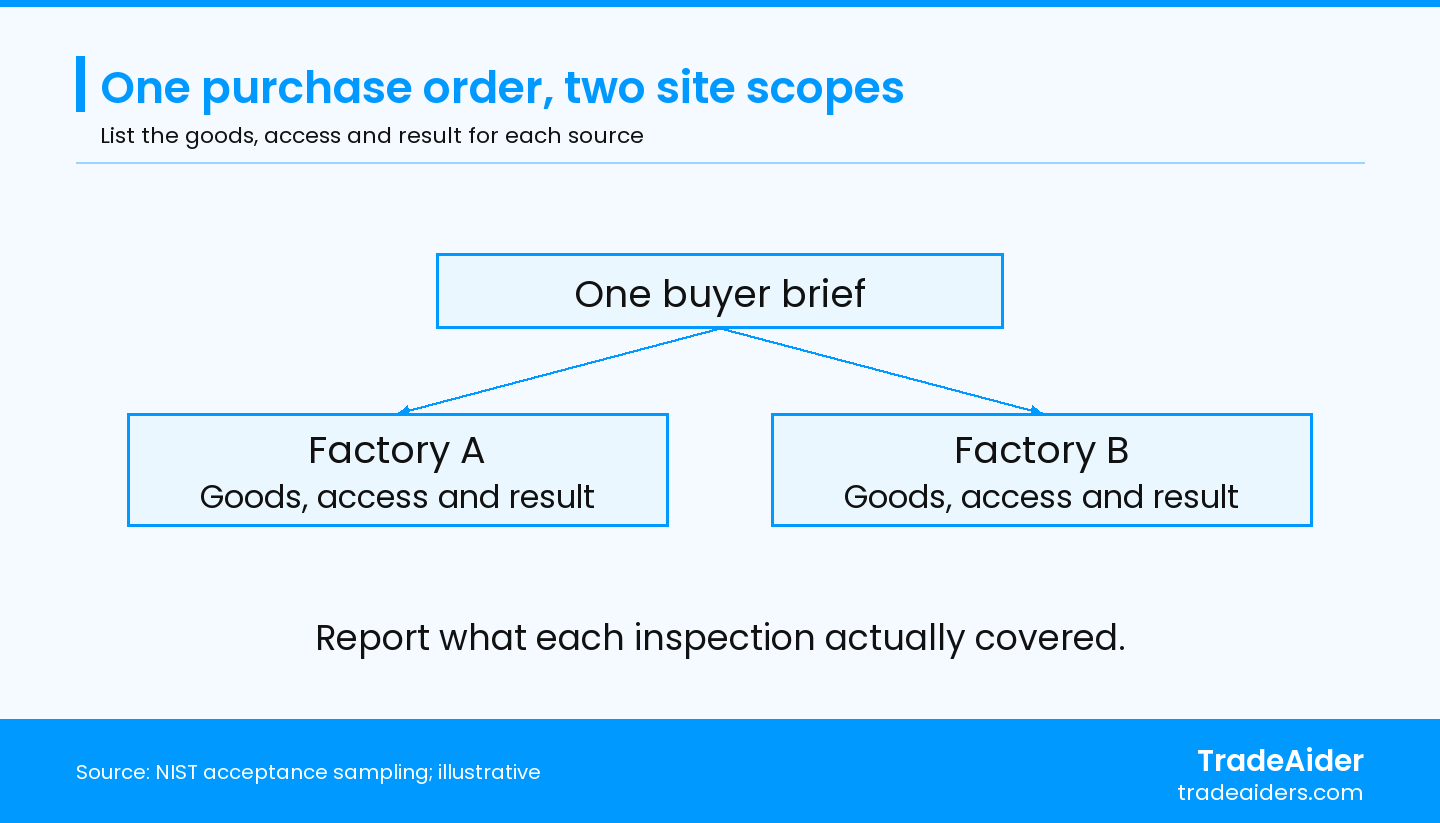
A buyer can coordinate the checks in one brief and keep each site’s coverage visible in the report package.
Write one brief with a section for each factory
Name the production site, inspection site, physical goods and required records for each scope before confirming the booking. A trading company may submit the request for both factories. Ask for the address, site contact and stock details for each facility so the appointment can be confirmed with the people who can present the goods. If the provider can schedule both sites under one work order, list both addresses and their separate scopes under that number. If it needs a work order for each address, link both to the same PO.
Complete this checklist twice, once for each factory group. Put both sets of details under the PO number. Use TradeAider’s inspection standard when preparing your instructions, then record the agreed details for this order. If you only have early quantities and tentative dates, use them for the initial inquiry and label them provisional.
Booking fieldFill in for each factoryConfirm before fieldworkLocations and contactsManufacturing address, actual inspection address, on-site contact and access hours.The named contact can admit the inspector and present the goods.Goods and identitySKU, revision, ordered and presented quantities, batch and carton IDs.The packing list maps each group to the right physical stock.Readiness and accessFinished and export-packed counts, proposed date, pallets available, and blocked stock.Required cartons can be opened and selected for the agreed checks.Checks and samplingApproved reference, test setup, eligible lot, selection method and acceptance rules.The same agreed reference and the necessary equipment are available where needed.Report and releaseReport language and format, required photos, result by lot, and release approver.The provider confirms separate reports or a consolidated report with clear site sections.Schedule and quoteVisit dates, work required at each address and proposed follow-up.Confirm what the quote covers and how a readiness change affects the assignment.
Plan two site visits when the goods stay at the factories
If the goods stay at two factories, arrange access and an on-site check at each address for the requested work. One provider can coordinate the visits if it confirms coverage at both locations. Give each site its own contact, readiness deadline and appointment. Let the provider know if the sites use different equipment, tooling or assembly aids that change the setup for an agreed test. When one team travels between locations, reserve enough time to complete each scope including selection, unpacking, checks and recording. A confirmed appointment covers the named address and work. A second address needs its own fieldwork arrangement.
Use one warehouse visit only for checks it can support
A common warehouse can support one visit for finished-goods checks when both groups are available, traceable and testable there. Confirm that the buyer permits transfer before inspection and that the provider agrees to the warehouse location. Reserve space to select and open cartons and verify that required equipment, samples and handling support will be available. If the assignment includes observing work in process or witnessing a check that needs the factory’s equipment, retain the applicable factory work in the brief.
GS1’s traceability guidance distinguishes events such as shipping and receiving from the data that describe them. For the warehouse route, ask for a factory dispatch list and a warehouse receipt that tie each carton or identifiable pallet to its source, including quantities and any repacking. Keep a map from old identifiers to new ones if labels changed. If the warehouse cannot identify which factory produced particular cartons, record the gap before agreeing on any factory-specific conclusion.
Set the sampling decision for each factory group
Decide which population is subject to each acceptance result and apply the agreed selection and decision rules to it. Separate lot decisions are a practical starting point when production comes from two facilities. Confirm whether each factory group includes changes in materials, product revisions or packing that need separate checks. If your quality team proposes one combined lot, obtain agreement before selection on the population, why pooling fits the order, and how both sources can enter the agreed draw. Inspecting in a single warehouse leaves those choices open.
NIST’s guidance on lot acceptance sampling plans describes a plan as a selection scheme plus decision rules. Give the inspector the eligible quantities and source carton map for both groups. Specify the sampling method, recorded unit, applicable checks and decision criteria. Where you want separate acceptance decisions, give each defined lot its own applicable plan. Tell the inspector how to record goods that are excluded, inaccessible or presented after selection.
ISO 2859-1:2026 describes AQL-indexed schemes for lot-by-lot inspection by attributes. A report that names the acceptance quality limit (AQL) still needs to identify the agreed plan and the actual lot. Keep separate sample sizes and decision criteria when the approved plan gives each factory lot its own disposition.
ASQ describes ANSI/ASQ Z1.4 as an attributes acceptance sampling system with switching rules for a continuing stream of lots. If that is the agreed system, confirm which edition and inspection history apply to the population under review. The buyer’s quality team should resolve any difference in instructions before the draw, particularly if the two factories have been managed as separate streams.
TradeAider performs pre-shipment inspection when the order quantity is 100% complete and at least 80% is packed for export. For a split assignment, confirm which quantities form each booked scope and how readiness will be checked. Have both factories report their finished, packed and accessible quantities separately. The overall packing percentage can hide a problem at one site.
One order for 1,800 racks with two readiness dates
Illustrative scenario. An importer buys 1,800 folding storage racks on one PO. Factory A makes 1,200 and Factory B makes 600. The buyer wants to approve the PO from one report package and has agreed separate sampling and acceptance decisions for the two source groups. The buyer issued the same approved product specification and carton artwork revision to both factories.
Readiness across the whole order can hide a packing or access gap at one factory. All 1,800 racks are finished. Factory A has packed its 1,200 racks for export, and Factory B has packed 300 of its 600. The combined packed count is 1,500, about 83% of the order. At Factory B, half the group is packed. The buyer needs final packing checks on both groups and has asked the provider to confirm readiness for each visit.
The buyer and provider agree to inspect Factory A first and book Factory B after its packing is ready. The first file gives Factory A’s address, 1,200-unit lot, selection records and result. Under Factory B it shows 600 units planned and the inspection pending, with the missing packing readiness and a follow-up date. A PO summary stays open. If the buyer’s shipping plan permits partial release, the buyer can consider the A group on its own recorded evidence.
At the second visit, inspection finds that some of Factory B’s cartons carry an earlier artwork revision. The buyer requests identification and verification of the affected carton range before its release. A shared PO summary shows the A result and the decision for the B group separately. If the buyer had waited for one warehouse visit instead, both groups would have needed to arrive, remain identifiable and be available for the agreed checks before the inspector could cover them there.
Keep the report and release tied to the actual inspection scope
A consolidated report can work if it preserves site- or lot-level evidence, limitations and decisions. Agree the format with the inspection provider and report recipient before booking. If the provider issues two reports, use the PO number as the shared reference and list both report IDs in your own release record. The buyer can review them together without losing the source of each result. If the approved plan yields one combined acceptance decision, document each factory’s coverage and identify the lot that the combined result covers.
For each entry, record the production source and actual site visited, date, lot ID, presented and excluded quantities, sample and test coverage, findings and report reference. If both sources were inspected at a warehouse, use the warehouse as the inspection location in both entries and keep the production source distinct. If the sites were visited on different dates, preserve those actual dates in a shared report. A single header date for the whole file gives too little information about which goods were available at each check.
Use an explicit status for work that remains open. “Factory B pending” tells receiving and logistics teams to look for later evidence. “Factory A passed the agreed checks” remains tied to its listed lot and any exceptions in the report. Record the buyer’s separate authorization to release or hold each affected group. If the groups were mixed after inspection, reconcile the shipment identifiers to the covered cartons before carrying the decisions forward.
When you contact TradeAider about a two-factory order, send the PO, both addresses, the quantities and packing status at each site, and your required report format. Include any proposed warehouse transfer and the checks that must happen at a factory. Ask for written confirmation of the site coverage, schedule and deliverables before you approve the booking.
Frequently Asked Questions
Can one inspector visit both factories on the same day?
One inspector may be able to visit both factories on the same day if travel, access and the full checks fit the confirmed schedule. Ask for a time window at each site and a plan if the first appointment runs late. The number of inspectors and dates depends on the work and site access the provider confirms.
What if the supplier gives only its office address?
Ask for the address and contact where each group of goods is actually available before you approve the visit or the sampling instructions. The supplier’s office can stay on the commercial record. If the goods are presented there, ask how they link to the full eligible lot and whether the site can support the planned checks.
Can the buyer use the same approved sample at both sites?
The same approved reference can be used at both sites if each inspector can verify its identity, revision and condition against the order instructions. If you send two copies, record how each was approved. If one physical sample must travel between sites, plan its custody and timing so the second team can use it before drawing conclusions.

関連記事
TradeAiderサービスでビジネスを成長させる
下のボタンをクリックして、TradeAiderサービスシステムに直接入ります。予約から支払い、報告書の受け取りまでの簡単な手順は操作が簡単です。