
- 会社概要

- 当社のサービス
- あなたの業界
- リソース
- ニュース&ブログ
A chair that collapses under normal use is not just a product failure — it's a liability event. For importers sourcing chairs from China, weight capacity and stability are the two mechanical properties most likely to cause serious customer injury and most likely to be inadequately tested before shipment. Product inspection in China that addresses these risks proactively is not an optional extra; it's a core part of responsible sourcing.
This guide covers what weight and stability checks should be part of a professional chair inspection, what standards apply, how inspectors conduct these checks on the factory floor, and how to set up your specifications to make the inspection meaningful.
Key Takeaways
- Weight capacity and stability are safety-critical properties — defects in these areas can cause customer injury and product liability exposure.
- Factory self-testing is not a substitute — third-party inspection provides independent verification that production units match approved structural standards.
- Different chair categories have different applicable standards — residential seating, office chairs, bar stools, and outdoor chairs each have their own requirements.
- Early-production inspection (DPI) catches structural issues before the full batch is made — not just at pre-shipment when correction is expensive.
Why Weight Capacity and Stability Are High-Risk Properties in Chinese Chair Manufacturing
China is the world's largest manufacturer and exporter of chairs across virtually every category — office, dining, outdoor, bar, and occasional seating. The supply chain is mature but highly fragmented. Most factories purchase sub-components — frames, seat shells, hardware, foam, webbing — from multiple suppliers, then assemble them. This creates variability at the joint and fastening level that visual inspection alone cannot detect.
Weight capacity failure typically doesn't look like anything during a visual inspection. A chair with a frame that will fail under dynamic load looks the same as one that won't. Stability failure — tipping under lateral load or during the act of sitting — is similarly invisible without functional testing. This is why product inspection in China for chairs must include physical load and stability tests, not just a look-over for cosmetic defects.
The Stakes for Importers
An Amazon FBA seller discovered this the hard way when a bar stool with an undersized tube wall gauge passed visual inspection but began failing in customer homes under normal use. The structural weakness was in the joint between the seat support ring and the leg — a weld that looked clean but had inadequate penetration. After a cluster of one-star reviews and two reported injuries, the listing was suspended. The inspection conducted before shipment had covered cosmetic defects only. There was no weight or stability test on the checklist.
Beyond the commercial impact, importers selling into the EU, UK, or US carry product liability for goods that cause injury. Demonstrating that you followed a documented inspection process — including mechanical testing — is a critical part of your legal position if a claim arises.
Applicable Standards for Chair Weight Capacity and Stability Testing
The relevant standard depends on your target market and chair category. Inspectors conducting pre-shipment inspections need to know which standard applies to your product before they arrive on-site. Major furniture standards by market and category include:
| Standard | Region / Application | Key Tests |
|---|---|---|
| EN 1728 / EN 12520 | EU — domestic seating | Seat static load, back static load, stability, durability cycling |
| EN 1022 | EU — domestic seating stability | Forward, backward, and lateral stability under specified load |
| ANSI/BIFMA X5.1 | US — office seating | Seat durability, leg strength, stability, drop test |
| ASTM F1858 / F1669 | US — outdoor furniture | Structural integrity, load capacity, stability |
| BS EN 581 | UK / EU — outdoor seating | Static and dynamic strength tests, stability |
| GB/T 10357 | China domestic standard | Equivalent mechanical testing for Chinese market compliance |
Most Chinese furniture factories are familiar with EN and BIFMA standards for export markets. What varies is how consistently they apply those standards to production batches versus pre-certification samples — which is precisely what independent inspection verifies.
What Weight Capacity Checks Look Like in a China Product Inspection
Weight capacity testing in a factory-level inspection is a practical functional test, not a full laboratory procedure. EN 1728:2012 specifies test methods for the strength and durability of all types of seating, covering static load, dynamic durability, impact, and stability categories. Inspectors conduct these tests on production samples drawn from the batch using standard AQL sampling methods.
Static Seat Load Test
The inspector applies a defined static vertical load to the centre of the seat for a specified duration. For EN 12520 (domestic seating), the standard test load for non-upholstered chairs is 1,200 N (approximately 122 kg) for 10 cycles, held for 10 seconds per cycle. After loading, the chair is inspected for structural failure (joint separation, frame fracture, leg collapse), permanent deformation exceeding the allowable threshold, fastener loosening or pull-through, and seat shell cracking.
This test is typically conducted using a load cell and standard weights or a calibrated hydraulic test fixture. Inspectors document the applied load, duration, and all observable outcomes with photographs.
Back Rest Load Test
A horizontal load is applied to the backrest at a specified height. For domestic seating per EN 1728, the backrest static load test applies 560 N horizontally, simulating a user leaning back hard against the chair. This test specifically checks the integrity of the back-to-seat connection — typically the most structurally stressed joint in a chair and the most common point of failure in low-cost Chinese production.
Leg Strength and Joint Integrity
Individual leg and joint strength is checked by applying lateral and vertical loads at the leg connection points. This test catches under-spec tube wall thickness, inadequate weld penetration, and loose hardware that won't be visible during visual inspection. For chairs with leg-to-seat connectors (common in flat-pack designs), the inspector checks connector specification against the approved BOM and applies load to verify the joint holds under rated capacity.
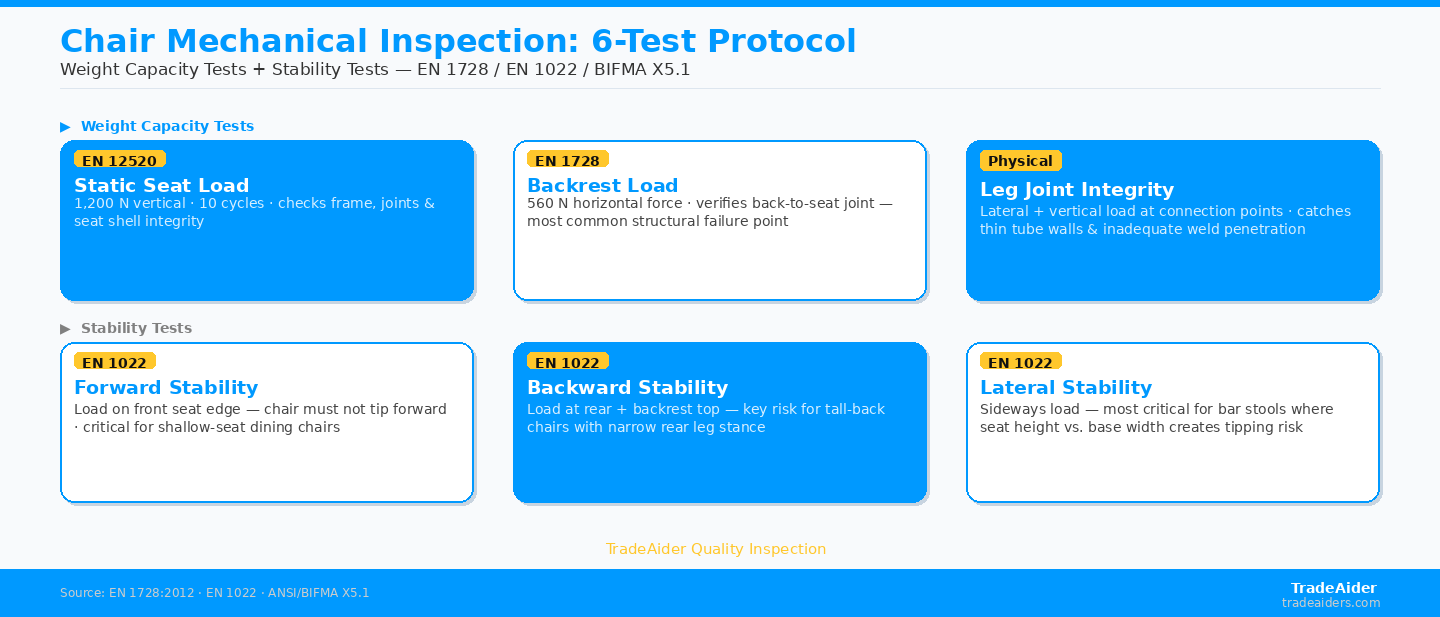 Chair mechanical inspection runs three weight capacity tests and three stability tests — each targeting a distinct failure mode that a purely visual inspection would miss entirely.
Stability Testing: The Often-Overlooked Check
Stability testing is separate from weight capacity and often receives less attention in basic inspection programs — which is a significant oversight. A chair can pass its weight capacity test and still tip dangerously during normal use.
Forward, Backward, and Lateral Stability
Per EN 1022, forward stability testing applies a load to the front edge of the seat — the chair must not tip forward. Backward stability applies a load at the rear of the seat and top of the backrest — particularly important for dining chairs with tall decorative backrests and narrow rear leg stance. Lateral stability applies a sideways load to the seat or backrest — most critical for bar stools and high chairs, where the seat height-to-base width ratio creates inherent tipping risk.
Many bar stool failures trace back to bases that are visually appealing but geometrically unstable — a problem that inspection catches and visual-only review misses entirely.
Field Stability Check
Beyond formal load tests, inspectors perform a practical sit-and-rock test on sampled units — shifting weight forward, backward, and laterally to assess stability perception. While not a substitute for formal testing, this check catches floor-contact issues like uneven leg lengths, which cause rocking and contribute to stability failures under load.
Integrating Weight and Stability Checks Into Your Inspection Checklist
The most effective way to ensure these checks happen is to define them explicitly in your inspection checklist before the inspection is booked. A vague instruction like "check quality" will result in a cosmetic-focused inspection. A specific checklist naming the applicable standard, the test load, and the pass/fail criteria gives the inspector clear parameters to work to.
TradeAider's inspection standard documentation provides a framework for building product-specific checklists. For chairs, your checklist should specify: applicable standard, static seat load test parameters (load, duration, cycle count), backrest load test parameters, stability test directions required, leg joint and hardware inspection criteria, and pass/fail criteria and defect classification.
When to Inspect: PSI vs. DPI for Structural Properties
For chairs, structural issues benefit enormously from during-production inspection (DPI). If a weight capacity or stability problem is discovered during pre-shipment inspection when the full batch is complete, correction options are limited — often rework of every unit or a full re-production run. DPI at the 20–30% production completion stage allows the same structural tests on early production samples, catching the problem while only a fraction of the batch has been made. Use the inspection cost calculator to model the cost difference for your order volume.
Frequently Asked Questions
What weight capacity should a standard dining chair be rated for?
Most EU and US market dining chairs are rated to support a minimum of 120 kg (approximately 265 lbs) static load. EN 12520 specifies a 1,200 N seat static test load as the minimum for non-upholstered domestic chairs. For commercial use seating (restaurants, offices), higher ratings of 150–160 kg are common. Your product specification should define the rating, and the inspection checklist should test to that rating.
Can a factory inspection catch all structural defects?
No — factory-level inspection tests a sampled subset of production units under standardized conditions. It provides strong assurance about the batch's general conformity but can't test every unit. Full compliance certification from an accredited laboratory tests a specified sample under the complete standard test protocol. For most commercial import programs, factory inspection plus periodic lab certification provides the appropriate level of assurance. Contact our team to discuss what combination makes sense for your product and market.
How do I know if my factory's own test reports are reliable?
Factory self-certification test reports should be treated as indicative, not definitive. Key questions: Was testing done on production units or pre-production samples? Is the test lab accredited (CNAS in China, or an internationally recognised body)? Do the batch records confirm the tested unit uses the same materials and construction as what's being shipped? Independent third-party inspection verifies these questions on-site and provides a report you can stand behind if a dispute arises.
What's the difference between a weight capacity test and a durability test?
Weight capacity tests verify that a chair holds a specified static load without structural failure — this is a point-in-time strength check. Durability tests apply lower loads repeatedly (thousands of cycles) to simulate long-term use, revealing fatigue failures that static tests won't catch. Most factory-level inspections cover static load and stability. Full durability testing per EN 1728 or BIFMA X5.1 requires a lab setup. TradeAider's product testing service can coordinate lab durability testing alongside field inspection.

関連記事



TradeAiderサービスでビジネスを成長させる
下のボタンをクリックして、TradeAiderサービスシステムに直接入ります。予約から支払い、報告書の受け取りまでの簡単な手順は操作が簡単です。

