
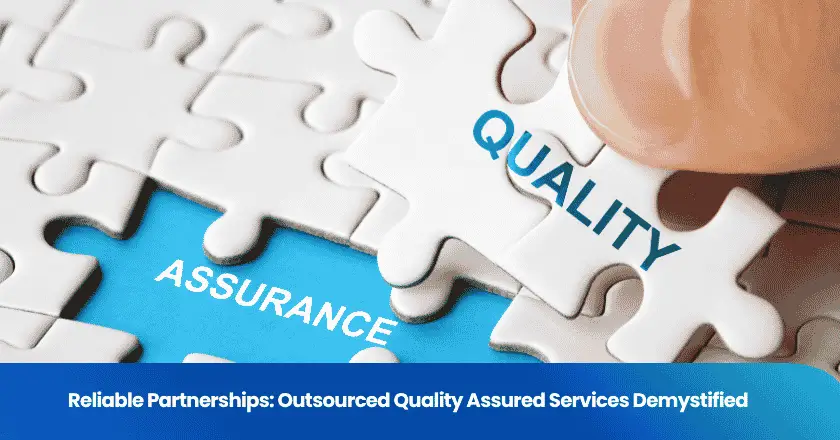
For brands, importers and e-commerce sellers sourcing products from China, outsourcing production and supply chain operations has long been a core strategy for cost efficiency and scale. Yet many businesses find that outsourcing manufacturing often comes with an unspoken trade-off: reduced visibility into product quality, inconsistent process control, and elevated risk of defective shipments. This gap is where outsourced quality assured services deliver their core value.
Far from being a simple add-on expense, third-party quality assurance (QA) outsourcing is a structured partnership that brings independent, on-the-ground quality control expertise to remote supply chains. It allows businesses to maintain rigorous quality standards without the overhead of building and managing an in-house local inspection team, turning the uncertainty of cross-border sourcing into a controlled, predictable workflow.
What Are Outsourced Quality Assured Services?
In the context of manufacturing and global sourcing, outsourced quality assured services refer to the practice of delegating product inspection, supplier audit, compliance verification and loading supervision to an independent third-party professional firm. These services cover the full production lifecycle — from incoming raw material review to final shipment release — and serve as an objective layer of verification separate from factory self-inspection.
Their core purpose is not to replace a brand’s internal quality strategy, but to extend it into the local factory environment. Buyers set the standards and acceptance criteria; the third-party executes on-site checks, documents findings and delivers factual, data-backed reports to support shipment decisions.
The Core Difference From Factory Self-Inspection
In-house factory QC teams inherently operate under pressure from production schedules and shipment deadlines, which can create incentives to downplay defects or overlook batch-wide issues to keep orders on track. Outsourced third-party inspectors have no stake in production outcomes and answer only to the buyer’s quality requirements. This independence is the foundational value of outsourced QA, and the reason its findings carry credibility for commercial decisions and dispute resolution.
Why Businesses Outsource Quality Assurance: Core Strategic Benefits
Outsourcing quality control delivers measurable advantages across cost, expertise, consistency and flexibility dimensions.
Reduced Operating Cost and Flexible Scaling
Building and running an in-house local inspection team incurs heavy fixed costs: full-time salaries, travel expenses, training, management overhead and idle time during low-order seasons. Outsourced services operate on a per-service fee model, so costs scale directly with order volume. Businesses can increase inspection frequency for new suppliers or high-risk product lines, and reduce it for proven, stable partners, converting fixed quality overhead into variable, ROI-aligned spend.
On-Ground Expertise Across Local Manufacturing Hubs
China’s manufacturing capacity is distributed across specialized regional hubs: electronics and toys in Guangdong, furniture and textiles in Zhejiang, machinery and hardware in Jiangsu, and more. Established third-party QA providers maintain resident inspectors across all major production regions, with deep familiarity of local factory operations, typical defect patterns and industry practices. This local presence allows inspections to be scheduled within 1–2 business days, a level of responsiveness nearly impossible for remote in-house teams to match.
Standardized, Consistent Quality Benchmarks
Businesses working with multiple suppliers often struggle with uneven quality standards from factory to factory. Outsourced QA providers apply uniform inspection protocols, AQL sampling rules and defect classification criteria across every partner facility. This single, impartial benchmark eliminates quality variance between suppliers and ensures consistent product experience across all SKUs and sales channels.
Objective Accountability and Dispute Resolution
When quality disputes arise, factory self-inspection records carry limited weight as evidence. A timestamped, photo-documented third-party inspection report serves as a neutral, auditable record of condition at the point of shipment. It supports fact-based discussions with factories about rework or deductions, clarifies liability between production and logistics stages, and provides credible documentation for insurance or cargo claims.
Building Reliable Outsourced QA Partnerships: Key Pillars
A reliable outsourced quality partnership is more than a transactional book-and-report flow. It is built on clear rules, shared expectations and structured collaboration. Mature, long-term partnerships rest on five core pillars.
Aligned Quality Standards and Clear Scope
Every effective partnership starts with aligned standards. Buyers should define upfront the exact inspection criteria: AQL levels, product specifications, golden sample references, target market regulatory requirements and high-priority defect items. Vague requests such as “check the quality” reliably produce misaligned results. A clear, written checklist and acceptance criteria table is the foundation of any productive QA outsourcing arrangement.
Transparent Workflow and Traceable Records
A trustworthy service provider maintains full transparency throughout the process: confirming appointment times in advance, flagging critical issues in real time during inspection, and issuing a full formal report with photo evidence within 24 hours. Modern digital platforms also allow buyers to track inspection status, access historical reports and review trend data in one place, so all quality records are centralized and traceable rather than scattered across email threads.
Local Execution and Factory Communication
Quality inspection is as much about on-site coordination as it is about checking products. Local resident inspectors understand factory operating rhythms and can communicate directly with production management to coordinate on-site rectification while they are still on premises. A good third-party provider acts as both verifier and facilitator — upholding quality standards while helping factories resolve issues efficiently, without creating adversarial buyer-supplier dynamics.
Clear Division of Responsibilities
Outsourcing QA does not mean handing over all quality decision-making. The third-party’s role is to objectively record facts, classify defects against agreed standards and provide professional assessment. The final decision to accept, rework or reject a batch always rests with the buyer. Clear role boundaries prevent both overreach by the service provider and unrealistic “set it and forget it” expectations from the client.
Continuous Improvement Loop
The greatest value of long-term partnerships comes from data-driven improvement. Over time, a QA provider can aggregate historical inspection data to identify recurring defect patterns, high-risk suppliers and priority control points. This insight allows buyers to shift quality investment from reactive end-of-line defect catching to proactive upstream prevention, steadily lifting overall supply chain performance.
Common Challenges and Practical Solutions
Outsourced QA partnerships encounter predictable friction points. Addressing them proactively dramatically improves collaboration efficiency.
Misalignment on Defect Severity
It is common for buyers and inspectors to initially differ on how severe a given defect is. The solution is to calibrate standards through a trial order at the start of the partnership, formalize a written defect classification guide for each product category (critical / major / minor), and hold regular calibration reviews to keep judgments aligned as product lines evolve.
Delayed Information Feedback
Waiting days for inspection results can miss the window for on-site rework before a scheduled ship date. The fix is to work with providers that offer real-time issue alerting during inspection for critical findings, rather than waiting for the full final report. For standard orders, a 24-hour report turnaround should be the baseline service expectation.
Low Factory Cooperation
Factories sometimes resist third-party inspection or push back on rework requirements. The most effective approach is to embed third-party inspection requirements into purchase contracts and communicate the rule to suppliers upfront. Experienced QA providers also have established factory communication practices that resolve pushback professionally, without putting the buyer in direct conflict.
TradeAider Quality Assurance Services in China
TradeAider provides professional third-party quality assurance services across all major manufacturing regions in China, serving global brands, importers and cross-border e-commerce sellers.
Our inspector network covers every core industrial hub, with local teams trained in international AQL standards and regulatory requirements for major destination markets including the EU and US. Our service scope spans the full production lifecycle: pre-production material verification, during-production process audits, final random inspection, container loading supervision and supplier capability assessments, supporting product categories from toys, apparel and furniture to electronics, hardware and home goods.
Clients can book inspections, track progress and receive real-time issue updates through our online service system. Every inspection delivers an official, photo-documented report within 24 hours. For long-term partners, we also provide customized quality trend analysis and optimization recommendations to help buyers move from batch-by-batch defect control to sustained supply chain improvement.
Frequently Asked Questions
What is the difference between outsourced QA and factory self-inspection?
Factory self-inspection is an internal control function operated by the manufacturer, and it is inherently influenced by production and shipment schedule incentives. Outsourced third-party QA is fully independent, accountable only to the buyer’s quality standards, and delivers objective findings that can be used as credible evidence for commercial decisions and disputes.
Is outsourced quality service only for large enterprises?
No. Because services are charged per inspection with no minimum volume commitment, outsourced QA is accessible to businesses of all sizes. Small and mid-sized sellers often use it selectively for first orders with new suppliers or high-risk product lines, making it a highly flexible quality control tool rather than a large enterprise-only expense.
What standards are used for outsourced product inspection?
The industry baseline is the international AQL (Acceptable Quality Limit) sampling standard, most commonly configured as AQL 2.5 for major defects and AQL 4.0 for minor defects. On top of that baseline, inspection criteria are customized to match the buyer’s product specification sheet, approved sample and target market regulatory requirements.
Can outsourced inspection eliminate all quality issues?
Third-party random sampling inspection drastically reduces the risk of widespread batch defects and catches the vast majority of quality problems before shipment, but it cannot guarantee zero defects due to statistical sampling principles. For high-value products with zero-defect requirements, 100% piece-by-piece full inspection is available as a dedicated service scope.
Conclusion
Outsourced quality assured services are fundamentally a solution to the information gap in remote global supply chains. They extend a buyer’s quality standards into the factory, without the cost and complexity of building a local in-house team.
A reliable outsourcing partnership is never about “handing quality off to someone else.” It is about building a structured, transparent, standards-based collaboration that combines the buyer’s product knowledge with the provider’s local execution capability. For businesses sourcing from China, outsourced QA is not an extra cost — it is a foundational tool for balancing cost efficiency, delivery speed and consistent product quality across every supplier and every order.
関連記事

TradeAiderサービスでビジネスを成長させる
下のボタンをクリックして、TradeAiderサービスシステムに直接入ります。予約から支払い、報告書の受け取りまでの簡単な手順は操作が簡単です。

