
- 会社概要

- 当社のサービス
- あなたの業界
- リソース
- ニュース&ブログ
Quality control in fashion manufacturing should follow the production timeline: lock the tech pack and approved sample, verify fabric and trims, check early production, control measurements and workmanship during the run, then use final inspection to confirm labels, packing, and release evidence. Fashion defects are expensive because many of them look small until size, shade, label, or fit complaints reach customers.
Fashion QC starts with requirements. ISO 9001 frames quality management around consistently meeting customer and applicable requirements, which fits apparel because the product file must define fit, materials, workmanship, labels, packing, and destination obligations before production begins.
Label compliance is not optional decoration. The FTC textile labeling guide explains that most textile and wool products need labels covering fiber content, country of origin, and the identity of the responsible business. If those details are wrong at shipment, the goods may be physically well made and still commercially unsafe to release.
Safety boundaries also matter. CPSC clothing guidance explains the flammability standard for clothing textiles and why dangerously flammable fabrics are prohibited. Visual inspection should not overclaim safety testing, but it should verify that the buyer has the right compliance evidence before shipment.
- Start with the product file: tech pack, BOM, approved sample, size spec, tolerances, labels, packing, and care instructions.
- Inspect before defects multiply: inline checks are essential when measurement, shade, seam, or print issues can spread across the order.
- Separate visual QC from compliance proof: labels can be checked visually, but flammability and restricted-claim evidence need the right testing route.
- Make final inspection release-ready: AQL sampling, measurement tables, defect counts, labels, packing, and carton spread should support ship, hold, sort, rework, or reinspection.
What Are the Quality Control Steps in Fashion Manufacturing?
The key steps are tech pack review, approved sample freeze, fabric and trim approval, pre-production setup check, inline production inspection, measurement and workmanship control, label and care-instruction review, final AQL inspection, packing verification, and release or rework decision.
The sequence matters because fashion quality is cumulative. A wrong fabric shade can enter cutting. A measurement tolerance can drift after sewing starts. A care label can be printed incorrectly before packing. A carton can mix sizes after final finishing. Final inspection can find these issues, but it may be too late to fix them cheaply if the earlier controls were weak.
For finished-lot sampling, ISO 2859-1:2026 supports AQL-indexed sampling by attributes. In fashion manufacturing, that means the buyer should define critical, major, and minor apparel defects before final inspection rather than debating severity after cartons are opened.
For claims that visual inspection cannot prove, the Flammable Fabrics Act guidance from CPSC is a reminder that apparel safety may require testing and documentation. Inspection should verify evidence exists and labels are present, not pretend a visual check can replace a required test.
Fashion QC Step-by-Step Workflow
Use the workflow to match each production stage with the evidence it should produce.
| Step | What to Check | Best Timing | If It Fails |
|---|---|---|---|
| Tech pack review | BOM, fabric, trims, artwork, labels, measurements | Before sample approval | Freeze missing requirements |
| Approved sample freeze | Fit, shade, stitching, print, accessories, packing | Before production | Record change log |
| Material and trim check | Fabric shade, GSM, hand feel, zippers, buttons, elastic | Before cutting/sewing | Hold affected material |
| Inline inspection | Early output, measurements, seam, print, shade, defects | During production | Correct process drift |
| Measurement control | Size spec, tolerance, key points of measure | Inline and final | Sort by size or rework |
| Label review | Fiber, origin, care, size, barcode, hangtag | Before packing | Reprint or relabel |
| Final inspection | AQL, workmanship, packing, carton spread, quantity | Before shipment | Release, hold, sort, rework, reinspect |
The workflow should be adjusted by product type. A knit T-shirt, woven shirt, leather jacket, activewear set, children's sleepwear, swimwear, handbag, or fashion accessory does not share the same risk profile. Fit-sensitive products need stronger measurement control. Printed products need artwork and placement checks. Regulated children's items need a tighter compliance boundary.
The buyer should also separate quality evidence from compliance evidence. An inspector can measure a garment and verify a care label is present. The buyer still needs the correct test report, fiber documentation, or safety evidence when the destination market requires it.
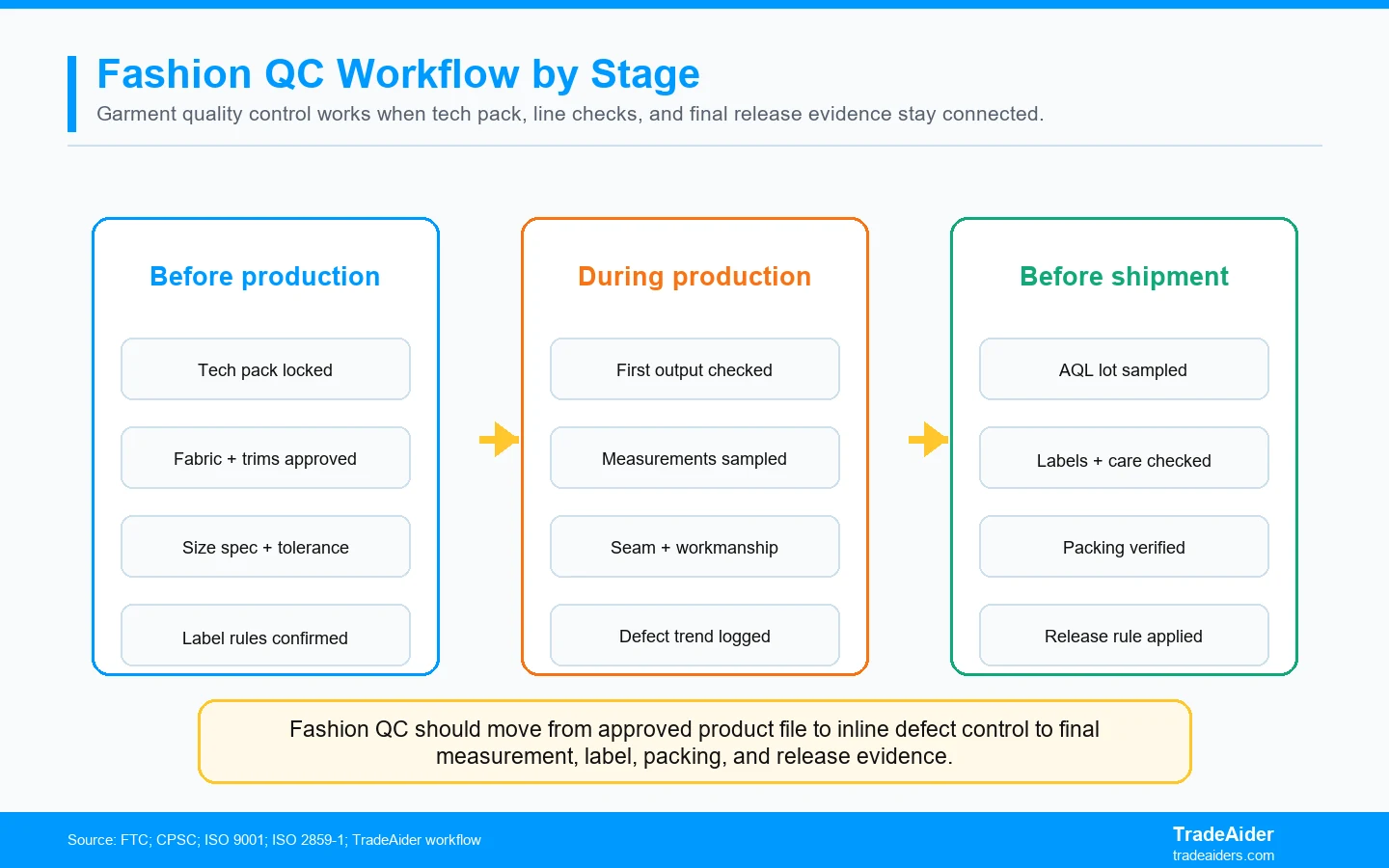
Fashion QC should move from approved product file to inline defect control to final measurement, label, packing, and release evidence.
The Product File Is the First Fashion QC Control
A fashion inspection cannot be stronger than the tech pack and approved sample behind it.
The tech pack must define what the inspector will judge
The tech pack should cover bill of materials, fabric composition, GSM or weight, color standard, trims, hardware, print or embroidery placement, seam type, stitch density, size specification, tolerance, label artwork, care instructions, packing method, carton marks, and barcode rules. If a requirement matters to the customer, it should be in the file.
Fashion suppliers often make practical changes during sampling. A substitute button, revised seam, alternate label size, or changed fabric lot may be acceptable, but only if the buyer records the approval. Otherwise the inspector and factory may compare production against different expectations.
Approved samples need size, shade, and workmanship boundaries
The approved sample is not only a visual reference. It should anchor fit, hand feel, shade, print placement, construction, accessories, and packing. For color-sensitive goods, the buyer may need fabric swatches or shade bands. For fit-sensitive goods, the size spec and tolerance matter more than a single sample photo.
A clean sample can still hide production risk. The buyer should ask which parts of the sample are fixed requirements and which parts allow tolerance. This prevents the factory from treating every small change as acceptable and prevents the inspector from rejecting harmless variation.
The Fashion QC Workflow Should Follow Production Timing
Garment quality control is strongest when the buyer sees defects before cutting, sewing, finishing, and packing lock them in.
Material checks belong before cutting
Fabric shade, weight, width, composition, hand feel, stains, holes, colorfastness evidence, shrinkage expectations, and trim compatibility should be checked before cutting begins. A fabric problem found after sewing is no longer a fabric problem; it has become a production-delay problem.
For trims, check zipper function, button finish, snap strength, drawcord, elastic, buckle, eyelet, label, hangtag, polybag, and carton material. Small trim differences can create return complaints when the listing, buyer sample, or retailer requirement promised something else.
Inline inspection catches measurement and workmanship drift
Inline inspection should check the first finished output and a spread of in-process units. The inspector should record key measurements, seam defects, skipped stitches, loose threads, puckering, shade variation, print placement, stain, hole, odor, accessory mismatch, and packing readiness.
Measurement drift deserves special attention. If the waist, chest, inseam, sleeve, or length moves outside tolerance in early production, the buyer should not wait for final inspection. Correct the pattern, marker, cutting, sewing, washing, or finishing process while there is still time.
Labels and Compliance Evidence Need a Separate Pass
A garment can pass workmanship inspection and still fail if the label or compliance file is wrong.
Fiber, origin, care, and responsible-party labels must match the market
For U.S.-bound textile and wool products, the FTC guidance makes label content a release issue: fiber content, country of origin, and responsible business identity are part of the required label framework. The inspector should verify the physical labels against the buyer's approved artwork and destination requirements.
Care labels need special attention because they influence returns and complaints. If the supplier changes fabric, dye, wash, print, or trim, the care instruction may need review. A wrong care label can create shrinkage, color bleeding, or customer damage claims after sale.
Safety claims should be proven outside visual inspection
Visual inspection can confirm that a flammability label, warning, or test reference is present. It cannot prove fabric flammability, restricted substances, drawstring safety, or children's sleepwear compliance by looking at finished garments.
When the product type has safety or regulatory risk, the buyer should coordinate testing before shipment and treat the inspection report as a document and label verification step. That keeps the report honest and prevents overclaiming what the inspector could see.
Final Fashion Inspection Should Support a Release Decision
The final inspection should not only list garment defects; it should tell the buyer what can ship.
Final inspection should sample across SKU, color, size, carton, packing version, and production date. It should check workmanship, measurements, fit-critical points, shade, print or embroidery, accessories, labels, care instructions, barcode, polybag, carton marks, quantity, and packing condition.
Defects should be separated by severity and concentration. Loose threads across random units may be sorted. Wrong care labels across one SKU may need relabeling. A repeated measurement failure in one size may require holding that size. A safety-related label or sharp accessory issue may need escalation before release.
The strongest final report gives the buyer choices: release clean SKUs, hold affected sizes, sort minor defects, rework label problems, reinspect after correction, or coordinate testing. A final report that only says pass or fail can be less useful than a report that shows exactly where the risk sits.
Scenario Estimate: A 2 cm Measurement Drift Can Become a Return Pattern
Fashion quality failures often look small in the factory but large to the customer wearing the product.
Assume a 6,000-piece women's blouse order has a chest measurement tolerance of plus or minus 1 cm. If one size runs 2 cm small across 900 pieces, the factory may see a small measurement issue, but the buyer sees a concentrated fit complaint.
If each customer return, replacement, markdown, or handling event costs $10, even a 12% return rate on that affected subgroup creates about 108 problem orders and $1,080 in direct handling exposure before counting reviews, retailer penalties, or brand damage.
This is an illustrative estimate, not a guaranteed cost. Its value is the decision rule: when measurement drift concentrates by size, color, or production line, hold the subgroup and correct it instead of releasing the full lot with a general pass.
Where TradeAider Fits in Fashion QC
TradeAider can help fashion importers connect tech packs, inline checks, AQL sampling, label verification, packing checks, and final release evidence into one inspection workflow.
When setup risk is high, Pre-Production Inspection can verify fabric, trims, labels, packaging, approved sample, and production readiness before cutting or sewing starts.
When measurement or workmanship drift is the concern, During Production Inspection can check early output and repeated defects while correction is still possible. For final release, Pre-Shipment Inspection can verify finished garments, labels, packing, carton spread, and AQL results.
If the garment category involves hidden safety or compliance claims, TradeAider can coordinate product testing services alongside inspection instead of letting visual checks overclaim what they cannot prove.
SPAR Scenario: The Garments Looked Fine, but One Size Failed
The buyer used measurement concentration to hold one subgroup instead of blocking the whole order.
Situation: A Shopify apparel brand ordered 7,200 knit dresses in six sizes and four colors.
Problem: Final inspection found that size M in two colors ran outside chest and length tolerance, while other sizes were acceptable.
Action: The buyer asked TradeAider to expand measurement checks for the affected size/color groups and photograph size-label and carton identity.
Result: The buyer held 1,180 pieces for correction, released the clean sizes, and accepted a split shipment instead of delaying the entire launch.
Fashion QC File Before Inspection
Prepare this file before booking a fashion manufacturing inspection.
- Tech pack, BOM, approved sample photos, and change log.
- Size specification, tolerance table, and key points of measure.
- Fabric, trim, hardware, label, hangtag, care, and packaging artwork.
- Critical, major, and minor defect examples by garment type.
- SKU, size, color, carton, and production-date sample spread.
- Testing or compliance files required for the destination market.
The file should be short enough for an inspector to use and precise enough to stop a shipment decision. If the buyer cannot define what counts as a major measurement, label, or workmanship defect, the supplier will define it by convenience.
For fashion products, treat fit, shade, labels, and packing as commercial quality, not administrative details. These are the points customers notice and marketplaces or retailers may reject.
If your fashion order has fit, shade, label, trim, or packing risk, send TradeAider the tech pack, size spec, approved sample, fabric/trim list, label artwork, and production status. The next step is to build a fashion QC inspection plan for your order before the issue becomes a return pattern.
Frequently Asked Questions
What is quality control in fashion manufacturing?
It is the process of checking whether garments match the tech pack, approved sample, measurements, workmanship standards, labels, packing, and destination requirements before release.
When should fashion products be inspected?
Use checks before production for materials and setup, during production for measurement and workmanship drift, and before shipment for AQL, labels, packing, quantity, and release evidence.
What defects are common in garment inspections?
Common defects include measurement out of tolerance, shade variation, stains, holes, skipped stitches, puckering, loose threads, wrong label, missing accessory, bad print placement, and poor packing.
Can an apparel inspection prove flammability compliance?
No. Inspection can verify labels, documents, and visible product condition, but flammability or restricted-substance compliance needs the appropriate test evidence and regulatory review.
What should importers send before a fashion inspection?
Send the tech pack, size spec, approved sample, change log, label artwork, packing instructions, defect classification, and any testing or compliance files needed for the destination market.
関連記事

TradeAiderサービスでビジネスを成長させる
下のボタンをクリックして、TradeAiderサービスシステムに直接入ります。予約から支払い、報告書の受け取りまでの簡単な手順は操作が簡単です。

