
- 会社概要

- 当社のサービス
- あなたの業界
- リソース
- ニュース&ブログ
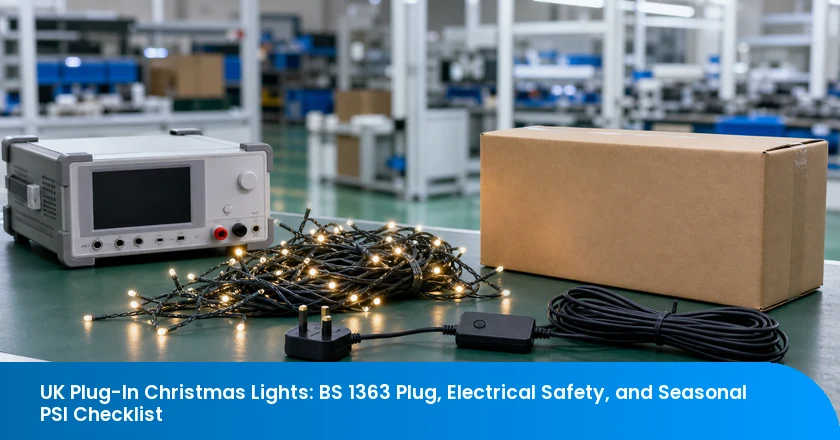
For a Great Britain-bound plug-in Christmas-light shipment, the useful China-side control is an evidence-to-lot handoff. It connects the agreed product version, technical-file and declaration references, approved plug-and-fuse bill of materials, cable and controller identifiers, retail claims, and carton records to selected finished goods. It does not perform electrical-safety testing, determine whether a plug complies with BS 1363, certify conformity, or decide whether equipment may be placed on the market.
The distinction matters in peak season. A selected light string can look correct while a different fuse, cable, controller, outdoor claim, or retail-pack revision is mixed into another carton range. The buyer needs a record that makes the physical match—or a missing link—visible before export and preserves the technical and legal decisions with their accountable owners.
Start With the GB Electrical-Equipment Scope and the Actual Light-Set Version
The Electrical Equipment (Safety) Regulations 2016 GB guide applies to electrical equipment designed or adapted for use between 50 and 1,000 volts AC or 75 and 1,500 volts DC, subject to listed exclusions; scope for the actual light set must be confirmed by the accountable technical or regulatory owner. GOV.UK guidance on the Electrical Equipment (Safety) Regulations 2016 in Great Britain sets out the voltage limits and the relevant business duties.
Great Britain means England, Scotland, and Wales; it is not the Northern Ireland route. “Plug-in Christmas lights” is also not a complete product identity. Before approving artwork or final packing, distinguish the connected model or SKU; rated input; adaptor or transformer where present; light string; controller; plug; fuse; cable; connector; intended indoor or outdoor use; IP claim if any; marking; instructions; and retail-pack revision. A product family may contain versions with different components or claims, so one file name or product photograph is not enough.
- Confirm the intended market and identify the actual electrical version rather than a generic seasonal product name.
- Assign a controlled model or SKU, BOM revision, pack-artwork revision, and declaration reference.
- Keep applicable regulatory, standards, and test questions with the accountable technical or regulatory owner.
- Do not turn a component label, a factory statement, or a single selected sample into an electrical-safety conclusion.
The GB guide also describes manufacturer duties to prepare technical documentation, follow the relevant conformity-assessment process, prepare a declaration, apply the relevant marking, and maintain series-production controls. Those duties frame the evidence a buyer should request; they do not change the limited role of an on-site final inspection.
Freeze One Controlled Plug-In Light-Set Architecture
The Electrical Equipment (Safety) Regulations 2016 are the legislation underlying the GB electrical-equipment safety objectives and economic-operator duties described in the government guide.
A release record is useful only when it names the connected light-set architecture: rated input, plug, fuse, cable, controller, adaptor where present, light string, connector, marking, indoor or outdoor claim, and retail-pack revision. Start with one buyer-controlled comparison sheet. Record the model; rated input and stated rating; plug format and visible markings; approved fuse identity or value reference; cable type, colour, length tolerance where specified, entry point, and marking; controller housing and label; adaptor identity where supplied; connector configuration; LED or lamp-string version; retail-pack artwork; instruction version; and the indoor, outdoor, or IP language the buyer approved. The sheet is not a substitute for a product file or a test report. It is the bridge that makes a physical comparison reproducible.
TradeAider can scope a Pre-Production Inspection service to compare early samples and agreed physical references before a cable, controller, or retail-pack change spreads through production. The GB electrical-equipment guide also describes series-production controls that account for changes in equipment design or characteristics. A visual check cannot supply a missing method, scope, or result.
Keep the GB Marking Route, Declaration, and Technical File With the Version
For electrical equipment in scope, the GB electrical-equipment guide describes technical documentation, a declaration of conformity, relevant conformity assessment, and CE or UKCA marking under the applicable conditions; the file must correspond to the actual equipment version. Current GOV.UK GB marking guidance includes the Electrical Equipment (Safety) Regulations 2016 among the relevant product-regulation routes. If a technical decision needs a method and result rather than a document or physical comparison, use appropriate product testing services.
Give the factory and inspector references, not an instruction to judge them. The controlled index can name the product version, intended GB route, declaration reference, technical-file reference, applicable evidence owner, marking location, instruction version, and evidence date. The buyer’s technical owner decides whether the record is sufficient for the actual product. The inspector can compare the supplied reference and visible version cues, then report a match, mismatch, or missing reference.
Where a standards question is material, retain the selected reference and its owner in the index. The UK designated-standards publication for low-voltage equipment is a current source for technical owners; it is not a short-cut to selecting a standard for a particular light set. The underlying Electrical Equipment (Safety) Regulations 2016 remain the legal source.
Treat the BS 1363 Plug, Fuse, Cable, and Controller as a Controlled Assembly
The Department for Business and Trade publishes designated-standards notices and a consolidated list for low-voltage electrical equipment in support of the Electrical Equipment (Safety) Regulations 2016.
“BS 1363 plug” should trigger a controlled evidence request, not a visual pass/fail shortcut. A PSI can compare selected visible plug, fuse, cable, controller, and label details against a buyer-controlled BOM and evidence index, but it cannot determine BS 1363 compliance or electrical safety. In the inspection brief, identify the approved plug model or supplier reference, the fuse reference supplied by the buyer, cable specification reference, cord-entry or anchorage checkpoints the buyer wants photographed, controller version, connector arrangement, and light-set model. Then specify what the inspector should compare on selected units and what should be escalated: a different visible plug body, unapproved fuse reference, different cable marking, changed cable entry, changed controller label, or a mismatch between the selected assembly and the agreed record.
That comparison can preserve useful facts, including close photos and affected carton references. It cannot establish plug construction compliance, determine whether an electrical test was appropriate or passed, or resolve a conflict between a supplier statement and the technical file. The same boundary applies to controllers and any connected adaptor. A controller can make the shipped configuration different even when the light string looks unchanged.
Keep Indoor, Outdoor, and IP Claims Tied to the Approved Evidence
The GB EMC guide addresses electrical and electronic equipment liable to generate electromagnetic disturbance within its stated scope, while the GB RoHS guide says equipment within scope may also need to meet other regulations.
An indoor or outdoor claim, IP claim, marking, and instruction set should be controlled as one retail version and checked as physical facts against the approved evidence record.
For seasonal décor, claims often change later than the component order. Treat “indoor use,” “outdoor use,” IP language, warnings, marking, instruction insert, product image, and retail-pack revision as one pack-control question. A PSI can compare whether selected packs show the approved wording and whether the selected light set carries the expected version cues. It should not decide whether a claim is legally adequate or whether the actual product delivers a claimed protection level.
This matters because electrical products can have overlapping regulatory questions. Confirm applicability for the actual product with the responsible owner instead of copying a generic claim set across variants.
| Evidence lane | Selected factory comparison | What it cannot determine | Accountable owner |
|---|---|---|---|
| GB route and file | Version, declaration reference, marking location, instruction version | Applicable route or conformity outcome | Manufacturer or regulatory owner |
| Plug-in assembly | Plug, fuse reference, cable, entry point, controller, adaptor, connector | BS 1363 or electrical-safety compliance | Technical owner and laboratory |
| Retail claim | Marking, instructions, indoor or outdoor wording, IP artwork, pack revision | Claim adequacy or claimed protection performance | Pack and regulatory owner |
| Shipment record | Selected item, retail pack, carton label, lot, and rework record | GB market-release approval | Buyer release owner |
The table gives the report its useful language: “selected assembly matched the buyer-controlled reference” is an observable statement. “The lights are compliant” is not. If the selected pack or carton range cannot be connected to the controlled version, record a hold for the named owner rather than stretching the inspection conclusion.
Use Seasonal PSI to Compare the Packed Lot to the Evidence Pack
A seasonal PSI can record selected finished light-set, retail-pack, carton, and lot facts against buyer-controlled records, while laboratory, legal, and conformity decisions remain with their accountable owners. A PSI, or pre-shipment inspection, is a finished-goods check before export.
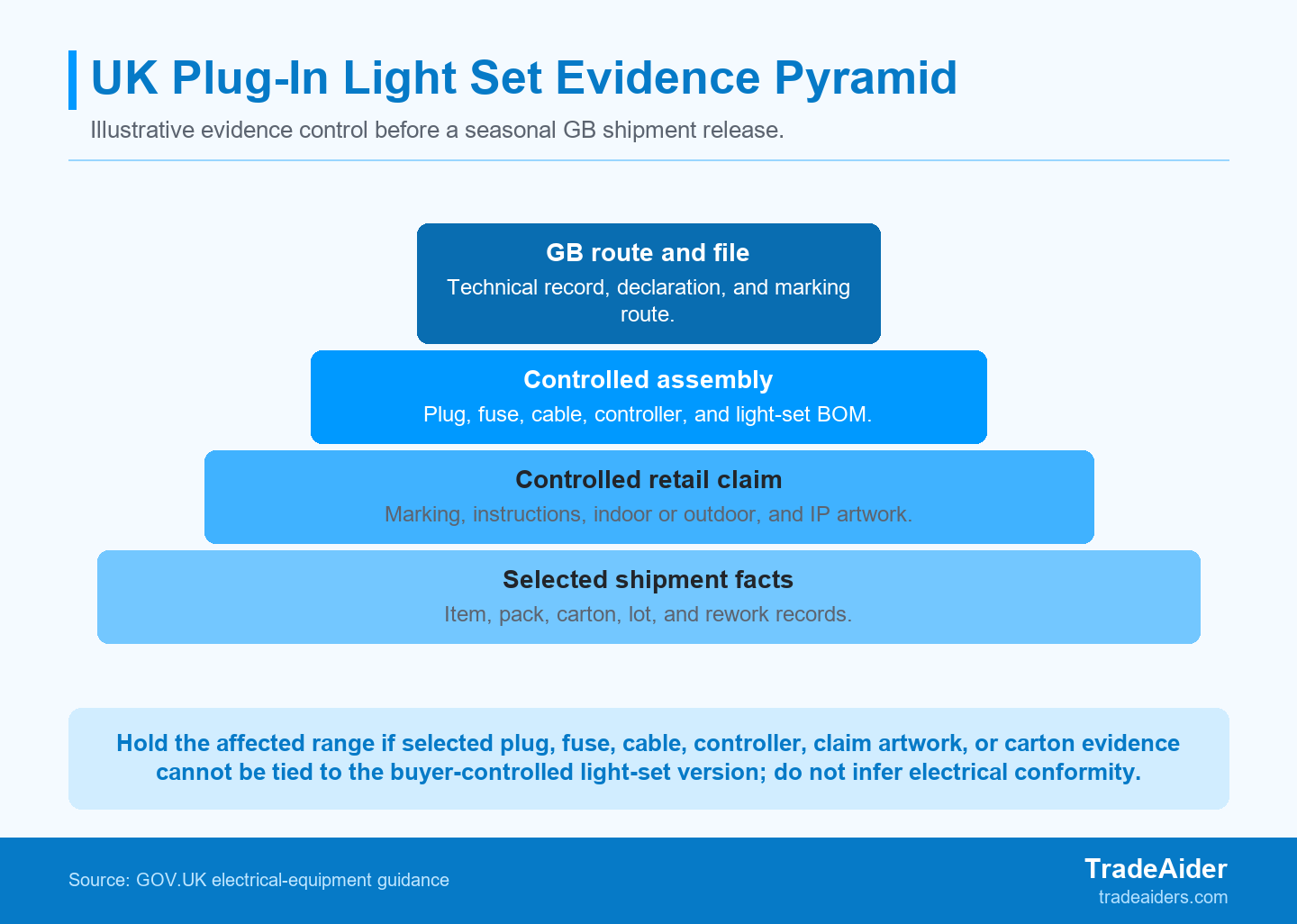
Use the pyramid to separate controlled evidence from a final physical comparison; it is not an electrical-safety or conformity decision.
TradeAider scopes a PSI when 100% of the order quantity is completed and at least 80% is packed for export. For peak-season light sets, attach the controlled model and SKU list; declaration and technical-file references; plug and fuse BOM; cable, controller, adaptor, and connector references; approved retail artwork and instruction insert; claim wording; sample basis; carton plan; supplier lot record; rework log; required photos; and the hold-and-escalation contact. The inspector should record the selected comparison and the affected range, not issue an electrical or legal verdict.
Set the hold rule before the sample is selected. Hold the identifiable carton or process range when a visible plug, approved fuse reference, cable marking, cable entry point, controller label, adaptor, connector, marking, instruction, claim artwork, carton label, or rework record does not match the controlled record. If the supplier cannot establish a clean boundary for the affected variant, expand the hold to the unseparated shipment. TradeAider’s Pre-Shipment Inspection service can document the agreed physical comparisons against that scope.
Illustrative Scenario: Reworked Controller-and-Plug Variant Before Dispatch
When a reworked controller-and-plug variant cannot be tied to a retrievable carton or process boundary, the buyer should hold the reworked range for evidence reconciliation and targeted reinspection.
This composite uses a GB-bound plug-in decorative light set. It shows a controlled-assembly and carton-record gap after rework; it is not a client case, electrical test result, BS 1363 conclusion, conformity conclusion, or market-approval outcome.
Situation, Problem, Action, and Result
The illustrative scenario preserves a rework-record gap and targeted reinspection path without making an electrical-safety, BS 1363, conformity, or market-placement conclusion.
Situation. A private-label importer is preparing plug-in Christmas lights for Great Britain retail distribution.
Order context. The order contains 360 export cartons of one controlled light-set SKU, with an approved plug-and-fuse BOM, controller label, indoor-use retail artwork, and carton plan.
Readiness state. Finished goods are complete and export-packed for the buyer’s shipment-release decision.
Observation one. The inspector finds selected units with the expected plug appearance, cable marking, controller label, retail pack, and carton label in an identified carton range.
Observation two. The factory reports that controllers and plugs were reworked during a late production window, but it cannot connect the rework record to a bounded carton range. A selected unit from a later carton has a controller label that does not match the buyer-controlled reference.
Problem. The inspector can preserve the selected plug, cable, controller, retail-pack, carton-label, and missing rework-link facts. The inspector cannot determine whether the reworked assembly is electrically safe, BS 1363 compliant, or conforming for GB supply.
Action. The buyer holds 180 cartons potentially connected to the unbounded rework window and asks the manufacturer to reconcile the controlled BOM, rework record, and carton plan before release.
The manufacturer identifies the affected production window, segregates the relevant cartons, supplies an updated controlled component record, and completes the agreed corrective work before a targeted reinspection.
Result. The reinspection compares selected plug, fuse reference, cable, controller, retail-pack revision, carton label, carton range, and revised packing record. It produces a bounded physical evidence record only.
Illustrative only. This is not a client case, electrical-safety assessment, test result, BS 1363 conclusion, CE or UKCA conformity conclusion, regulatory report, or market-approval outcome.
Brief a UK Christmas-Lights Pre-Shipment Inspection
A practical scope names the controlled light-set version, evidence references, plug and fuse BOM, cable and controller identifiers, claim artwork, sample basis, carton plan, photos, and escalation owner.
Attach the controlled model and SKU list; product-file and declaration references; plug, fuse, cable, controller, adaptor, and connector BOM references; marking location; approved artwork and instruction insert; indoor or outdoor and IP claim wording where used; supplier batch and carton plan; rework record; sample basis; required photos; acceptance cues; and hold-and-escalation contact. Use inspection standard guidance to state observable acceptance points. For a China-side seasonal light-set comparison, request a UK Christmas lights inspection quote.
Who Is TradeAider?
TradeAider is a quality inspection, testing, and certification service provider in China, with coverage across Guangdong, Zhejiang, Jiangsu, Shandong, and Fujian. Its nationwide network of quality control specialists provides real-time reporting for scoped quality-control work.
Inspection & QA Services are offered at an all-inclusive rate of $199/man-day. TradeAider is an Amazon Service Provider Network (SPN) partner.
Frequently Asked Questions
The FAQ keeps GB electrical route, plug assembly, technical evidence, retail claims, and physical inspection decisions in separate accountable lanes.
Do the Electrical Equipment (Safety) Regulations 2016 Apply to All Christmas Lights?
The GB guide applies to electrical equipment within stated AC or DC voltage limits and exclusions; the accountable technical or regulatory owner must confirm scope for each light-set configuration. A buyer should not assume that a seasonal product name, a plug photograph, or a factory statement resolves scope. Instead, retain the product version, rated input, intended market, and controlled evidence references.
Can a Visual Inspection Prove a BS 1363 Plug or Light Set Is Safe?
No—a visual pre-shipment inspection can compare selected plug, fuse reference, cable, controller, marking, retail pack, carton, and lot facts with the buyer-controlled evidence set. It can photograph differences and identify affected ranges. It cannot determine BS 1363 compliance, run or validate electrical tests, assess safety objectives, certify conformity, or approve market placement. Send those questions to the responsible technical, laboratory, or regulatory owner.
Can CE Marking Be Used for Plug-In Christmas Lights in Great Britain?
For equipment within the applicable conditions, GOV.UK guidance allows CE or UKCA marking routes in Great Britain. The right marking and declaration approach depends on the actual product, evidence, applicable route, and intended market. Keep the chosen route, declaration reference, product version, marking location, and technical-file reference together. Great Britain, Northern Ireland, and EU supply are not interchangeable market routes, so confirm the target before final artwork and shipment release.
What Should a Seasonal Christmas-Lights PSI Compare?
A seasonal PSI should compare selected finished light-set identity, plug and fuse reference, cable and cable-entry details, controller and adaptor identifiers, connector configuration, markings, instructions, retail claims, carton labels, supplier lot, rework records, and carton range before export. State the sample basis, required photos, hold trigger, and escalation owner in advance. The report can show whether selected physical goods match that controlled record; it cannot replace electrical testing, conformity assessment, legal advice, or a GB market-release decision.
関連記事


TradeAiderサービスでビジネスを成長させる
下のボタンをクリックして、TradeAiderサービスシステムに直接入ります。予約から支払い、報告書の受け取りまでの簡単な手順は操作が簡単です。

