
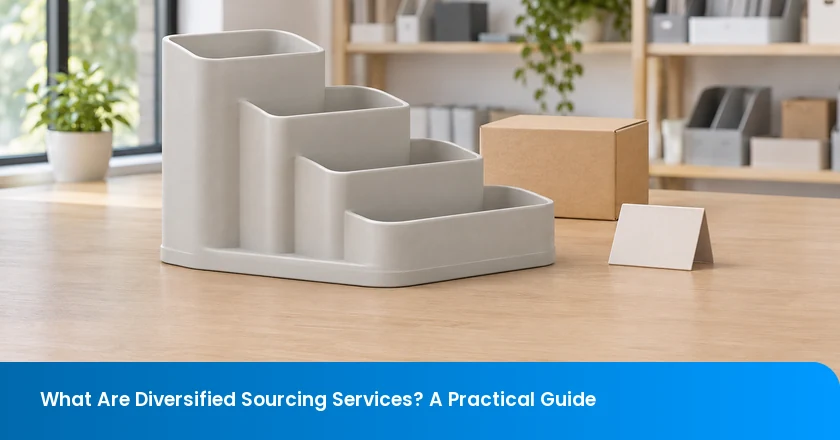
Diversified sourcing services are services that help a business develop and coordinate more than one suitable way to obtain goods or services. They can involve different suppliers, locations, buying channels or purchasing categories. Their value comes from options that meet the business need, rather than simply from a longer supplier list.
For an importer, growing brand or sourcing agent, the first question is what needs to change: dependence on one factory, limited capacity, access to a new product category, or the work required to manage procurement. That objective determines which services and alternatives are useful.
What diversified sourcing services mean
Diversified sourcing services combine the search for alternatives with the work needed to assess and manage them. A service arrangement may help a buyer find suitable suppliers, compare offers, coordinate evaluation and maintain purchasing relationships. The practical objective is usable supply options, with the responsibilities for developing those options made clear.
Diversification can support continuity, market access or commercial choice. These are different goals. Adding a specialist for a new category broadens what the buyer can purchase; qualifying another factory for an existing item addresses a different need. State the intended result before measuring success.
The buyer may perform this work internally, delegate selected tasks to a sourcing partner, or combine both approaches. Retain an internal owner who can explain requirements and authorize commitments. The service label alone does not establish which purchasing decisions the provider may make.
What a diversified sourcing service can include
A diversified sourcing service can cover several parts of the procurement lifecycle. The agreed scope may include defining requirements, researching markets, screening suppliers, obtaining comparable quotations, coordinating samples, following orders and reviewing performance. Some arrangements also coordinate contracts or logistics; others stop at supplier introductions.
Specify an output for each commissioned task. Market research should identify relevant candidates and why they fit. A quotation comparison should retain specifications, quantities and commercial assumptions. Sample coordination should identify the construction evaluated and unresolved issues. An order update should distinguish confirmed production status from an expected date.
Functional support, such as purchase requests, order administration or invoice handling, helps the purchasing process operate. It does not by itself create another source of production. Likewise, a logistics provider can offer another route without finding another manufacturer. These functions can be combined, but their contributions should remain distinguishable.
Agree who contacts factories, approves samples, negotiates terms, places orders and authorizes changes. State how fees, commissions, supplier payments and exceptions will be handled. A buyer should be able to trace a recommendation to the information supplied and identify who owns the next decision.
Supplier, geographic, channel and category diversification
Diversification can change suppliers, geography, channels, materials or logistics. The relevant choice depends on the dependency you want to reduce. NIST-hosted CIRAS guidance on supply chain mapping describes examining suppliers, their suppliers, materials and transportation to reveal concentration and interdependencies. Use that practice to establish what a proposed option actually changes.
| Dimension | What changes | What to establish |
|---|---|---|
| Supplier | Another capable producer or service provider | Actual site, requirements and usable capacity |
| Geographic | Production or supply in another location | Shared upstream inputs and regional exposure |
| Channel | Factory, agent, distributor or platform route | Which entity and factory fulfill the order |
| Material or category | Another approved input or purchasing category | Suitability, change approval and category needs |
| Logistics | Another transport or distribution route | Feasibility, cost, timing and handling conditions |
Multiple buying channels may lead to the same factory. Different factories may also depend on the same critical input or route. An additional contact can be commercially useful without resolving the particular concentration risk you identified.
Material substitution needs technical review against the product requirements. Buying more categories does not automatically create substitutes for existing items. Keep category expansion, approved substitution and backup supply separate when defining the service outcome.
How the main procurement categories fit
Procurement categories describe different aspects of a purchase and can overlap. Domestic procurement takes place within the buyer’s home country; international procurement crosses national borders. Cross-border buying may add currency, customs and transport considerations, but a domestic seller may still rely on imported inputs. Neither label establishes the final dependency.
Direct procurement concerns inputs used in the goods or services the business sells; indirect procurement supports daily operations. SAP’s explanation of direct and indirect procurement uses this distinction. It concerns the purpose of the purchase, rather than whether the buyer deals directly with a factory or uses an intermediary.
For example, material incorporated into a manufactured product belongs to its production needs, while office cleaning supports operations. Either purchase can be important to continuity. Avoid assuming that indirect purchases are always low risk or that direct procurement always means a large order.
Goods procurement concerns tangible items, such as components, equipment or finished products. Service procurement concerns work or access, such as maintenance, design or consulting. Goods need defined construction, quantity and acceptance checks; service arrangements need defined deliverables, milestones or operating expectations. Apply diversification to the requirement that matters, not to a category name alone.
Benefits depend on usable alternatives
Diversified sourcing can improve continuity when another suitable option is available in time. NIST MEP’s manufacturing supply chain risk guidance identifies risks involving single-source parts, capacity, quality, transportation and forecasting. Its redundancy examples vary by item, including additional tooling, split supply and distributor networks; they are planning options rather than a universal formula.
Other potential benefits include comparing commercial offers, accessing additional capacity and finding specialist knowledge or new product ideas. These benefits depend on the proposed suppliers and the buyer’s ability to evaluate them. A larger network can produce more choices while also increasing the work needed to make those choices useful.
Test each claimed benefit against the trigger. If the concern is one factory’s capacity, an additional agent using that factory may not help. If the concern is access to a different manufacturing process, a specialist producer may add value even when it is not the lowest-price option.
Compare total cost and coordination effort
Compare total cost for the same purchasing requirement. Include the product or service price, tooling, qualification, transport, inventory, administration and switching work where relevant. A cheaper unit quotation can become a more expensive arrangement when it requires additional samples, freight, coordination or stock.
Ask candidates to quote against the same specification, quantity, packaging, delivery responsibility and payment assumptions. Identify minimum order quantities (MOQs), which are the smallest quantities a supplier agrees to accept, and distinguish recurring charges from initial setup costs. Retain unknown costs as unresolved items rather than treating them as zero.
Splitting demand can reduce volume leverage or leave several small orders to manage. Conversely, concentrating everything with one provider can leave a costly dependency. Evaluate the alternatives against the risk and resources involved; there is no reliable savings percentage or cheapest strategy implied by the term diversified sourcing.
Qualify suppliers before treating them as backups
Qualify a supplier before counting it as a usable alternative. ASQ’s supplier-selection guidance considers relevant experience, quality, capacity, technical support and total cost, with cross-functional participation and evaluation methods such as quotations, visits and samples. It also describes benefits from closer relationships with fewer suppliers, which is a useful counterweight to increasing numbers for their own sake.
Identify the actual proposed manufacturing site and product requirements. Review the relevant process, equipment, material route and available capacity. Use samples and suitable testing or a pilot order to resolve the questions the documents cannot answer. Record gaps and corrective actions before changing the candidate’s status to approved for the intended work.
TradeAider’s factory audit scope includes supplier information, production lines and equipment, quality management and warehousing. A focused audit can support a capability assessment; a product’s material or performance requirements may need separate evidence.
A suitable sample does not establish unlimited production capacity. Confirm the volume, lead time and conditions the alternative can support. Keep the approved product, site and operating assumptions connected so a later allocation uses the arrangement actually assessed.
Put the sourcing arrangement into a working plan
A working sourcing plan connects the objective, option, qualification work and intended use. Name the owners and the evidence still needed. Use a copyable brief like this for each relevant product or purchasing category:
- Requirement: product/category and revision: ___; demand and needed-by date: ___.
- Reason to diversify: dependency or service gap: ___; desired improvement: ___.
- Proposed option: supplier, actual site, channel and relevant upstream/route: ___.
- Qualification: required samples/checks/pilot: ___; open issue and owner: ___.
- Use arrangement: capacity, MOQ, lead time and costs: ___; allocation or activation trigger: ___; decision owner: ___.
Agree contracts and order procedures around the completed brief. Define product requirements, permitted changes, delivery responsibilities, payment terms and how a problem is escalated. Confirm who may commit volume or approve a deviation; a coordinator’s status update should not silently become an authorization.
Separate supplier qualification from current shipment condition. TradeAider’s pre-shipment inspection includes agreed checks of finished-order samples and reporting. Use the appropriate batch evidence alongside supplier records when deciding on an actual order, rather than assuming that approval of the factory settles every delivery.
Illustrative example: two channels, one factory
This is a hypothetical example, not client data. A brand buys a molded desktop organizer through an agent. To reduce dependence on one factory, it adds a platform seller. Both routes disclose Factory A as the manufacturer. The buyer has gained another commercial channel, but not another manufacturing site.
The sourcing plan therefore still shows Factory A as the production dependency. The buyer investigates Factory B, a separate producer. Its sample looks suitable, but the proposed resin differs from the approved specification. Treating appearance as sufficient would leave the material requirement unresolved.
The technical owner asks for the approved material or evaluates a formally proposed change against the applicable product requirements. After that issue is resolved, the buyer confirms the relevant sample results, a suitable pilot and the capacity arrangement before assigning production. Any commissioned inspection or testing supports the specific product decision; it does not guarantee unlimited surge capacity.
If the actual site, material evidence or available capacity remains unknown, keep the corresponding qualification or backup status pending and assign the missing work. Do not activate an unqualified source simply because the primary route has become inconvenient. The observable improvement is a separately identified option that meets the agreed requirements and can support the intended order.
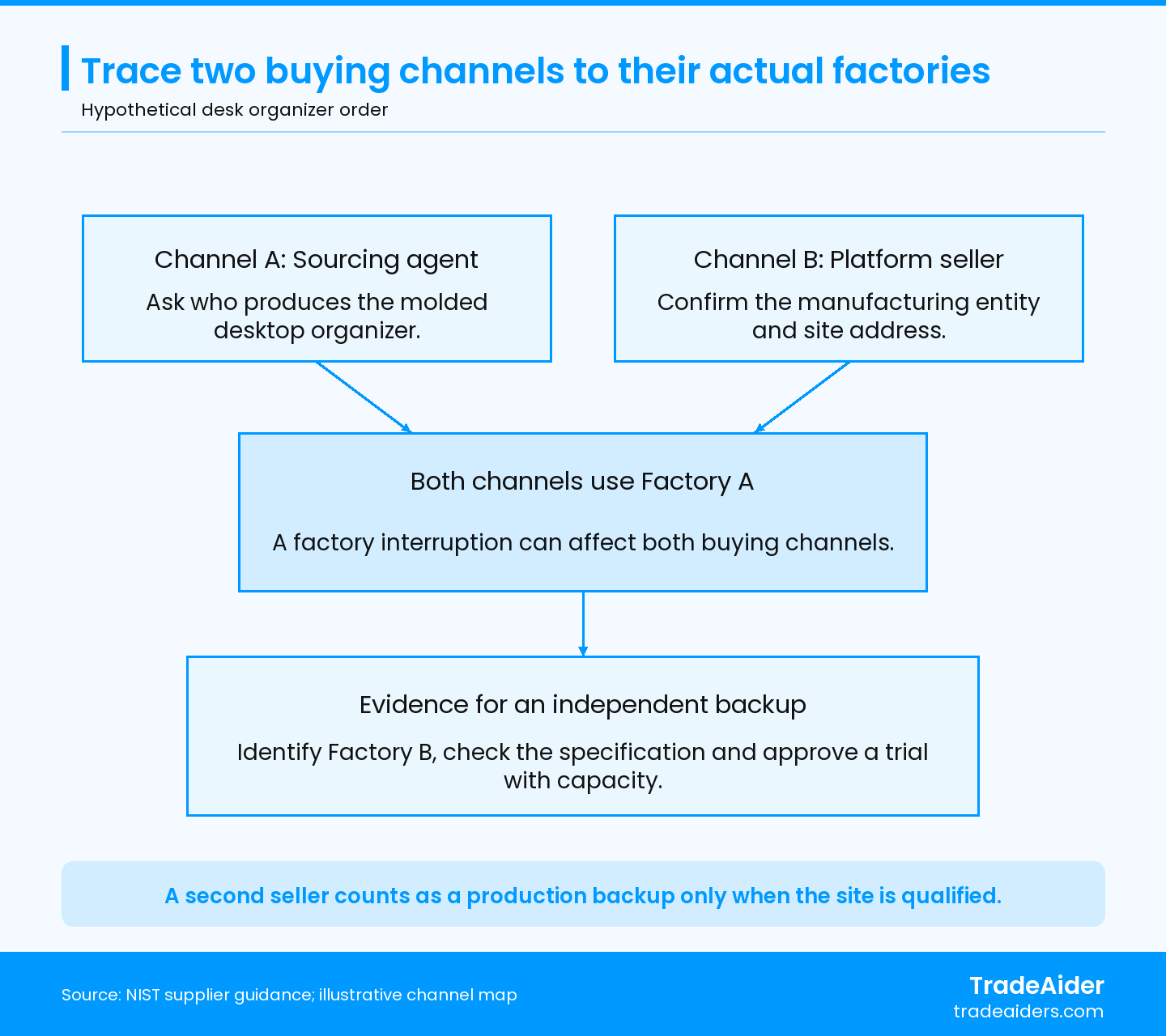
Illustrative order. A sourcing agent and a platform seller can use the same production site. Confirm the actual site and qualified usable capacity before counting a backup.
Use e-procurement and AI to support decisions
E-procurement is a way to manage purchasing electronically. SAP’s procurement guide describes online requisitioning, ordering and purchasing with centralized or automated interactions and transactions. A platform can help coordinate those activities, while the underlying factories and supply dependencies still need to be understood.
Useful digital functions include controlled supplier records, comparable quotation fields, purchase approvals, order tracking and invoice workflows. Use consistent supplier identities and specification versions so records from different channels can be matched. Adding another platform account does not by itself create another qualified producer.
AI can assist tasks such as organizing quotations, highlighting missing fields or flagging unusual changes for review. Confirm important conclusions against the original records and retain human authorization for commitments. An automated comparison is only useful when its inputs describe comparable products, quantities and commercial terms.
For teams developing their procurement process, the practical direction is connected information with clear control: know who supplied a fact, which version applies and who can act on it. Evaluate digital tools against those tasks and the systems already used. Avoid assuming that adopting software guarantees accurate forecasts, lower inventory or error-free procurement.
Manage relationships, compliance and changing conditions
Diversified sourcing needs continuing relationship and performance management. Track comparable quality findings, delivery performance, responsiveness and unresolved actions for the work each supplier actually performs. Discuss recurring issues and changed demand with the relevant suppliers. More contracts and handoffs require enough staff time to keep these records useful.
Cross-border arrangements also need clear language, time zones, escalation contacts and logistics responsibilities. Resolve important instructions in a shared written record. Assess relevant product, destination and trade requirements for the actual transaction; geographical diversification does not remove those duties or establish that two jurisdictions have equivalent rules.
Sustainability can be integrated into the purchasing criteria. ISO 20400:2017 provides guidance on integrating sustainability into procurement across organizations of different sizes and activities. It is guidance, rather than a universal product certificate. Translate the relevant environmental and social expectations into suitable supplier questions and evidence.
Protect sensitive drawings, prices and contract information through appropriate access and sharing arrangements. Train the purchasing team in the approval process and how to identify changes. Review the sourcing plan after a material, site, capacity or route change, and when performance shows the previous assumptions no longer hold. An alternative needs upkeep to remain usable.
Before expanding your sourcing network
- Define the dependency or purchasing gap you want to address.
- Distinguish seller channels from actual production and upstream sources.
- Qualify the proposed option against the product and intended volume.
- Agree total cost, responsibilities and activation conditions, then maintain the arrangement.
Define the quality evidence for your next sourcing step
Begin a TradeAider inquiry with available product and order details, the supplier/site in China and the supplier-capability or batch-quality question you need to resolve. Share specifications or existing records where available. Before service, agree suitable factory-audit or inspection checks, requirements and reporting. Contact our team to discuss the relevant scope and a report of the commissioned findings.
FAQ
Can a small buyer diversify without splitting every order?
Yes, a qualified standby arrangement may fit better than dividing every order. Agree the minimum volumes, maintained tooling and records, available capacity and work needed to reactivate the supplier. Revisit those assumptions before relying on it after a long idle period. A dormant quotation is not assured supply, and keeping an alternative usable may still require samples, trial work or continuing commercial commitments.
Who should control molds and technical files across factories?
Agree ownership, permitted access and transfer arrangements before sharing tooling or files. The agreement should address storage, maintenance, changes, permitted production, retrieval and the costs of moving or reproducing tooling where relevant. Give each factory the controlled information it needs without unnecessarily disclosing another supplier’s commercial data. Do not assume that paying a tooling charge alone resolves every ownership or access question.
How should buyers handle conflicting supplier reports?
Compare the underlying samples, methods and conditions before choosing which conclusion applies. Confirm product revisions, material identities, dates, units and acceptance criteria, then ask the technical owner to explain the difference. Different scopes can produce different findings without either report answering the full question. Resolve the relevant evidence gap or arrange suitable repeat work; averaging incompatible results does not establish that the product meets requirements.

関連記事

TradeAiderサービスでビジネスを成長させる
下のボタンをクリックして、TradeAiderサービスシステムに直接入ります。予約から支払い、報告書の受け取りまでの簡単な手順は操作が簡単です。