
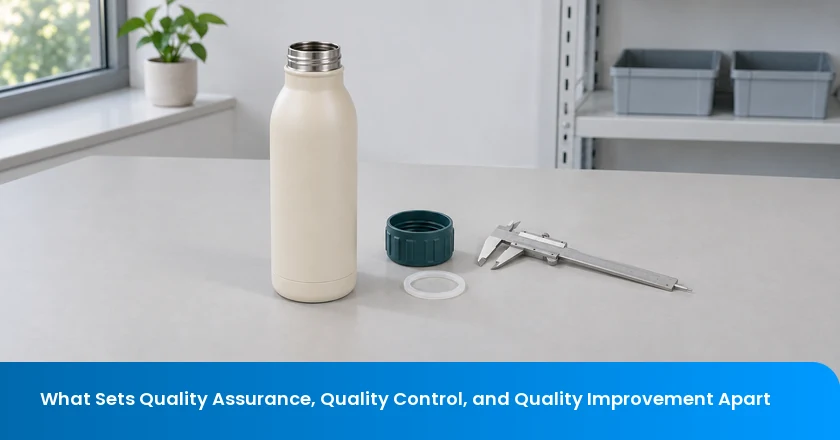
Quality assurance builds confidence that quality requirements will be met. Quality control uses operational activities to meet those requirements and respond to actual performance. Quality improvement changes how work performs and checks whether the change produces a better result. All three contribute to quality management. Understanding their different questions and evidence helps you assign work, handle a current finding and improve the process that produced it.
Choose the quality task by the question it must answer
- Use QA to establish and review the working methods that support quality requirements.
- Use QC to observe actual performance and take the agreed response.
- Use QI to investigate a gap, test a change and verify its effect.
- Connect verified changes back to instructions and monitoring, with named owners for the handoff.
Compare the purpose, work and evidence of QA, QC and QI
The Quality Press book Foundations of Quality Risk Management places quality planning, quality assurance, quality control and quality improvement within quality management. They contribute related forms of work toward quality objectives. Quality Press public sampler
Compare quality assurance, QA, quality control, QC, and quality improvement, QI, by purpose, activity, timing, evidence and use. Their activities can overlap. The following comparison is a practical way to assign work while keeping the question and expected output clear.
| Aspect | QA | QC | QI |
|---|---|---|---|
| Purpose | Build confidence in meeting requirements | Fulfill requirements through operational work | Improve performance through verified change |
| Typical work | Controlled instructions, training and reviews | Measurement, inspection, monitoring and response | Gap analysis, cause investigation and trials |
| Timing | As methods are established, used and reviewed | At the relevant material, process or output stage | When a gap or opportunity prompts a change |
| Evidence | Approved methods and implementation records | Actual observations against defined criteria | Baseline, tested change and effectiveness results |
| Use | Resolve an unclear or unreliable working method | Respond to current performance or product findings | Adopt and sustain an evidenced improvement |
A document review, measurement or team meeting takes its meaning from its purpose. Ask what the activity is intended to establish and what evidence it produces. This keeps the comparison useful even when the same people perform several functions.
Quality assurance builds confidence in how work is done
ASQ describes quality assurance through planned and systematic activities that provide confidence in fulfilling quality requirements. ASQ handbook glossary
Use approved requirements, controlled instructions, training and reviews to build confidence in consistent work. Keep the actual requirement and current revision identifiable. For an order involving a threaded bottle cap, the factory needs the approved cap reference, assembly instructions and applicable checking method.
Review how that information reaches the people doing the work. An instruction stored in an office has limited practical value if the assembly station uses an earlier revision. Check the issued version, the operator's understanding and the records showing how a change was introduced. Assign responsibility for withdrawing superseded instructions.
Assurance work continues as the process is used. A review can examine whether the agreed method is being followed and whether its records support the intended confidence. Findings from production or customer feedback may reveal a gap in the method or its implementation. Keep that review connected to the actual activity.
For a buyer, a useful assurance discussion asks how the supplier maintains agreed requirements through changes in materials, people or tooling. Request records relevant to that question, then relate them to the product observations. The system and its actual implementation both matter to the judgment.
Quality control measures and responds to actual performance
ASQ describes quality control as operational techniques and activities used to fulfill quality requirements. ASQ handbook glossary
Place checks where the relevant characteristic can be observed and acted on. Incoming-component measurements, assembly checks and finished-order inspections can address different questions. Define the characteristic, method, reference, coverage and response at the stage where you need the information.
NIST describes statistical process control through comparing process observations with a model based on prior performance and investigating signals from that comparison. This adds an ongoing monitoring role to the quality work. NIST process-control explanation
When a check finds a problem, identify the affected product and record the observed condition against its criterion. Apply the agreed containment or disposition process, such as holding identified goods for review or arranging an authorized correction and recheck. Preserve the initial findings so later repair results remain understandable.
For TradeAider pre-shipment inspection, the order quantity is 100% complete and at least 80% packed for export. Agree references, sampling and feasible finished-order checks.
Use those observations within the agreed scope. Share recurring findings with the factory's quality and production owners so they can investigate the process behind them and decide what further evidence is needed.
Quality improvement changes performance and verifies the effect
Jayet Moon describes quality improvement through performance analysis and systematic change, with improvement realized in the positive effect of that change. Quality Press public sampler
Define the performance gap and a measure, investigate causes, test the change, verify its effect and maintain the successful method. Retain unresolved causes as unknown. The improvement record should explain what changed and how the team judged the resulting performance.
For recurring cap leaks, replacing a failed cap can address the particular bottle. A project investigating why closures repeatedly leak needs a broader question about the process and a way to compare results. Decide the relevant measure and checking conditions before running the trial.
A proposed adjustment remains a proposal until the evidence supports its effect. If a trial improves the targeted result, review whether it introduced another problem and whether the method remains practical in production. Then decide how to incorporate the verified change into regular work and monitor whether the gain persists.
Choose improvement methods for the problem
Choose a method around the question, available evidence and complexity of the change. The team needs enough structure to investigate the cause and assess the result. Give each tool a specific job within that work.
ASQ describes the plan-do-check-act cycle, PDCA, through planning an improvement, trying it preferably on a small scale, comparing observed with expected results and acting on the causal system. ASQ handbook glossary
For a bounded trial, write down the proposed change, expected observation and checking method. After the trial, decide whether to adopt, adjust or investigate further. Keep a record of an unsuccessful trial as well, since it helps explain why the team changed direction.
The ASQ DMAIC guide follows Define, Measure, Analyze, Improve and Control. It connects reliable baseline measurement and cause analysis with work to verify a solution and monitor sustained performance. ASQ DMAIC guide
Use cause investigation to test an explanation for the problem. Sort records by relevant conditions, examine the suspected mechanism and compare what the explanation predicts with observations. Keep alternative explanations open while evidence is incomplete.
NIST MEP's archived overview describes lean manufacturing as a continuous improvement model addressing non-value-added activities. Archived NIST MEP overview
If unnecessary movement or waiting is the target, measure that burden alongside the relevant product outcome. Retain the checks needed to demonstrate requirements while evaluating a more efficient way of working.
Connect quality work to applicable requirements
Map applicable product, market and contractual requirements to responsible owners and evidence. Review the actual obligation alongside process and product records. This makes the compliance discussion specific to the product, destination and claim being assessed.
QA can support the planned handling of requirements, revisions and records. QC can provide observations against the criteria within its checking scope. QI can address weaknesses found in that work. Keep the evidence needed for each particular obligation identifiable as you combine those contributions.
Ask the responsible technical or compliance owner to resolve a missing requirement or method. For example, a supplier's general assembly instruction may leave the purchased configuration's test condition unclear. Record the gap and obtain the applicable reference before making that technical judgment. Use available observations for the questions they can support while the unresolved item remains pending.
Make the handoffs between the functions explicit
Connect QA references to QC observations and QI verified changes, then update the relevant instructions and monitoring. Assign clear owners for these handoffs. A finding becomes easier to use when the next person can identify the product, criterion, observation and outstanding question.
NIST reports that American Douglas Metals worked with Insyte on documented processes, introducing the system to employees and training internal auditors. A further project developed corrective-action and root-cause skills. This is a reported implementation at that company. NIST MEP case account
The case distinguishes establishing a documented way of working from building the skills to respond to nonconformities. In your own project, give the investigation owner access to the observations and working references. After a change is verified, give the instruction owner the approved revision and the monitoring owner the checks needed to follow performance.
A buyer can request those separate outputs when reviewing recurring supplier problems. Identify the response for the current order and the evidence expected from the longer-term investigation. Set follow-up dates around the work needed to answer each question.
Illustrative bottle project from findings to verified change
Illustrative example. A reusable bottle order shows leaking caps under the agreed check. QA records identify the approved cap revision and assembly instructions. QC records the findings, affected order and disposition.The production engineer investigates the closure operation, tests a suspected fixture cause and verifies the proposed change. QI evidence remains pending until comparable before-and-after results support improvement. The verified method then updates QA instructions and QC monitoring. These are hypothetical conditions, with no client result or universal test threshold.
Start the shared record with the requirement and actual leak observation. Assign the current-order review to the responsible buyer or product-disposition owner. Have the engineer compare the suspected fixture condition with observed assembly behavior and design a trial that can test that explanation.
If the changed method produces the required result under comparable conditions, record the evidence and authorize the applicable instruction update. Follow later production using the agreed monitoring plan. If baseline data are missing, assign the factory quality manager to establish the comparable measurements and keep the improvement conclusion pending.
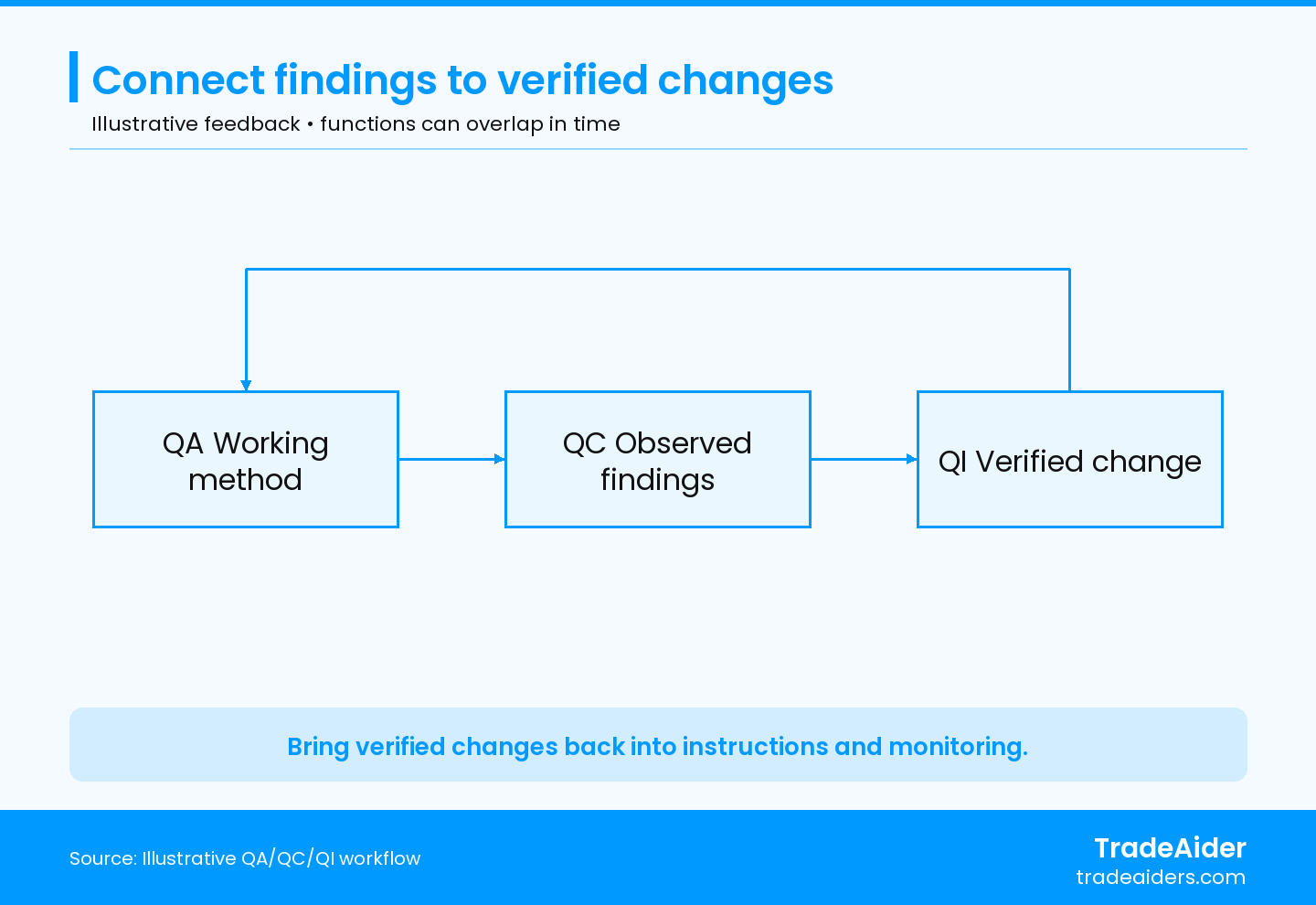
Illustrative feedback between QA, QC and QI. Functions can overlap in time. Verified changes update working instructions and monitoring.
If the leak method itself is unclear, ask the technical owner to confirm the procedure and criterion first. Retain the observed leaks and current-order review while the related conformity judgment awaits that reference. This branch resolves a different evidence gap from an unverified cause.
Use a shared QA, QC and QI working record
Use a shared working record for the requirement, QA method, QC observation, current-product action, QI change, effectiveness evidence and feedback owner. Assign missing inputs before making the affected judgment. Copy the fields below into your review or project record.
| Working item | Complete for this project | Owner and follow-up |
|---|---|---|
| Requirement | Product/revision ___ Characteristic ___ Criterion ___ Method ___ | Technical owner ___ Resolve a missing reference before the related judgment. |
| QA method | Instruction/revision ___ Training or implementation evidence ___ | Method owner ___ Confirm the current version is used at the work location. |
| QC observation | Order/run ___ Stage ___ Coverage ___ Raw findings ___ | Checking owner ___ Preserve the criterion, observations and record location. |
| Current-product action | Affected scope ___ Hold/correction/disposition ___ Recheck ___ | Disposition owner ___ Record authorization and the result of any recheck. |
| QI investigation and trial | Gap ___ Proposed cause ___ Supporting evidence ___ Trial change ___ | Investigation owner ___ Test the explanation and record alternative causes. |
| Effectiveness evidence | Baseline ___ Follow-up ___ Comparable conditions ___ Outcome ___ | Verification owner ___ Keep the improvement conclusion pending if comparison data are missing. |
| Return to daily work | Verified revision ___ Operator introduction ___ Monitoring ___ Review date ___ | Implementation owner ___ Confirm the new method is issued and later performance reviewed. |
For the bottle example, the observed leak goes in the QC field and the order response goes in current-product action. The fixture explanation belongs in the investigation field with its evidence. Record the trial and comparable result before completing the effectiveness field.
Give each unresolved item a named owner and due date. If a requirement is missing, the technical owner supplies it. If a baseline is missing, the quality manager establishes the measurement basis. If a change is verified but the old instruction remains in use, the implementation owner completes that handoff. These actions make the record usable at different stages of the project.
Measure improvement against a comparable baseline
Compare improvement results using consistent requirements, methods, population and production stage. Preserve raw counts and any changed conditions before attributing the result to the intervention. Decide the relevant observation period and what follow-up would show the change is sustained.
For a production project, define whether the measure covers first-pass output, repaired goods, a sample or the complete run. Record relevant changes in product mix, materials or checking coverage. If several conditions changed together, the results may support a useful trial observation while leaving the specific cause unresolved.
Review the targeted outcome alongside other affected requirements and the effort needed to operate the new method. Once the responsible team adopts the change, retain the revised instructions, implementation evidence and subsequent observations. An adverse later result should trigger the agreed response and further review. Monitoring then supplies fresh QC evidence for the next quality decision.
Apply the distinctions across different types of work
Use the same functional questions in manufacturing, software and healthcare administration while adapting requirements, methods, responsibilities and evidence to each setting. The following are illustrative workflow examples.
In manufacturing, a controlled assembly instruction can support QA, a measured closure result can support QC, and a tested process revision can contribute to QI. The bottle project shows how those outputs connect.
In software, a team might establish a review procedure, check an identified release against its requirements, then investigate recurring errors and assess a revised development practice. Record the release and checking coverage so the comparison remains meaningful.
In healthcare administration, an appointment-routing procedure, a check of actual routing records and a measured workflow trial can serve the corresponding functions. The responsible organization defines its professional requirements and methods. Keep each example tied to its own setting when deciding what evidence and expertise the work needs.
Discuss inspection checks for your order
Send TradeAider the product and order information you already have, the factory, destination, timing and known findings. Existing specifications and reports can support the discussion. Before inspection, agree references, sampling, feasible checks and how limitations will be recorded. Contact our team to discuss an inspection scope and a report of the agreed checks and observations.
FAQ
Can one small team handle QA, QC and QI?
A small team can combine QA, QC and QI responsibilities while keeping each task, evidence and reviewer explicit. Assign technical and product-disposition decisions to the responsible qualified owner. Record who performs the work and who reviews its result so that a shared job title leaves the handoffs clear.
Does a passed inspection demonstrate quality improvement?
A passed inspection demonstrates improvement only when a valid comparison with baseline evidence supports that conclusion. Otherwise, it establishes the observed result within its checking scope. Compare requirements, coverage, methods and production stage before attributing a better result to a particular change.
Can quality improvement begin before defects occur?
Yes. An identified opportunity can start an improvement project before a defect is observed. Define the expected benefit and a way to evaluate the change, such as reducing an avoidable handling step while maintaining the required product result. Test the proposal and verify its actual effect.
関連記事
TradeAiderサービスでビジネスを成長させる
下のボタンをクリックして、TradeAiderサービスシステムに直接入ります。予約から支払い、報告書の受け取りまでの簡単な手順は操作が簡単です。