
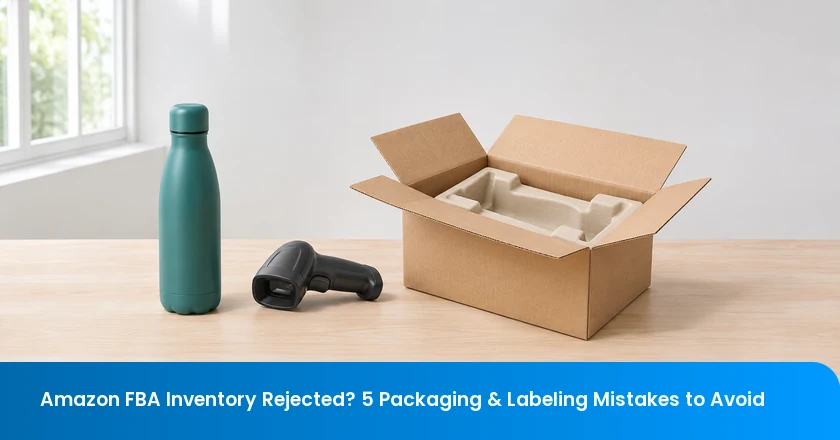
FBA receiving problems often begin with an identifiable mismatch between the product, its packaging and the shipment information. To prevent them, check the required unit barcode, protective packaging, actual contents, packed carton measurements and product-specific preparation before dispatch. A label that scans can still identify the wrong item. A correct label can also become unreadable after the final bagging operation.
The platform requirements below concern US Fulfillment by Amazon (FBA), checked in November 2026. Use the requirements for the actual destination store and shipping route when preparing another shipment.
Checks that prevent FBA packing errors
- Check the physical finished pack against the current label and shipment files.
- Separate unit identification, carton identification and transport labels during verification.
- Choose the correction from the observed problem and confirm the result before dispatch.
Why FBA packaging problems can lead to different receiving outcomes
Prevent FBA receiving problems by checking unit labels, physical packaging, actual contents, packed carton measurements and product-specific preparation against the shipment’s current marketplace requirements. Together, these checks establish what is being sent, how it is protected and whether the recorded shipment describes the goods.
Amazon lists labeling errors, damage, policy violations and delivery to the wrong fulfillment center among potential reasons for shipment refusal. The reported defect and actual receiving status determine the next action. Keep a recorded label defect, a receiving delay and a refused load distinct when asking the packing team or carrier to investigate. Amazon shipping and refusal guidance.
Amazon ended planned FBA prep and item-labeling services in the US marketplace from January 1, 2026. Sellers must arrange this work upstream. Assign the supplier or prep partner the current files and a clear completion check before the goods reach the fulfillment center. Amazon US service-change announcement.
Some current help pages describe Amazon attempting to correct an inbound defect. That is a response to incorrectly prepared inventory, separate from the planned prep service that ended. Arrange complete preparation before dispatch, and use the actual notification to understand any later corrective handling.
1. Incorrect or unscannable unit labels
Since March 31, 2026, resellers including authorized resellers must use Amazon barcodes for US FBA. Eligible Brand Representatives may use manufacturer barcodes when the product meets the stated conditions. Confirm the actual selling role and product eligibility before accepting a supplier’s proposal to leave the manufacturer code exposed. Amazon barcode-choice FAQ.
The Amazon Standard Identification Number (ASIN) identifies the catalog product. The Fulfillment Network Stock Keeping Unit (FNSKU) identifies inventory through Amazon’s fulfillment system. Give the packing team the current SKU-to-label mapping, including the correct variation and condition. A sharp print of another color’s label still sends the wrong identity into receiving.
Amazon requires an appropriate unit barcode that remains scannable after prep. Keep labels off corners and curves, preserve safety labels and cover other visible product barcodes except serial-number and Transparency codes. Use at least 300 dpi and blank space of 0.25 inches at the sides and 0.125 inches above and below. Amazon unit-label requirements.
Scan a finished unit using the agreed equipment, then compare the decoded value with the approved mapping. Examine the label after wrapping, bagging and sealing. A scanner beep proves that a code was read. The comparison establishes whether it identifies the actual sellable unit. Retain the scan result with the SKU and a photo that shows its placement.
Also check the practical print condition. Smudging, reflective surfaces, folds and transparent film glare can interfere with access to the code. Correct the print or placement problem, then scan again in the final pack condition. A screenshot of the label PDF cannot show whether the applied label has been folded under a seam.
2. Unsuitable bags, cartons or protective materials
For US FBA polybag prep, Amazon specifies at least 1.5 mil thickness, a fully sealed bag, scan visibility and a suffocation warning for an opening at least 5 inches measured flat. A mil is a thousandth of an inch. Keep that unit on the material specification so the supplier and inspector use the same thickness requirement. Check the warning’s prominence and the applicable print size against the actual bag. Amazon polybag requirements.
Use a sound shipping carton, suitable cushioning and a secure retail pack. Check whether voids, crushed corners or loose components allow damage or separation during handling. Inspect the packing arrangement with the actual product inside, since an empty sample carton cannot demonstrate how the finished goods are supported.
A useful comparison is a bottle held securely by a fitted insert versus the same bottle moving freely inside a large retail box. The second arrangement needs a packing correction even if its exterior looks clean. Ask the supplier to show how the product, accessories and inner packaging sit together, then verify that the closure retains them.
Keep the material specification and the packed result connected. A supplier may buy the right bag but leave it unsealed, or use the approved insert without seating the product correctly. Record the observed condition and the packing change needed. This separates a material substitution from an assembly error and gives the packing team a specific correction.
3. Contents that disagree with the unit pack or shipment plan
Count sellable units separately from the components inside a set. Compare the opened pack with the approved bill of materials and packaging claims, then reconcile carton contents with the shipment plan. Missing accessories affect what the customer receives, while incorrect carton quantities also make the inbound information inaccurate.
For example, a bottle-and-cleaning-brush set is one sellable unit. A carton count of complete sets and a component count inside each opened set answer different questions. Record both where the inspection scope calls for them. Finding the correct number of retail boxes does not establish that each contains its promised brush.
Amazon requires each shipping box to carry its own unique FBA Box ID label and carrier label. Keep them off seams and corners, and match the box-content SKUs and quantities to the correct box. Do not copy a convenient label across cartons whose contents differ. Amazon shipment-label requirements.
Give a packing operator a way to identify which carton is being checked before it is sealed. If a mixed-SKU box is reopened or its contents change, reconcile the updated physical contents with the shipment data and the label for that box. Record the affected carton identity so a correction remains traceable after boxes move to the dispatch area.
4. Cartons outside the applicable size or weight requirements
Current US FBA limits for ordinary multi-unit cartons are 36 inches long, 25 inches wide, 25 inches high and 50 lb total. Single-item exceptions and category-specific conditions need separate review. Measure the closed packed carton and enter the actual values. Amazon’s current page sets these ordinary length and weight requirements. Amazon carton size and weight requirements.
Measure the package that will actually travel. Extra cushioning, an overbox or bulging panels can change its external size. A nominal carton drawing or an unpacked product measurement leaves that change untested. Use a suitable scale for gross weight, including all units, packaging and inserts, and record the measurement against the carton identity.
For a heavy or oversize single item, establish the applicable exception and handling labels before packing. The help page gives different conditions for special shipments and categories. A lifting label alone does not establish that the selected carton or route is eligible. Obtain the specific applicable instructions before assigning a packing limit.
Underfilled cartons need attention as well. Check whether the contents shift and whether unsupported panels are likely to collapse under handling. A carton can fall within the permitted dimensions and still need a packing-strength or cushioning correction.
5. Incomplete product preparation or a skipped final check
Amazon requires secure sellable units, contained and clearly marked sets, accessible barcodes and all applicable category-specific preparation. Fragile, liquid, sharp and expiration-dated goods need their relevant additional checks. Identify every prep requirement that applies to the actual product before deciding the packing method. Amazon packaging and prep requirements.
Check cleanliness, visible damage, closures, loose parts and the final retail presentation against the agreed product requirements. A damaged item needs a product disposition as well as any packing repair. For a set, examine whether its components remain together through the intended handling. For a dated product, make the relevant date visible through the finished preparation.
TradeAider’s pre-shipment inspection takes place when the order quantity is 100% complete and at least 80% packed for export. Agree which FBA packing operations will already be finished at that visit. If labels or bags are applied afterward, assign a final check of that changed condition before dispatch.
The sampling plan also matters. State the checks and selected quantities in advance, including any separately agreed carton reconciliation. Keep the report’s actual coverage visible when deciding whether further sorting, repacking or verification is needed.
Illustrative example of a relabeling error before dispatch
In this illustrative reseller scenario, a final bagging operation hides the required unit barcode and a copied box label identifies different contents. Hold the affected packing run, relabel against the current files and rescan the final bagged units while reconciling each affected carton. The product is a bottle-and-brush set, and the shipment is still at the factory.
The initial label printout matches the approved file. After packing, however, the unit’s code sits beneath a folded seam and will not scan reliably. Separately, the copied carton label points to a box configuration that differs from the physical SKU quantities. Improving printer resolution would leave both observed placement and carton-identity errors unresolved.
The packing supervisor identifies the affected run, moves the unit label to an accessible location and replaces the copied carton labels with the correct unique labels. The checker then records decoded unit values against the SKU mapping and reconciles the affected boxes against the updated shipment information.
The observable result is a readable, correctly mapped unit label and a carton record that matches its physical contents. If the packing run cannot be identified, widen the hold to the unresolved scope while it is investigated. This is a hypothetical example of directing a correction from evidence.
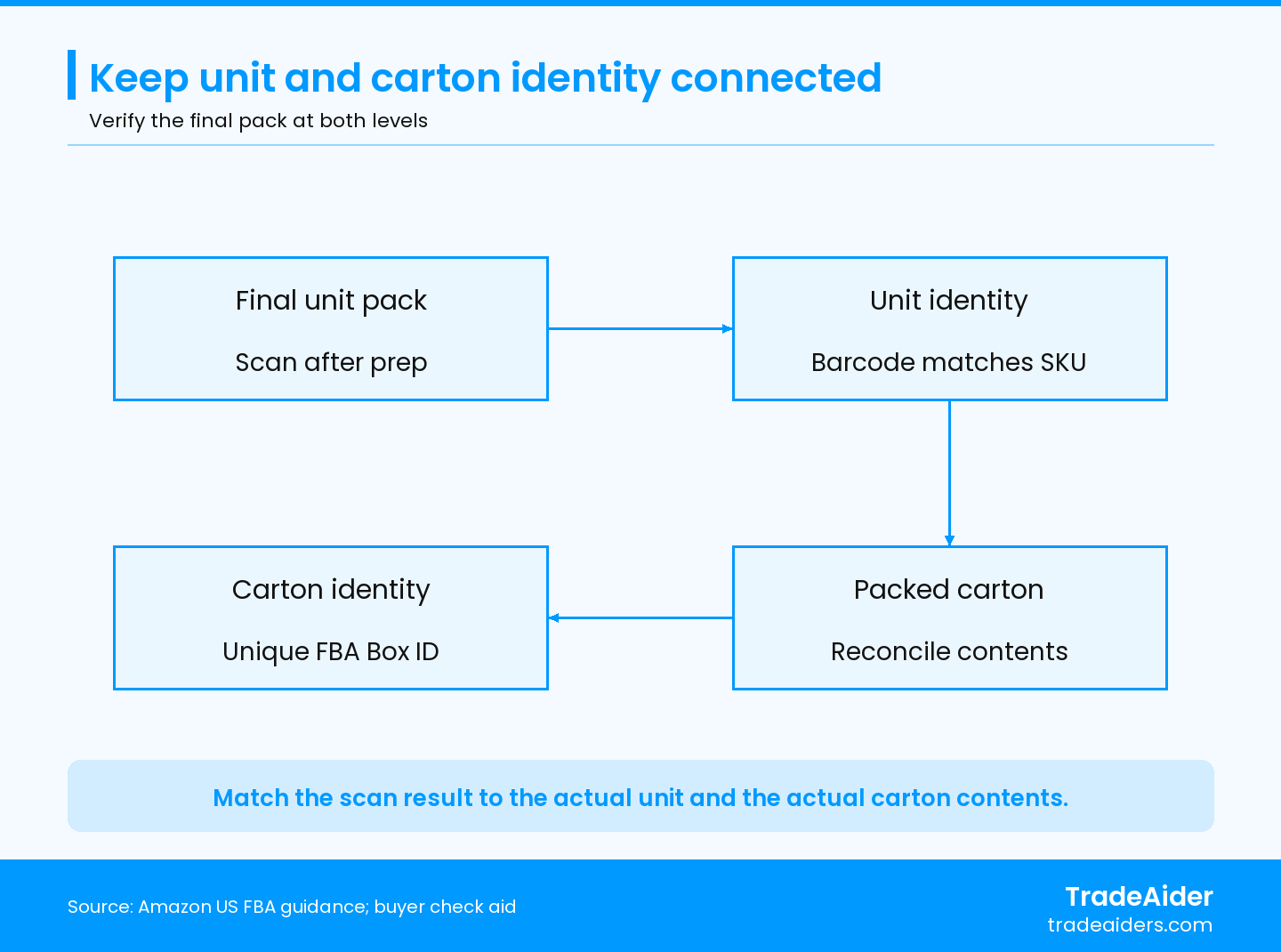
Buyer check aid. A readable unit barcode and a matching carton identity answer different questions.
Use a final packaging and labeling check record
The following comparison helps route an observed problem to the appropriate packing action.
| Mistake | Incorrect condition | Corrective check |
|---|---|---|
| Unit label | Readable code maps to another variation | Compare the final scan with the approved SKU mapping |
| Physical packaging | Open bag or unsupported product inside the carton | Verify material, closure and the packed protective arrangement |
| Contents | Missing accessory or copied box identity | Check complete sets and reconcile each affected carton |
| Measurements | Unpacked dimensions entered for a packed box | Measure and weigh the closed carton against the applicable limit |
| Final prep | Required protection added after the last check | Verify the changed final condition before dispatch |
Record the marketplace, shipment and SKU references, final pack condition, scan result, carton identity, measured size and weight, contents and corrective-action result. Mark unresolved requirements for clarification before dispatch. Copy the record below for the actual shipment and expand its rows to match the agreed scope.
| Check | Reference and observation | Correction and final result |
|---|---|---|
| Shipment identity | Store, shipment ID, SKU and file revision ___ | Unresolved reference and responsible person ___ |
| Unit label | Required code, decoded value and placement photo ___ | Relabel scope and final scan result ___ |
| Pack and preparation | Material, closure, protection and applicable warning ___ | Repack action and observed condition ___ |
| Contents and carton ID | Accessories, SKU quantities and unique box identity ___ | Reconciled contents and current shipment data ___ |
| Packed measurements | Closed size, gross weight and applicable limit ___ | Changed pack and repeated measurements ___ |
| Dispatch decision | Covered scope, open findings and report reference ___ | Hold or release, decision maker and date ___ |
Use the observation column to preserve what was physically checked. Enter the correction and its observed result in the final column. An unresolved label file, category requirement or box identity remains an open item for the responsible person. A signed row should identify the work actually covered.
If Amazon has already refused the shipment
Preserve Amazon’s actual defect or refusal notice, carrier record and shipment identity. Locate the affected boxes and use the named support or carrier route to agree corrective handling before another dispatch. Ask for the precise reason and the physical location of the goods so the next instruction can be carried out.
For a refused load, coordinate with the carrier and the instructions attached to the refusal. For a received shipment with a recorded defect, use the issue and shipment references when seeking clarification. Keep photos, label files, scan results, measurements and packing records associated with those references.
When the issue is corrected, record what changed and which goods were checked again. Confirm the permitted next movement before arranging transport. Repeating the same dispatch with unchanged labels or unresolved shipment information leaves the observed cause in place.
Prepare the factory-side inspection brief
Start with available product and order details, factory, destination, shipping plan and known packaging concerns. Agree the actual references, sampling, feasible checks and report before inspection. Include current label and pack files when available, and identify any preparation planned after the visit.
Contact our team to discuss an appropriate packaging and labeling inspection scope. TradeAider can use the agreed checks to report findings that support factory correction and your shipment decision.
FAQ
Does a carrier shipping label replace the FBA Box ID label?
No. The carrier label identifies the transport parcel, while the FBA Box ID links the carton to the inbound shipment. Keep both associated with the correct physical box. If contents change during repacking, check the shipment data and box identity again before the carrier collects the goods. The actual carton record should reflect that final configuration.
What should I do if the carrier misses the delivery window?
Check the actual shipment status and ask the carrier to confirm the required booking or rescheduling for the receiving location. Retain the shipment reference and the carrier’s response, then follow any instructions shown for that load. A missed window needs a transport and appointment check. Its consequences depend on the actual issue recorded for the shipment.
Does every FBA item need the same drop test?
No. The applicable preparation or packaging test depends on the actual product category, packaging arrangement and route into Amazon’s fulfillment network. Identify the relevant instruction before assigning a test height, sequence or acceptance criterion. If a fragile-product requirement applies, record that procedure and its result. Use a product-specific test where required and agree its inspection conditions in advance.

Artigos Relacionados

Expanda seu negócio com o Serviço TradeAider
Clique no botão abaixo para entrar diretamente no Sistema de Serviço TradeAider. Os passos simples desde a reserva e pagamento até o recebimento de relatórios são fáceis de operar.