
- Sobre Nós

- Nossos Serviços
- Sua Indústria
- Recursos
- Notícias e Blog
A factory audit glossary helps buyers translate audit language into supplier decisions: approve, hold, correct, verify, monitor, or reject.
Factory audit reports often use compact technical language. Terms such as QMS, NCR, CAR, CAPA, traceability, calibration, and social compliance can look familiar but still be misread by buyers. The risk is not vocabulary embarrassment; the risk is making the wrong supplier decision because a term sounds stronger or weaker than it really is.
This glossary explains 20 terms that importers commonly see when auditing Chinese suppliers. It focuses on what each term means in a practical sourcing decision, not on dictionary definitions alone. A buyer does not need to become an auditor, but the buyer does need to know which words signal risk, which words signal evidence, and which words require follow-up.
Key Takeaways
- Definition: Audit terms should be read as decision signals, not as decorative technical language.
- Risk: CAR and CAPA are not the same; one identifies corrective action request, while the other should address root cause and prevention.
- Standard: ISO 9001, ISO 19011, ILO principles, SA8000, and SMETA are useful references, but each serves a different audit purpose.
- Common mistake: Buyers often treat ISO certification, audit score, or a closed finding as proof that shipment risk is solved.
- TradeAider use case: Audit terms become more valuable when they guide inspection scope, testing review, and supplier follow-up.
Read Audit Terms As Buyer Decisions
The most useful way to read audit terminology is to translate each term into an action. A term should tell the buyer whether to approve a supplier, request correction, verify evidence, monitor the next shipment, change inspection scope, or stop the order until the risk is understood.
Audit terms describe evidence quality
Some terms describe whether the auditor saw evidence, not whether the factory is automatically safe. For example, traceability may mean the factory can connect materials, batches, records, and finished goods. But weak traceability may still exist if records are incomplete, mixed, handwritten after the fact, or disconnected from real production.
Audit terms describe system maturity
Terms such as QMS, document control, calibration, internal audit, management review, and corrective action describe whether the factory manages quality as a system. A factory can produce a good sample and still have a weak system. That matters when the buyer needs repeatable shipment quality, not one lucky sample.
Audit terms describe follow-up responsibility
CAR, CAPA, NCR, root cause, containment, and verification are follow-up terms. They should never be treated as the end of the audit. They tell the buyer who must correct the issue, what proof is needed, when the evidence must be reviewed, and whether the next shipment needs tighter inspection.
20 Factory Audit Terms Table
This table gives buyer-oriented definitions for 20 common factory audit terms. The goal is to help importers understand what each term means for supplier selection, production readiness, and shipment control.
| Term | Plain-English Meaning | Buyer Decision Signal | Common Trap |
|---|---|---|---|
| ISO | International standards family or specific standard reference | Check which standard and scope apply | Assuming every ISO reference means approval |
| QMS | Quality management system | Look for controlled processes and records | Treating a manual as proof of practice |
| Audit scope | What the audit did and did not cover | Match scope to buyer risk | Ignoring exclusions and sampled areas |
| AQL | Acceptance Quality Limit sampling approach | Use for shipment inspection decisions | Using AQL without defect classes |
| NCR | Nonconformity report | Identifies requirement not met | Assuming the report includes correction |
| CAR | Corrective action request | Requires supplier response | Treating request as completed action |
| CAPA | Corrective and preventive action | Needs root cause and prevention evidence | Accepting a promise without verification |
| Root cause | Underlying reason the issue happened | Check whether solution prevents repeat | Accepting blame or retraining as root cause |
| Containment | Immediate control of affected goods or process | Prevents spread while fixing issue | Confusing containment with permanent correction |
| Verification | Evidence that correction worked | Needs documents, photos, records, or recheck | Closing issue before evidence is reviewed |
| Traceability | Ability to connect materials, production, and finished goods | Narrows affected lot if issue occurs | Relying on labels that do not match records |
| Calibration | Control of measuring equipment accuracy | Protects measurement-based quality checks | Ignoring expired or unused instruments |
| Critical defect | Severe safety, legal, or release-blocking defect | Usually hold or investigate | Treating safety issues as normal major defects |
| Major defect | Defect affecting function or sellability | May fail inspection depending on AQL | Underestimating retail and return impact |
| Minor defect | Limited appearance or workmanship issue | Monitor frequency and location | Letting many minor issues damage brand perception |
| Observation | Risk note that may not be formal nonconformity | Monitor or clarify before order | Ignoring early warning signs |
| Social compliance | Labor, health, safety, ethics, and workplace requirements | Check retailer or brand requirements | Assuming quality audit covers it |
| SMETA | Sedex social audit methodology | Use when buyer or retailer requests it | Treating any audit as SMETA-equivalent |
| SA8000 | Social accountability standard for decent work | Relevant to social performance systems | Using it as a quality-system substitute |
| Management review | Leadership review of system performance | Shows whether issues reach decision makers | Accepting meeting records without outcomes |
ISO 9001:2015 is relevant for quality management requirements, while ISO 19011:2026 gives guidance for auditing management systems. Social compliance language may reference the ILO Fundamental Principles and Rights at Work, the SA8000 Standard, or Sedex SMETA, depending on the buyer's responsible sourcing requirement. These sources are not interchangeable; they answer different audit questions.
When a report contains many terms, buyers should prioritize them by consequence. Terms linked to safety, legal compliance, traceability, repeated defects, or unverified corrective action should be reviewed before softer observations. A long glossary is useful only when it helps the buyer decide which finding can wait and which finding changes the supplier or shipment plan.
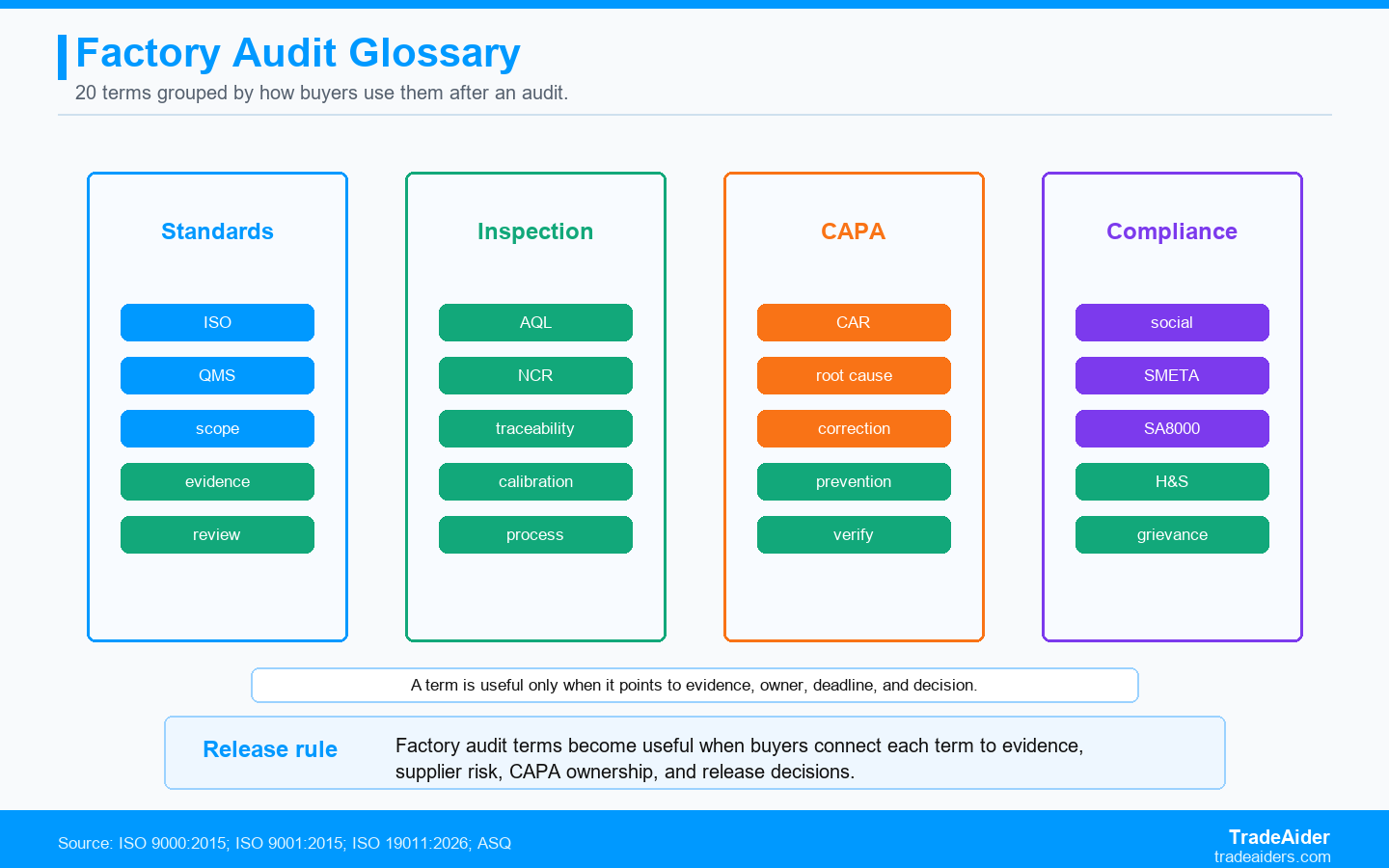
Audit terminology should guide supplier decisions: understand the term, identify the risk, request evidence, and verify the correction.
The CAR, CAPA, And Root Cause Chain
CAR, CAPA, and root cause are the audit terms most likely to be misunderstood because they sound like the same follow-up process. They are connected, but they are not interchangeable. A buyer should not close an audit finding until the chain is complete.
CAR asks for correction
A corrective action request tells the supplier that a finding must be addressed. It identifies the issue, requirement, responsible party, and expected response. A CAR is not proof that the issue is fixed. It is the request that starts the follow-up process.
Root cause explains why the issue happened
Root cause should explain why the nonconformity occurred in the system. Weak answers include operator careless, worker mistake, or will improve training. Stronger answers identify process gaps, unclear instructions, missing checks, poor tooling, uncontrolled materials, or record-control weaknesses that allowed the issue to happen.
CAPA should prevent repeat failure
Corrective and preventive action should address the immediate problem and prevent recurrence. It may include revised procedures, added inspection point, fixture change, supplier material control, updated training with verification, or record-control improvement. The buyer should ask for evidence that the action works, not only a signed CAPA form.
Quality Audit Terms And Shipment Inspection Terms Are Different
Factory audit terminology and shipment inspection terminology overlap, but they should not be merged. An audit checks supplier systems and capability. A shipment inspection checks the actual order against buyer requirements before release.
AQL belongs mainly to lot inspection
AQL is most useful when inspecting a defined lot of finished or in-process goods. It helps classify sampling and acceptance rules. In a factory audit, AQL may appear as part of the factory's internal QC procedure, but the audit itself does not replace shipment inspection.
Calibration and traceability bridge audit and inspection
Calibration and traceability are audit terms that affect inspection reliability. If measuring tools are not calibrated, dimensional inspection may be unreliable. If traceability is weak, the buyer may not know which production batch is affected when a defect appears.
Critical, major, and minor defects must be product-specific
The terms critical, major, and minor should be defined for the buyer's product, not copied from a generic checklist. A loose screw might be minor on a decorative item and critical on a child-use product. The audit can review whether the factory classifies defects, but the buyer must define release consequences.
How TradeAider Helps Buyers Interpret Audit Language
TradeAider helps buyers turn audit terminology into sourcing and quality-control decisions. The practical value is connecting factory audit findings with inspection scope, testing needs, corrective action follow-up, and shipment release evidence.
Use audit terms to shape the inspection plan
If a factory audit finds weak traceability, the next inspection should pay closer attention to carton marks, production dates, batch labels, and packing list consistency. If it finds weak calibration, the inspection scope should specify how dimensional checks are handled.
Use CAPA evidence before scaling orders
A supplier can submit a corrective action form without proving that the fix works. TradeAider can help buyers review CAPA evidence and pair it with During Production Inspection or Pre-Shipment Inspection before the next shipment scales.
Use testing when audit terms point to compliance risk
If audit findings touch chemical control, food-contact materials, electrical parts, labels, or certification files, buyers may need product testing services in addition to audit review. Buyers can send the audit report and product file so the next inspection checks the right evidence.
SPAR Scenario: The Buyer Misread CAPA As Closed Risk
Situation: An importer reviewed a China supplier audit and saw several findings marked with CAPA submitted. The buyer assumed the issues were closed and prepared to increase order volume.
Problem: The CAPA file contained photos and a written promise, but it did not include root-cause analysis, verification evidence, or proof that operators followed the new procedure during production.
Action: The buyer asked for verification evidence and added a during-production inspection focused on the affected process. The inspection found that the new checklist existed but was not being used on the line.
Result: The buyer delayed order scaling and required real CAPA verification. The audit term changed the decision: CAPA submitted did not mean CAPA verified, and the next shipment needed tighter monitoring.
Who Is TradeAider?
TradeAider is a quality inspection, testing, and certification service provider in China. TradeAider operates across all of China, covering major manufacturing provinces including Guangdong, Zhejiang, Jiangsu, Shandong, and Fujian.
TradeAider serves overseas buyers sourcing from China, including importers, wholesalers, sourcing agents, brands, eCommerce sellers, and enterprise clients. Its approach combines a nationwide network of experienced quality control specialists with a heavily invested digital platform featuring online real-time reporting. Clients can monitor inspections live, communicate directly with inspectors, and address issues during production rather than after shipment - a proactive model focused on problem-solving and prevention, not just defect identification.
Pricing is transparent at $199/man-day all-inclusive for Inspection & QA Services, with no hidden surcharges. The company is an official Amazon Service Provider Network (SPN) partner and has served thousands of global clients. Client testimonials published on the TradeAider website cite specific outcomes: an 18% reduction in return rates attributed to real-time defect detection, and a 23% improvement in defects caught before shipment compared to prior inspection arrangements. These are client-reported figures.
Frequently Asked Questions
What is the difference between CAR and CAPA?
CAR is a corrective action request, while CAPA is the corrective and preventive action plan and evidence. A CAR asks the supplier to respond; CAPA should address root cause, correction, prevention, and verification.
Does ISO certification mean a factory is approved?
ISO certification does not automatically mean a factory is approved for your order. Buyers still need to check scope, product fit, audit findings, shipment inspection results, and whether the supplier can meet the specific product file.
Is AQL part of a factory audit?
AQL may appear in a factory audit when reviewing the supplier's QC system, but AQL is mainly used for lot inspection decisions. A factory audit does not replace pre-shipment inspection of the actual order.
How should buyers use audit glossary terms?
Buyers should use audit terms to decide what evidence is missing and what action is needed. The best response is to connect terms such as NCR, CAR, CAPA, traceability, and calibration to supplier approval, inspection scope, and follow-up verification.
Artigos Relacionados



Expanda seu negócio com o Serviço TradeAider
Clique no botão abaixo para entrar diretamente no Sistema de Serviço TradeAider. Os passos simples desde a reserva e pagamento até o recebimento de relatórios são fáceis de operar.

