
China remains a major manufacturing center, but “irreplaceable” is too broad a verdict for every product and buyer. A diversified supply chain can retain Chinese production, components or engineering while adding other qualified routes. The useful question is which capability or dependency is difficult to replace for your product, delivery calendar and acceptable cost.
Replacing final assembly, qualifying another material supplier and rebuilding an entire production network are different projects. Each can change a different exposure. A country-level statistic helps explain the scale of the manufacturing base; supplier and product evidence determine whether a particular route works.
China is a major manufacturing node, not a universal answer
UNIDO’s 2025 industrial-statistics Global Highlights reports that China accounted for 32.0% of global manufacturing value added in 2024. Manufacturing value added measures the sector’s contribution to economic value. This is not a share of every product category, a count of export orders or a measure of the quality of an individual factory.
That scale makes China important to a discussion of manufacturing diversification. It does not establish that a buyer must source every item there, or that another location cannot perform a particular operation. A company can change one stage while continuing to use Chinese inputs, or keep a Chinese factory while qualifying an independent supply of a critical component.
Define the replacement question precisely: the product or process, the required output, the disruption being addressed and the period during which continuity is needed. A route that is difficult to replace before the next selling season may have more alternatives after engineering, testing and supplier development. Neither situation justifies a permanent verdict for all manufacturing.
Where manufacturing depth can matter
An established production network can create value through the relationships around the final factory: tooling, components, finishing, packaging, skilled operations and engineering support. For the China route under review, identify which of those relationships actually shorten development, stabilize output or make corrections practical. Do not assume that every supplier or industrial area offers the same depth.
For a component-heavy product, the important capability may be coordinating several parts to the same revision. For a textile item, it may be reliable access to the approved fabric, dyeing or finishing process. For a molded product, it may be tooling maintenance and repeatable dimensions. Those are specific capabilities that can be examined and compared.
Ask how a change moves through the network. Who approves the revised drawing, obtains the material, makes the sample and corrects the production line? A low quote loses value if a small change requires an unavailable upstream supplier. Conversely, a capable alternative with its own qualified inputs may offer a workable route even when its national manufacturing base is smaller.
Labor availability and technical skill belong in the same assessment. Examine the actual line, supervision, training and output needed for the order. A national wage comparison cannot show whether that line can make your product at the required rate and quality.
Quality belongs to the supplier, process and product
Quality depends on the supplier’s controls and the product being made, not on a country label. Check specifications, approved references, material control, process capability, measurement, traceability and correction of actual defects. An experienced manufacturing base creates options; it does not make supplier qualification unnecessary.
ISO’s quality-management overview identifies ISO 9001 as a standard for quality management systems. Relevant system evidence can help an assessment, but it is not the same record as a product test or a shipment’s inspection results. Check what the document covers rather than treating a certificate heading as proof that the order conforms.
Market requirements also remain product-specific. The European Commission’s CE-marking guidance explains that CE marking is not an indication of origin or approval as safe by an EU authority, and not every product requires it. Moving a factory does not remove the applicable manufacturer/importer responsibilities. A generic list of “international certificates” cannot establish compliance for every item.
Use the relevant records for their own purposes: assess the factory’s operations, verify the ordered construction and obtain the tests or conformity documentation needed for the destination. This supports a sourcing decision without turning national manufacturing scale into a quality guarantee.
What e-commerce and digital visibility change
E-commerce makes assortment and replenishment important sourcing questions. A seller may need multiple colors, package versions, labels and frequent repeat orders. Confirm who controls those variations, how approved files reach production and whether the required inputs and capacity will be available when replenishment is due.
Digital visibility helps only when the information is meaningful. A dashboard status does not create material stock or verify a packed unit. Photographs and measurements tied to a product, revision and finding can help a buyer act on a problem while the order is still in production.
For a China order, TradeAider’s during-production inspection covers agreed production, appearance, dimensional, functional and packaging checks with reporting. Define the checks that matter to the assortment or changed process. Inspection visibility supports those decisions; it does not guarantee marketplace acceptance or a replenishment date.
What China Plus One can actually change
China Plus One describes adding a production or sourcing route while retaining China for some work. The additional route might serve another customer region, provide capacity, or reduce exposure to a particular site or transport interruption. It need not reproduce every stage of the existing network.
Name the intended benefit before choosing the location. A backup assembly line addresses a different problem from an independent material source. Production closer to a customer may change transport exposure, but the result depends on where inputs originate and how the complete route operates. Adding a second contract is not yet the same as having a usable backup.
The OECD’s supply-chain resilience overview notes that its aggregate modelling does not show relocalization consistently improving resilience. That finding is not a forecast for an individual importer. It is a reason to examine vulnerabilities and trade-offs rather than assuming that a more domestic or geographically different network is automatically more stable.
Diversification also has operating costs: another qualification process, specifications to maintain, inventory decisions and production learning. Those costs may be justified by the exposure reduced or the capacity gained. Compare the intended outcome with the added work instead of treating diversification itself as the result.
Trace what the second factory still shares
Map the inputs that both routes depend on. MEP practitioners writing on NIST’s manufacturing blog recommend looking beyond direct suppliers to their suppliers, critical materials, transport routes, geographic concentration and interdependencies. Applied to a sourcing decision, that makes the upstream exposure visible before final-assembly locations are counted as independent.
A second factory may use the same specialized component, toolmaker or material source as the first. That can still be useful if the concern is a disruption at one assembly site. It provides less protection against a shortage at the common input supplier. Record both the independence gained and the dependency retained.
The pattern varies by sector. In its February 2026 battery commentary, the International Energy Agency reports that China manufactured well over 80% of lithium-ion batteries in 2025 and describes China-linked component dependencies at battery factories elsewhere. This is battery-sector evidence, not a share that can be assigned to every industry or supplier. It shows why the location of cell production alone may not describe the whole supply chain.
For your product, distinguish the final factory, critical input suppliers and available alternatives. If an input’s source is unknown, keep that gap visible. A supplier’s “local production” description is not enough to establish that the relevant upstream exposure has changed.
Compare alternative routes by product and process
Compare a defined product route rather than assigning permanent quality or cost ranks to countries. Vietnam, India, Mexico, Malaysia or Thailand may enter a shortlist for different business reasons; the candidate factory and its input route still need to fit the order. A specialist supplier elsewhere may replace one component without replacing the current assembly location.
Separate the capabilities being compared. An electronics assembly operation, a fabric-finishing process, a precision part and a source of raw material are different roles. Do not place them in one “replacement for China” column as though each offered the same output. For each candidate, identify which stage it can actually supply.
Use the worksheet below with the same specification, quantity and delivery requirement for the current and alternative routes. Fill the two entries for each item; where an answer is missing, identify who will obtain it before the decision.
| Compare | Record for both routes | Decision affected |
|---|---|---|
| Product and process | Current: ___; alternative: ___ | Same output and requirements |
| Critical inputs | Current sources: ___; alternative sources: ___ | Shared or independent exposure |
| Capacity and order fit | Output/assortment: ___; availability: ___ | Usable capacity for this order |
| Quality evidence | References: ___; tests/pilot: ___ | Demonstrated product capability |
| Calendar and route | Inputs: ___; production: ___; transit: ___ | Time to usable inventory |
| Cost and changeover | Recurring: ___; transfer: ___; gaps: ___ | Comparable cost and readiness |
The result may favor keeping the current route, piloting an alternative, or changing only a stage or input. A missing answer is not proof that the alternative is incapable; it is a reason to resolve that part of the business case before committing volume.
Compare the full route and transition cost
Compare the cost of obtaining usable goods through each route. Include the same materials, tooling assumptions, packaging, quality work, freight, applicable duties and taxes, inventory and expected correction work. Keep one-time qualification and transfer costs separate from recurring production costs. A wage or quoted unit-price difference alone cannot establish the delivered saving.
Delivery needs the same complete-route view. The World Bank’s Logistics Performance Indicators 2.0 uses shipment-level tracking data; its 2025 report draws on 2023–2024 data and highlights connectivity, speed, reliability and unpredictability at stages such as ports and transshipment points. This is useful context for investigating a route, not a promise about a factory’s next delivery.
Ask for the sequence from input availability through production, inspection, correction, dispatch and transport. Confirm the basis of each estimate. A nearby assembly location may still wait for imported components, while a longer route may work with available stock and a reliable production slot. Compare the actual sequence rather than the map distance.
Qualify the move before shifting volume
A second source becomes useful when it can produce the approved item at the required time and capacity. Confirm the technical package, tooling access, material availability, production responsibilities and product-specific evidence before transferring volume. Then use a pilot to observe whether the planned route works.
For a China supplier, a scoped TradeAider factory audit can examine the agreed supplier information, production equipment, quality management and warehousing. Specify the capability questions relevant to your product. The resulting observations support qualification; they do not establish every upstream dependency or guarantee future output.
During the pilot, compare the actual material, construction, workmanship, function, packing and delivery against the agreed requirements. Investigate deviations, apply the relevant correction and verify the affected result. A successful sample does not by itself demonstrate sustained production capacity, and an unused backup can lose readiness as people, materials or processes change.
Use repeat performance to decide whether to scale or retain the route as a limited backup. Keep the current supply plan workable during the transition and agree how later design changes reach each qualified supplier. There is no single maturity period that can be assigned to all products and countries.
Illustrative example: two sewing sites, one fabric source
This is a hypothetical example, not client data. A backpack buyer adds a sewing factory in another country while retaining its China factory. A supplier map then shows that both factories buy the approved coated fabric from the same mill. The buyer has added sewing capacity but retained a common material dependency. If the concern is an interruption at one sewing site, the additional route may be useful once its capacity and product performance are qualified. If the concern is a shortage at the shared mill, changing sewing location does not resolve it. The buyer therefore evaluates an alternative fabric source against the agreed material and finished-product requirements, including the effects on construction and appearance. The technical owner establishes the necessary tests and acceptance criteria; the supplier provides identifiable material and production samples. After relevant corrections and reassessment, the buyer checks pilot results, input availability and the complete calendar before reallocating volume. If the mill identity or criteria remain missing, the claimed material independence remains unproven. The sewing alternative can still be assessed for the narrower benefit it actually offers.
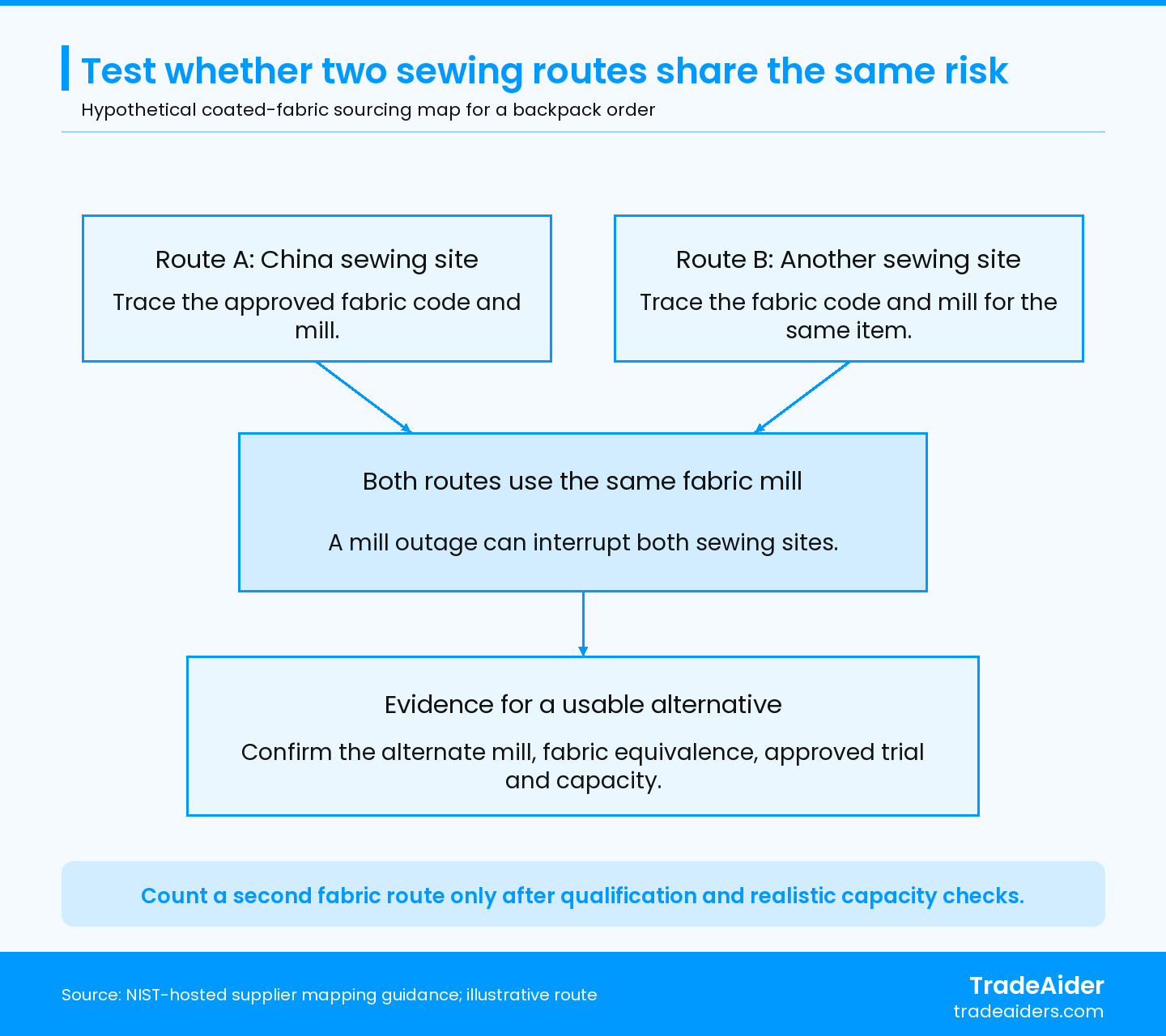
Illustrative supply map. Trace the critical fabric to its actual mill and qualify any alternate fabric against the same requirements before treating the second route as independent.
When should China remain part of the sourcing plan?
- Retain the China route where demonstrated capability, calendar and economics support the product.
- Add a route when it reduces a named exposure or supplies usable capacity.
- Trace critical inputs before calling the routes independent.
- Change volume or production stages after the alternative meets the agreed requirements.
Turn the sourcing question into a quality brief
Begin a TradeAider inquiry with the product and order information available, the China supplier/site, destination and current approved references. Identify the quality or changeover concerns you want the assessment to resolve. Before service, agree checks, access, samples, criteria and reporting. Contact our team to discuss a suitable factory assessment or production-inspection scope and a report of the commissioned findings.
FAQ
Does a second production country require a fixed volume split?
No fixed split is established by the China Plus One label. Set allocation from forecast demand, qualified capacity, minimum order quantities, cost and the benefit each route provides. Include the effort needed to keep a backup ready. A small pilot allocation and a sustained production allocation serve different purposes, so review the split as evidence and demand change.
Should a buyer transfer all tooling before the alternative is qualified?
Avoid making the current route unusable before the alternative can meet the agreed requirements. Review ownership, access, condition, compatibility and any need for duplicate tooling as part of the transfer plan. Obtain the relevant contractual and technical advice for the actual arrangement. A tool’s physical arrival at a new site does not establish that the site can produce acceptable goods with it.
What if a supplier will not name a critical upstream source?
Treat the claimed independence as unverified and seek an appropriate disclosure or assessment route. A confidential supplier-to-assessor arrangement may resolve a commercially sensitive identity question. Define what you need to know about source location, availability and shared exposure, and which evidence can establish it. If the gap remains, do not describe the backup as independent of that critical input.

Artigos Relacionados

Expanda seu negócio com o Serviço TradeAider
Clique no botão abaixo para entrar diretamente no Sistema de Serviço TradeAider. Os passos simples desde a reserva e pagamento até o recebimento de relatórios são fáceis de operar.