
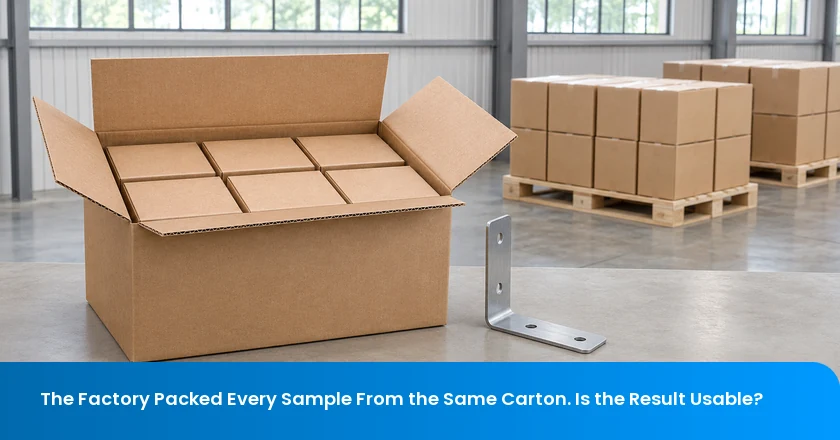
Use the result for the units and checks actually observed. If the factory supplied all the samples from one easy-to-reach carton in a larger inspection lot, the piece count alone cannot support lot acceptance. First confirm that the carton was the original source rather than a box used to carry samples already drawn. If the actual selection broke the agreed plan or cannot be verified, preserve the findings and arrange a valid draw before relying on a lot result.
Use the observations for what was actually checked
A convenience sample from one carton documents the units and checks actually observed, while a larger lot decision needs evidence from the agreed draw. A lot is the group of goods covered by one inspection decision. When a report says that 48 items were inspected, you still need to know which lot was presented, which items entered the sample, and how they were chosen.
- Keep the actual observations, such as a broken part or the number of units that received a function check.
- Verify original carton IDs and selection records before deciding whether the report had a documentation problem or a sampling problem.
- Withhold an unsupported lot verdict and commission a fresh draw if the buyer still needs lot acceptance.
The NIST Engineering Statistics Handbook describes using a sample selected at random from a lot to make an acceptance decision about that lot. In a finished-goods inspection, the lot boundary might cover multiple pallets of the same product. If the selector picked one conveniently placed carton, the observations can describe the sampled units, including defects found, and any carton-level checks performed on that specific box.
Statistics Canada’s guidance on non-probability sampling explains that generalizing beyond such a sample depends on strong assumptions about how the selected units resemble the population. In a warehouse, one carton may contain goods from one packing run or one variant. More pieces from that carton add observations about those pieces. They do not give the other cartons a chance to be selected.
Trace each sample back to its source carton
Reconstruct original selection using the packing list, carton log and item references before treating a photographed carton as the source. Start with the final inspection brief and eligible cartons at the time of the draw. Ask who chose the cartons, how they picked individual units, and whether any selected cartons were inaccessible or substituted. Use the carton ID and pallet location together if carton numbers restart on each pallet.
If you use TradeAider’s inspection standard when preparing a brief, keep the order-specific selection instructions with it. The actual agreed plan and any documented amendments give you a basis for checking what the inspector did.
Check whether one carton was only used for staging
Keep original carton IDs separate from a carton used to stage or transport already selected items. A photo of the samples together may show how they were carried to a workbench. Ask for the original selection sheet, the carton identifiers as opened, and the sample IDs linking the pieces to the recorded checks. Compare totals by carton and by check. If the record clearly shows that different cartons supplied the samples and that the draw met the plan, ask the report issuer to clarify the photo and attach the original record. If the team cannot reconstruct that link from reliable records, mark source coverage as unverified.
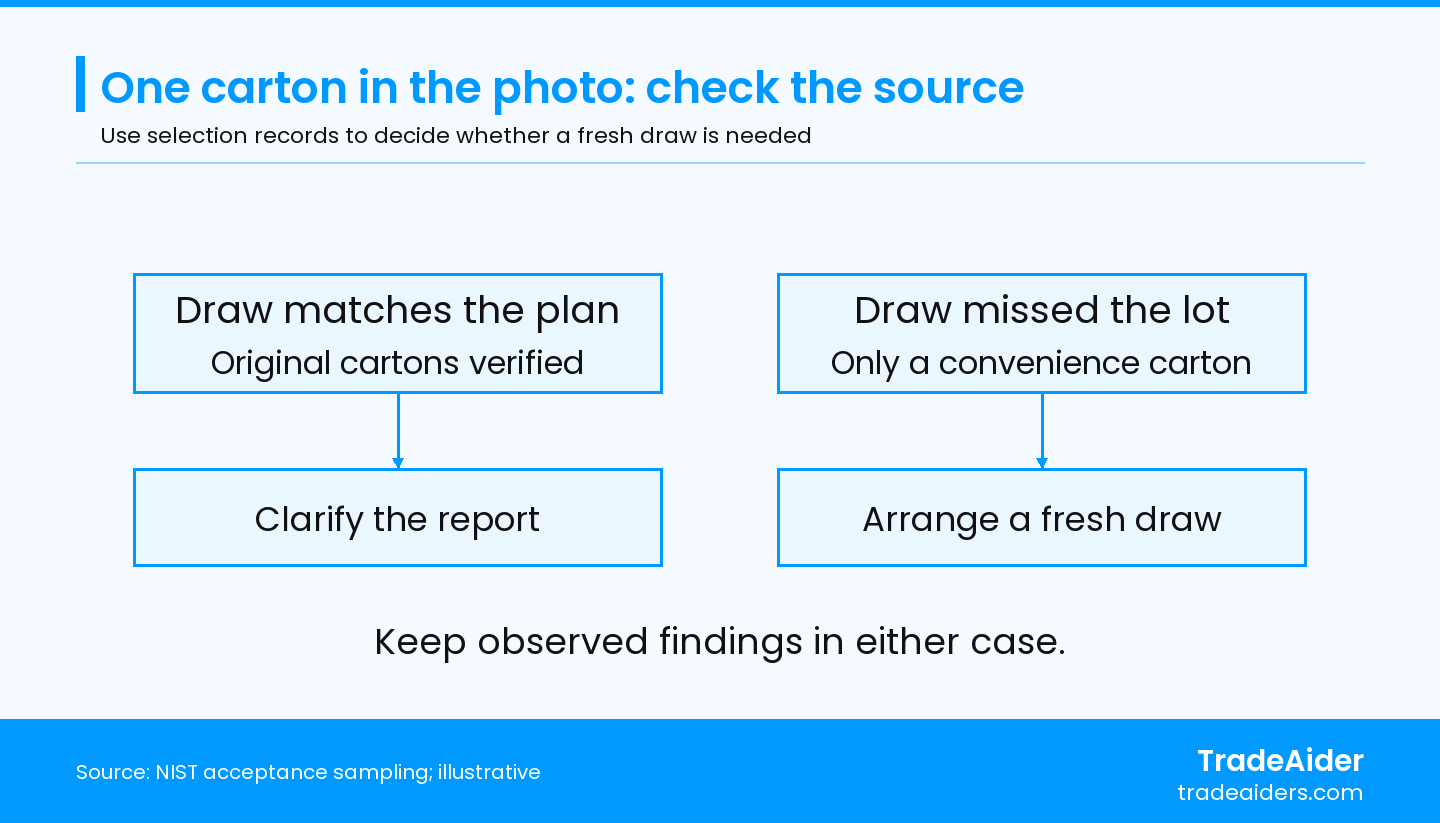
A photo of one carton can show where samples were staged. Trace the original cartons before choosing whether to clarify the report or draw again.
Compare the actual draw with the agreed sampling plan
If the lot or approved design permits one carton, verify the complete population and how units were selected before relying on the result. One carton may contain the entire lot. In that case, selecting units from that carton can meet the selection method. When the order extends beyond it, check whether the wider population had the intended opportunity to be selected and whether the plan supports the exact draw and the proposed conclusion.
Statistics Canada’s description of multistage probability sampling distinguishes selecting groups from selecting units within those groups. In a plan that uses cartons as groups, look for both choices in the log. A factory can move the selected cartons and assist with opening. The record still needs to show how the plan determined which cartons and units to use.
ISO 2859-1:2026 specifies schemes for lot-by-lot inspection by attributes, indexed by acceptance quality limit (AQL). Attributes inspection classifies units or counts nonconformities under the applicable plan. If the order uses an AQL-based plan, verify the agreed edition and rules along with what was drawn. AQL and a sample size on the report cannot tell you which cartons were available for selection.
Choose the follow-up based on what went wrong
A traceable reporting omission needs documentation. A nonconforming draw for a larger lot requires a new valid sample when lot acceptance is still needed. If the uncertainty is whether the photograph shows a staging carton, try to recover the original records before spending time on a second visit. Ask for corrections by the report issuer and keep the original version alongside the addendum.
NIST’s guide to lot acceptance sampling plans explains that a plan combines the selection method with decision rules. When the first selection did not meet the agreed method, rebuild the eligible lot list and arrange access to the relevant pallets and cartons. Confirm who will select them, how substitutions or inaccessible goods will be logged, which checks apply, and how each result will be used. If goods have been sorted, reworked or moved, confirm what population now exists before sampling.
Keep an actual defect finding visible even if the original lot decision is unsupported. If you need to know where the defect extends, make a targeted check of the affected stock, such as cartons from the same packing run or with the same component code. Record why those cartons were selected and what the check covered. If the original inspection had valid observations from a separate scoped check, preserve that result on its own terms.
NIST’s description of double sampling illustrates a planned exception in which the rules can call for a second sample and specify how to combine both rounds. Verify that the first draw was valid under that plan before applying its second-stage rule. When the first carton was chosen for convenience outside the plan, taking enough extra pieces to hit the total does not turn it into a planned double sample. Record any newly agreed sample on its own basis.
TradeAider performs pre-shipment inspection when the order quantity is 100% complete and at least 80% is packed for export. If a visit needs a fresh draw, confirm the goods are available for the intended sample and agree access to the recorded lots or pallets. A packing percentage cannot establish that the specific cartons needed for the draw can be reached.
A 48-unit check that missed the rest of the lot
Illustrative scenario. An importer has 60 master cartons of shelf brackets, with 48 units per carton across three pallets. The buyer’s written plan calls for two cartons selected at random from each pallet and eight units selected at random inside each of those cartons. All 48 selected pieces receive a visual check and two per carton receive an assembly check. These are the buyer’s example instructions for this order.
A complete planned sample count can still be unusable for lot acceptance if the selection violates the carton-level design. The first report shows 48 visual checks with no findings. Its notes and raw worksheet show that the factory presented all 48 from the readily accessible carton C-014 on pallet P1. Two of those pieces were checked for assembly and one tab failed to seat. The buyer records the visual and assembly observations for C-014, keeps the defect evidence, and sets aside the proposed lot verdict.
After the factory makes all three pallets accessible and confirms their contents, the inspector makes a fresh draw using the agreed plan. The following example shows how to record both the original and new selection. Use unique unit marks or another traceable reference to link individual findings back to each entry.
Round and sourceSelection and countsWhat the record showsInitial P1 · C-014Factory presented one carton. 48 visual, 2 assembly.0 visual findings, 1 tab fit failure. Observations from this carton.Fresh draw P1 · C-006, C-0192 randomly selected cartons. 8 visual, 2 assembly per carton.Record the unit marks and outcomes under each carton ID.Fresh draw P2 · C-023, C-0382 randomly selected cartons. 8 visual, 2 assembly per carton.Record the unit marks and outcomes under each carton ID.Fresh draw P3 · C-045, C-0582 randomly selected cartons. 8 visual, 2 assembly per carton.Record the unit marks and outcomes under each carton ID.
The new draw covers 48 visual checks and 12 assembly checks. Apply the agreed decision criteria to that draw. If no tab fails in the new sample, the original failure still needs its own disposition. Ask the supplier to identify which cartons received the same fitting batch and decide what to hold, sort or specifically verify based on what can be traced. Keep the original failure and the new result separately visible in the release file.
Write the inspection scope into the release record
Keep observed defects and evidence limitations in the release file even after a valid new draw. Record the identified lot and carton ranges, packing status and access limits, plan and revision, who drew the samples, the source carton and unit IDs, and counts by check. The buyer should be able to trace the result for each check to the group and the applicable rule.
Write down which conclusion is pending and what evidence will close it. For example, if the initial report shows an assembly issue in one carton and the origin of the fittings is still being investigated, record the finding and any stock on hold. If the new draw supports a lot acceptance result, record that result and its scope separately from the decision about the known issue. A single line saying “reinspection done” leaves the receiving team without either boundary.
If you need to scope a follow-up, gather the first report, purchase order, carton map, packing status, and the specific checks the buyer needs to close. Share those records when you contact TradeAider to discuss selection access and the evidence the report should capture.
Frequently Asked Questions
Do I need to open every carton for a valid sample?
The number of cartons to open depends on the agreed selection method, the lot structure and the checks the buyer needs. Make the eligible cartons available for selection and open those chosen by the plan. If you need to verify an outer carton mark on every package, scope that as a separate check with its own unit and coverage.
Can the factory open cartons for a remote inspection?
The factory can assist with handling in a remote inspection if the agreed method preserves who selects the units and how their origin is recorded. Agree how to verify the eligible cartons, the actual selection and the chain from opening to checking on camera. When the team cannot see or verify selection, describe the evidence as observations on the items presented.
Can a new random draw include the first carton?
The first carton can be eligible for the new draw when it still belongs to the lot and the approved selection rules include it. If its contents were removed, changed, tested destructively or segregated, reconcile its current status before drawing. Where eligible and selected again, identify the carton and record the newly selected units under the new round.
Artigos Relacionados

Expanda seu negócio com o Serviço TradeAider
Clique no botão abaixo para entrar diretamente no Sistema de Serviço TradeAider. Os passos simples desde a reserva e pagamento até o recebimento de relatórios são fáceis de operar.