
- Sobre Nós

- Nossos Serviços
- Sua Indústria
- Recursos
- Notícias e Blog
A global sourcing service carries a buyer's procurement and product integration beyond one country's market. It is not a single purchase or a single supplier relationship. The concept covers requirement confirmation, supplier evaluation, contracting, quality inspection and receiving, settlement, post-management and risk response. Understanding it means seeing that staged process, the risks that sit across it, and the trends that are reshaping how buyers plan cross-border sourcing.
What a Global Sourcing Service Is
A global sourcing service is a cross-border procurement and product integration service that uses suppliers in more than one country. A buyer or a sourcing provider compares their cost, quality and delivery, then integrates the supply chain links that carry the product from design and raw material through manufacturing to delivery. The point is not only a lower unit price. It is a combination of cost advantage and broad product coverage, so the buyer can compare sources instead of depending on one market. That is why the concept is wider than a purchase order, and why the stages that follow matter as much as the supplier chosen.
Because the work crosses borders, it runs on trade rules and not only on a supplier relationship. The World Trade Organization, which deals with the rules of trade between nations, describes its agreements as the legal ground-rules for international commerce. For a buyer, that means duties, customs procedures and documentation are part of the sourcing decision rather than an afterthought once the goods are ready. A plan that ignores those rules tends to meet them at the port.
The Core Process of a Global Sourcing Service
The core process of a global sourcing service runs through seven stages. It starts with requirement confirmation and analysis, then moves through supplier selection and evaluation, contract signing and execution, quality inspection and receiving, payment and settlement, post-management and evaluation, and risk management and response. The stages are sequential, but each one also has to hold its own evidence, because a weak record at one stage becomes a dispute at the next.
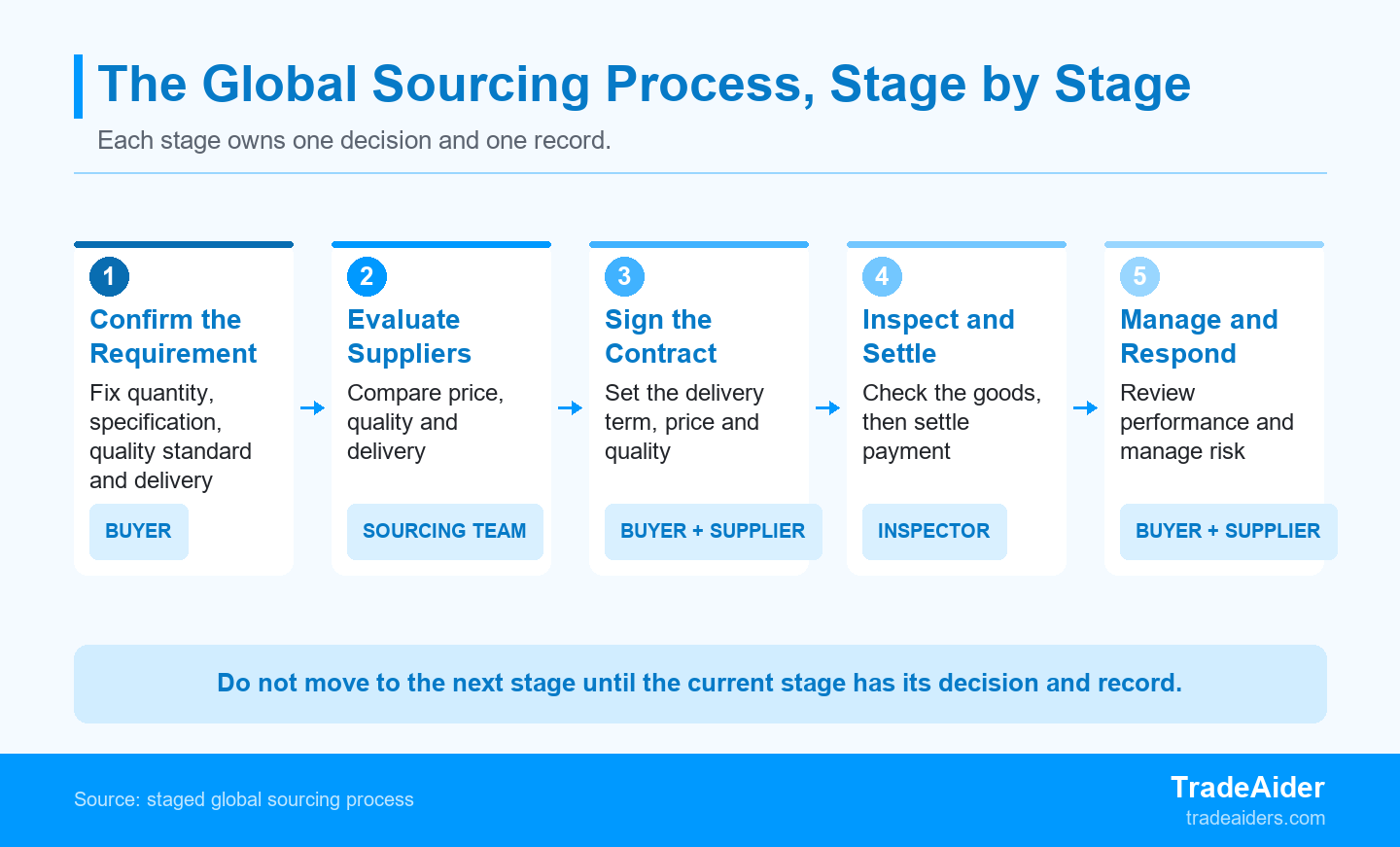
Each stage of a global sourcing service owns one decision and one record, from the requirement to the supplier review.
Each stage owns one decision and one record, so the buyer can place an independent check wherever a decision carries the most cost. Keep the specification separate from the method used to check it, because a clear requirement can still be measured in more than one way. The inspection-standard guidance explains how the two are kept apart.
Requirement Confirmation and Supplier Evaluation
The process starts by confirming the requirement. The buyer defines quantity, specification, quality standard and delivery, then studies the market to understand supply, price and potential suppliers. Only after that does it search, shortlist and evaluate candidates on price, quality, delivery capability and after-sales service. Comparing suppliers before the specification is fixed produces a shortlist that cannot be scored, because there is no standard to score it against.
Evaluation usually covers the supplier's qualifications, production capacity and quality control system, not just the quoted price. This is also where the buyer decides whether the supplier's own checks are enough or whether an independent stage is needed later. Agree the price, delivery date and payment method against the confirmed requirement, and record what was agreed, because the contract stage depends on it.
Contract Execution, Quality Inspection and Settlement
The contract fixes the delivery terms, the price and the quality requirement. Trade terms matter here. The Incoterms rules are a set of eleven three-letter standard trade terms used in contracts for the sale of goods. They are recognized by UNCITRAL as the global standard, and they clarify the tasks, costs and risks involved in delivery between the seller and the buyer. In practice the delivery term decides who arranges transport, who pays for it and where risk passes, which in turn shapes where an inspection makes sense.
Procurement execution follows the contract. The buyer places orders, tracks progress, handles delays and confirms that what arrives meets the agreed standard. Quality inspection is where the requirement becomes evidence: the delivered goods are checked against the agreed specification, and only then are they received and warehoused. Payment and settlement close the transaction and record it, so the financial trail and the quality trail point to the same order.
Post-management, Performance Evaluation and Risk Response
After delivery, the service shifts from transactions to a relationship. The buyer evaluates delivery quality and supplier performance on a regular cycle, feeds the results back and works on the issues that recur. That review keeps a supplier's assurance honest over time, because performance is judged on records rather than on the last conversation.
Risk response runs alongside it. The buyer identifies the points where the process can break, such as exchange-rate swings, supply interruptions or policy changes. It assesses how likely and how serious each one is, then prepares a response and a contingency plan. Risk management is therefore a standing stage, not a review that happens after a loss.
The Main Risks in Global Sourcing Services
The main risks in global sourcing services fall into five families: supplier and quality risk, price and exchange-rate risk, logistics and transportation risk, political and legal risk, and cultural, communication and hidden-cost risk. The list is not a reason to avoid cross-border sourcing. It is a way to see that each risk sits with a party that can act on it. A risk with a named owner and a record is managed; the same risk without an owner is a surprise waiting to happen.
A buyer can turn the families into a checklist by asking, for each one, who controls it and what evidence shows it is controlled. The supplier controls its own system and records, the buyer controls the specification and the contract terms, and the carrier controls transit. Check how a supplier's quality system is scoped before trusting its assurance, using the audit-standard guidance as the reference for what that system should cover.
| Risk family | Who controls it | Evidence the buyer keeps |
|---|---|---|
| Supplier, quality and IP | The supplier's quality system | Supplier evaluation and audit records |
| Price and exchange rate | The contract terms | Agreed currency and price basis |
| Logistics and transportation | The delivery term and carrier | Insurance and shipment records |
| Political, legal and compliance | The buyer's compliance owner | Screening and compliance records |
| Cultural and hidden cost | The buyer's brief and budget | Controlled specification and cost breakdown |
Supplier, Quality and Intellectual Property Risk
Supplier risk is the most familiar family. A supplier can become unstable because of political turmoil, natural disaster or an economic crisis, interrupting supply or delaying an order. It can also apply a different quality standard from the one the buyer expects, which breaks consistency across a run or across orders even when each individual unit looks acceptable.
Intellectual property adds a third dimension. In cross-border sourcing, ownership and protection of designs, tooling and specifications is a real exposure, and a dispute can turn into legal cost and lost time. The control for all three is the same: check the supplier's quality system, keep a documented record trail, and agree in the contract who owns the design and the tooling before production starts.
Price, Exchange-Rate and Logistics Risk
Price and exchange-rate risk sit in the contract. Market prices move, and a cross-border order is usually transacted in a currency that is not the buyer's own. A rate change can therefore raise or lower the landed cost after the price is agreed. Fixing the currency and the price basis in the contract is the practical hedge; leaving them open moves the risk onto whoever can least absorb it.
Logistics and transportation risk is the physical side. Cross-border transport can be delayed by weather, congestion or customs, and goods can be damaged or lost in transit. Insurance and a clear delivery term decide who carries that loss. Because the delivery term already allocates transit risk, the logistics plan and the contract terms should be decided together rather than in sequence.
Political, Legal, Cultural and Hidden-Cost Risk
Political and legal risk covers changes no supplier can control. Trade policy, tariff measures and regulatory revisions can alter the terms of an order, and the compliance duties around labour and human rights now have named frameworks. The International Labour Organization reports that forced labour affects 27.6 million men, women and children and that 63% of it happens in the private economy. That is why a buyer screens a supply chain rather than assuming it is clean.
The regulatory direction is toward documented diligence. The European Commission states that Directive 2024/1760, as amended, establishes a corporate due diligence duty for very large in-scope companies. They must identify and address adverse human rights and environmental impacts across their chains of activities. Due diligence, the process of identifying and addressing those impacts, is therefore becoming a record a buyer or its customer may have to produce.
Cultural and communication risk and hidden costs round out the family. Language, business practice and time-zone gaps can slow a negotiation or distort a specification, and costs such as tariffs, insurance and communication can sit outside the quoted price. Budget for them explicitly and keep one owner for compliance, so the duties do not fall between the sourcing and quality teams.
Coordinating Specifications, Quality Evidence and Escalation Across Regions
When the same product is sourced for more than one market, the specification and the evidence have to be coordinated rather than assumed. The buyer keeps one specification per destination and one quality evidence trail, so a component or material is checked against each market's requirement and the result is filed against the right order. A single shared specification is efficient, but it hides the difference between markets until a test exposes it.
That is where independent testing earns its place. TradeAider's product testing in accredited laboratories verifies product quality and safety through testing in accredited laboratories in China, and the process runs from needs alignment and sample management to testing, result determination and report issuance. The record from that process is what turns a specification into evidence.
Escalation should be defined before it is needed. Decide in advance who stops a batch, who requests the re-test, and what evidence closes the issue. A pre-shipment inspection, a final check of a completed, packed order before it leaves the factory, gives the buyer a documented decision point before release. Keep the path short: a named owner, a defined trigger and a record of the outcome.
Illustrative Example: A Specification That Changes Between Markets
An illustrative case shows how one specification can hide a regional difference. An importer sources 24,000 small kitchen appliances across two runs of 12,000 for the US and EU markets, through a sourcing service and a factory in China, with one shared product specification for both. To cut cost, the factory substitutes an internal power-supply component, keeps the outer label unchanged and does not issue a change notice. The first run passed inspection against the shared specification, so the buyer assumes the second run will behave the same way and does not re-check the component list.
The second run passes the visual inspection, but the substituted component fails the EU electrical safety specification while the US sample still passes. The factory cannot show an approved change record or a test report for the substitute, and no first-article check was run for the new part. The shared specification hid the difference because the same component did not meet every destination rule, so the mismatch appeared only when the component was tested against each market's requirement and the change record was requested.
The buyer holds the affected batch, escalates from sorting to a specification and component correction, and requires a first-article check against each destination specification before the run continues. The factory restores the approved component or submits the substitute with a change record and a first-article report for each destination, then rebuilds the 3,500 affected units. The buyer re-tests the corrected first article and the next production sample against both specifications, and keeps the change record and both test reports in one file. This is an illustrative sourcing example, not measured client data, a supplier rating, or a compliance result.
Global Sourcing Service Development Trends
Global sourcing services are being reshaped by several trends at once, and each one changes what a buyer has to plan. The clearest are digitalized and intelligent procurement, more resilient and partly nearshored supply chains, and sustainable and ethical procurement. They are not separate projects, because all of them depend on knowing what the product must meet and how that is proven.
Whichever trend a buyer adopts, the organization that runs the checks matters as much as the plan. For a short overview before sharing a specification and a destination list, review TradeAider's company background.
Digitalization is the first. Procurement software already integrates supplier information, orders and inventory into one view, and artificial intelligence is moving from reporting into decision support. That shift brings its own risk discipline. NIST describes its AI Risk Management Framework as intended for voluntary use to incorporate trustworthiness considerations into AI products, services and systems, released on 26 January 2023. A buyer adopting AI in sourcing can adopt that framework alongside it.
Sustainability is the second. United Nations Sustainable Development Goal 12 covers responsible consumption and production, and its target 12.7 promotes sustainable public procurement. Buyers are responding by weighing the environmental and social impact of a supplier and a material, not only its price.
Ethical sourcing is the third, and it overlaps with the second. The UN Global Compact sets out ten principles covering human rights, labour, environment and anti-corruption, including the elimination of forced and compulsory labour (Principle 4) and the abolition of child labour (Principle 5). Alongside nearshoring and supply-chain resilience, these trends point in the same direction: a sourcing plan that can name its evidence.
Turn the Concept Into a Sourcing and Quality Plan
Send the product, the destination specifications and the schedule with the request so the sourcing stages and the quality checks can be reviewed together. A first sourcing brief is short, and it states the decisions that drive every later check.
- Name the destination markets and confirm each market's specification.
- Map each process stage to its decision, owner and record.
- Assign every risk family an owner and the evidence that proves it is controlled.
- Keep the specification, change and test records with the order file.
A review needs four inputs: the product and its destination markets, the applicable specifications and standards, the supplier and production schedule, and the shipment date and required evidence. TradeAider can review those inputs, agree which inspection and testing stages apply, and return a scoped sourcing and quality proposal with an agreed stage list, check list and reporting deliverable. Keep the request short but complete, because a clear brief lets the provider confirm the destinations and the checks before quoting, and avoids a check list that misses a requirement or repeats one a destination does not enforce. If several markets are involved, list them all so the scope can be planned together. To scope that work, contact TradeAider about your sourcing and inspection plan.
Frequently Asked Questions
Is global sourcing the same as buying from a cheap supplier?
No, because a global sourcing service covers the whole cross-border process, from requirement confirmation and supplier evaluation to quality inspection, settlement and risk response. A cheap supplier is a price outcome; the service is the process that finds, contracts, checks and manages a source. If the buyer stops at the lowest quote, it skips the stages that turn a price into a shipment that meets the destination specification, and it carries the quality and compliance risk alone.
Who owns quality when a factory is overseas?
The buyer keeps the final responsibility, so it names the specification, the check and the record in the contract rather than relying on the supplier's assurance. The supplier controls its own system and records, and an independent inspection or test can verify a stage, but neither transfers the buyer's duty to the destination market. That is why the process names an owner for each risk and keeps the evidence with the order file, so responsibility is documented before a problem appears.
Do Incoterms rules change who inspects the goods?
Incoterms rules allocate the tasks, costs and risks of delivery, so they shape where an inspection makes sense even though the buyer still decides the quality standard. A term that passes risk early means the buyer should inspect before that point, because after it the loss may be the buyer's. The rule does not set the quality requirement itself, so agree the specification and the inspection point together, then choose the delivery term that matches them.
Which sourcing trend should a buyer plan for first?
Start with the specification and the evidence trail, because digitalization, nearshoring and sustainable procurement all depend on knowing what the product must meet and how it is proven. A buyer that can name its specifications, its suppliers and its records can adopt procurement software or an AI tool without losing control of the data. The same record supports a due diligence request or a sustainability claim. The trends change the tools, but the specification and the evidence stay the foundation.
Artigos Relacionados
Expanda seu negócio com o Serviço TradeAider
Clique no botão abaixo para entrar diretamente no Sistema de Serviço TradeAider. Os passos simples desde a reserva e pagamento até o recebimento de relatórios são fáceis de operar.

