
- Sobre Nós

- Nossos Serviços
- Sua Indústria
- Recursos
- Notícias e Blog
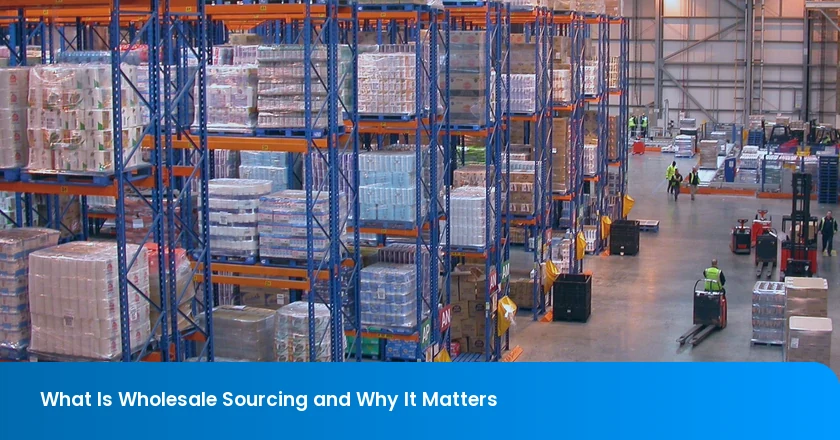
Wholesale sourcing is the purchase of goods in large quantities, directly from a wholesaler, manufacturer, or distributor, instead of buying them in retail quantities. It matters because buying at volume changes the unit cost, the range of products a business can offer, and the supply relationships it depends on. This page explains what wholesale sourcing means, why it matters, how the process runs from demand to delivery, who the roles in the supply chain are, and how buyers build and evaluate supplier relationships.
What Wholesale Sourcing Means
Wholesale sourcing is a business buying goods in large quantities directly from a supplier — a wholesaler, manufacturer, or distributor — rather than in retail quantities. The definition also covers some intangible purchases, such as a service contract or a software license bought on behalf of the business. What makes a purchase wholesale is not the product category but the position it occupies in the supply chain: the goods are bought to be resold, processed, or used in operations rather than consumed by the buyer as a household would consume them.
Read wholesale sourcing as a sequence rather than a single purchase. A need becomes a written specification; the specification is matched to a supplier; the supplier quotes a price and a delivery term; and the delivered goods are checked against what was specified. Each step leaves a record that the next step uses, so the sequence is only as strong as its weakest step. A buyer who skips the specification and starts from a price has no reference point, and the comparison reduces to whichever number looks smaller. If you are deciding who should perform those checks before you share specifications and supplier records, review TradeAider's company background.
Wholesale sourcing also differs from procurement, although the two terms are often used together. Sourcing is the work of deciding which supplier and which product should be used and whether the evidence supports that choice; procurement is the transaction that places, tracks, and pays for the order once those choices are made. A business can run a clean procurement process and still have a sourcing problem, because the order was placed before the supplier and the product were qualified. Keeping the two steps separate is what makes the records useful later.
Why Wholesale Sourcing Matters: The Main Benefits
The main benefits of wholesale sourcing are a lower unit cost through volume, a wider product range, access to exclusive lines, and fewer transaction and administrative costs than repeated small orders. The benefits are connected rather than independent: a lower unit price from a supplier who cannot meet the delivery or quality requirement is not a saving, and a wider range is only useful when the buyer's market can actually sell it. Treat the benefits as a set of trade-offs, and decide which one matters most for the order in front of you. The two that buyers most often have to justify are cost and range.
Lower Unit Cost and Fewer Transaction Costs
Buying in volume lowers the unit price through economies of scale and removes the transaction, transport, and administrative costs that repeated small purchases add. Economies of scale means the reduction in unit cost that comes from producing or buying in larger quantities. The saving is not only in the price per unit: a single larger order replaces many small ones, so the work of raising purchase orders, arranging transport, and reconciling invoices falls as well.
Compare the total cost rather than the headline unit price. A lower unit price that requires a larger safety stock, a longer lead time, or a deposit the buyer cannot fund can cost more across the whole order than a slightly higher price with better terms. Write down which costs the order will actually carry, then compare suppliers on that basis.
A Wider Product Range and Exclusive Lines
Buying at wholesale scale gives a business access to more suppliers, brands, specifications, and models, and can secure exclusive lines that are not available to retail buyers. At wholesale scale a buyer can often source a variation — a size, a material, a finish — that a retail channel does not carry, and can ask a supplier to hold that variation for the buyer's market.
The range advantage is a sourcing decision, not a catalogue to browse. Decide which gap in the buyer's own market the range should fill, then source against that gap. An exclusive line is usually conditional on volume and on the buyer's ability to sell it, so it belongs in the negotiation rather than in the assumption.
The Wholesale Sourcing Process, Step by Step
The wholesale sourcing process runs from identifying demand and writing the specification through researching and evaluating suppliers, assessing quality, and negotiating price and terms, and each step produces a record the next step depends on. Identify demand first: the type, quantity, and timing of what the business needs, set against current stock and expected sales. Turn that demand into a specification that names the material, dimensions, performance, and packaging, because a quote can only be judged against a requirement that is written down. Then research suppliers, evaluate their capability and quality evidence, agree the price and terms, and place the order with a check attached to it.
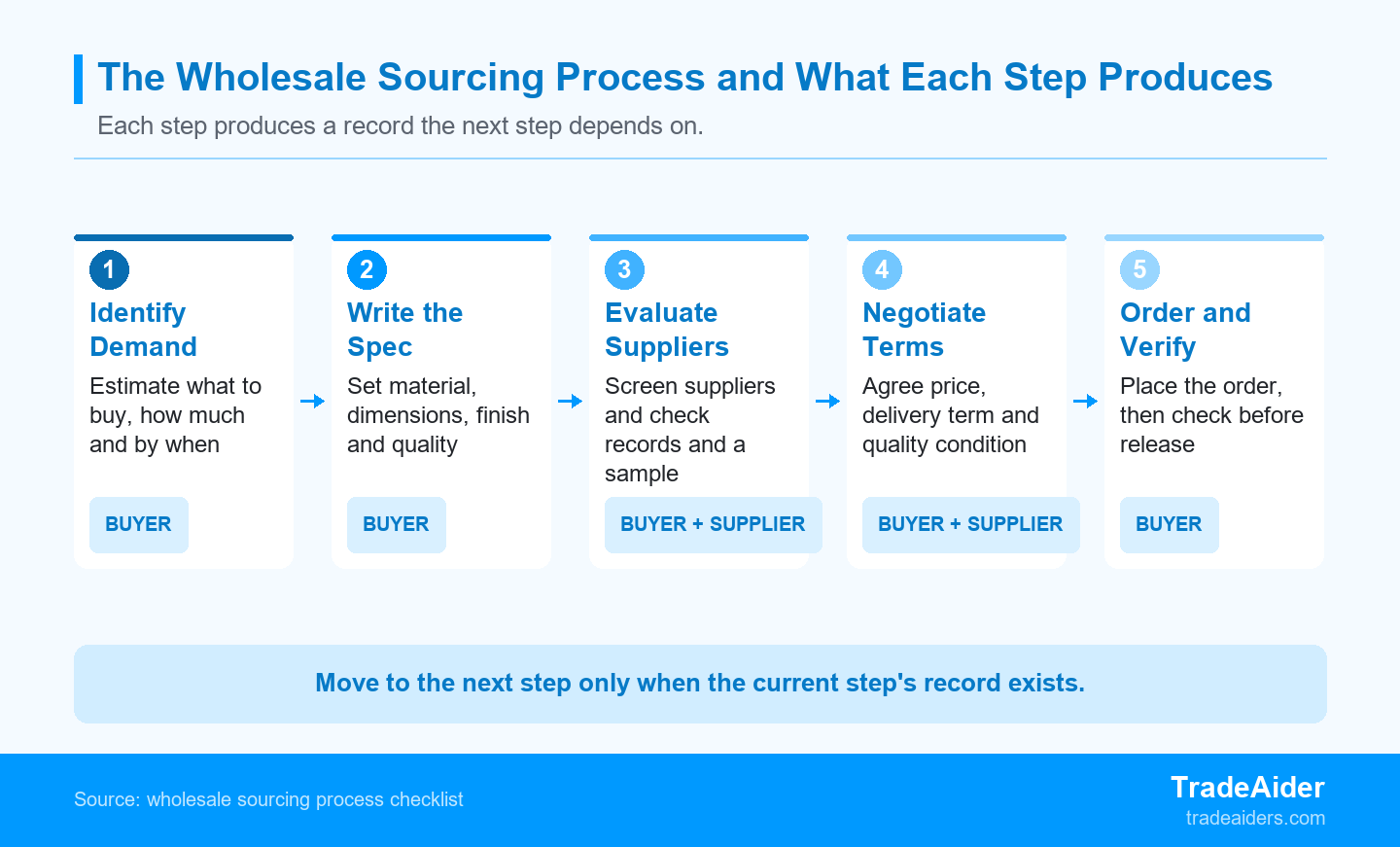
Each step produces a record the next step depends on, so a wholesale order is only as safe as the steps before it.
Price and terms are two different agreements. The price is the number; the delivery term decides who arranges carriage, who pays for it, and who carries the risk at each point along the way. ICC Incoterms rules are a set of eleven three-letter trade terms that clarify the tasks, costs, and risks involved in the delivery of goods from sellers to buyers, so the buyer should name the term before the order is confirmed rather than after a dispute begins.
The quality step belongs in the plan, not at the end of it. TradeAider's pre-production inspection checks raw materials and components against the buyer's specifications and compares samples with bulk production before production begins, which is the stage where a mismatch is still cheap to correct. Once the process is written down as a sequence, the buyer can see which step still has an open question.
How to Research and Evaluate a Supplier
A supplier is researched through market and industry channels and then evaluated on reputation, production capability, its quality system, and the records it can show, using published standards as a common reference for quality and sampling. Search channels matter because they decide which suppliers a buyer ever sees: market research shows how many suppliers operate in a category and at what scale, industry recommendations surface suppliers that other buyers have already tested, and trade shows allow a face-to-face comparison of samples and capability.
A quality system is easier to compare than a reputation, because it can be named and checked. ISO 9001 provides a framework for organizations to meet customer and regulatory requirements and consistently improve their processes, so a supplier that builds to a named standard can be asked for the record that shows the standard was followed rather than for an assurance that quality is good.
Quality assessment then turns the standard into a check. NIST's statistical methods handbook, section 6.2, describes lot acceptance sampling as deciding on a lot-by-lot basis whether to accept a lot as likely to meet requirements or reject it as likely to have too many defective units. The buyer's job is to agree the sampling plan and the acceptance level before production, not to argue about one sample after the goods are packed. Before trusting a supplier's claim about its controls, check how a factory audit is scoped and what it can and cannot prove in the audit-standard guidance.
Illustrative Example: A First Wholesale Order
In an illustrative case, a small home-goods retailer places its first wholesale order for a storage-basket line, 6,000 units across three sizes, and compares a wholesaler and a factory. The buyer estimates demand, writes a specification for material, dimensions, and finish, and asks both suppliers for a unit price, a delivery date, and their quality evidence. The wholesaler quotes a slightly higher unit price but can ship from stock in two weeks, while the factory quotes lower and needs a longer production run.
The wholesaler can ship part of the order from existing stock and offers the shorter lead time. The factory offers the lower unit price but cannot show incoming material records or a first-article process. The buyer writes the specification and the quality condition into the order before confirming it.
The lower unit price answered only the cost step, while the lead time, the supplier evidence, and the delivery terms still had to be checked, so the cheaper quote was not the cheaper sourcing decision. The buyer places the first order with the supplier that can show the evidence and meet the delivery window, and conditions the release on a first-article check against the written specification.
The first production units differ from the approved sample in the finish, so the factory corrects the process and rebuilds the affected 500 units before the order continues. The buyer re-checks the corrected first article against the specification, then inspects the packed order before release and keeps the records with the order file. This is an illustrative sourcing example, not measured defect data, a supplier rating, or a compliance result, and later changes are not accepted on the strength of it.
Wholesalers, Distributors, and Manufacturers in the Supply Chain
The supply chain has three main roles — the wholesaler, the distributor, and the manufacturer — and each performs a different function, so direct sourcing from a manufacturer trades an intermediary's services for a different set of responsibilities. A wholesaler buys goods in bulk and resells them to retailers or other businesses, and its value is the stock, consolidation, and short lead time it holds ready. A distributor moves goods to a wide network of sales points and adds logistics and after-sales service along the way. A manufacturer makes the product, and buying from one directly can lower the unit price and allow customization, at the cost of a longer run and more of the sourcing work moving to the buyer.
| Role | What it does | What the buyer gets | Main trade-off |
|---|---|---|---|
| Wholesaler | Buys in bulk, stores, and resells to businesses | Stock ready now, mixed orders, shorter lead time | A margin is added to the price |
| Distributor | Moves goods to a wide network of sales points | Distribution reach, logistics, after-sales service | Less control over the product and its specification |
| Manufacturer | Produces the goods to a specification | Lower unit price, customization, technical support | Longer run, higher minimum, more sourcing work for the buyer |
Whichever role supplies the goods, the product has to be identified the same way on both sides. GS1 describes its standards as a global common language for business, covering product identification, barcodes, and supply-chain traceability, which is what lets a buyer compare a product across suppliers and roles instead of relying on each supplier's own description. Choose the role that supplies the service the buyer cannot perform itself, and keep that choice separate from the price comparison.
Building Long-Term Supplier Relationships
Long-term supplier relationships rest on trust built through continuous communication and reliable delivery, and on mutual benefit through negotiated terms and collaborative growth. Trust is not declared; it is accumulated from repeated evidence that the supplier delivers on time, in the agreed quantity, and to the agreed specification. Communication keeps that evidence visible on both sides: regular contact lets the buyer understand the supplier's capacity and risks, and lets the supplier understand the buyer's demand and constraints.
Mutual benefit is the second half of the relationship, and it is negotiated rather than assumed. As volume and reliability grow, a buyer can reasonably ask for better terms — a longer payment window, a firmer delivery commitment, or a discount that reflects the repeat business — and a supplier can reasonably expect stable orders in return. Collaborative growth goes further: the two sides share market information, develop new products, and work through problems together. A relationship does not replace a written order, though. Keep the quality standard, the delivery term, and the current specification in writing, so the relationship and the record stay consistent.
Why Research and Evaluation Matter
Research and evaluation mitigate risk by filtering out unreliable suppliers and protecting product quality, and they support the informed, strategic procurement decisions that a long-term sourcing program depends on. Meticulous market research and supplier evaluation identify the suppliers that may have credibility problems, insufficient capacity, or unstable quality, and they keep the buyer out of a relationship that would have produced delivery delays or defects. They also put a number on what the buyer is comparing, so a decision rests on evidence rather than on the confidence of a sales conversation.
Evaluation is also a decision asset, not a one-off task. A recorded assessment can be updated for the next order instead of being restarted, and it supports the strategic questions — which suppliers to keep, what to buy, and how to budget for it. Keep the acceptance criteria separate from the method used to check the goods, because the two answer different questions; the inspection-standard guidance explains how those two are kept apart.
Run the evaluation before the order, not after the first problem. A supplier that cannot show capacity, quality records, or a stable delivery history is a risk the buyer takes on for the whole order, and the cost of replacing that supplier mid-order is usually higher than the time spent checking it in advance. Record what was checked, what the supplier showed, and what remained open, so the next order starts from a known position instead of a fresh conversation. That record is what turns a one-time check into a sourcing capability the business can reuse.
Turn the Definition Into a First Wholesale Sourcing Checklist
Send the demand, the specification, the supplier evidence, and the terms with the request so the sourcing plan and the inspection scope can be reviewed together.
- Write the demand and the specification before comparing any quote.
- Screen suppliers for capability and quality evidence, not for reputation alone.
- Name the delivery term and the quality condition before the order is confirmed.
- Agree the inspection stage before production starts, not after the goods are packed.
- Keep the approved sample, the specification, and the order records together.
Work the checklist in order, because each item depends on the one before it. A quote cannot be judged before the specification exists, a delivery term cannot be agreed before the supplier is chosen, and an inspection stage cannot be placed before the production schedule is known. When an item is still open, treat the whole order as open rather than accepting a verbal assurance that the gap will be closed later. The list is short on purpose: it names the few things that change the outcome, not every task a sourcing team performs.
Verification is a defined comparison against an agreed criterion rather than an informal look, and the NIST Engineering Laboratory advances measurement science, standards, and technology for engineered systems, which is the discipline behind that distinction. To scope the work, contact TradeAider about your wholesale sourcing scope.
Frequently Asked Questions
Is wholesale sourcing the same as procurement?
No, wholesale sourcing is the broader work of finding, qualifying, and buying from the right suppliers, while procurement usually means the transaction that places and manages an order with a supplier that has already been chosen. A buyer can run a clean procurement process and still have a sourcing problem, because the order was placed before the supplier and the product were qualified. Treat the two as separate steps: qualify first, then place the order, and keep the evidence for each.
What should a first-time buyer do before placing a wholesale order?
Estimate demand, write the specification, and screen suppliers for evidence before agreeing a price, then set the quality and delivery terms where a problem can still be corrected. In practice that means naming what the product must be, asking each candidate for records rather than assurances, and agreeing the check that will be run before production. The order of those steps matters more than the speed of the first quote.
Should I buy from a wholesaler or directly from a manufacturer?
It depends on the service you need, because a wholesaler supplies stock, consolidation, and a shorter lead time, while a manufacturer can offer a lower unit price and customization in exchange for a longer run and more of the sourcing work. If the buyer needs goods quickly and in mixed quantities, the wholesaler's margin often buys a real service. If the buyer needs a specific specification at volume and can manage the production lead time, direct sourcing can be the better decision. Match the role to the need rather than to the price alone.
How much supplier evidence should I ask for before ordering?
Ask for the records that match the steps you cannot check yourself, such as material sourcing, incoming inspection, and a first-article process, and treat unverifiable claims as open items rather than settled ones. The right amount is the evidence that answers the question you actually have: can this supplier make this product to this specification, on this schedule, and show it. More documents are not better if they do not change the decision.

Artigos Relacionados


Expanda seu negócio com o Serviço TradeAider
Clique no botão abaixo para entrar diretamente no Sistema de Serviço TradeAider. Os passos simples desde a reserva e pagamento até o recebimento de relatórios são fáceis de operar.

