
- About Us

- Our Services
- Your Industry
- Resources
- News & Blog
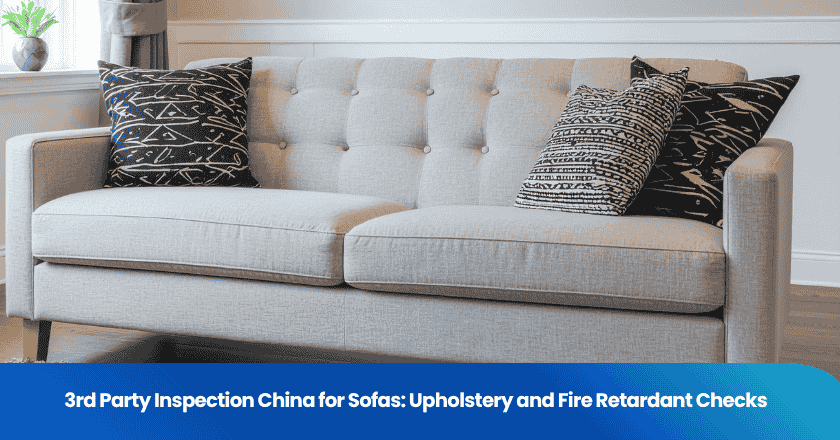
Sofas are among the most returned furniture categories in e-commerce — not because customers change their minds about style, but because the product that arrives does not match what they expected. Torn stitching, uneven cushions, color mismatches, and non-compliant fire safety materials drive returns that erase margins and damage brand reputation. For importers sourcing sofas from China, third-party inspection that covers both upholstery quality and fire retardant compliance is the most effective way to protect their business.
This guide explains what a thorough sofa inspection covers, how fire retardant testing works, the standards that apply across different markets, and how to set up an inspection protocol that catches problems before your sofas ship.
Key Takeaways
- Upholstery inspection covers fabric quality, stitching, cushion fill, and frame construction — the four elements that determine whether a sofa meets customer expectations
- Fire retardant compliance is legally required in the UK (Furniture and Furnishings Fire Safety Regulations 1988), the US (California TB 117-2013), and increasingly in the EU
- Third-party inspection verifies both visual quality and regulatory compliance — catching defects that in-house QC teams at factories often miss or overlook
- ANSI/NFPA 260 cigarette ignition resistance testing is the most widely referenced international standard for upholstered furniture fire safety
- Pre-shipment inspection at $199 per man-day catches upholstery defects and fire safety documentation gaps before sofas leave the factory
Upholstery Quality Checks: What Inspectors Look For
Fabric and Leather Inspection
The upholstery surface is the first thing your customer sees and touches. Inspectors evaluate fabric and leather across several dimensions:
- Color consistency — panels cut from different dye lots can show visible color variation. Inspectors compare all visible fabric panels under standardized lighting to detect mismatches. A difference that seems minor under factory fluorescents becomes obvious in a customer's living room
- Pattern alignment — for patterned fabrics, inspectors check that patterns match at seams and continue visually across cushion boundaries. Misaligned patterns at seams are classified as major defects under AQL standards
- Surface defects — pulls, snags, loose threads, pills, stains, and color fading are checked across all upholstered surfaces. Leather is examined for scratches, discoloration, wrinkles that exceed specification, and inconsistent grain texture
- Colorfastness — for fabrics destined for markets with strict labeling requirements, inspectors may perform a rub test using a white cloth to check for dye transfer. Significant color transfer indicates poor colorfastness that will worsen with use
Stitching and Seam Quality
Stitching failures are one of the most common sofa complaints. Inspectors examine:
- Stitch density — stitches per inch must meet specification. Too few stitches per inch creates weak seams that separate under normal use. Too many can perforate and weaken the fabric
- Seam alignment — seams should be straight and even. Wavy seams, crooked piping, or uneven seam allowances are classified based on visibility. Seam misalignment visible at arm's length is a major defect
- Thread quality — inspectors check for loose threads, skipped stitches, broken threads, and improper knotting. Any seam with more than two consecutive skipped stitches is flagged for rework
- Piping and welt cord — decorative piping should be uniform in width, filled consistently, and lie flat without twisting or gaps
Cushion Fill and Comfort
Cushion quality directly affects customer satisfaction but is difficult to evaluate from photos alone. Inspectors check:
- Foam density — measured by weighing a known volume of foam. Density below specification means cushions will compress prematurely and lose support. A typical sofa seat cushion should use foam with a density of at least 25-30 kg/m3 for residential use
- Cushion firmness — inspectors compress cushions to a specified percentage of their thickness and evaluate recovery. Slow recovery or permanent deformation indicates under-spec foam
- Fill distribution — for fiber-filled or down-blend cushions, inspectors check for even distribution. Clumping, hollow spots, or visible lumps through the fabric are defects
- Cushion dimensions — measured against specification to verify correct size and consistent dimensions across matching cushions
Frame and Internal Construction
The internal frame determines whether a sofa maintains its shape and structural integrity over years of use. Where accessible, inspectors evaluate:
- Frame material — verify that the wood species, plywood grade, or engineered wood type matches the specification. A common substitution issue is using lower-grade plywood or particleboard instead of the specified kiln-dried hardwood or high-density plywood
- Joinery — check for glued and screwed joints, corner blocks, and reinforcing brackets where specified. Staples alone at critical joints are a red flag
- Spring system — verify the type of suspension (sinuous springs, eight-way hand-tied, webbing) matches the specification. Check for even tension, proper attachment, and adequate support spacing
- Webbing and support — inspect webbing type, tension, and spacing for consistency
Fire Retardant Compliance Checks
Fire safety compliance for upholstered furniture is not optional in many markets — it is a legal requirement. Importers who ship non-compliant sofas face product recalls, fines, and liability for fire-related injuries. Third-party inspection verifies compliance before products leave China.
UK Market: Furniture and Furnishings Fire Safety Regulations 1988
The UK has the strictest upholstered furniture fire safety requirements in the world. The Furniture and Furnishings (Fire) (Safety) Regulations 1988 require that:
- Upholstery covers pass the cigarette test (BS 5852 Part 1) — a lit cigarette placed on the fabric must not cause ignition
- Upholstery covers pass the match test (BS 5852 Part 1) — a simulated match flame applied for 20 seconds must not cause sustained ignition
- All fillings must be fire retardant and meet specific ignition resistance standards
- Products must carry a permanent fire safety label with specific wording prescribed by the regulations
During inspection, the inspector verifies the presence of fire safety labels with correct wording, checks that fire retardant treatment documentation is available from the factory, and confirms that fill materials match the specified fire-rated grades. The inspector cannot conduct destructive fire testing on-site — that requires laboratory conditions — but verifying documentation and labels is a critical compliance checkpoint.
US Market: California TB 117-2013 and NFPA Standards
In the United States, fire safety requirements for upholstered furniture vary by state. California's Technical Bulletin 117-2013 is the most widely referenced standard:
- TB 117-2013 focuses on smolder resistance of cover fabrics and requires that upholstery materials resist ignition from smoldering cigarettes. This replaced the earlier TB 117-2000 which required flame retardant chemicals
- ANSI/NFPA 260 provides a standardized cigarette ignition resistance test for upholstered furniture components — it is the most commonly specified international fire safety standard for sofas manufactured in China
- ASTM E1537 establishes the heat release rate test method for upholstered furniture, measuring how much heat a burning sofa generates and how quickly fire spreads
EU Market and GB Standards in China
China's national standard GB 26607 specifies fire performance requirements for upholstered furniture produced domestically and for export. For importers selling into the EU, EN 1021-1 (cigarette test) and EN 1021-2 (match flame test) are the relevant standards.
| Market | Standard | Test Type | Inspector Verification |
|---|---|---|---|
| United Kingdom | BS 5852 / FFRS 1988 | Cigarette + match flame | Fire labels, FR documentation |
| United States | TB 117-2013 / NFPA 260 | Smolder resistance | FR treatment certs, lab reports |
| European Union | EN 1021-1 / EN 1021-2 | Cigarette + match flame | Test reports, material certs |
| China (domestic) | GB 26607 | Fire performance classification | Factory compliance docs |
| International | ASTM E1537 | Heat release rate | Lab test report verification |
Setting Up a Sofa Inspection Protocol
Pre-Inspection Documentation Requirements
Before the inspector arrives, request that the factory prepare the following documentation for fire safety verification:
- Fire retardant treatment certificates for all fill materials — foam, batting, and fiber fill
- Third-party fire test reports from accredited laboratories for cover fabrics and filling materials
- Material specifications listing foam density, fabric composition, and frame materials
- Fire safety label artwork for verification against regulatory requirements
When documentation is missing or incomplete, that alone is a finding — it suggests the factory may not have proper fire safety controls in place. A pre-shipment inspection that includes documentation review catches these gaps before the product ships.
On-Site Inspection Checklist
A comprehensive sofa inspection combines visual checks, physical measurements, and documentation verification:
- Fabric or leather: color consistency, surface defects, pattern alignment, rub test for colorfastness
- Stitching: stitch density, seam alignment, thread quality, piping uniformity
- Cushions: foam density verification, firmness test, fill distribution, dimension check
- Frame: material verification, joinery inspection, spring tension, webbing condition
- Fire safety: label presence and wording, FR treatment documentation, material certificate verification
- Overall assembly: level seating, aligned cushions, smooth reclining mechanisms (if applicable), no squeaks or rattles
Each finding is photographed and documented with measurements. When the inspection uses real-time reporting, you receive these results as they are recorded — enabling same-day accept-or-reject decisions rather than waiting for a PDF report to arrive days later.
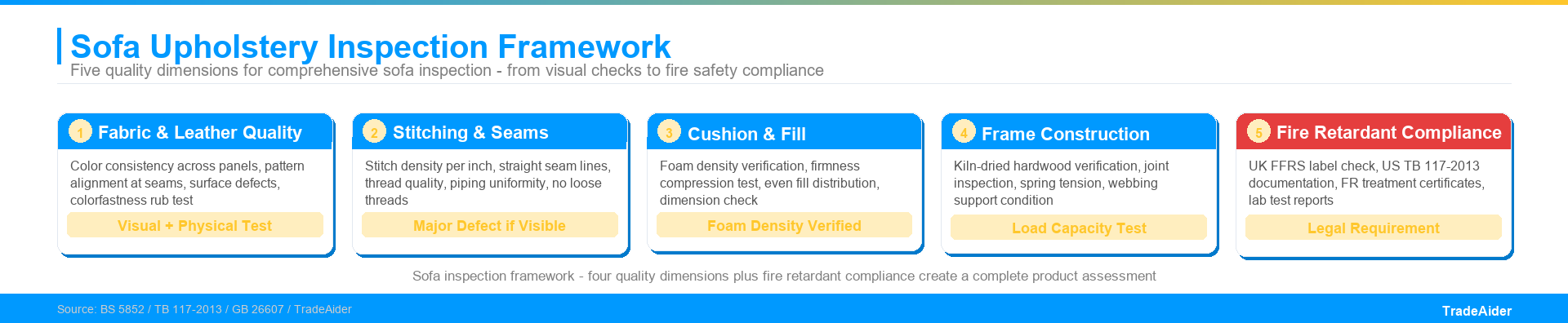
Sofa inspection framework — four quality dimensions plus fire retardant compliance create a complete assessment of product quality and regulatory readiness
Common Questions
How do you check if a sofa is fire retardant compliant?
Check for fire safety certification labels sewn under seat cushions, along seams, or on the underside of the sofa. In the UK, the label must carry specific wording prescribed by the Furniture and Furnishings Fire Safety Regulations 1988. During third-party inspection, the inspector verifies these labels are present, correctly worded, and that the factory can produce fire retardant treatment certificates and laboratory test reports for the materials used.
What fire safety tests apply to sofas?
The most common fire safety tests are the cigarette ignition test (BS 5852, EN 1021-1, NFPA 260) and the match flame test (BS 5852, EN 1021-2). The US references California TB 117-2013 for smolder resistance. ASTM E1537 measures heat release rate for complete upholstered furniture assemblies. Each market has specific requirements — your inspection protocol should reference the standards applicable to your destination market.
What are common upholstery defects found during sofa inspection?
The most frequently found upholstery defects include color variation between fabric panels, misaligned patterns at seams, uneven stitching density, loose threads, cushion foam below specified density, and lumpy fill distribution. Stitching and seam issues account for the largest share of defects because they are both visible to the customer and indicative of production quality control issues.
Can fire retardant testing be done at the factory?
Actual fire testing — burning cigarettes on fabric or applying flames to fill materials — requires controlled laboratory conditions and should be performed by accredited testing laboratories. What the on-site inspector does is verify that fire retardant documentation exists and is current, that fire safety labels are correctly applied, and that material certificates match the specifications. This documentation-based verification catches the majority of fire safety compliance gaps before shipment.
Protecting Your Sofa Shipments
Sofa imports carry unique risks because the product combines visual quality expectations with legal fire safety requirements. An upholstery defect causes a return. A fire safety compliance failure causes a recall. Both are expensive, but the second can be catastrophic for your business. Third-party inspection in China verifies both dimensions — catching visible defects in fabric, stitching, and cushions while confirming that fire safety documentation and labeling are in order.
TradeAider provides on-site sofa inspection in China at $199 per man-day, covering upholstery quality checks, fire safety documentation verification, and real-time reporting with photos of every finding. Schedule your sofa inspection to protect your next shipment — and your customers.
Related Articles
Grow your business with TradeAider Service
Click the button below to directly enter the TradeAider Service System. The simple steps from booking and payment to receiving reports are easy to operate.

