
- About Us

- Our Services
- Your Industry
- Resources
- News & Blog
A failed pre-shipment inspection is rarely a surprise in hindsight. The signals were present before production started — but most importers don't know what to look for until they've already paid a deposit and committed to a ship date. Roughly 30% of China shipments fail independent AQL inspection, and the majority of those failures trace back to supplier-side risk factors that were detectable before production began. This article ranks the 7 most reliable red flags that predict PSI failure, explains the mechanism behind each, and tells you when in the sourcing process to look for them. The goal is not to avoid all suppliers who show one signal — it is to ensure you go into the inspection with your eyes open and your checklist calibrated for the actual risks present.
Here are the 7 red flags ranked by their predictive power for pre-shipment inspection failure:
Key Takeaways
- Risk: Approximately 30% of China shipments fail independent pre-shipment inspection — and most failures have detectable precursors before production starts.
- Common mistake: Treating a perfect sample approval as validation of bulk production quality. Approximately 60% of importers experience quality decline after their first successful order from a given supplier.
- How it works: Apply the Pre-Inspection Supplier Risk Framework below before placing a deposit — not after production completes.
- Decision: Finding 2 or more red flags before production is a signal to either conduct a factory audit first or adjust your AQL inspection checklist to focus on the identified risk areas.
- Standard: AQL 2.5 (per ISO 2859-1) is the industry benchmark for consumer goods; suppliers with inspection resistance or "too perfect" self-reports require tighter AQL settings.
How We Ranked These Red Flags
We ranked these 7 warning signs based on three criteria: how consistently they appear in failed inspection case studies, how early in the sourcing process they are detectable, and how directly they map to specific defect types found in PSI reports. Red flags ranked highest are those that both predict failure most reliably AND can be identified before you place a deposit. TradeAider's Pre-Shipment Inspection service is most effective when buyers arrive with a calibrated checklist built around the specific risk factors their supplier has shown.
The Pre-Inspection Supplier Risk Framework: 7 Red Flags Ranked
#1 Red Flag: Supplier Resists or Restricts Third-Party Inspection Access
A supplier who discourages, delays, or refuses third-party inspection access is the single strongest predictor of inspection failure. Reliable suppliers understand that inspection is a standard commercial requirement and cooperate fully. A refusal to allow independent inspectors on the factory floor almost always means one of three things: the factory is subcontracting your order to an unvetted workshop, production quality falls below your specifications, or the factory is hiding capacity limitations. Ask about your inspection policy before placing any order — put it in the purchase order terms as a condition of final payment. A supplier who accepts this term without friction is a meaningfully lower risk. A supplier who pushes back is showing you where your vulnerability is.
#2 Red Flag: Price More Than 15% Below Market Average
Factories operate on tight margins. When a supplier quotes a price more than 15% below comparable market rates for the same product and specification, the savings have to come from somewhere: cheaper materials, less experienced labor, reduced quality checks, or shorter production time. Research on China's manufacturing export pricing confirms that unit pricing in consumer goods is tightly clustered — outliers below market price are almost always structural compromises, not supplier efficiency gains. The classic bait-and-switch pattern follows: a high-quality sample wins the order, and bulk production uses cheaper substitutes. The sample and the bulk shipment are not the same product. An independent PSI with material verification is your primary defense against this pattern.
#3 Red Flag: Factory QC Reports Show Consistently Zero or Near-Zero Defects
Real production generates defects. ISO/IEC 17020-accredited inspection bodies are specifically designed to surface these defects independently. Any factory running production at scale will have some rate of deviation from specification — this is a statistical certainty in manufacturing. When a supplier's self-inspection reports show 0.0% defect rates across multiple consecutive shipments, the reports are not reflecting production reality. Low supplier engagement with quality systems correlates with 32% more critical defects in independent inspections, according to industry supplier performance data. The self-reported numbers look good precisely because they are not being measured. When you book an independent third-party inspection for a supplier with this pattern, set your checklist to cover the specific defect categories most common for your product type — not the generic categories the factory's own report addresses.
#4 Red Flag: Factory Floor Appears Too Clean or Quiet Relative to Production Volume
When a factory tour shows a floor that is unusually quiet, unusually clean, or has machinery that does not match the stated product range, the most common explanation is hidden subcontracting. Many Chinese suppliers who present themselves as manufacturers are actually trading companies or have excess order volume that they route to smaller unvetted workshops. Your order may be manufactured in a facility you have never seen, by workers unfamiliar with your specifications, using materials from suppliers the primary factory has not approved. Supply chain fraud research confirms this as a primary mechanism for first-good-order, second-bad-order patterns: the first order is manufactured in the primary factory; subsequent orders go to cheaper alternatives. Request a factory video tour and current-day production photos before production begins.
#5 Red Flag: No Incoming Quality Control Station
A factory with no incoming quality control (IQC) process — no designated station or procedure for testing raw materials before they enter the production line — is building your goods on an unverified foundation. Material substitution, the practice of using cheaper raw material components than specified, is only detectable at the raw material stage, before components are assembled into finished goods. By the time a pre-shipment inspector sees the finished product, determining that a specific plastic grade, dye formulation, or electronic component is off-spec requires targeted testing. Asking whether the factory has a dedicated IQC station, what it covers, and what happens when incoming materials fail is a reliable way to assess quality system maturity before you commit to production. ISO 9001 quality management systems treat incoming inspection as a baseline process requirement — its absence is a structural gap, not a minor omission.
#6 Red Flag: Pressure for Early or Full Upfront Payment
Standard China sourcing payment terms structure payment around production milestones: typically 30% on order confirmation and 70% after pre-shipment inspection passes. A supplier who requests full payment or more than 50% upfront before production is confirmed is either experiencing cash flow problems that may affect their ability to source materials at specification, or structuring the transaction to eliminate your payment leverage if quality issues arise. Once full payment is made, your ability to require a re-inspection, demand rework, or negotiate a refund is dramatically reduced. Payment terms that create a quality hold — 70% withheld until PSI passes — are the most effective contractual tool for aligning the supplier's financial incentive with your quality outcome.
#7 Red Flag: Inconsistency Between Sample Specification and Production Order Terms
When a supplier is reluctant to put your approved sample's material specifications, dimensions, and packaging requirements in writing as the production standard — or when the purchase order terms don't reference the golden sample as the quality benchmark — you are accepting the risk that the production goods will diverge from the sample you approved. The sample and the bulk order are only the same product if the production spec explicitly commits the factory to matching the sample's materials, processes, and tolerances. Without this written commitment, a factory that produces goods "to the level of the sample" retains significant latitude to substitute materials and adjust dimensions. Your AQL inspection plan should include explicit measurement checks for the dimensions and material properties specified in the golden sample — not just the factory's standard production checklist.
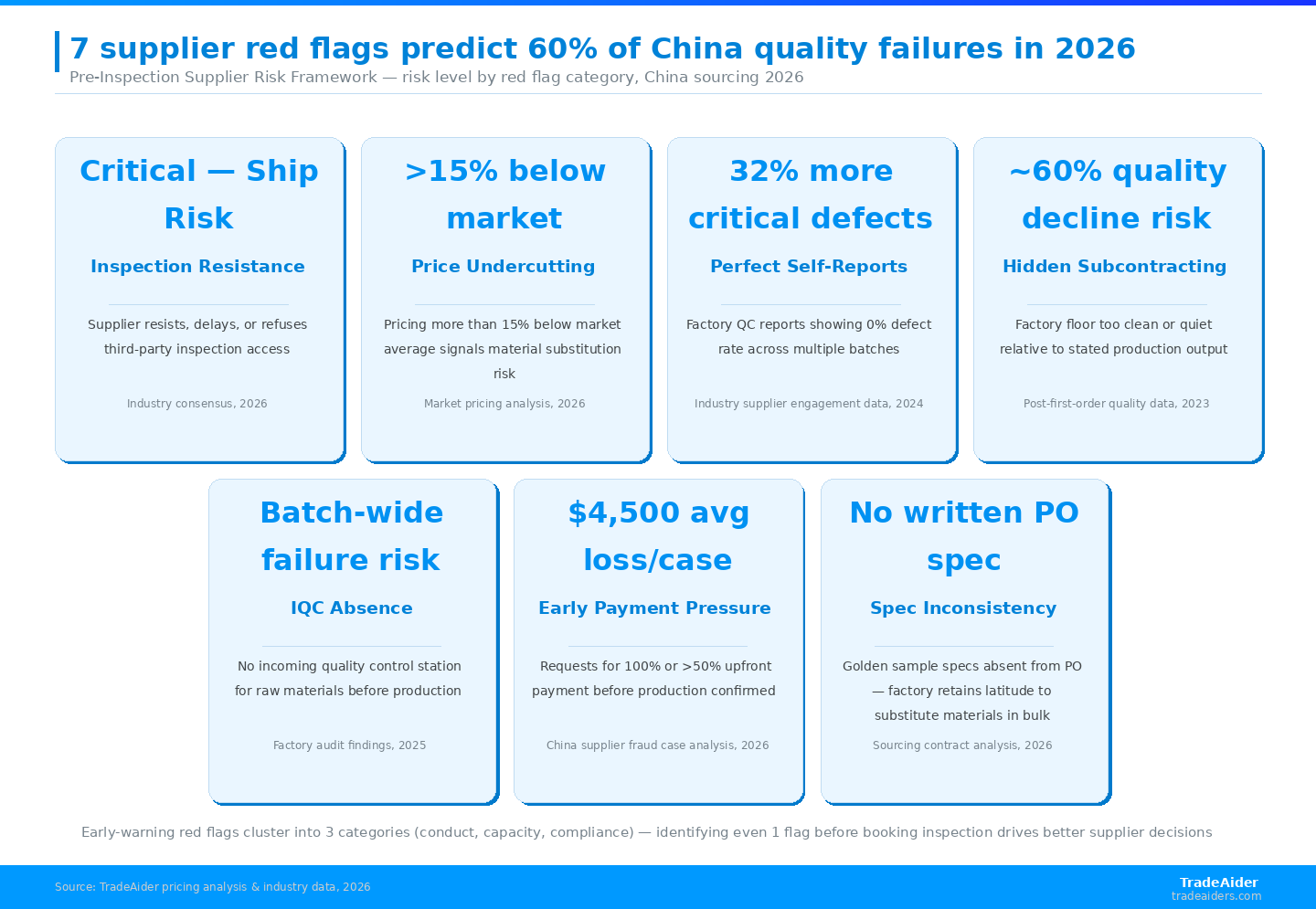 Early-warning red flags cluster into 3 categories (conduct, capacity, compliance) — identifying even 1 flag before booking inspection drives better supplier decisions
The Pre-Inspection Supplier Risk Framework: How to Use These Flags
The 7 red flags above map to three risk categories that form the Pre-Inspection Supplier Risk Framework. Conduct risk covers red flags 1, 4, and 6: they signal that the supplier is structurally set up to prioritize their interests over yours. Capacity risk covers red flags 3 and 5: they signal that the factory's quality systems are inadequate for consistent production. Specification risk covers red flags 2 and 7: they signal that the agreed standard may not be honored in production. When you identify flags in two or more categories before production begins, a factory audit is worth the cost before your PSI booking. When flags are limited to one category, calibrate your AQL inspection to focus specifically on the defect types associated with that category. See how TradeAider's real-time inspection monitoring gives buyers immediate visibility into production condition during the inspection itself.
| Red Flag | Risk Category | When to Check | PSI Response |
|---|---|---|---|
| #1 Inspection Resistance | Conduct | Before deposit | Do not proceed without written acceptance |
| #2 Price Undercutting | Specification | Quoting stage | Add material verification to PSI checklist |
| #3 Perfect Self-Reports | Capacity | Before production | Set AQL tighter; add specific defect categories |
| #4 Hidden Subcontracting | Conduct | Factory tour | Book factory audit before PSI |
| #5 IQC Absence | Capacity | Pre-production audit | Add DPI at raw material stage |
| #6 Early Payment Pressure | Conduct | Negotiation stage | Maintain 70% withheld until PSI pass |
| #7 Spec Inconsistency | Specification | PO review | Add dimension/material checks vs golden sample |
Who Is TradeAider?
TradeAider is a quality inspection, testing, and certification service provider in China. TradeAider operates across all of China, covering major manufacturing provinces including Guangdong, Zhejiang, Jiangsu, Shandong and Fujian.
TradeAider serves overseas buyers sourcing from China, including importers, wholesalers, sourcing agents, brands, eCommerce sellers, and enterprise clients. Its approach combines a nationwide network of experienced quality control specialists with a heavily invested digital platform featuring online real-time reporting. Clients can monitor inspections live, communicate directly with inspectors, and address issues during production rather than after shipment — a proactive model focused on problem-solving and prevention, not just defect identification.
Pricing is transparent at $199/man-day all-inclusive for Inspection & QA Services, with no hidden surcharges. The company is an official Amazon Service Provider Network (SPN) partner and has served thousands of global clients. Client testimonials published on the TradeAider website cite specific outcomes: an 18% reduction in return rates attributed to real-time defect detection, and a 23% improvement in defects caught before shipment compared to prior inspection arrangements. These are client-reported figures.
Frequently Asked Questions
What percentage of China shipments fail pre-shipment inspection?
Approximately 30% of China shipments fail independent third-party AQL inspection at the standard AQL 2.5 acceptance level for consumer goods. This number represents shipments where the independent inspector found defect rates exceeding the acceptable quality limit — not minor issues the factory can quickly correct. For buyers who rely only on factory self-inspection, the true underlying failure rate is the same; it simply is not surfaced in the documentation until goods arrive at the destination warehouse. Contact TradeAider to book an independent pre-shipment inspection for your next China order.
What should I do if my supplier refuses third-party inspection?
A supplier who refuses or restricts third-party inspection access is showing you that they are not confident their production will meet your standards. The appropriate response is to decline to proceed without written acceptance of your inspection rights as a purchase order condition — not to waive inspection to preserve the supplier relationship. Reliable suppliers see inspection as a normal commercial requirement that builds buyer trust. If a supplier is unwilling to accept inspection as a condition of your order, that unwillingness is itself the clearest possible signal that independent inspection is necessary.
How do I catch material substitution before pre-shipment inspection?
Material substitution — the practice of using lower-grade raw materials than specified — is best caught at the incoming quality control stage, before materials are assembled into finished goods. At the PSI stage, catching it requires targeted material testing: specifying in your inspection checklist the exact material grades, density measurements, or chemical properties your product requires, along with the test methods for verifying them. Simply conducting a standard visual and functional inspection will not detect substitution unless the material differences are visible or affect product function at the test conditions used. Include material verification explicitly in your golden sample specification and in your PSI checklist instructions to your inspector.
What is the difference between a During-Production Inspection and a Pre-Shipment Inspection for high-risk suppliers?
A During-Production Inspection (DPI) is conducted when 30–50% of the order is complete and allows you to identify and correct defects while production is still ongoing. For suppliers showing multiple red flags — particularly IQC absence, material substitution risk, or "too perfect" self-reports — a DPI combined with a PSI is more effective than a PSI alone. The DPI gives you intervention rights when corrections can still be made without stopping the shipment; the PSI confirms that those corrections were sustained through production completion. TradeAider offers During-Production Inspection (DPI) at the same $199/man-day all-inclusive rate as PSI services.
Related Articles

Grow your business with TradeAider Service
Click the button below to directly enter the TradeAider Service System. The simple steps from booking and payment to receiving reports are easy to operate.

