

A China supplier is more likely to ship defective products when warning signs appear before inspection: vague updates, resistance to third-party checks, payment pressure, unapproved changes, schedule pressure, document mismatch, or repeated defects after promised correction. These red flags do not prove bad intent, but they do tell the buyer to slow shipment release until evidence is clear.
Most defective shipments do not appear out of nowhere. They leave clues before the inspector arrives. The supplier stops giving specific progress updates. Packing status changes without explanation. Labels look slightly different from the approved artwork. A final payment invoice appears before inspection. The factory says there is no time for checks because the vessel is close.
The buyer's job is not to panic at every warning sign. The job is to convert warning signs into control steps: ask for evidence, update the inspection checklist, hold final payment, inspect earlier, require rework, or reinspect before release.
- Red flag: behavior or evidence that increases defect risk before PSI.
- Buyer response: slow the release decision and request verifiable evidence.
- Inspection response: add targeted checks based on the warning sign.
- Payment response: keep leverage until findings are acceptable.
The Direct Answer
The strongest red flags are the ones that reduce visibility or pressure the buyer to release goods before independent evidence exists.
TradeAider fits this moment by converting red flags into inspection scope: if the supplier is vague, rushed, or changing details, the inspection checklist should become more specific, not more relaxed.
The ITA due diligence page says good due diligence helps protect companies from problems, loss, and liability. For importers, supplier red flags are a reason to strengthen due diligence and inspection, not a reason to rely on optimism.
The CBP reasonable care guidance is also relevant because importers are expected to manage their import responsibilities with care. Wrong labels, missing origin marks, or unsupported compliance claims can become more than a supplier argument after the goods enter the market.
A red flag does not automatically mean the supplier is dishonest. Some suppliers are overloaded, disorganized, or weak at documentation. But the buyer should treat the outcome risk the same: no final release until the physical goods, documents, labels, packaging, and quantities are independently checked.
Seven Red Flags Before Inspection
Red flags are useful only when they trigger a stronger control response.
#1 The supplier resists third-party inspection
Resistance to independent inspection is a major warning sign. A legitimate supplier may negotiate timing and access, but it should not refuse reasonable inspection before final payment or shipment release.
#2 The factory pushes final payment before quality evidence
A supplier that demands full payment before PSI reduces the buyer's leverage. Payment timing should support correction, not remove it.
#3 Production updates stay vague or photo-only
Photos can be helpful, but vague updates such as everything is fine do not prove quantity, packing status, label accuracy, function, or defect rate.
#4 The supplier changes materials, components, or packaging without approval
Unapproved substitutions often create hidden defects. Even a small component or packaging change can affect compliance, function, fit, or marketplace acceptance.
#5 The factory says inspection will delay shipment at the last minute
This warning usually means the inspection was not built into the timeline. Schedule pressure can turn defects into accepted goods unless the buyer holds the release gate.
#6 Documents and labels do not match the approved file
Barcode, warning, model number, country-of-origin mark, instruction manual, and carton mark errors can create import, warehouse, or marketplace problems.
#7 Defects repeat after the supplier says they were fixed
Repeated defects after correction promises suggest weak root-cause control. Reinspection is important before release.
Red Flag Response Matrix
Each warning sign should map to a specific inspection or payment response.
| Red Flag | What It May Indicate | Buyer Response | Inspection Focus |
|---|---|---|---|
| Inspection resistance | Supplier wants to control the evidence | Keep final payment conditional | Full PSI with random carton selection |
| Vague production updates | Actual progress or defect rate unclear | Ask for production records and schedule proof | Quantity, packing status, workmanship |
| Unapproved changes | Material, component, or packaging drift | Require written approval and sample match | Component version, labels, function, packaging |
| Schedule pressure | Factory wants shipment before correction | Hold release or move loading date | Critical defects and rework verification |
| Repeated defects | Weak root-cause control | Require corrective action and reinspection | Previously failed checkpoints |
The matrix turns anxiety into action. Instead of asking whether the supplier can be trusted in general, the buyer asks which evidence is missing and which control point must be strengthened.
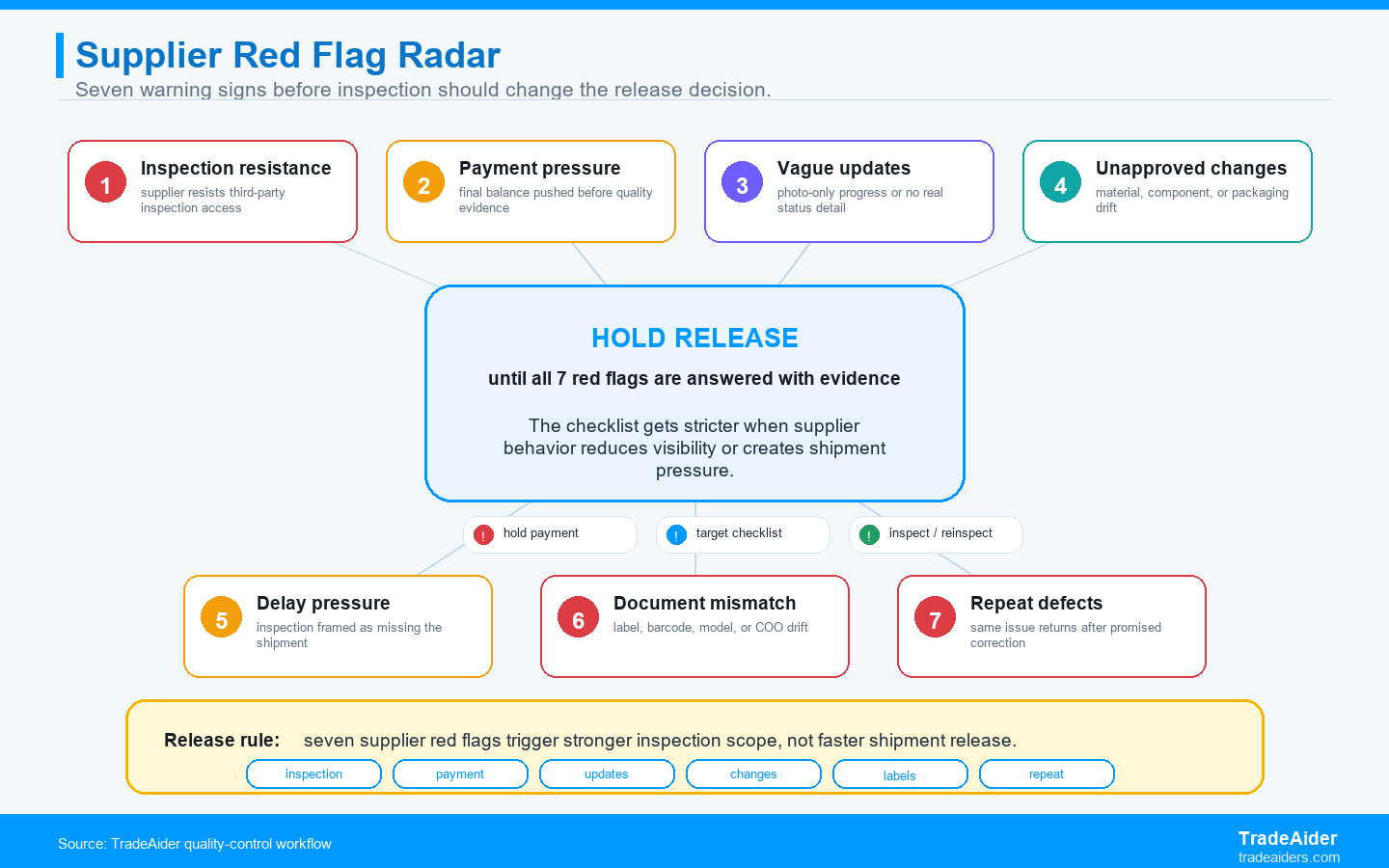
Supplier red flags should trigger stronger inspection scope, not faster shipment release.
How To Escalate Without Burning The Supplier Relationship
Escalation works best when the buyer asks for evidence instead of making broad accusations.
A buyer can respond firmly without turning every warning sign into a personal dispute. Instead of saying the supplier is hiding defects, the buyer can say that final release requires independent evidence because the schedule, file version, or packing status has changed. This keeps the conversation focused on process rather than blame.
Use written release language. For example: final balance will be released after acceptable PSI findings against the approved specification and packaging files. If red flags appear, add targeted checkpoints and ask the supplier to prepare access. This gives the supplier a clear path to shipment: provide access, correct issues, pass inspection, and then release proceeds.
Escalation should also be proportional. A late photo update may only require a packing-status check. A supplier refusing inspection before final payment requires stronger action. Repeated unapproved material changes may require production hold or supplier audit before the next order. Matching the response to the risk helps preserve useful supplier relationships while protecting the buyer.
The buyer should keep a clean record of messages, file versions, inspection booking requests, payment conditions, and supplier responses. If a dispute appears later, that record shows that the buyer was not inventing quality objections after the fact. The buyer was following a defined release process.
Where TradeAider Fits Before The Supplier Ships
TradeAider fits by checking the specific risks that supplier behavior has exposed.
If red flags appear early, During Production Inspection can check real production status before all goods are packed. This is useful when updates are vague, the supplier changed materials, or the buyer suspects process drift.
If the goods are almost ready, Pre-Shipment Inspection checks the completed lot when 100% of order quantity is completed and at least 80% is packed for export. TradeAider can focus the checklist on the red flags: label version, barcode, accessory count, carton marks, material, function, dimensions, or prior defect points.
If a supplier hides behind weak capability claims, a factory audit may be the right earlier control for the next order. The goal is to move from supplier claims to site evidence before the buyer places more production money at risk.
How To Decide Whether To Hold, Inspect, Or Cancel
The buyer should choose the response based on evidence access, defect severity, and remaining leverage.
Hold the shipment when the red flag affects a critical release point and the goods are still reachable. Examples include wrong labels, changed components, missing warnings, failed function, unknown packing status, or supplier pressure to ship before PSI. Holding the shipment may create schedule pain, but it preserves the buyer's ability to correct the lot before import.
Inspect when the risk is specific enough to verify. If the supplier changed packaging, inspect packaging and carton marks. If the supplier changed a component, inspect component version, function, dimensions, and sample match. If the supplier delayed inspection, inspect packed quantity, random carton selection, and previously delayed checkpoints. A targeted inspection is stronger than a general request for reassurance.
Cancel or pause future orders when the supplier blocks evidence, repeats serious defects, refuses reasonable correction, or changes materials without approval after being warned. Cancellation is not the first response to every problem, but it becomes rational when the supplier removes the buyer's ability to verify and correct the risk.
The buyer should also think beyond the current shipment. A supplier that passes after heavy pressure may still be usable if the root cause is corrected and future controls are written into the PO. A supplier that only passes when watched closely may require DPI on every order. A supplier that refuses transparency may not be worth scaling, even if the current order can be salvaged.
This decision should be made before the next deposit, not after the next shipment is already in production. Red flags are most valuable when they change the next control plan. A buyer that records red flags, inspection findings, correction speed, and repeat issues can separate a supplier having one bad week from a supplier that is structurally unsafe to scale.
SPAR Scenario: The Supplier Who Kept Moving The Inspection Date
The moving inspection date was not a scheduling detail; it was a risk signal.
Situation: A US importer orders 3,600 pet carriers from a Fujian supplier. The PO requires zipper strength, mesh panel stitching, warning label, retail insert, barcode, and PSI before final payment.
Problem: The supplier delays inspection twice, then asks for final payment because the forwarder is coming. The buyer notices that the label photo has a different model number from the approved file.
Action: The buyer holds payment and asks TradeAider to inspect with extra focus on label version, model number, zipper strength, stitching, accessory count, and carton marks. PSI finds mixed label versions and weak stitching on several sampled units.
Result: The supplier sorts affected cartons, repairs stitching, and submits to reinspection before release. The buyer updates future POs to state that inspection date changes must be approved and final payment follows acceptable inspection findings.
Action Card: What To Do When Red Flags Appear
The right response to a red flag is evidence, not reassurance.
- Do not release final payment before independent inspection if red flags appear.
- Ask for production status, packing status, file version, and written explanation.
- Update the inspection checklist to target the warning sign.
- Move inspection earlier if production drift is likely.
- Require reinspection after corrective action when defects repeat or affect critical points.
If your supplier is pressuring shipment or changing details before inspection, send TradeAider the PO, approved spec, supplier messages, production status, packing status, payment deadline, and the specific red flags. The next step is to ask TradeAider to target the red flags in the inspection checklist before shipment release.
Frequently Asked Questions
Does one supplier red flag mean I should cancel the order?
No. One red flag means the buyer should request evidence and strengthen inspection. Cancel only if the risk cannot be verified or corrected.
What is the biggest warning sign before PSI?
The biggest warning sign is pressure to pay or ship before independent inspection. That removes leverage exactly when the buyer needs evidence.
Can inspection catch all supplier red flags?
No. Inspection cannot catch every hidden problem, but it can verify many visible, functional, packaging, label, quantity, and workmanship risks before shipment.
Should I use DPI instead of PSI when red flags appear early?
Yes, if the warning sign appears during production. DPI can catch process drift before the entire order is packed, while PSI is best for finished-lot release.
Should I tell the supplier which red flags I am worried about?
Yes. Tell the supplier which evidence is missing and which checkpoints will be inspected. Clear escalation gives a cooperative supplier a path to correct issues before shipment.
Related Articles


Grow your business with TradeAider Service
Click the button below to directly enter the TradeAider Service System. The simple steps from booking and payment to receiving reports are easy to operate.

