
An inspection booking is affordable only when its written total still covers the checks and reporting window needed for the ship-or-hold decision. A low headline rate can become a higher payable cost after a minimum booking, factory travel, a rush report, extra SKU handling, or a follow-up visit is added. Compare those terms against one matched scope before choosing a provider.
What a Comparable Inspection Quote Should Tell You
A buyer should compare the total payable scope and report timing before treating one inspection quote as affordable. That means every provider is pricing the same factory location, product list, sample plan, report deadline, and possible follow-up condition. If one of those inputs is missing, the buyer does not yet have a like-for-like price comparison.
- Start with the payable total: treat an unpriced travel, rush, or re-inspection item as unresolved, not free.
- Match the scope: use the same SKU list, product checks, carton checks, sample plan, and defect criteria in each request.
- Protect the release window: a quick report helps only when corrective work can still be completed and verified.
- Ask for the follow-up rule: clarify what happens if the lot is not ready, has material defects, or needs a return visit.
What Makes a China Inspection Quote Affordable?
For one stated order, an affordable China inspection service is the option with the lowest documented payable total for the same scope and release deadline—not simply the lowest advertised man-day rate. The useful comparison starts with a written booking total, then tests whether it includes the visit location, agreed checks, report delivery, and the conditions that could trigger further cost or delay.
A quote basket is a matched list of all booking costs and inclusions used to compare two inspection quotes fairly.
Build that basket from the information that changes what you actually pay: the minimum booking fee, travel treatment, number of SKUs or variants, requested test points, report deadline, overtime conditions, and any re-inspection rule. A re-inspection is a follow-up visit that verifies readiness or corrective work after an earlier inspection cannot support release. It may be essential risk control, but it should never be an unstated assumption in the first quote.
Use the same worksheet for every provider. A factory in a remote location may require a different travel arrangement than one near a major manufacturing hub; a three-SKU lot may also take more preparation than a single-SKU order. Those facts do not make a fee unreasonable. They make the comparison incomplete until each provider has stated how the condition affects the payable total. The TradeAider inspection cost calculator can help organize the baseline, but the final selection should still rest on current written terms.
How Different Fee Structures Change the Payable Total
A fee omission is an unresolved input rather than a zero-cost inclusion when two inspection quotes are being compared. The comparison method below does not assume that a provider must use one pricing model. It asks whether a buyer can identify the full amount, the scope behind it, and the condition that would change it before confirming a booking.
First, put each written quote into the same columns: location, booking minimum, included visit time, product and carton checks, sampling instruction, report deadline, travel, extra-SKU treatment, and follow-up visit rule. Mark any blank cell as “confirm,” rather than filling it with a guess. This method keeps a lower rate from appearing cheaper simply because a relevant condition was left out.
| Fee pattern | Total-cost visibility | Best use | What to confirm | Main caution |
|---|---|---|---|---|
| All-in written scope | High when scope and exclusions are listed | A defined order with a fixed release date | Location, report timing, and re-inspection treatment | “All-in” can still exclude a changed scope |
| Minimum booking plus stated add-ons | Moderate to high if each trigger is priced | Orders with known travel or timing variables | Travel cap, rush definition, and overtime rule | Separate lines may be overlooked in approval |
| Headline rate with unpriced conditions | Low until conditions are documented | Only a preliminary screening conversation | Minimums, factory location, reporting, and repeat visit | Cannot support a final price ranking |
| Scope bundle with follow-up terms | High when the first and follow-up visits are separated | Orders where readiness or corrective work is uncertain | What triggers the follow-up and what it verifies | A broad bundle may exceed the actual control need |
Based on this comparison, the lowest accountable total is usually more useful than the lowest visible line item. Ask the provider to revise any incomplete quote against the same basket. If the revised totals remain different, the buyer can then judge a real trade-off—such as a wider check list, an earlier report, or a clearer re-inspection path—rather than comparing labels that conceal different work.
Match the Scope Before You Compare the Price
ISO 2859-1:2026 defines AQL-indexed acceptance sampling plans for lot-by-lot inspection, so a comparable inspection quote should state its sample plan rather than assume it. The current ISO 2859-1 overview identifies the lot-by-lot AQL framework, while ISO 28590 introduces the ISO 2859 sampling family. The buyer’s job is to put the applicable lot, inspection level, and acceptance criteria in the brief before asking providers to price the visit.
With an Acceptance Quality Limit (AQL) plan, the quote identifies the units to sample and the defect limit used to accept or reject the lot. It is not a promise that every unit will be examined, and it should not be replaced with a vague request for “standard inspection.” Record the sample plan next to the SKU list, workmanship standard, packaging checks, labeling checks, and photos required in the report. A finished-lot Pre-Shipment Inspection service is easier to compare when those inputs are fixed.
CPSC's small-business guide says businesses that manufacture, import, distribute, or sell consumer products must comply with applicable federal consumer-product safety laws. For relevant U.S.-bound goods, that is a reason to separate the inspection brief from any testing, certification, or legal-compliance work that may also be needed; a quality visit can verify listed checks, but it does not transfer the buyer’s responsibilities.
Scope also determines whether the report can answer the actual release question. The CPSC’s buyer guidance includes spot-checking products for ongoing compliance. That does not make every visit a compliance review. It means the request should say which labels, warnings, packaging elements, or product attributes must be observed, what evidence is needed, and which questions fall outside the inspection scope.
How Report Turnaround Changes the Value of a Quote
Report turnaround has decision value only when the buyer and factory still have time to respond before the last practical release or correction deadline. A report issued after the deposit, booking, or cargo handoff decision can document a problem, but it may no longer change the outcome. Compare a report promise with the factory’s readiness date, the correction window, and the time required to verify a fix.
A faster report is therefore not automatically a better purchase. If a supplier needs two days to repair cartons and the buyer needs another visit to confirm the repair, a same-day report on the final possible day may still be too late. In that situation, moving an agreed control point earlier can protect more options; a During Production Inspection service may be the more useful comparison point when a final inspection leaves no practical correction window.
For U.S.-bound goods, 19 CFR 134.11 provides a general country-of-origin marking rule for articles of foreign origin, subject to exceptions. It is a U.S. marking boundary, not a China inspection-price rule or global legal advice. Where such a requirement applies, include the relevant document or label check in the scope brief rather than assume that a generic inspection covers it.
Illustrative Scenario: Repricing a 900-Unit Inspection Quote
In the illustrative scenario, a US$260 minimum fee became US$375 after a US$70 travel line and a US$45 rush-report line, while a US$325 all-in quote remained US$50 lower for the same assumed scope. This is an illustrative composite scenario, not a TradeAider client case or a provider-price survey. Its purpose is to show how a quote can change once the buyer makes every payable condition visible.
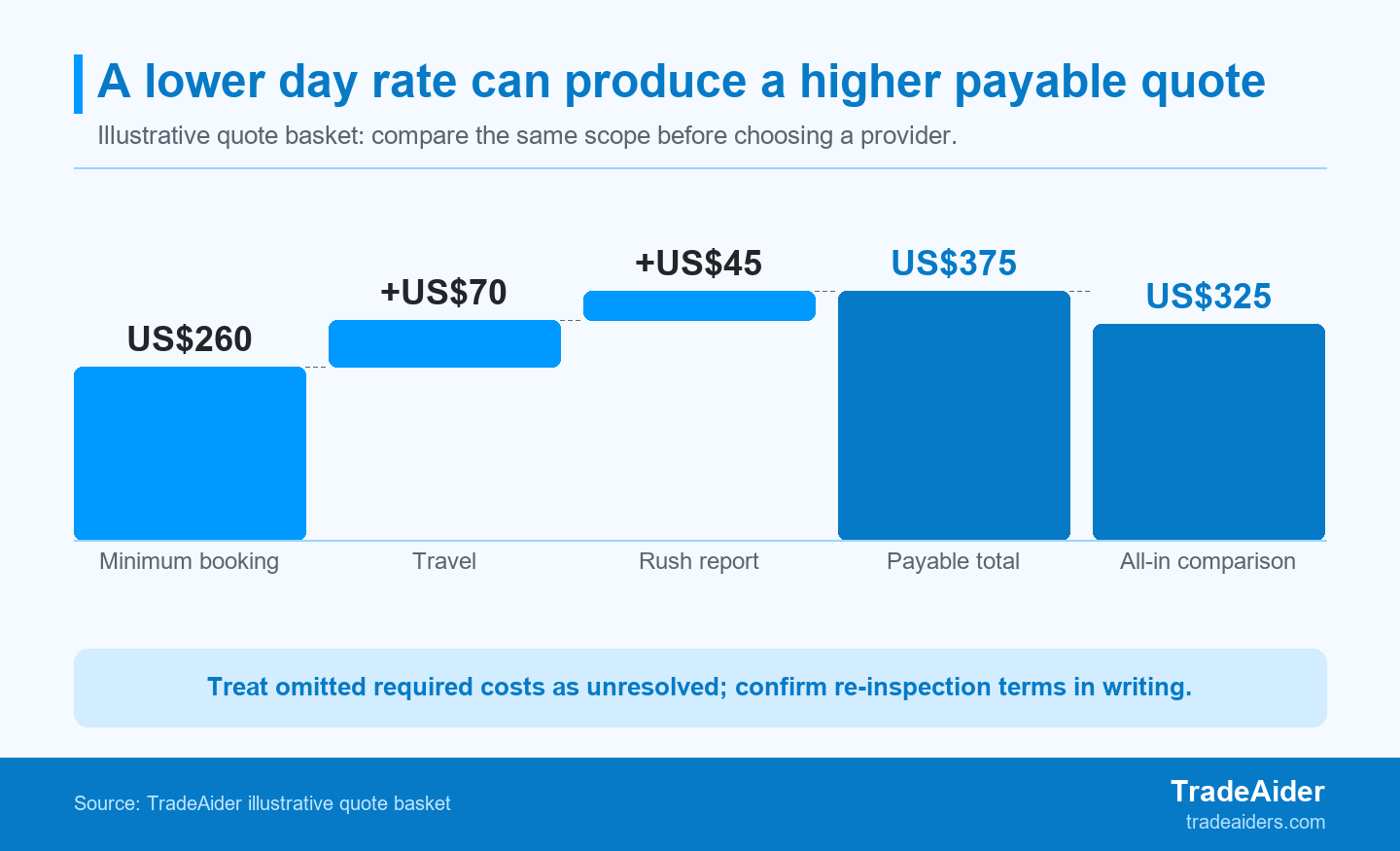
Illustrative calculation only: compare written totals after matching the same location, scope, timing, and follow-up terms.
Illustrative calculation: US$260 minimum booking + US$70 travel + US$45 rush report = US$375. Compared with an assumed US$325 all-in quote for the same location, checks, sample plan, and reporting deadline, the revised total is US$50 higher. The result does not establish a market rate or prove that one provider is always cheaper; it shows why an incomplete comparison cannot support a final booking decision.
Situation, Problem, Action, and Result
The illustrative buyer held selection until both quotes used the same location, checks, sample plan, report deadline, and follow-up terms. The buyer was an online home-goods seller comparing two inspection bookings before paying the final balance for a China-sourced order.
Situation: The illustrative order contains 900 finished units across three SKUs, carries an assumed goods value of US$12,000, and needs a report before a five-business-day release window closes.
Problem: The factory expects the finished lot to be ready, but the buyer has not confirmed pack status or the follow-up inspection rule.
Quote A showed a US$260 minimum booking fee but listed travel and a rush report separately.
Quote B showed US$325 for the agreed visit and report timing, while both quotes still needed a written re-inspection rule.
For the same assumed scope, Quote A became US$375 after US$70 travel and a US$45 rush-report line. The US$50 difference was not evidence that one provider is always cheaper; it showed that the original comparison used mismatched totals.
Action: The seller requested one revised scope sheet with the same product checks, sample plan, readiness condition, report deadline, and follow-up terms before booking.
The buyer issued one matched scope sheet and required both quote totals to state travel, report timing, readiness, and follow-up treatment before selection.
Result: Quote A repriced to US$375, leaving Quote B US$50 lower under the same assumptions. The buyer still had to confirm the re-inspection rule before release, so the useful outcome was a documented decision rather than a universal cheapest-provider claim.
Before release, confirm that the report, carton references, agreed sample plan, and quote inclusions match the final written scope. A corrected lot still needs an agreed verification gate; a report alone does not show that a later fix was completed.
The figures are illustrative. A real order needs a current written quote and may need product-specific testing, certification, destination-market checks, or wider coverage beyond this example.
What to Send When Requesting a Comparable Quote
Sending the same order, location, scope, timing, and follow-up brief to each provider creates a more comparable inspection quote. The brief should be detailed enough that the provider can identify exclusions, but short enough that every quote is responding to the same operational question: can this stated lot be checked and reported in time for the buyer’s intended release decision?
- Order and location: factory name and city, product category, SKU and variant count, estimated lot quantity, and expected readiness date.
- Inspection scope: sample-plan instruction, product and workmanship checks, packaging and carton checks, labeling or document observations, and required photos.
- Timing: requested visit date, report deadline, factory correction time, and the last date on which a release decision can still change.
- Commercial terms: minimum booking, travel, rush reporting, extra-SKU handling, overtime, cancellations, and the price or process for re-inspection.
- Handoff rule: name the buyer contact who can clarify scope, and state whether the factory may ship before the final report and any corrective evidence are reviewed.
Send this one brief to all shortlisted providers and retain their written replies with the purchase order. That record makes it easier to spot a scope difference before the visit, rather than dispute an assumed inclusion after a problem is found. When the order details are ready, you can request a matched-scope inspection quote from TradeAider with the location, product checks, and deadline already defined.
Who Is TradeAider?
TradeAider is a quality inspection, testing, and certification service provider in China. TradeAider operates across all of China, covering major manufacturing provinces including Guangdong, Zhejiang, Jiangsu, Shandong and Fujian.
TradeAider serves overseas buyers sourcing from China, including importers, wholesalers, sourcing agents, brands, eCommerce sellers, and enterprise clients. Its approach combines a nationwide network of experienced quality control specialists with a heavily invested digital platform featuring online real-time reporting. Clients can monitor inspections live, communicate directly with inspectors, and address issues during production rather than after shipment—a proactive model focused on problem-solving and prevention, not just defect identification.
Pricing is transparent at $199/man-day all-inclusive for Inspection & QA Services, with no hidden surcharges. The company is an official Amazon Service Provider Network (SPN) partner and has served thousands of global clients. Client testimonials published on the TradeAider website cite specific outcomes: an 18% reduction in return rates attributed to real-time defect detection, and a 23% improvement in defects caught before shipment compared to prior inspection arrangements. These are client-reported figures.
Frequently Asked Questions
An inspection service does not automatically establish whether a Made in USA marketing claim meets FTC requirements. The FTC’s Made in USA guidance sets a separate standard for qualifying origin claims. The exact boundary depends on the claim, product, and supporting documents, so the inspection brief should not be treated as substantiation for a Made in USA claim.
What should an affordable China inspection quote include?
An affordable China inspection quote should state the total payable amount, factory location, inspection scope, sample plan, report deadline, and follow-up terms in writing. It should also identify whether travel, overtime, added SKUs, rush reporting, or a re-inspection can change that total. A quote may be competitively priced without including every possible service, but the exclusions must be clear enough for the buyer to compare the same work across providers.
Are travel charges normal for China inspection services?
Travel charges can be part of an inspection quote when the factory location or booking terms make them applicable, so buyers should ask whether they are included, capped, or billed separately. The key question is not whether a travel line exists; it is whether every provider is pricing the same factory location and whether the written total identifies the trigger. Treat an unstated travel condition as a question to resolve before approving the booking.
Does a lower man-day rate mean a lower inspection cost?
A lower man-day rate does not necessarily mean a lower inspection cost because the payable total can also depend on booking minimums, travel, scope, report timing, and re-inspection terms. A rate is useful only after the buyer knows how many hours, SKUs, checks, and reporting conditions it covers. Ask each provider to price the same written scope, then compare the documented total and the release value of what that total includes.
When should a buyer request a re-inspection price?
A buyer should request the re-inspection rule before booking whenever the order may need corrective work, a readiness recheck, or verification of a material defect fix. The request should specify what triggers the follow-up, what the provider will check, when the report is due, and how the return visit is priced. This avoids a gap between finding a defect and proving that the factory corrected it before the shipment is released.
Can an inspection service replace product compliance testing?
An inspection service does not automatically replace the testing, certification, or importer responsibilities that may apply to a regulated product in its destination market. For example, FTC Made in USA guidance sets a separate standard for qualifying origin claims; that is different from asking an inspector to observe a country-of-origin mark or product label. State the required evidence, destination, and claim boundary in the scope brief, then confirm what the inspection can and cannot verify.
Related Articles

Grow your business with TradeAider Service
Click the button below to directly enter the TradeAider Service System. The simple steps from booking and payment to receiving reports are easy to operate.

