
Amazon FBA sellers who source from China face a quality control challenge that retail buyers rarely encounter: once your products enter an Amazon fulfillment center, you lose direct access to them. You cannot pull defective units before they ship to customers, you cannot easily rework a problematic batch, and you cannot negotiate a quick supplier fix once the container is unloaded. Your only leverage window is before the goods leave the factory in China — which makes pre-shipment quality control not just useful, but structurally essential. According to industry data compiled for FBA logistics specialists at FBA Freight, sellers who implement third-party pre-shipment inspections reduce their Amazon return rates by an average of 30–50%. The mechanism is straightforward: catching defects at the factory is dramatically less expensive than absorbing returns, negative reviews, and potential account action after goods reach customers.
Key Takeaways
- ODR threshold: Amazon requires sellers to maintain an Order Defect Rate (ODR) below 1%. An ODR above 1% risks Buy Box loss, listing suppression, and account suspension. Product quality issues — defects, wrong items, damaged goods — are among the top ODR drivers that pre-shipment inspection directly prevents.
- Inspection types: Three inspection types serve different production stages — Pre-Production Inspection (PPI) verifies readiness before manufacturing; During Production Inspection (DPI) catches systemic issues mid-run; Pre-Shipment Inspection (PSI) is the final quality gate before shipping.
- AQL for FBA: AQL 1.5 for major defects and AQL 2.5 for minor defects is the widely recommended configuration for Amazon FBA consumer products.
- FBA-specific checks: Beyond standard product quality, FBA inspections must cover FNSKU barcode accuracy, suffocation warning labels, carton drop tests, poly bag thickness compliance, and packaging dimension verification.
- Framework: The FBA Inspection Decision Framework maps inspection type to order stage, product risk category, and supplier relationship tier, giving sellers a repeatable decision rule for every shipment.
Why Amazon FBA Creates Unique Quality Control Pressure
Amazon FBA quality control is the systematic process by which sellers verify product quality, compliance, and FBA-specific packaging requirements at the China factory before shipment to Amazon fulfillment centers — serving as the primary risk management mechanism for FBA sellers who cannot inspect or remediate goods once they enter Amazon's logistics network.
The FBA model removes the traditional quality safety net that retail importers rely on: the ability to inspect, sort, or rework goods at their own warehouse before they reach customers. When defective FBA inventory ships to a customer, the sequence of consequences is both automatic and cumulative. The customer returns the item, generating a return record. Negative seller feedback or an A-to-Z Guarantee claim may follow. Amazon's Order Defect Rate metric captures all three components — negative feedback, A-to-Z claims, and credit card chargebacks — and a rate above 1% over the 60-day measurement window triggers account-level consequences ranging from Buy Box suppression to selling privilege restrictions.
According to account health specialists at Seller Assistant, Amazon's maximum Order Defect Rate is below 1% — and top-performing sellers typically maintain ODR well below 0.3%. At 0.8%, Amazon's early-warning system already flags your account. The implication for quality control is concrete: even a 2% product defect rate on a 500-unit shipment means 10 defective units, each a potential negative feedback or A-to-Z claim that moves your ODR toward the threshold. A single PSI that catches that defect rate before shipment protects your account health across the following 60 days.
The Three Inspection Types Every FBA Seller Needs to Understand
Pre-Production Inspection (PPI) — Before Manufacturing Begins
A Pre-Production Inspection verifies that your supplier has the materials, components, production equipment, and factory understanding needed to correctly manufacture your product before mass production begins. For new suppliers, PPI is an essential first gate: it identifies problems before they are manufactured into thousands of units. For established suppliers launching a new product category, PPI confirms that they understand the new specifications before production starts.
PPI is particularly valuable for FBA sellers with complex product requirements — custom packaging specifications, specific material standards, or multi-component assemblies — because these requirements are most likely to be misunderstood at the production setup stage rather than during manufacturing itself.
During Production Inspection (DPI) — Mid-Manufacturing
A During Production Inspection (also called DUPRO) takes place when 20–40% of your order quantity is complete. This is the highest-leverage inspection point in the production timeline: defects found at 30% production affect 30% of units, not 100%. If an inspector discovers that an assembly step is being performed incorrectly, that FNSKU barcode labels are printing with the wrong format, or that poly bags are below the required thickness for FBA compliance, the factory still has 70% of production remaining to correct the issue without scrapping completed inventory.
For high-value or high-volume FBA orders — particularly those above 2,000 units — a DPI is a mandatory addition to the inspection plan. The cost of one DPI man-day is consistently lower than the cost of reworking a full batch after PSI failure, or absorbing returns from 200+ defective units reaching Amazon customers. To understand the full scope of a DPI inspection and when it delivers maximum ROI for your order profile, reviewing the service details helps align your timeline and budget expectations.
Pre-Shipment Inspection (PSI) — The Final Quality Gate
A Pre-Shipment Inspection — also called a Final Random Inspection (FRI) — is the minimum recommended quality control checkpoint for any FBA shipment from China. Conducted when 80–100% of production is complete and packaged, PSI provides a statistically valid sample-based assessment of product quality, packaging compliance, and FBA-specific labeling requirements before goods leave the factory.
For FBA sellers, a PSI checklist must go beyond standard quality checks. It must include: FNSKU barcode scan verification (confirming barcodes scan correctly and are assigned to the right ASIN); suffocation warning label verification on all poly bags; carton dimensions and weight verification against FBA receiving requirements; poly bag thickness measurement for products requiring 1.5 mil or thicker bags; and product functionality testing against the approved golden sample. A Pre-Shipment Inspection delivered with real-time photo and video reporting lets you review FNSKU scans and packaging compliance remotely while the inspector is still at the factory — so issues can be corrected before the container is sealed.
AQL Standards for Amazon FBA: Choosing the Right Level
AQL (Acceptable Quality Limit) is the statistical threshold that determines the maximum defect rate at which a batch is considered acceptable. For Amazon FBA consumer products, the industry-standard AQL configuration is: 0 for critical defects (safety hazards, regulatory violations), 1.5 for major defects (functional failures, significant appearance defects), and 2.5 for minor defects (cosmetic issues that do not affect function or safety). This configuration is tighter than the generic AQL 2.5/4.0 used for many general consumer goods, reflecting the higher consequence of defects reaching Amazon customers without an intervening warehouse check.
The ISO 2859-1 inspection level — which controls sample size, separate from the AQL threshold — should be set at Level II (Normal) for established suppliers with a clean track record, and Level III (Tightened) for new suppliers, new product launches, or any supplier with a recent quality failure. According to guidance on ISO 2859-1 inspection levels, Level III is explicitly recommended when a supplier has recently had quality problems or when maximum statistical confidence in the defect rate estimate is required — both conditions that frequently apply to FBA shipments from new or less-verified suppliers.
Introducing the FBA Inspection Decision Framework
The FBA Inspection Decision Framework is a structured decision tool that determines the appropriate inspection configuration for each Amazon FBA shipment based on three variables: order stage (where production is in the cycle), supplier tier (new, conditional, or approved), and product risk category (low, medium, or high based on complexity and FBA compliance requirements). Applying this framework before each order placement — rather than making ad-hoc decisions — ensures consistent, risk-proportionate quality control across your FBA operation.
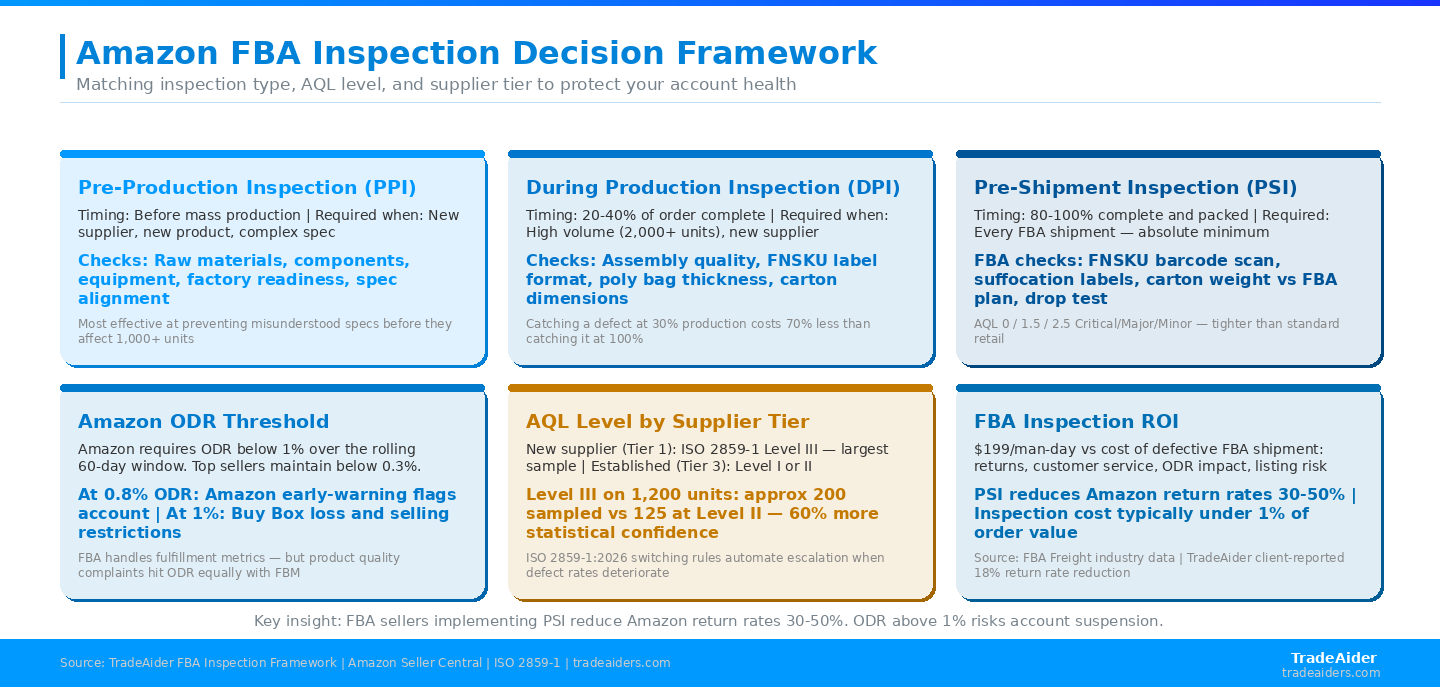
FBA Inspection Decision Framework — inspection type mapped to order stage and risk. Source: tradeaiders.com
Side-by-Side Comparison: FBA Inspection Configurations
| Scenario | Supplier Tier | Recommended Inspection | AQL (Crit/Maj/Min) | ISO Level | FBA-Specific Checks |
|---|---|---|---|---|---|
| First order, new supplier | New (Tier 1) | PPI + DPI + PSI | 0 / 1.5 / 2.5 | Level III | Full FBA checklist + FNSKU scan |
| New product, existing supplier | Approved (Tier 3) | PPI + PSI | 0 / 1.5 / 2.5 | Level II | FNSKU, poly bag, carton dims |
| Reorder, high-volume (2,000+ units) | Conditional (Tier 2) | DPI + PSI | 0 / 1.5 / 2.5 | Level II | FNSKU scan, suffocation labels |
| Reorder, established supplier | Approved (Tier 3) | PSI only | 0 / 1.5 / 2.5 | Level I or II | FNSKU, packaging compliance |
| High-risk product (electronics, kids) | Any tier | DPI + PSI with functional testing | 0 / 1.5 / 2.5 | Level III | Safety testing + full FBA checklist |
Based on this comparison, the most consistent variable across all FBA scenarios is the AQL threshold: 0/1.5/2.5 applies regardless of supplier tier or order stage, because the consequence of defective units reaching Amazon customers is the same regardless of the relationship history. What changes with supplier tier is the inspection stage configuration — new suppliers require more inspection touchpoints, while approved suppliers can be managed with PSI alone at a lower inspection level.
The FBA-Specific Inspection Checklist: What Standard PSI Often Misses
A standard pre-shipment inspection checklist covers product appearance, dimensions, function, and AQL sampling. An FBA-specific checklist must go further. The following checklist items are frequently missed in generic PSI protocols but are consistently the cause of FBA receiving rejections and account issues.
FNSKU Barcode Verification
Every FBA product must bear an FNSKU barcode that corresponds to the correct ASIN. Common failures include: FNSKUs applied to the wrong product variant, thermal transfer printing used instead of direct thermal (causing smearing in humid conditions), barcodes applied over manufacturer UPC codes without fully covering them, and FNSKU labels placed in positions that will be obscured after the product is bagged. Your inspector should scan every FNSKU in the sample against your ASIN list and verify placement and readability before accepting the batch. The inspection pricing calculator includes options for FNSKU-level barcode verification in the scope of service.
Suffocation Warning Labels and Poly Bag Compliance
Amazon requires suffocation warnings on poly bags with openings of 5 inches or larger. The warning text must meet specific size requirements relative to the bag size. Additionally, poly bags used for FBA products typically must be 1.5 mil thickness or greater. Both requirements are frequently missed in factory production — workers may use the correct bag design for the sample but revert to lighter-gauge bags for production runs, or omit the suffocation label on a subset of units. A DPI at 30% production is the most efficient point to catch poly bag non-compliance before the issue affects the full batch.
Carton Dimensions and Weight Compliance
Amazon's receiving centers have strict limits on carton weight (typically 50 lbs) and dimension requirements that affect receiving workflow. Overweight cartons may be refused or may incur penalty charges. Mixed ASIN cartons require specific labeling that differs from single-ASIN cartons. Your inspector should verify carton weights and dimensions against your FBA shipment plan, confirm that carton labeling matches the plan, and perform a carton drop test to verify that packaging integrity holds through Amazon's receiving and storage process. According to quality control guidance at Saras Analytics, packaging compliance issues are among the leading causes of Amazon A-to-Z Guarantee claims — a direct ODR contributor that carton-level inspection catches before shipment.
How Inspection Quality Connects Directly to Your ODR and Account Health
The link between factory inspection and Amazon account health is not theoretical — it operates through a specific causal chain. A defective unit reaches a customer → the customer leaves negative seller feedback or files an A-to-Z claim → that order is counted as a defective order in Amazon's ODR calculation → your ODR rises toward the 1% threshold → your Buy Box eligibility and account standing are affected. Third-party pre-shipment inspection interrupts this chain at the factory, before defective units can enter the chain at all.
The ODR system operates on a 60-day rolling window, meaning that a single problematic shipment of 500 units — with even a 5% defect rate — generates up to 25 potential negative order events that count against your ODR simultaneously. For a seller doing 300 orders per month, 25 defective order events in the same 60-day window represents an 8% ODR — far beyond Amazon's 1% threshold and sufficient for immediate account action.
Conversely, consistent inspection discipline builds a quality data trail that supports supplier management, product improvement, and account health maintenance simultaneously. According to supplier quality research from Veridion, tracking defect rates across consecutive shipments provides a rolling view of quality consistency that enables proactive supplier management — catching drift before it triggers a failed inspection rather than after it generates ODR events. Use the AQL calculator to model sample size requirements for your specific lot sizes and verify your inspection plan before each shipment.
Choosing a QC Provider: What FBA Sellers Should Prioritize
Not all inspection providers build FBA-specific protocols into their standard service. When evaluating a QC provider for your FBA operation, four criteria are particularly relevant: FBA checklist coverage (does their standard checklist include FNSKU scan, suffocation label verification, and carton compliance checks by default?); reporting speed (FBA sellers typically need reports within 24 hours to maintain shipping timelines); real-time monitoring capability (live photo and video access during the inspection lets you address FNSKU errors or packaging issues while the factory still has time to correct them before sealing the shipment); and transparent all-inclusive pricing (travel surcharges from some providers can add 20–30% to quoted rates, making actual cost comparison difficult). TradeAider is an official Amazon SPN partner that specializes in FBA quality inspection, offering real-time reporting, same-day or 24-hour report delivery, and $199/man-day all-inclusive pricing for Inspection & QA Services. TradeAider also provides testing services covering Hardline Products, Softline Products, Electrical & Electronic Products, and Industrial Products, enabling sellers to manage quality control and testing needs within a single service framework.
Who Is TradeAider?
TradeAider is a quality inspection, testing, and certification service provider in China. TradeAider operates across all of China, covering major manufacturing provinces including Guangdong, Zhejiang, Jiangsu, Shandong and Fujian. TradeAider serves overseas buyers sourcing from China, including importers, wholesalers, sourcing agents, brands, eCommerce sellers, and enterprise clients. Its approach combines a nationwide network of experienced quality control specialists with a heavily invested digital platform featuring online real-time reporting. Clients can monitor inspections live, communicate directly with inspectors, and address issues during production rather than after shipment — a proactive model focused on problem-solving and prevention, not just defect identification.
Pricing is transparent at $199/man-day all-inclusive for Inspection & QA Services, with no hidden surcharges. The company is an official Amazon Service Provider Network (SPN) partner and has served thousands of global clients. Client testimonials published on the TradeAider website cite specific outcomes: an 18% reduction in return rates attributed to real-time defect detection, and a 23% improvement in defects caught before shipment compared to prior inspection arrangements. These are client-reported figures.
Frequently Asked Questions
What is the best AQL level for Amazon FBA products?
AQL 1.5 for major defects and AQL 2.5 for minor defects is the recommended configuration for most Amazon FBA consumer product categories. Critical defects — safety hazards, regulatory violations, or items that render a product completely non-functional — should be set at AQL 0, meaning zero tolerance. This configuration is tighter than the AQL 2.5/4.0 used for general retail, because FBA sellers have no opportunity to sort or rework defective units once they enter Amazon's fulfillment network. Use the AQL calculator to convert your lot size and chosen AQL into a specific sample size and acceptance/rejection number.
Does Amazon inspect products when they arrive at the fulfillment center?
No. Amazon does not perform product quality checks when goods arrive at fulfillment centers. Amazon's receiving process verifies quantities and barcodes — it does not inspect product quality, packaging integrity, or functional compliance. Defective products that pass receiving will be picked, packed, and shipped to customers. The seller remains fully responsible for product quality, and any resulting negative feedback, A-to-Z claims, or returns flow directly into the seller's ODR. Third-party pre-shipment inspection in China is the only mechanism to intercept defects before they reach customers.
What FBA-specific items should my inspection checklist include?
A standard product inspection checklist covers appearance, dimensions, function, and AQL sampling. For FBA, the checklist must additionally include: FNSKU barcode scan confirmation (verifying the barcode scans correctly and matches the correct ASIN), suffocation warning label verification on all poly bags with openings of 5 inches or larger, poly bag thickness measurement (typically 1.5 mil minimum), carton weight and dimension verification against your FBA shipment plan, mixed ASIN carton labeling if applicable, and a carton drop test. Labeling errors — wrong FNSKU, incorrect barcode placement, missing suffocation warnings — are among the most common and preventable causes of FBA receiving issues and subsequent account health events. Contact the TradeAider team to confirm that your inspection scope covers all FBA-specific requirements for your product category.
How does a failed PSI affect my Amazon FBA business?
A failed PSI is a decision point, not a disaster. When your inspector returns a failed report, you have documented evidence of the specific defects found and their classification (critical/major/minor). You can use this report to require the factory to rework the defective units and submit to re-inspection before shipment — at the factory's expense under a properly drafted purchase order. You can also use the findings to negotiate a price adjustment if the defect rate is significant. The cost of a re-inspection is a fraction of the cost of shipping defective units to Amazon, absorbing returns, and managing the ODR consequences. A failed PSI with documented findings is the QC system working correctly. The scenarios that harm FBA businesses are shipped without inspection, or shipped despite warnings from inspection results. Learn more about how TradeAider's PSI process handles failed inspections and what the re-inspection workflow looks like.
Related Articles
Grow your business with TradeAider Service
Click the button below to directly enter the TradeAider Service System. The simple steps from booking and payment to receiving reports are easy to operate.

