
Build an apparel and footwear RSL test plan around identified materials, colors and components, then connect each line to the required substances, laboratory preparation and acceptance criteria. An RSL is a restricted substances list. A report for the main fabric does not automatically cover a print, coating, plastic part or metal trim. Start with the customer’s adopted requirements and destination, map the actual product, and obtain a clear decision on which specimens can represent which variants before testing or reusing a report.
Three decisions that make an RSL plan usable
- Identify the governing requirements and who will accept the report.
- Map each material, color, finish and component to a specimen and test scope.
- Record permitted grouping and reassess affected lines when the product changes.
Fix the RSL, destination and report acceptance basis
Keep the acceptance bases distinct. The AFIRM RSL provides a common reference, while brands can set their own testing and report-acceptance requirements. The ZDHC manufacturing restricted substances list, or MRSL, addresses chemical inputs to production rather than the finished-product evidence question alone. Applicable destination laws remain a separate assessment: the European Commission’s REACH restrictions overview explains that restrictions can affect substances, mixtures and articles, including imports.
Planning references checked: October 30, 2026. The reference documents are AFIRM RSL Version 11, 2026, and AFIRM’s 2024 Sampling Guidance. In the AFIRM testing matrix, Level 1 identifies testing required within that approach; Level 2 identifies recommended testing that a brand may require. Read the footnotes and confirm brand adoption. A blank cell is not evidence that a tested specimen contained none of the substance.
Write down the destination, product category, intended age group, adopted RSL edition and customer protocol. Confirm the laboratory and report format the recipient will accept. A sourcing agent should resolve these points with the buying brand rather than assume that a report accepted for another customer will transfer unchanged. Where the program or legal scope is unclear, identify who will provide the missing compliance decision.
For every selected substance or group, keep the method, applicable limit, reporting capability and result units together. A list of chemical names alone does not tell a laboratory how to prepare the sample or judge the result. Equally, do not import every value from an older chemical information sheet: use those sheets to understand potential sources, then obtain current limits from the governing requirements.
Maintain the chemical brief alongside agreed product specifications. TradeAider’s inspection reference points help organize the appearance, construction and packing references used for inspection; those references and the laboratory chemical program answer different questions.
List the product’s materials before selecting tests
Make a component inventory before selecting a chemical panel. AFIRM’s sampling guidance calls for identified material and preparation instructions. It treats coated fabrics that cannot be completely separated as one fabric, and calls for relevant sampling limitations, such as glue residue on separated materials, to be reported. Physical preparation changes what the result represents.
Use the bill of materials, often called the BOM, together with photographs and supplier references. For apparel, include body fabric, contrast panels, print or transfer, embroidery, labels, coatings, elastics, fasteners and other trims. For footwear, identify upper, lining, insole, outsole, foam, adhesive system and hardware as applicable. A product name such as “synthetic shoe” is too broad to identify those materials.
Give each entry a stable part or material ID. Record composition, supplier, color code, finish or coating, and the revision supplied for testing. Add where it sits on the product and any relevant contact or use condition. A zipper, for example, can contain textile tape and metal or polymer parts; one trade name can hide several material questions. Ask the supplier for the missing identity instead of treating an unknown trim as an unimportant trim.
Distinguish a planning entry from a physical test specimen. Listing a coating separately makes it visible in the plan, but does not authorize scraping it off for every method. Record the laboratory’s intended preparation and any inseparable combination. For a glued assembly, make clear whether the reported material includes adhesive residue. Keep the prepared sample description aligned with the acceptance basis.
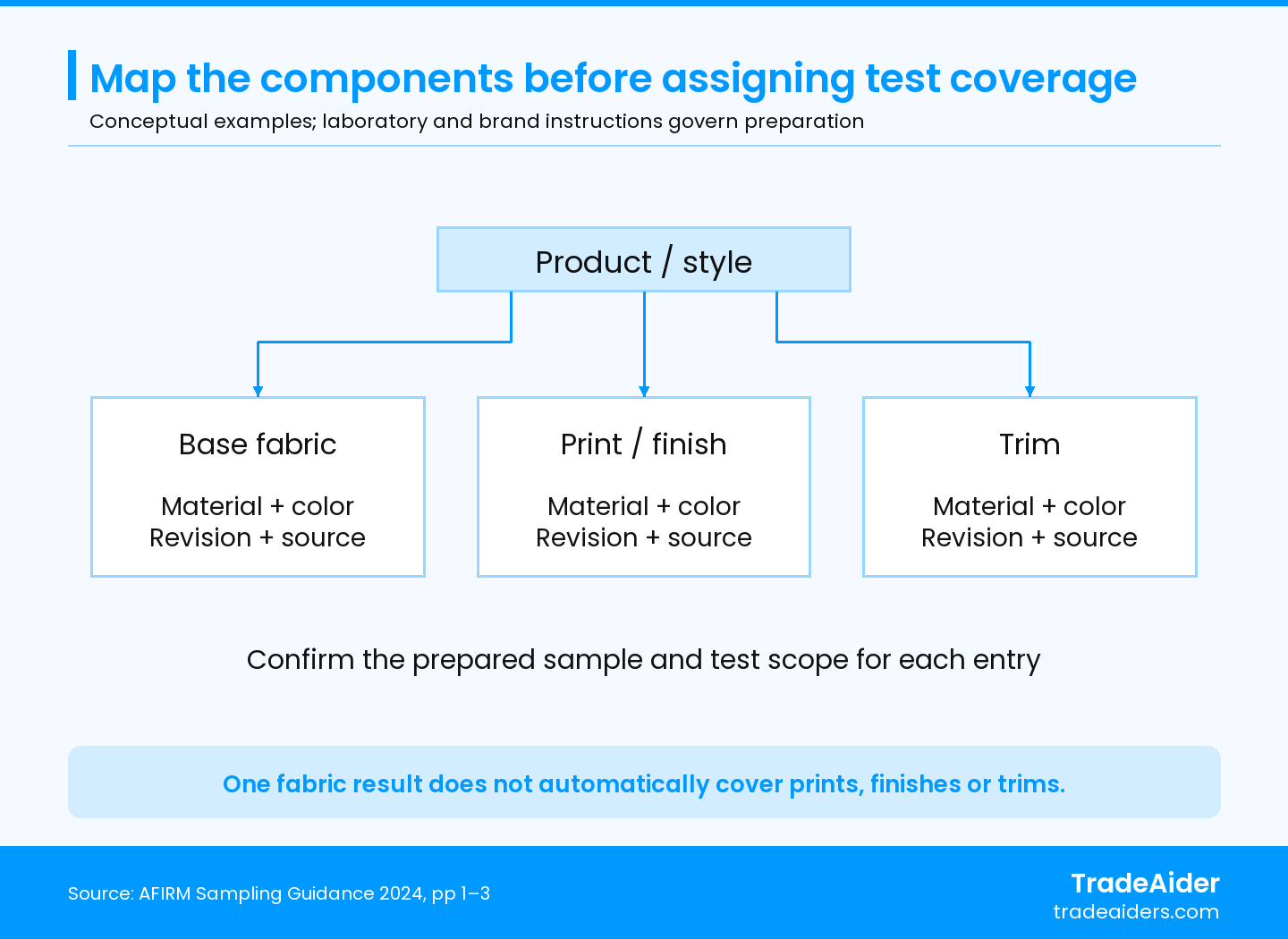
Illustrative plan entries for a multi-material product. Keep each material, color and revision identifiable; have the laboratory and brand decide the appropriate preparation and any permitted grouping. The branches do not mean every layer can be physically separated.
Also identify the supplied state. A raw fabric, a treated fabric and a finished washed garment are different descriptions, even if they start from the same base material. Where upstream evidence is proposed, ask which later print, finish or assembly steps could affect the chemical question. This helps the laboratory decide what evidence remains useful and what still needs a representative finished sample.
Build a material, color and component test matrix
Use material identity to select relevant substance questions, then translate them into the laboratory request. The following matrix is a starting tool, not a complete test panel. Its examples identify potential uses or sources of substances; they do not establish that a particular component contains them or that every listed test is mandatory.
| Material/component entry | Chemical questions to assess | Color/finish and sample boundary | Decision to record |
|---|---|---|---|
| Dyed textile or textile lining | Selected azo-amines; formaldehyde-related finishing questions as applicable | Identify fiber blend, dye/print route, color and final treatment | Adopted matrix rows, specimen IDs and required methods/criteria |
| Placement print, transfer or coated fabric | Relevant additives and residuals; phthalates may relate to some print/polymer systems | Identify the print/coating chemistry and whether the sample can be separated | Prepared state and whether a result describes the layer or combined material |
| Plastic, foam or rubber part | Select relevant additives and substance groups for the actual polymer | Distinguish polymer type, color, supplier and finish | Do not assign every polymer the same panel by appearance |
| Leather upper, patch or trim | Assess relevant leather substances, including chromium VI where applicable | Identify leather process, color, coating and supplied revision | Leather-specific methods and coverage of the finished material |
| Metal fastener, eyelet or ornament | Assess applicable metals requirements, including nickel release where relevant | Identify alloy, plating/paint and the relevant contact condition | Whether the actual finished part and required evaluation are covered |
| Adhesive or bonded combination | Choose applicable residual and chemical questions from the adopted program | Identify adhesive system, applied state and bonded materials | Which finished combination or prepared specimen the result represents |
For each row used, replace the generic description with the actual supplier material reference and color/finish codes. Ask the laboratory to populate the ordered substance groups, methods, limits and reporting limits from the adopted program. Record any deliberate exclusions and their basis. This is more useful than ordering a named package without knowing which product parts it addresses.
Read material definitions as well as substance names. A plasticized print is not simply another dyed textile; a plated eyelet is not described fully by the underlying alloy. If material identity is uncertain, obtain technical information from the supplier and let the laboratory resolve the classification before reducing the scope. “Not selected because unknown” should remain an open gap, not become a pass.
The outcome is a set of requested decisions: this specimen, prepared in this way, assessed for these substances under these criteria. Keep the laboratory’s response against the same row so that missing coverage stays visible when the report arrives.
Decide which colors and finishes each specimen represents
Give each specimen a material, color, supplier, finish and component revision, then state which product variants it is intended to represent. Any grouping needs an explicit basis accepted for the customer’s program. A common style number or similar-looking shade does not establish that two samples share the relevant chemistry or production history.
Create the color map before dispatch. If a garment uses the same body fabric in several colors, list those colors rather than writing only “assorted.” If the print or coating also changes, show that change on its own line. For shoes, a new upper color can coexist with an unchanged lining but a newly colored outsole; map these separately so the laboratory can assess the actual differences.
Avoid making the darkest color a universal proxy. The supplier may use different colorants, binders or finishes across the range, and a light-colored component can introduce a different chemical question. Ask what supports the proposed representative selection and who accepts it. Where that information is unavailable, retain the uncovered color or component as an identified item awaiting a decision.
Add the grouping decision to the request: tested individually, included in a specifically authorized group, or covered by identified existing evidence accepted for this use. Include the member IDs and the conditions of any acceptance. This preserves the difference between several products sharing a proven material and several different materials merely sharing a product name.
Shipment sampling does not resolve these chemical coverage choices. An AQL sampling resource can help discuss defect sampling from a defined order lot; it does not determine how many material/color specimens an RSL program needs. Keep the order population and the laboratory’s component sample map distinct.
Approve composite testing before samples are combined
A composite is a mixture of part samples assessed together. AFIRM’s composite-sampling guidance ties its use to brand instructions, suitable materials and methods, and an appropriate split criterion supported by the laboratory’s reporting limit. It also identifies exclusions, including nickel release and chromium VI. Combining parts is therefore a specific approved decision, not a general shortcut for every matrix row.
Before combining anything, confirm the member IDs, proportions, ordered substances, applicable criteria and how the result will be interpreted. Ask the laboratory to explain whether the method can detect a problematic member after mixing. Preserve enough identified material for any required individual follow-up. If the conditions cannot be justified, retain separate specimens rather than sending an undefined mixed bag.
Illustrative example: Assume equal masses and complete recovery for three hypothetical specimens containing 90, 0 and 0 mg/kg of a substance. Their theoretical mixture concentration is 30 mg/kg. If an invented per-component criterion were 50 mg/kg, that mixture being below 50 would not establish that each member met it: the first member is above 50. These are hypothetical values, not client results, a legal limit or an authorized laboratory split criterion.
The practical action is to obtain a suitable, documented composite interpretation from the laboratory and the brand, including sufficient reporting capability for the applicable decision. Do not use the arithmetic above to create an acceptance rule yourself. If a report does not identify its composite members, resolve that missing scope before extending its result to the individual colors.
Match each laboratory result to the material, color and component tested, and keep its test scope distinct from the observations recorded during order inspection.
Reopen the affected lines when materials or colors change
A substitution should reopen the affected coverage question. In its material and report-acceptance FAQ, AFIRM treats virgin-polyester and recycled-PET versions as distinct materials in its example. Its painted-metal guidance also links acceptance to brand policy and the actual combination: replacing the paint calls for evidence on the new paint. A familiar style name does not explain either change.
Compare the current component map with the tested version. Mark changes in material source or composition, recycled content, dye or pigment, print formulation, coating, adhesive, plating and final treatment as relevant. Then ask the responsible laboratory or brand which substance questions and specimens are affected. The task is to define the changed scope, rather than automatically discard every unchanged result or automatically reuse the entire old package.
Record the answer against the affected rows. For example, an unchanged textile lining can retain its own evidence subject to the program’s acceptance rules, while a new outsole formulation remains pending. Keep that distinction explicit in a footwear matrix. Name the person responsible for each affected row and record the evidence behind the decision. Keep unresolved coverage marked pending, with the agreed next action and purchasing disposition, until the responsible reviewer records an answer. If the supplier cannot identify whether the material actually changed, obtain the missing production or material reference before treating it as unchanged.
Also check whether the adopted RSL, method, limit or report-acceptance policy has changed since the earlier work. There is no universal report validity period supplied by this planning matrix. Retain the program’s actual timing and change rules, plus the decision-maker’s recorded acceptance, rather than invent a standard expiry date for every RSL report.
TradeAider’s product testing services are a starting point for discussing the required laboratory scope; confirm the executing laboratory, accepted methods and report requirements. For pre-shipment inspection, the order quantity is 100% complete and at least 80% packed for export. Agreed visible component, color and packing observations can reveal mismatched references, while chemical concentration remains a laboratory question.
Carry the agreed matrix into the test request and order checks
Turn the matrix into a request that links the accepted requirements to identifiable specimens and the intended report user. Preserve preparation instructions, test scope and open decisions in the same handoff. Agreed inspection observations can support order traceability; they remain separate from laboratory chemical results.
| Request line | Complete for this order | Result or decision to retain |
|---|---|---|
| Requirements | Destination/product category: ___; adopted RSL/version: ___; customer protocol: ___ | Confirmed acceptance basis and recipient |
| Material/color map | Component/material ID: ___; source: ___; color/finish/revision: ___ | Which purchased variants the specimen represents |
| Preparation/grouping | Prepared state: ___; separate or authorized group: ___; member IDs: ___ | Lab/brand instructions and limitations |
| Ordered analysis | Substance group/method: ___; limit/units: ___; reporting limit: ___ | Each requested result against its own criterion |
| Evidence and changes | Report/sample IDs: ___; changed entries: ___; acceptance/open items: ___ | Recorded scope decision and required follow-up |
Use one line per material/color or accepted sample group and ordered test scope. The AFIRM test request form template is another starting resource for a structured submission. Adapt the request to the laboratory and customer requirements rather than assume a template selects the right chemicals or approves a proposed composite.
Ask for the report’s sample description to preserve the component IDs and relevant photographs or member list. Results should identify the substance or group, method, units, reporting capability and applicable criterion, with preparation limitations where they affect interpretation. Reconcile the report with the request before accepting the coverage. A missing requested result remains an unanswered line even if the report has an overall pass on other tests.
For the order handoff, provide the approved component references and report identifiers to the inspection provider. Agree which factory observations will be made and what happens when an item differs from the reference. Keep the chemical review with the responsible laboratory, brand or compliance owner. The inspection record can document what was checked and observed against the agreed scope.
To discuss testing and agreed order checks, contact the TradeAider team with available product and order information, factory, destination, timing, the component/color list and existing reports. Identify substitutions, unresolved laboratory questions and the intended recipient’s language, format and acceptance requirements. Initial information can start the discussion; settle the technical references, equipment and open testing work before inspection.
FAQ
What if a trim is too small for the laboratory’s requested mass?
Ask the laboratory for the quantity needed and whether an identified supplementary sample can represent the actual trim. Agree its material, color and treatment state before dispatch. AFIRM’s guidance notes that extra material for a washed product should receive the corresponding wash. Do not silently replace a finished trim with untreated stock, and disclose any preparation limitation that remains.
Can a supplier’s safety data sheet replace finished-product RSL evidence?
A safety data sheet can help investigate the formulation, but it does not by itself establish a finished component’s RSL result. Use it to clarify chemical identity and the supplier’s process, then ask which product-level evidence the adopted program requires. Keep the document’s product identity and supplied state visible; do not turn an input-chemical declaration into a laboratory result for the finished article.
Does a failed composite identify which color or component failed?
No. A failed composite identifies a problem in the defined group and does not by itself identify the responsible member. Follow the agreed individual-testing procedure using retained, traceable specimens; AFIRM’s sampling guidance calls for individual follow-up after a noncomplying composite. Keep the group result and subsequent member results linked, rather than marking every color as the measured source or changing the group until it passes.
Related Articles


Grow your business with TradeAider Service
Click the button below to directly enter the TradeAider Service System. The simple steps from booking and payment to receiving reports are easy to operate.