
- معلومات عنا

- خدماتنا
- صناعتك
- الموارد
- الأخبار والمدونة
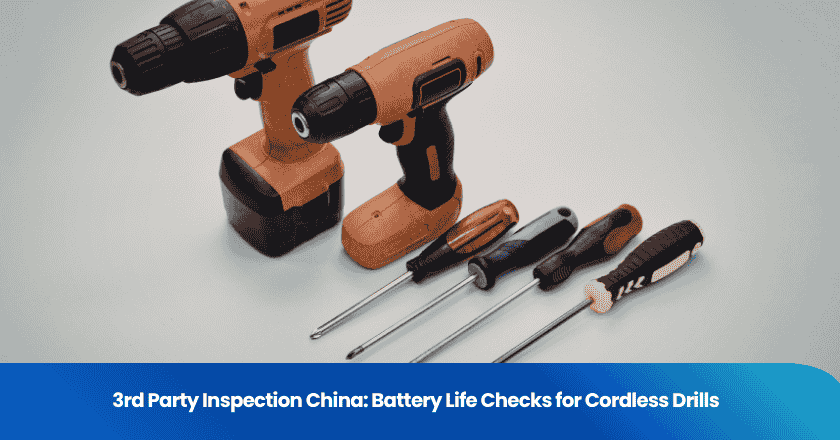
A cordless drill is only as good as its battery. The motor might be powerful, the chuck precise, and the ergonomics perfect — but if the battery dies after 15 minutes of use, your customer is not coming back. Battery life is the single most decisive quality metric for cordless power tools, and yet it is the one most often skipped during factory self-checks in China.
Third-party inspection with dedicated battery life testing catches the gap between what the spec sheet promises and what the battery actually delivers. This article explains how battery life checks work during a pre-shipment inspection in China, what standards apply, and how to build a test protocol that protects your brand.
Key Takeaways
- Battery life defines the cordless drill experience — a battery that underperforms its rated capacity generates returns, negative reviews, and warranty claims.
- Three core battery tests reveal the truth — visual inspection, voltage and capacity testing, and load runtime testing together provide a complete battery health picture.
- Regulatory compliance is mandatory — lithium-ion batteries in power tools must meet IEC 62133, UL standards, and China's GB38031 for safety.
- Third-party inspection with real-time reporting lets you verify battery claims before your products ship — at a fraction of the cost of post-sale failures.
Why Battery Life Is the Most Critical Quality Metric
Battery Performance Determines Product Perception
When consumers review cordless drills online, battery life dominates the conversation. A study of power tool reviews across major e-commerce platforms consistently shows that runtime and charging performance are the most mentioned factors in both positive and negative reviews — ahead of torque, speed, and build quality.
This creates a stark asymmetry: if your factory claims "2.0Ah battery with 45 minutes of runtime" and the actual battery delivers 25 minutes, the product fails in the customer's hands regardless of how well the drill motor performs. The battery is the first and last impression.
For importers sourcing cordless drills from China, this means battery life verification should be a non-negotiable part of every during-production inspection and pre-shipment inspection.
The Hidden Cost of Battery Failures
Battery failures are not just returns — they cascade into compounding costs:
| Cost Category | Impact | Typical Cost per Incident |
|---|---|---|
| Customer return | Return shipping, restocking, disposal | $15-45 per unit |
| Negative review | Reduced conversion rate on listing page | 5-15% sales decline |
| Warranty claim | Replacement unit, shipping, admin cost | $30-60 per claim |
| Safety incident | Product recall, legal liability, brand damage | $50,000+ |
Consider a scenario: an Amazon FBA seller imports 3,000 cordless drills. Post-sale analysis reveals 8% have batteries that deliver less than 70% of rated runtime. That is 240 defective units generating returns, negative reviews, and warranty claims — potentially costing over $15,000. A two-day inspection at $199 per man-day would have cost $398.
How Battery Life Testing Works During Inspection
Visual and Physical Battery Checks
Every battery life test starts with visual and physical verification:
- Label and marking compliance — Verify that the battery label shows correct voltage (V), capacity (Ah), chemistry type (Li-ion, NiCd, NiMH), and required safety markings (UL, CE, CCC, or others depending on target market). Mislabeled batteries are a regulatory red flag.
- Physical condition — Check for case swelling, deformation, scratches, or signs of leakage on the battery pack housing. Swelling is a critical safety indicator of internal cell degradation.
- Terminal condition — Inspect battery terminals for corrosion, oxidation, or bent contacts. Poor terminal contact causes voltage drop under load, reducing effective runtime.
- Weight verification — A battery that weighs significantly less than specification may have fewer or smaller cells inside, directly reducing capacity. Inspectors weigh samples on calibrated scales.
Voltage and Capacity Testing
This is where battery life verification moves from visual to quantitative:
- Open-circuit voltage (OCV) measurement — Using a calibrated digital multimeter, inspectors measure the battery's resting voltage. A fully charged Li-ion cell should read 4.2V per cell (or multiples: 12.6V for a 3-cell pack, 21V for a 5-cell pack). Significantly lower OCV indicates undercharged, degraded, or defective cells.
- Capacity discharge test — The battery is discharged at a constant current rate (typically 0.5C or 1C) until it reaches the cutoff voltage. The total energy delivered (in Ah or Wh) is compared against the rated capacity. A battery rated at 2.0Ah that delivers only 1.4Ah is a clear quality failure.
- Charge cycle verification — For a complete picture, inspectors may perform a full charge-discharge-recharge cycle to verify both charging efficiency and discharge capacity match specifications.
These tests require specific equipment (electronic loads, battery analyzers) that a qualified inspection service brings to the factory or arranges through a nearby testing laboratory.
Load and Runtime Testing
Voltage and capacity tests tell you about the battery in isolation. Load testing tells you how it performs in the actual drill — which is what your customer experiences:
- Stall torque test — The drill chuck is locked and the trigger is pulled. The battery's voltage drop under maximum load is measured. A healthy battery should maintain at least 80% of its rated voltage under stall conditions. A battery that drops below 60% will cause the drill to feel weak and trigger low-voltage protection prematurely.
- Runtime under rated load — The drill drives screws or drills holes under a controlled load (simulating normal use) until the battery is depleted. The total runtime is compared against the factory's claim. If the spec says 45 minutes and the test delivers 28, you have a problem worth catching.
- Thermal behavior — During load testing, the battery's surface temperature is monitored. Excessive heat (above 60 degrees Celsius on the pack surface) indicates high internal resistance, poor cell quality, or inadequate thermal management — all precursors to premature failure.
Load testing is the most time-intensive part of battery inspection, but it provides the data that matters most to your customer. This is where TradeAider's real-time reporting delivers maximum value — you see the runtime clock counting down, the temperature rising, and the final result as it happens.
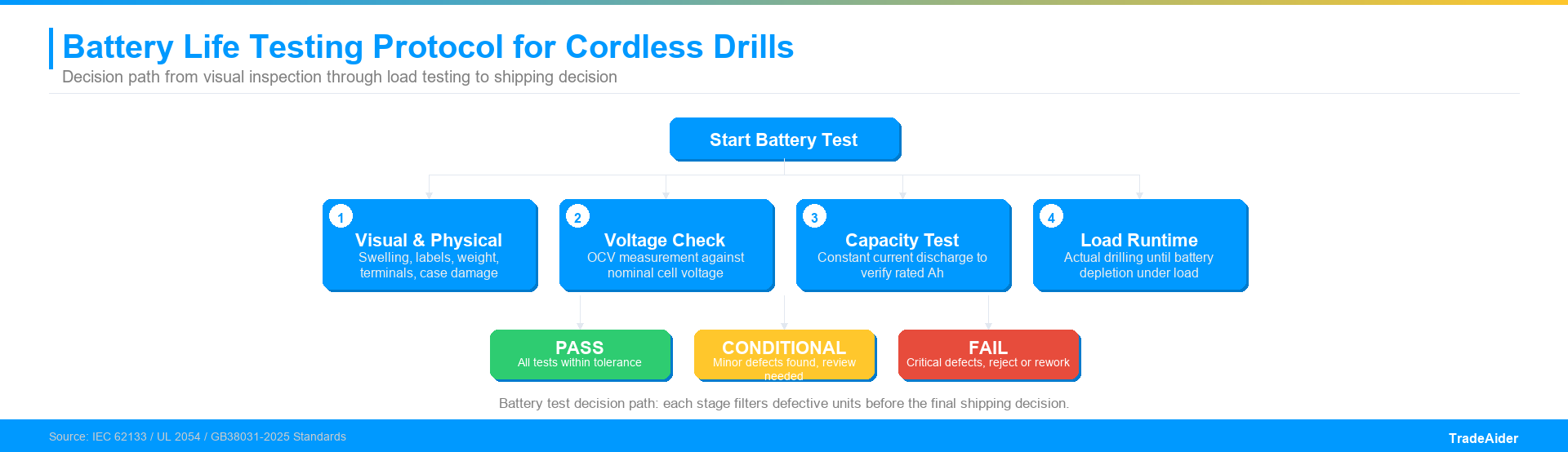
Battery test decision path: from visual inspection through load testing, each stage filters out defective units before they reach the next level of verification.
Regulatory Standards for Cordless Drill Batteries
US and EU Compliance Requirements
Cordless drill batteries — particularly lithium-ion packs — are subject to strict safety regulations in major markets:
United States: Lithium-ion batteries must comply with UL 2054 (household and commercial batteries) or UL 2595 (battery systems for power tools). The Consumer Product Safety Commission (CPSC) also requires that battery-powered tools meet applicable safety standards, and has issued recalls for power tools with batteries that overheat or catch fire.
European Union: Li-ion batteries must comply with the IEC 62133 standard for safety of portable sealed secondary batteries. Products carrying the CE mark must have a Declaration of Conformity that references this standard. The EU Battery Regulation (2023/1542) also requires battery passports for industrial batteries above 2kWh and supply chain due diligence for cobalt, lithium, and nickel.
China's GB Standards and CCC Certification
China's own regulatory framework for batteries has tightened significantly. The GB38031 standard mandates that battery packs must not catch fire or explode even during thermal runaway events. Products sold in China require CCC (China Compulsory Certification), which includes battery safety testing. Even if your products are exported (not sold in China), factories producing CCC-certified products generally maintain higher quality standards — and your inspector can verify compliance documentation during factory audit.
Building an Effective Battery Test Protocol
Defining Test Parameters
Before your inspection begins, document the exact test parameters the inspector should follow. Here is a practical template for a 20V cordless drill with a 2.0Ah Li-ion battery:
| Test | Parameter | Pass Criteria |
|---|---|---|
| OCV check | Fully charged resting voltage | 21.0V +/- 0.3V (5S pack) |
| Capacity discharge | 0.5C discharge to cutoff | ≥1.9Ah (≥95% of rated 2.0Ah) |
| Runtime test | Moderate drilling load | ≥85% of factory claimed runtime |
| Thermal check | Surface temp during load | Below 55 degrees Celsius |
| Voltage sag | Under stall torque | ≥16.8V (80% of nominal) |
Use the AQL calculator to determine how many batteries to test from your production lot. For high-value power tool batteries, a tighter AQL level (1.5 or 1.0) is recommended given the cost of post-sale failures.
Pass/Fail Criteria for Battery Performance
Define clear thresholds before the inspection:
- Critical failure (automatic reject) — Battery swelling, leaking, or emitting odor; OCV below 90% of nominal; capacity below 80% of rated; surface temperature exceeding 65 degrees Celsius under load.
- Major defect (conditional accept) — Capacity between 85-95% of rated; runtime below 85% of claim; terminal corrosion; label missing required information.
- Minor defect (acceptable) — Cosmetic scratches on battery housing; label alignment issues; minor voltage variation within tolerance.
Common Battery Issues Found During Inspection
After inspecting hundreds of cordless drill shipments, certain battery problems repeat across factories:
- Cell grade substitution — The factory uses Grade B or Grade C cells (cells that did not pass manufacturer quality screening) instead of Grade A cells. These cells have lower actual capacity, higher internal resistance, and shorter cycle life. Weight testing and capacity discharge testing expose this substitution reliably.
- Fake capacity labels — The label says 2.0Ah but the actual cells inside are 1.5Ah. Discharge testing reveals the truth within minutes.
- Inadequate battery management system (BMS) — A cheap or missing BMS allows over-discharge, over-charge, or thermal runaway. Inspectors check that the BMS cuts off at the correct voltage and that temperature protection engages properly.
- Poor soldering on battery tabs — Cold solder joints or excess solder on cell-to-cell connections increase resistance and generate heat. Visual inspection under magnification catches this.
- Inconsistent cell matching — Battery packs with poorly matched cells (different internal resistance or capacity) cause some cells to overcharge while others undercharge, reducing pack life dramatically. Capacity testing across multiple samples reveals batch-level inconsistency.
Catching any of these during a third-party inspection gives you the leverage to demand corrective action from the factory before production is completed — rather than discovering the problem after your customer's drill dies mid-project.
Frequently Asked Questions
How many batteries should be tested during an inspection?
For a standard pre-shipment inspection, 5-10 batteries from the AQL sample are selected for full testing (OCV, capacity, runtime). This is sufficient to identify systemic quality issues like cell substitution or fake capacity labels. For critical orders or new suppliers, increase to 10-15 samples for higher statistical confidence.
Can battery life testing be done at the factory?
Yes. Most battery life tests (OCV, visual, weight, basic capacity discharge) can be performed on-site at the factory. Full cycle life testing (500+ charge-discharge cycles) requires laboratory conditions and takes weeks. On-site testing focuses on verifying that the batteries in your current production lot meet specifications — which is exactly what you need before shipping.
What happens if batteries fail the inspection?
If batteries fail, the inspector documents the specific failure (capacity measured, runtime recorded, temperature observed) with test data and photographs. You then work with the factory to identify the root cause — typically cell grade, BMS quality, or assembly issues. After corrections are made, schedule a re-inspection to verify. Contact our team to arrange battery life testing for your next cordless drill shipment.
Does TradeAider provide battery safety certification testing?
TradeAider performs on-site battery life verification (capacity, runtime, thermal behavior) as part of standard inspection. For formal safety certification testing (UL, IEC 62133, CE), samples are submitted to accredited testing laboratories through product testing services. Your inspector can coordinate both on-site verification and lab submission in a single visit.
مقالات ذات صلة


نمِ عملك مع خدمة TradeAider
انقر على الزر أدناه للدخول مباشرة إلى نظام خدمة TradeAider. الخطوات البسيطة من الحجز والدفع إلى تلقي التقارير سهلة التشغيل.

