
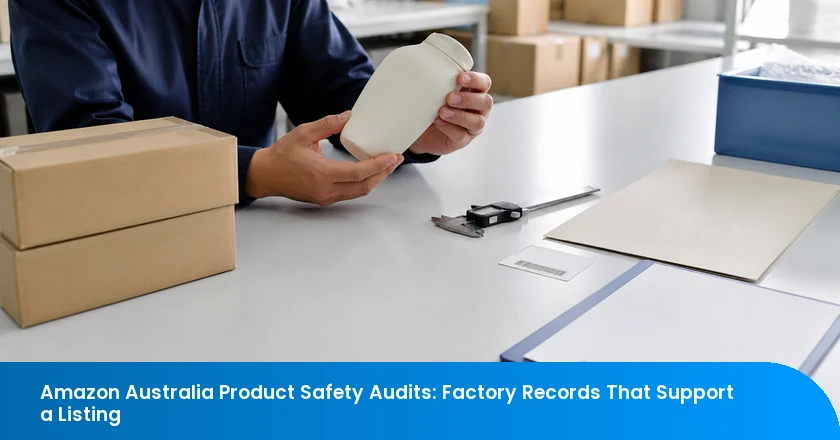
For Amazon Australia, a factory record supports a listing only when it can be connected to the product actually offered for sale: the current variant, the relevant Australian product-safety question, the finished lot, and the retail pack or listing information. A polished certificate with no traceable connection to those items can still leave the buyer unable to respond to a request. The working goal is a reviewable evidence chain, not a larger folder of documents.
Start With the Evidence Boundary, Not a Generic Audit
For an Amazon Australia offer, the supplier still needs to understand the applicable Australian product-safety duties; selling through an online marketplace does not transfer that responsibility to an inspection file. ACCC Product Safety guidance for online sellers says businesses at every stage of the supply chain must follow Australian product-safety laws. The ACCC's product-safety responsibilities page also makes clear that suppliers must comply with applicable mandatory standards and bans.
A factory audit or inspection can verify agreed production evidence, but it cannot provide legal advice or guarantee that Amazon will approve a listing. That boundary matters because the evidence request, product category, customer-facing claims, and Australian obligations can be different for each item. Treat the current Amazon notice and the applicable Australian rule as the decision inputs; use the factory file to establish what the goods are and how they were controlled.
The most reliable starting question is therefore not “Which certificate do we have?” Ask instead: “Can a reviewer follow this record from the listed variant to the finished cartons?” If the answer is unclear, the record may be useful background, but it is not yet reliable listing support. A good audit scope helps expose that gap before goods are released.
What Makes a Factory Record Useful for an Australian Listing
Listing-support evidence is strongest when it ties one current product identity to the relevant Australian check, the finished lot, and the customer-facing label or listing reference. It should be possible to see what was tested or checked, which variant it describes, which factory made it, and whether anything material changed after the record was created.
- Identity first: model, variant, material, product image, supplier, and retail pack should not point to several similar products.
- Scope before status: a “pass” matters only if the test, certificate, or inspection covers the relevant requirement and the actual configuration.
- Change history stays attached: a material, design, label, or pack change can make an older record unsuitable for the finished variant.
- Lot boundary stays visible: carton range, SKU, production date, or another practical identifier lets the buyer hold only the affected goods.
- Inspection is a handoff: it can reconcile agreed physical facts with the evidence file; it is not an Amazon account or legal approval.
That structure is also more practical for a sourcing team. It separates the question of whether a product needs a particular Australian review from the equally important question of whether the available record describes this production run. When those two questions are combined, teams often accept an old report because the product name looks close enough.
Build One Product Evidence Pack Before the Request Arrives
An Amazon request should be treated as a request for an evidence chain rather than a request for a generic certificate: each item should make the exact ASIN product easier to identify and verify. An ASIN is Amazon's identifier for the product offered on a listing. An Amazon Australia Seller Central moderator has explained that a requested laboratory report can need the product description and model, applicant and manufacturer details, evidence of compliance, and a product image that matches the ASIN. Read the Amazon Australia discussion; the specific request shown in Seller Central remains the controlling document.
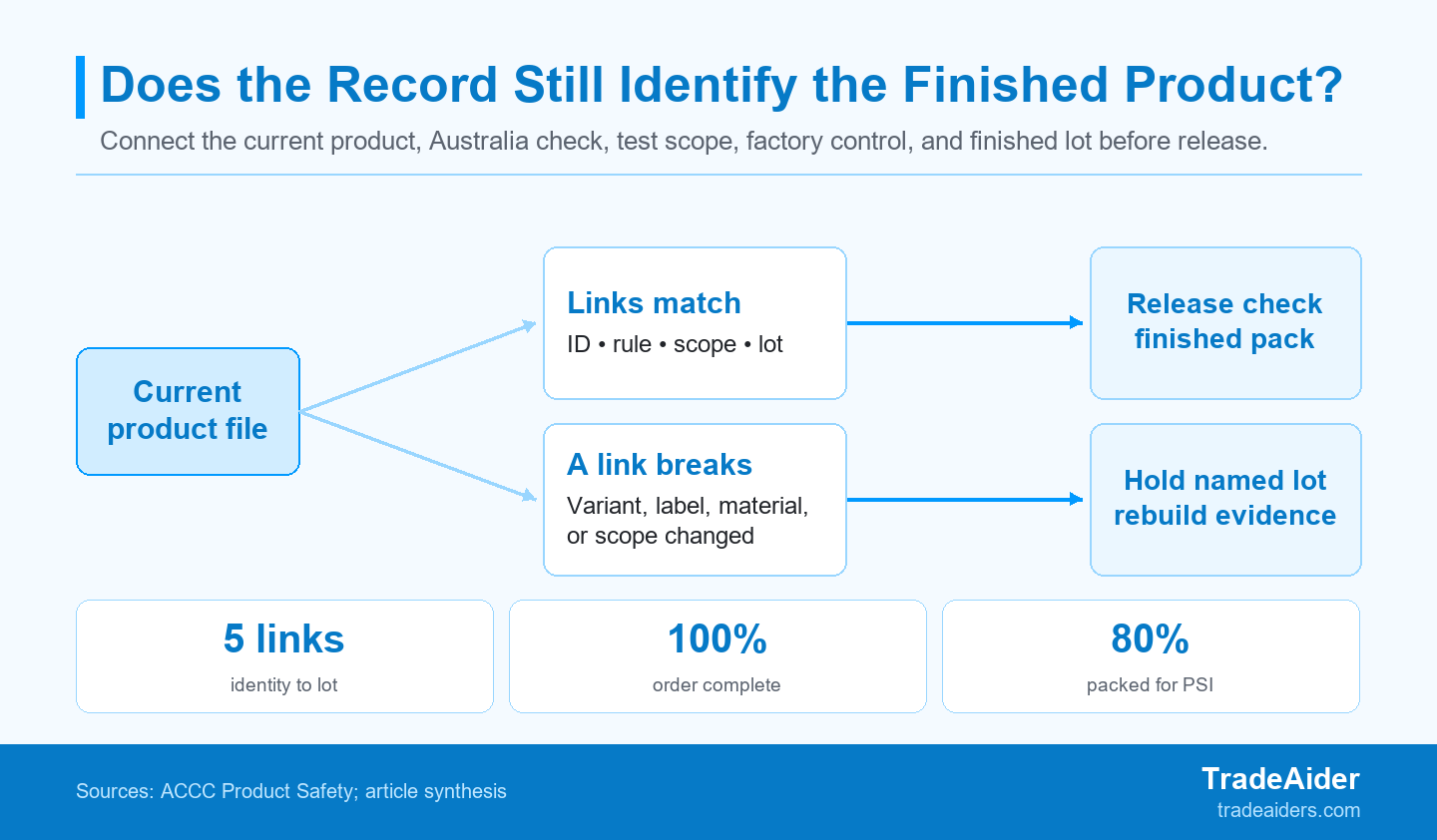
A release decision is only defensible when each evidence link still identifies the finished product and its lot.
For operational use, keep one evidence pack per product configuration rather than one broad supplier folder. “Configuration” includes the factors that could change the product that customers receive: SKU, colour or size where relevant, materials, electrical components, retail pack count, warnings, and label artwork. A product image is helpful only when it matches that configuration rather than a marketing prototype or a parent listing with several variants.
| Evidence link | What it should identify | Common mismatch that needs review |
|---|---|---|
| Product identity | Model, variant, material, image, and retail pack | Report names a similar sample or older model |
| Australia check | Applicable standard, information rule, ban check, or specialist route | A foreign test is assumed to answer an Australian requirement |
| Test or certificate scope | Method, configuration, date, laboratory, and conclusion | The scope does not include the final material or pack |
| Factory control record | Lot, control point, finding, correction, and verification | A correction is reported with no affected-lot boundary |
| Release evidence | Finished lot, current pack, label, and listing reference | Inspection occurred before a later label or component change |
Do not build the pack around a claim that an inspector cannot verify. For example, an inspection report can record a visible warning label against agreed artwork, but it should not imply that the warning language fulfils every legal requirement. The useful handoff is an observable fact plus the exact source file used for comparison. TradeAider applies that boundary when an inspection scope is built around buyer-supplied product references.
Prove That Every Record Names the Same Product
The test report, product image, model or variant, applicant and manufacturer details, retail pack, and listing attributes should describe the same product configuration. The Amazon Australia request example notes these kinds of product and party identifiers, so keep the complete matching record fields together. Start with a one-line identity string that a factory, buyer, laboratory, and marketplace operator can all read: product name, internal SKU, variant, pack count, factory, and the relevant product image version. Attach that string to the inspection brief and the evidence index.
This is where a factory audit becomes more than a capability review. The reviewer should look for a controlled specification, bill of materials where relevant, label artwork approval, and a method for separating variants. If the factory uses its own codes, map them to the buyer's SKU rather than assuming the codes will be self-evident to an Amazon reviewer.
Check Scope, Date, and Change History Before You Rely on a Report
Australian product-safety guidance says a report should be checked for the correct stock and relevant mandatory standard, and major design, material, or production changes can require retesting. In this context, that term means an Australian requirement that makes particular product features compulsory. The ACCC Product Safety testing guidance also advises suppliers to check that reports are complete, current, and applicable to the stock being supplied.
A change log is not paperwork for its own sake: it is the decision record that shows whether earlier test evidence still identifies the final variant. Record what changed, when it changed, which variants and cartons were affected, whether the change was approved, and what evidence must be re-evaluated. A “no change” confirmation can be valuable as well, provided the person responsible and the product boundary are clear.
There is no universal expiry date that makes every report valid or invalid. The better question is whether its scope still describes the product. A change in colour may be immaterial for one product and important for another; a material substitution, electronic component change, pack count change, warning change, or new intended use deserves a deliberate review. Where the requirement is unclear, seek product-specific regulatory or legal advice instead of stretching an inspection result.
Map the Product to Australian Safety, Information, and Ban Checks
If a product has an Australian mandatory standard, it must meet the relevant requirements before it is supplied in Australia; the requirements can include design, construction, packaging, or labelling. Such a rule can require particular safety or information features before supply. ACCC Product Safety's standards guidance explains that these requirements apply before supply, not after a listing has gained traction.
Before an online product is supplied to Australia, the seller should check bans and block products that are banned or non-compliant with Australian law. The ACCC Product Safety ban guidance specifically tells online sellers to make those checks before supply. This is a product-by-product exercise. An evidence pack should point to the exact product classification decision, not state broadly that the factory is “Australia compliant.”
Use a simple applicability note in the pack: product category; intended consumer and use; relevant Australian mandatory safety or information standard if one applies; ban check; other regulator or specialist route if relevant; and the source or adviser responsible for that conclusion. The note does not replace specialist advice. It stops the common error of having an excellent factory record for a question nobody has defined.
Use Test Evidence That Matches the Australian Question
Written third-party testing evidence can help support product-safety decisions, but the buyer still needs to be satisfied that the testing meets the obligations for the product and market. The evidence index should record the report number, laboratory, product identity, sampled configuration, standard or method, result, report date, and any limitations. That makes it possible to compare the test sample with the physical variant on the factory floor. Use the ACCC Product Safety testing guidance to review the report's stock and standard coverage.
A laboratory's accreditation must be checked against the particular standard or part of a standard being tested; accreditation for one test does not establish competence for every test. Ask what the accreditation covers, whether it is current, and whether it relates directly to the requested work. The ACCC Product Safety laboratory guidance notes that a laboratory may need more than one sample when tests destroy products or when variants require separate evidence.
A report can be genuine and still be the wrong record for a particular Amazon Australia question. It may cover a prior material, a different pack, a different label, or a different product family. Do not change the product description in a spreadsheet to make a report look closer to the listing. Preserve the original record, describe the mismatch, and decide whether the correct response is additional information, focused verification, retesting, or a hold.
Turn Factory Controls Into Listing-Ready Records
A product-safety compliance program should assign responsibility, conduct shipment inspections, obtain appropriate test certificates, fix failures before supply, and keep records. ACCC Product Safety's compliance-program guidance treats written records, accountable responsibility, inspection, and corrective action as connected parts of a practical program.
The most useful factory records are the ones that connect a control point to a named product, lot, observation, correction, and verification result. A receiving record that identifies only a supplier shipment is weaker than one that links the material code to the final variant. A corrective-action note that says “fixed” is weaker than one that states the defect, affected quantity, corrected action, recheck method, and result. TradeAider can use a factory audit to examine the control records that establish those links.
Ask the factory to nominate an evidence owner. That person should be able to retrieve the approved specification, production change log, incoming-material record where relevant, in-process checks, final inspection record, packaging approval, and carton map. The role is not to create paperwork after a request. It is to preserve the production facts while they can still be verified.
Use Inspection Evidence at the Correct Release Stage
For TradeAider, a pre-shipment inspection is scheduled when the order quantity is 100% complete and at least 80% packed; that finished-goods check can then reconcile the final product and pack with the evidence file. The 80% threshold concerns packing, not production completion. This timing gives the buyer a named lot, retail pack, carton marks, and final label to compare while a correction or hold is still possible.
At this stage, an agreed inspection scope can check observable facts: SKU and variant, quantity, appearance, workmanship, selected function tests, retail pack, label presence, carton marks, and carton range. Pair those findings with the evidence index. If a record refers to a different product configuration, do not hide that fact inside a pass/fail summary; state the discrepancy and the release decision it affects.
Product traceability also has a downstream safety purpose. Australian recall guidance says suppliers are responsible across the supply chain and begins with identifying affected products and assessing risk. That is why an identifiable carton range and variant boundary are valuable even before a problem exists. When the file is ready, you can verify finished, packed goods before shipment.
Illustrative Scenario: A Test Report That No Longer Identifies the Finished Variant
Illustrative scenario: In the illustrative scenario, an unrecorded material substitution means an older test report no longer clearly identifies the finished Amazon Australia variant. The decision is to isolate the changed configuration rather than assume that every carton shares the same evidence status.
Hold the Identifiable Variant, Then Rebuild the Evidence Link
Illustrative scenario: a marketplace seller works with a factory and inspection coordinator before shipment. The order contains 1800 storage organizers across three 600-unit variants for Amazon Australia. Variant B is 600 Variant B units in cartons B01-B15. The order is finished and the variants are separated by SKU, carton range, and retail-pack label. Variant B changed from a coated fabric to a different coated fabric after the earlier test report was issued. The change record identifies the supplier material code but the report and product image still show the former configuration. The carton map isolates Variant B in cartons B01-B15 while Variants A and C retain the previously documented configuration.
The issue is not whether the old report looks formal. The issue is that it does not clearly identify the finished Variant B configuration. The evidence chain remains intact for A and C but is broken for B. The buyer holds cartons B01-B15, keeps A and C within their normal release decision, and asks for the appropriate product-specific confirmation or test action for Variant B. The buyer also updates the evidence index and listing reference if the material change affects them.
The affected variant is held while the buyer obtains the correct product-specific evidence and verifies the finished material, pack, and label against the corrected record. Freeze the changed variant's listing evidence, retain the change record, update product identifiers or images if needed, and reconcile the corrected file to the held cartons. Release Variant B only when the current material, scope of evidence, product identity, label, and finished cartons identify the same configuration and the responsible owner accepts the updated file. This illustrative example is not a statement that every fabric change has the same regulatory consequence; hold only Variant B cartons B01-B15 because they are identifiable, not the entire order.
That conditional decision is often faster than a broad stop-start response. It preserves evidence, isolates the fact pattern, and gives the responsible product or legal specialist a defined question. It also makes any subsequent inspection focused: the inspector is checking the re-established link, not rerunning every historical document.
Send a Factory Evidence Brief That Can Be Checked
A release brief should name the product, variant, relevant Australia check, record set, lot boundary, change trigger, and release authority so that inspection evidence can be reconciled rather than merely collected. Give the factory and inspection provider the current specification, product image, retail-pack artwork, listing attributes that must match the physical product, report index, and carton map. State which records are reference-only and which need a visible or documentary comparison.
Include a clear escalation line: if the sampled unit, pack, label, material identifier, or carton reference differs from the agreed file, who decides whether the affected product is held, corrected, retested, or released? The answer should belong to the buyer's responsible owner, not to a generic inspection conclusion. This keeps the scope honest and makes a later corrective action easier to follow.
For an Amazon Australia product file, TradeAider can help verify agreed factory and finished-goods facts against the buyer's supplied references. Bring the current listing evidence, applicable product question, variant list, and release boundary into the scope, then request an e-commerce inspection scope for your current product file.
Frequently Asked Questions
Does a factory audit prove an Amazon Australia listing is compliant?
A factory audit does not prove an Amazon Australia listing is compliant, because it documents controls rather than a legal or platform decision. It can show whether the factory has controlled specifications, traceable records, change handling, and inspection evidence for an agreed product. The buyer still needs to interpret the current Amazon request and the applicable Australian product requirements for that item. Use the audit to strengthen the factual file, not to replace the responsible compliance decision.
Which identifiers should match across product safety records?
The product model or variant, material or configuration, product image, retail pack, supplier details, and listing attributes should all identify the same product. Add a lot or carton boundary when the records need to support a release decision. A broad product family name is usually not enough when variants differ in material, components, warning labels, or pack count. The practical test is simple: could an independent reviewer match the document to the physical unit without relying on assumptions?
When should an older test report be reviewed again?
Review it whenever the product design, material, production method, pack, label, or applicable requirement has changed enough that the tested sample may no longer match finished goods. Do not use a fixed time period as a substitute for that assessment. Some changes will be immaterial; others can change the product identity or the relevance of the test method. Preserve the earlier report, document the change, and obtain the appropriate specialist input or new evidence for the current configuration.
Can an inspection replace product testing for Australia?
An inspection cannot replace product testing for Australia because the two activities assess different, product-specific questions. An inspector can confirm observable product, pack, label, quantity, and carton facts against buyer-supplied references. A laboratory report may address a defined technical requirement for a tested configuration. Use both evidence types within their stated scope, and avoid presenting either one as a universal legal or marketplace approval.
What should happen if a safety concern appears after release?
An Amazon compliance request is product- and notice-specific, so the current request and the applicable Australian requirements control over a generic document checklist. The Amazon Australia request example illustrates product-specific record fields, while Australian standards guidance explains that the relevant mandatory standard controls before supply. Stop selling the affected product, identify the lot and risk, and follow the applicable Australian reporting or recall process without waiting for a routine documentation review. The right action depends on the product, issue, and supply-chain role, so obtain appropriate professional advice where needed. The evidence pack is valuable because it helps locate the affected configuration, records, cartons, and customer-facing information quickly. Keep release files, change records, and traceability references accessible after shipment.
مقالات ذات صلة

نمِ عملك مع خدمة TradeAider
انقر على الزر أدناه للدخول مباشرة إلى نظام خدمة TradeAider. الخطوات البسيطة من الحجز والدفع إلى تلقي التقارير سهلة التشغيل.

