
- معلومات عنا

- خدماتنا
- صناعتك
- الموارد
- الأخبار والمدونة
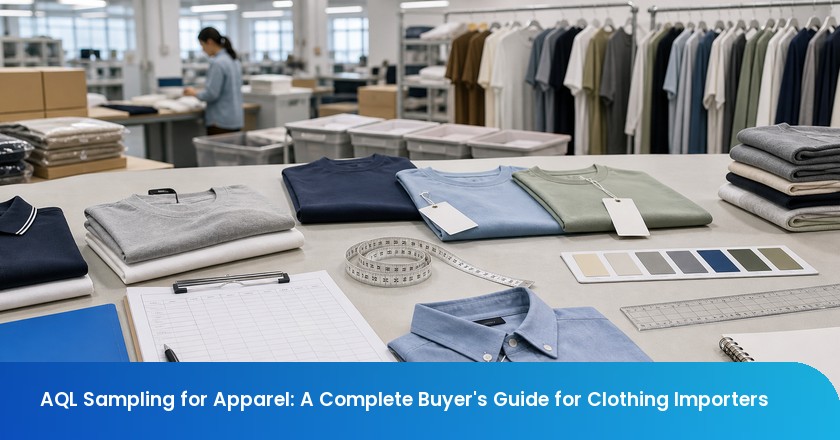
AQL sampling for apparel is a structured way to inspect a clothing lot by checking sampled garments for critical, major, and minor defects, while also covering size, color, measurement, workmanship, labels, and packing risks. It does not guarantee that every garment is perfect; it gives the buyer a consistent release decision based on the agreed sample size and defect thresholds.
Apparel buyers often hear AQL from inspectors, factories, and sourcing agents, but the term becomes practical only when the buyer defines the lot, size-color spread, inspection level, AQL values, defect classifications, measurement plan, and release rule. Without those inputs, the report may count defects but fail to answer the buyer's real question: can this shipment be released?
Clothing inspection also has a special challenge. A garment lot may include many sizes, colors, styles, fabric lots, trims, labels, and packing methods. If sampling is not distributed intelligently, the report may over-check one size and miss the variation that actually contains the defect. Apparel AQL should therefore combine statistical sampling with merchandising sense.
- Sampling layer: lot size, inspection level, sample size, AQL values, and Ac/Re numbers.
- Apparel layer: size-color coverage, measurements, workmanship, trims, labels, and packing.
- Defect layer: critical, major, and minor defects defined with garment-specific examples.
- Decision rule: AQL decides sampled pass/fail; measurement and compliance checks may need separate rules.
The Direct Answer
Set apparel AQL by defining the lot, covering size and color spread, applying defect-class AQL limits, and adding garment measurement checks that are not hidden inside cosmetic sampling.
ISO 2859-1:2026 is the current ISO standard for AQL-indexed sampling procedures for lot-by-lot inspection by attributes. Source: ISO 2859-1:2026.
ASQ describes ANSI/ASQ Z1.4 as an acceptance sampling system for attributes inspection using AQL. Source: ASQ Z1.4 and Z1.9 overview.
CPSC clothing guidance explains US flammability requirements for wearing apparel under 16 CFR part 1610 and related children's sleepwear rules. Source: CPSC clothing business guidance.
FTC apparel labeling guidance explains that most textile and wool products require labels showing fiber content, country of origin, and the responsible business identity. Source: FTC apparel labeling.
AQL sampling is not a substitute for flammability testing, fiber-content verification, care-label compliance, or legal review. It is the physical inspection layer that checks whether sampled garments match the buyer's approved files and visible requirements.
Apparel AQL Setup
The buyer should build the sampling plan before finished garments are packed.
| AQL Element | Apparel Meaning | Buyer Decision | Common Mistake |
|---|---|---|---|
| Lot definition | Style, color, size range, PO line, and shipment quantity | What garments belong to one decision? | Mixing styles into one vague lot |
| Size-color spread | Sample distribution across sizes and colors | Which variations must be represented? | Checking only easy sizes |
| Defect class | Critical, major, minor garment defects | How severe is each finding? | Debating severity after failure |
| Measurement sample | Garments measured against spec | How many pieces per size? | Treating measurements as cosmetic defects |
| AQL value | Acceptance limit by defect class | How strict is release? | Using same limit for all defects |
The buyer should separate workmanship sampling from measurement sampling. AQL can count attributes defects such as stains, broken stitches, skipped stitches, holes, shading, wrong label, or poor packing. Measurements may need their own sample count and tolerance rules because one out-of-tolerance size can create fit complaints even when the cosmetic defect count passes.
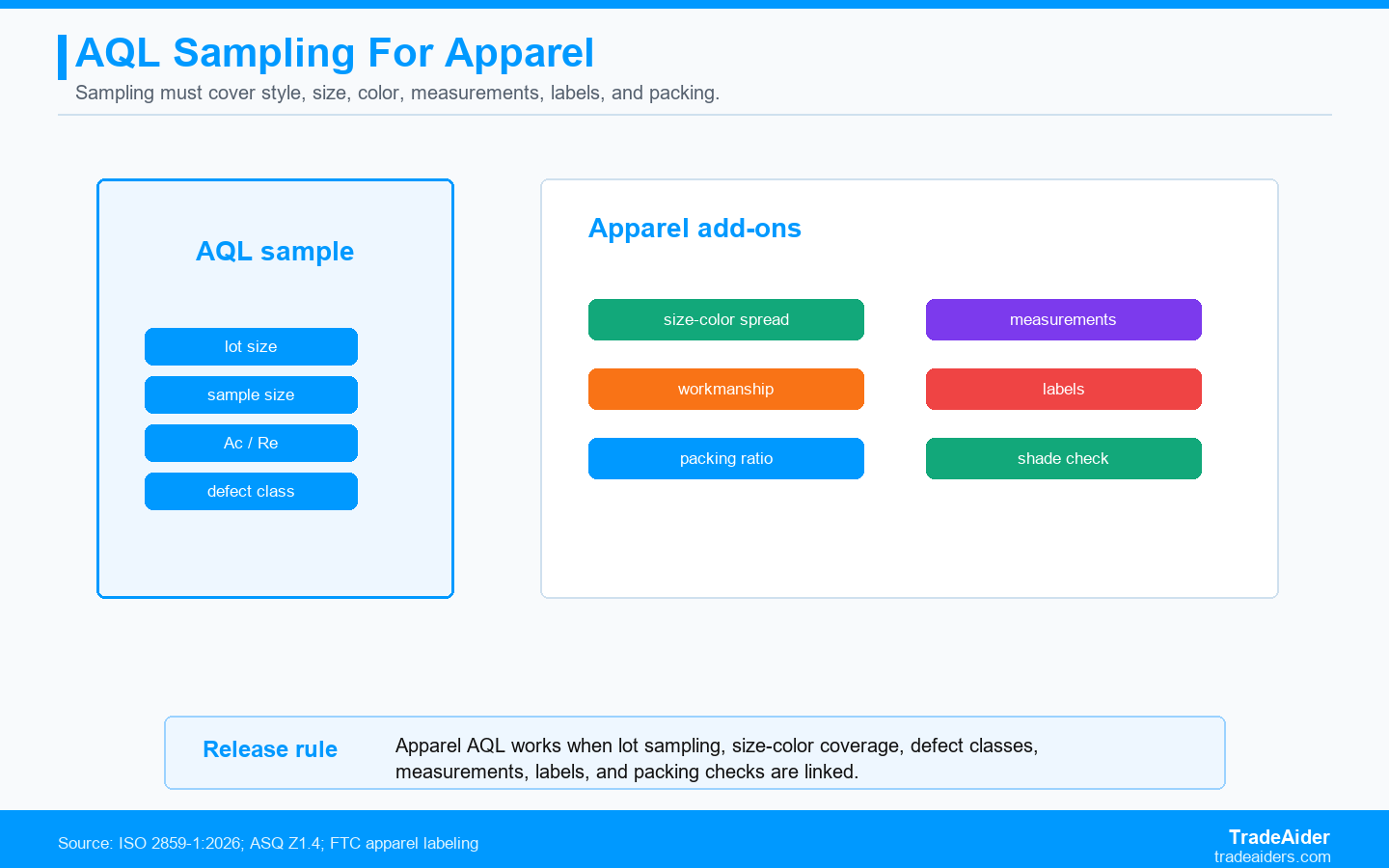
Apparel AQL works when lot sampling, size-color coverage, defect classes, measurements, labels, and packing checks are linked.
Step 1: Define The Apparel Lot
A lot should reflect the commercial decision, not factory convenience.
A clothing lot may include multiple sizes and colors under one style. The buyer should decide whether the entire style is one lot or whether each color, size range, or delivery batch needs separate coverage. A high-risk color, fabric lot, print, wash, or trim variation should not disappear inside a large combined lot.
If a style has six sizes and four colors, the inspector should not randomly check only the most accessible cartons. The sample plan should cover carton locations and variation spread. Otherwise, the report may miss shade difference, wrong label, wrong size ratio, or measurement drift in one color or size.
The buyer should also confirm production status. Apparel PSI usually works when goods are finished, pressed, folded or hung, labeled, and packed enough to represent the shipment. If too little is ready, the sample may not represent the lot. If everything is sealed and inaccessible, the inspector may not be able to check garment details properly.
Step 2: Classify Apparel Defects
Defect severity should follow customer use, brand promise, and compliance risk.
Critical defects in apparel may include safety or legal issues such as missing required warning, hazardous sharp object left in garment, severe contamination, wrong regulated label, or a condition that makes the product unsafe. Critical defects usually have the strictest tolerance.
Major apparel defects affect saleability or normal use. Examples include holes, broken seams, incorrect size label, wrong color, severe measurement out of tolerance, broken zipper, missing button, heavy stain, severe shade variation, wrong care label, or incorrect packing ratio. Major defects are the core commercial risk for most garment inspections.
Minor defects are lower-impact issues such as small hidden loose thread, slight crease, minor underside mark, or small packing blemish. Minor defects still matter when frequent because they show process control weakness and may affect customer perception at scale.
Step 3: Add Measurement And Label Checks
Apparel AQL is incomplete if it ignores fit and labels.
Measurements should be checked against the approved spec, size chart, and tolerance. The buyer should define which points of measurement matter: body length, chest, waist, hip, sleeve, inseam, shoulder, rise, hem, collar, cuff, or other garment-specific points. For stretch fabrics, the measurement method should be consistent.
Labels should be checked for size, fiber content, care instructions, country of origin, RN or responsible identity where relevant, hangtag, barcode, carton mark, and polybag warning where applicable. A garment can pass workmanship and still fail because the label file is wrong.
Packing should include size ratio, color ratio, folding, hanging, polybag, sticker, carton quantity, carton mark, barcode, and carton condition. For e-commerce apparel, customer-facing pack presentation can be as important as factory carton count.
Where TradeAider Fits In Apparel AQL
TradeAider fits by turning apparel specs into sampling, measurement, label, and packing evidence.
TradeAider can use Pre-Shipment Inspection to inspect apparel lots by AQL sampling, workmanship defects, measurements, labels, size-color spread, packing, carton marks, and report photos before release.
If garment defects are likely to appear during sewing, washing, finishing, or packing, During Production Inspection can catch issues before the finished lot is packed. If supplier capability is uncertain, factory audit service can review production and quality systems.
The business fit is fit and finish discipline. TradeAider helps clothing importers avoid a report that counts stains while missing measurements, labels, size spread, or packing ratio.
SPAR Scenario: The Lot Passed Workmanship But Failed Fit
The buyer needed measurement rules separate from cosmetic AQL.
Situation: A buyer orders 20,000 knit tops in four colors and six sizes. The supplier says final inspection can use standard AQL.
Problem: PSI finds few stains or sewing defects, but measurement checks show the medium and large sizes in one color are outside chest tolerance. The factory had cut one fabric lot incorrectly.
Action: TradeAider reports workmanship AQL separately from measurement findings, identifies affected color and sizes, and asks the supplier to sort and replace out-of-tolerance pieces before shipment.
Result: The buyer avoids fit complaints that would not have been caught by cosmetic defect counting alone.
Action Card: Apparel AQL Checklist
Build the plan around style, size, color, measurements, labels, and packing.
- Define lot by style, color, size range, PO line, and shipment quantity.
- Set AQL values for critical, major, and minor defects.
- Require sample distribution across sizes, colors, carton locations, and fabric lots where relevant.
- Create a measurement plan with points of measurement, tolerances, and sample count.
- Check labels, care instructions, fiber content, country of origin, barcode, hangtag, and packing ratio.
- State rework, sorting, reinspection, and payment-hold rules before inspection.
The buyer should review AQL results together with measurement and label results. A lot can pass cosmetic AQL but fail measurements. A lot can pass measurements but fail label or packing requirements. The final release decision should reflect all material checks, not one metric.
For apparel with high return risk, the buyer should review customer complaints before every inspection. If customers complain about fit, strengthen measurement sampling. If they complain about color, inspect shade and lab dips. If they complain about labels, inspect care and fiber labels more deeply. AQL should improve with real sales data.
The buyer should also create a defect photo guide. Apparel terms such as loose thread, open seam, needle hole, pilling, shade band, stain, and poor pressing become clearer when shown in photos. This helps the supplier, inspector, and buyer use the same severity language.
Common Apparel Sampling Mistakes
The biggest apparel AQL failures often come from poor sample distribution, not from the AQL table itself.
One common mistake is checking too many pieces from the same size or color. If the inspector samples mostly medium black garments because those cartons are easiest to reach, the report may miss a measurement issue in extra-large, a shade issue in white, or a packing error in the red colorway. Sample distribution should reflect the order structure.
Another mistake is ignoring fabric lots and production batches. A style may use the same tech pack but different fabric rolls, print lots, wash lots, or sewing lines. If defects concentrate in one batch, the inspector needs enough carton spread to detect the pattern. The buyer should tell the factory to keep batch identity visible where possible.
A third mistake is treating size labels as proof of size. The inspector should measure garments against the spec. A garment labeled large may be physically closer to medium. If the whole size run is shifted, customers will experience fit problems even when the label is technically present.
When To Add DPI For Apparel
DPI is useful when finished-goods inspection would be too late to correct the root cause.
During Production Inspection is helpful when the buyer worries about fabric shade, cutting accuracy, sewing quality, wash effect, print placement, embroidery, trims, or label attachment before the lot is packed. If defects appear only after all garments are finished, correction may require heavy sorting or remake. DPI gives the buyer an earlier signal.
For apparel launches, DPI and PSI can work together. DPI checks whether production is following the tech pack while there is still time to adjust. PSI checks the final packed shipment. The two reports should use the same defect language so the buyer can see whether early issues were corrected.
If you need an apparel AQL plan, send TradeAider the style list, size chart, color range, specs, label files, packaging plan, and defect history. The next step is to ask TradeAider to build an apparel AQL sampling plan before shipment.
Frequently Asked Questions
Is AQL enough for apparel inspection?
AQL is important for workmanship sampling, but apparel inspection also needs measurement, size-color coverage, labels, packing, and compliance-file checks.
Should measurements be counted as AQL defects?
Measurements should be reported clearly and may use separate rules because fit failures can affect entire sizes or colors even when cosmetic defects are low.
What AQL level is common for apparel?
It depends on buyer risk tolerance, brand standard, supplier history, and product type. Buyers often use different limits for critical, major, and minor defects.
Can inspection replace flammability or fiber testing?
No. Inspection verifies the shipment. Testing and compliance documentation may still be needed for flammability, fiber content, labeling, and market rules.
مقالات ذات صلة

نمِ عملك مع خدمة TradeAider
انقر على الزر أدناه للدخول مباشرة إلى نظام خدمة TradeAider. الخطوات البسيطة من الحجز والدفع إلى تلقي التقارير سهلة التشغيل.

