
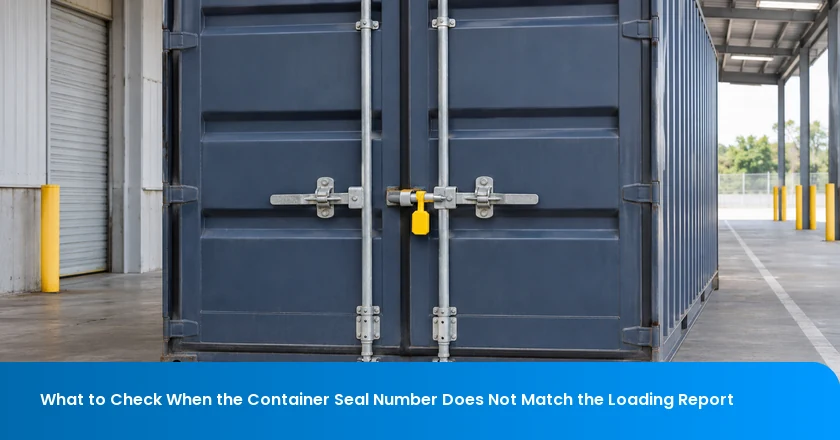
When a shipping document shows a different seal number from the loading report, verify the full container ID first. Ask the loading team for the original seal photos and application record, and ask the party with custody for the latest physical observation and any seal change record. Keep the original numbers and times while you check. If the evidence supports a transcription error, have the issuer correct its record. If the physical seal changed, identify who authorized and recorded it. Escalate an unexplained difference before approving the affected document, movement or unpacking step within your control.
Confirm the container and keep the conflicting records
Compare the full container ID, the seal characters and the time of observation before deciding which record needs correction. A booking or bill of lading can cover multiple containers. Start with the row for the right unit, then check that the loading report, photo series, shipping instructions and any later handoff records describe that same unit.
- Read the container ID from the door marking or a clear original photo, and match it character for character.
- Capture the seal number, seal location and visible condition without disturbing the seal.
- Preserve the conflicting file versions and record when, where and by whom each number was observed or entered.
The Bureau International des Containers identification guide identifies the container by its owner prefix, equipment category, serial number and check digit. Read the complete identifier. A seal close-up alone may show a number clearly while leaving open which container it came from. Ask for the wider shot of the closed doors and identifier, and a traceable link between that photo and the close-up.
Maersk’s seal guidance describes a seal number as a series of letters and numbers and asks buyers to compare it with the bill of lading at destination. Save the exact characters as observed, including any leading zeros, and preserve how each document displays them. If a character is illegible, mark it as such and get a clearer reading. Guessing a character to fit the expected number can hide the first point where the records disagree.
Build a timeline from sealing to the latest handoff
Build the timeline from independent observations, with document entries and revisions shown as separate events. Give each event a time and time zone, place, container ID, seal number, seal condition if observed, and the person or organization that made the record. Use the worksheet to find the first point where the numbers diverge.
Event or recordWho to askWhat to requestFactory loading and sealingPacker and loading supervisorOriginal door and seal photos, loading report, seal application log, and who witnessed it.Pickup or gate handoffHaulier, forwarder or terminal via the carrierDated handoff record or equipment receipt. Ask whether the number and condition were physically checked.Shipping instructions and transport documentShipper, forwarder and document issuerThe submitted seal field and the draft, issued or revised version for this container, with the amendment trail.Reported opening or resealCarrier or party that controlled the eventOfficial or operational reference, reason, date and place, authorization, and outgoing and replacement seal numbers.Latest custody or arrivalCurrent custodian or receiving teamActual seal reading and condition, linked to the container, plus the point at which the difference was reported.
Send each request with the container and shipment references, the two different numbers and the versions where they appear. If you already commissioned loading supervision, retrieve the brief alongside the report. TradeAider’s inspection standard describes tailoring inspections to buyer requirements. The actual brief helps you ask for evidence the observer was assigned and able to collect.
Ask the loading team for its original records
Ask the loading team for the original photos and seal application record for the identified container. The supplier or packer can explain which number was issued and who recorded its application. The loading supervisor can provide the report and contemporaneous records for the stage they witnessed. If the seal log and report disagree, ask what each person directly observed, when it was recorded, and whether one record was populated from the other.
TradeAider’s container loading supervision checklist includes inspection of container sealing and issuance of a formal report. Agree which seal photos and handoff details the team should collect when the service is arranged. For the current discrepancy, use any existing report to establish what the team observed at loading, then obtain the later events from the parties with custody at those points.
Ask who observed the seal at the next handoff
Ask each custodian what they actually observed and when, and mark inherited numbers separately. A gate receipt can establish that the container passed through a terminal. Ask whether its seal field was read at the gate or imported from shipment data. Two records with the same number are one piece of evidence if both came from the same entry. Keep a blank where a handoff record is unavailable and ask the forwarder or carrier who can retrieve it. If a record confirms the number but says nothing about condition, log those fields separately. A later observer may need to report the seal condition before the buyer can close the discrepancy.
Decide whether to correct, document a reseal, or escalate
Treat a supported transcription error, a documented authorized seal change, and an unresolved physical discrepancy as different decisions. Every route depends on the same container identity. If the physical ID cannot be linked to the load, resolve container identity before treating the seal issue as a one-field correction.
Correct a supported record error. The loading images and an independent later reading may show the same seal, while a typed field on the draft differs. Trace the point where the wrong number first entered. If the loading report itself is wrong, request a dated correction from its issuer based on the source evidence. If the mistake is in shipping instructions or the bill of lading, send the evidence to the shipper or forwarder and the responsible document issuer, and ask which downstream files need the corresponding correction.
For example, Maersk’s shipping instructions process allows a submitting party to request a revised copy for verification. If the conflict is in a draft, check that revised draft against the supporting seal and container evidence before approving it.
If the bill of lading has been issued, confirm the procedure with the issuer. Maersk’s bill of lading amendment guidance describes a change request that produces a new version for verification. Ask your issuer to confirm the accepted version and how it handles any affected filings, copies already sent, or notices to the receiving side. A revised loading report alone cannot update a carrier document.
Document an authorized seal change. The informative material accompanying the CTU Code, a code of practice for cargo transport units, gives authorized customs inspection as one legitimate reason for a seal change and calls for recording the action and replacement number. Obtain the official or carrier record for the event, including the reason, place, time and authority. Tie the old and new numbers to the same container and reconcile the replacement with the latest observation. Keep the original loading number as the historical record even when the carrier now has a different current number.
Escalate an unexplained difference. If the seal is missing, appears disturbed or shows an unexplained number, record what was visible and contact the parties responsible for the current handoff. The IMO, ILO and UNECE CTU Code advises a consignee to raise a seal discrepancy with the carrier and shipper, note it on cargo documentation, and make any official notification in accordance with national legislation. At arrival, pause routine opening and seek instructions from the carrier and the responsible receiving or clearance team. If you have yet to accept custody and national law has no notification requirement, the Code advises declining custody until the discrepancy is resolved with the carrier. In transit, notify the carrier or forwarder promptly and ask for an exception reference and next steps. The current custodian and competent authorities control physical access and movement where applicable.
One transposed seal number and a later replacement
Illustrative scenario. An importer is reviewing a draft bill of lading for two containers from one factory. On the row for Container A, the draft shows seal T84612. The signed loading report shows T84162. The buyer checks the complete container ID on the door photo and ties it to the same row in both records. The factory’s original seal close-up shows T84162, and the driver’s signed pickup check documents an independent reading of T84162 on that container.
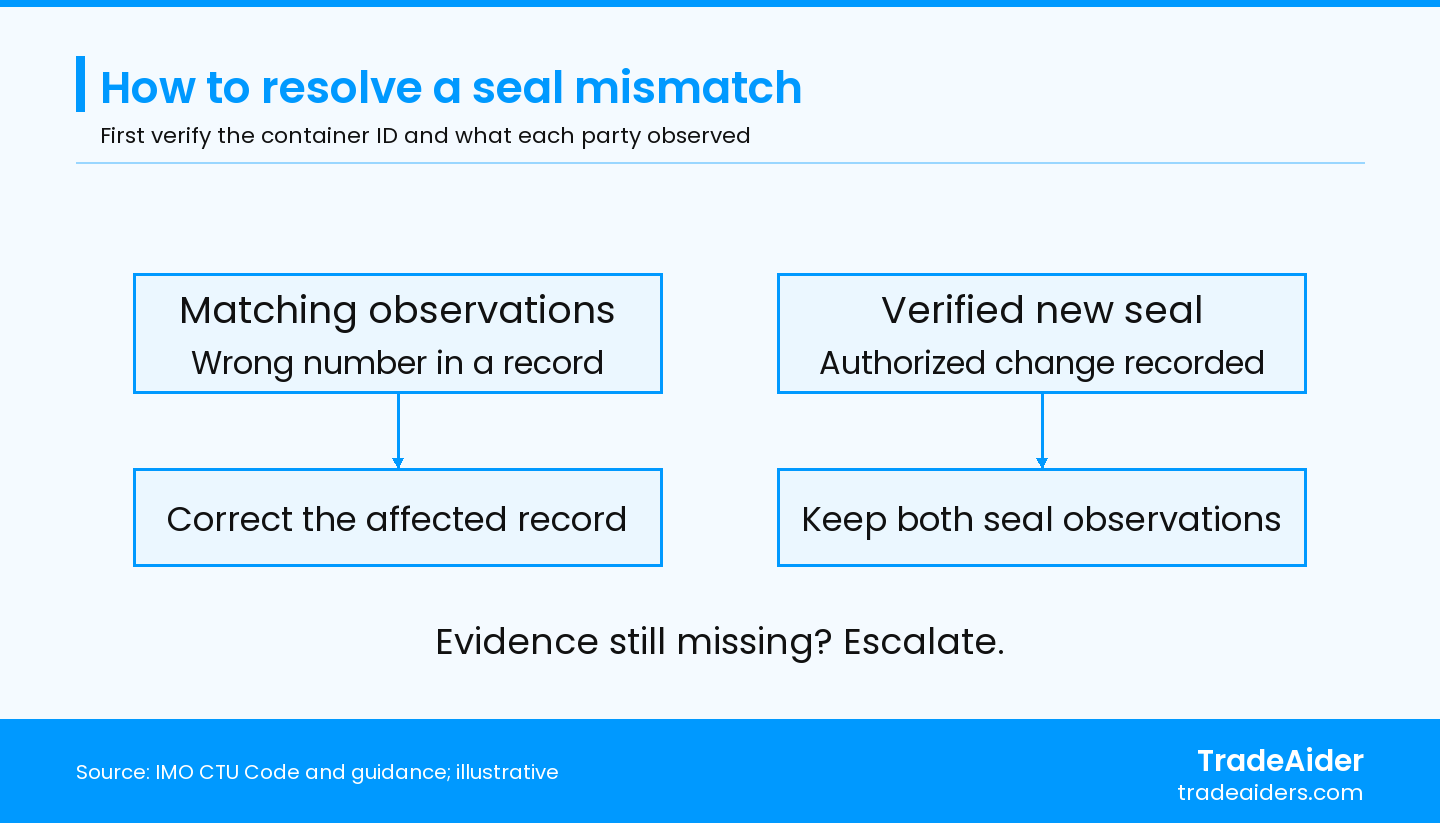
A document correction and an authorized seal change can occur on the same container at different times. Each needs its own evidence.
The shipper finds T84612 in the manually entered shipping instructions. At that point, the evidence supports a transposed entry through pickup. The buyer withholds approval of the draft for that row, and the shipper asks for a revised copy. The buyer keeps the original draft and asks the receiving team not to use it as the expected seal record.
A verified correction to a draft can coexist with a later authorized replacement on the same container. Before the paperwork is finalized, the carrier sends a customs examination record showing that T84162 was removed at the terminal and T94730 was applied to Container A. A later terminal check records T94730 on the same unit. The buyer retains T84162 in the loading report, preserves the incorrect draft as part of the record, and asks the issuer how the later event is reflected in the current document or attached notice. The receiver gets T94730 as the expected current reading along with the replacement record.
If the only new evidence were a terminal system field showing T94730 with no identified reading or examination record, the buyer would keep the discrepancy open. The verified typo would explain the old draft, but the current seal and any possible change would still require evidence. The forwarder or carrier would need to confirm the latest physical reading and its connection to Container A.
Close the discrepancy with the people who own the records
Keep the origin observation, transport amendment or reseal documentation, and final custody decision together. In the closing record, identify the container and the last verified seal, which records were corrected and by whom, who received the revised information, and what action the party responsible for the affected step authorized. Record outstanding gaps and name the owner and next step for each one.
Send the receiver the expected current seal and any approved change reference before delivery where possible. Ask for an acknowledgment so an old printout does not drive the receiving check. A matching seal number helps reconcile closure and custody records. Keep the tally, packing and product records as separate evidence for what was loaded and its condition.
A later customer complaint or shortage may turn a small discrepancy into a larger investigation. Preserve the original files and times alongside any corrections, including a record of who made the changes. When an inspection, a filing and a carrier document are each involved, get confirmation from the owner of each affected record. One person’s email can coordinate the handoff, while each owner still needs to confirm the part they control.
If you need seal evidence for an upcoming loading, share your loading site, planned date, booking or container details if available, and the photos and handoff fields you want recorded. You can contact TradeAider to agree on what the loading team should capture and how the report will identify each container.
Frequently Asked Questions
Can the loading inspector sign off on a different seal?
The loading inspector can explain what they witnessed and correct their own report, while a later seal requires evidence from the party who observed it. If the inspector has the original image, ask for a dated correction that cites the image and preserves the earlier version. For a replacement after loading, obtain the event record through the custodian or carrier and attach it separately.
What if the current seal matches the latest bill of lading?
A current match still leaves an open origin discrepancy when the loading report records a different seal for the same container. Look for the dated record that connects the original seal with the current one. If the carrier’s latest entry describes the origin seal, trace how it was recorded and ask the loading team to confirm the original photo and log.
What if the container carries more than one seal?
Ask the party with custody to record each seal by number, type and location before you compare the observations with the documents. The number on a second seal may have been added to the record without replacing the first one. Ask who installed each, when, and which identifiers the carrier and receiving records are intended to show. Keep both readings and clarify any unexplained change with the responsible party.
مقالات ذات صلة
نمِ عملك مع خدمة TradeAider
انقر على الزر أدناه للدخول مباشرة إلى نظام خدمة TradeAider. الخطوات البسيطة من الحجز والدفع إلى تلقي التقارير سهلة التشغيل.