
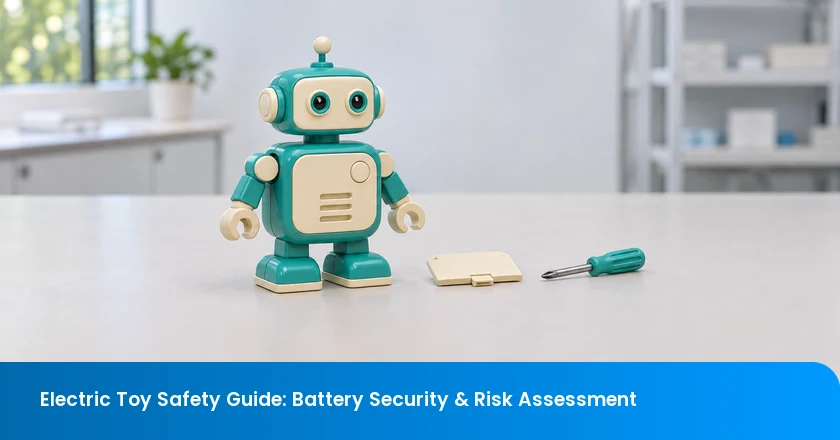
Electric-toy safety starts with the child, the battery and the way the toy will be used. Check that the product suits the intended age, that batteries remain securely contained and that the specified power and charging equipment are used. Damaged wiring, a broken battery door, unusual heat or leaking cells call for action before play continues.
Parents and caregivers need clear instructions for choosing, checking and using the toy. Importers and brands also need evidence that its battery compartment, circuit and charging system meet the applicable requirements. A useful risk assessment connects those responsibilities to the actual product.
Key takeaways for electric-toy safety
- Choose for the child’s age and play behavior, and identify every battery in the toy and its accessories.
- Inspect containment, wiring, polarity and charging arrangements as separate safety questions.
- Connect marks and test records to the actual model, power configuration and destination.
- Stop use when damage or warning signs appear, seek urgent help for suspected battery ingestion, and follow chemistry-specific collection instructions.
Choose an age-appropriate toy and identify its power system
Begin with the toy’s intended age and actual play characteristics. Read the instructions and identify the battery type, whether it is replaceable or built in, and who should replace or charge it. Include batteries in a remote control or other accessory in this check. The child’s use and the complete power configuration determine which concerns need attention.
Consider younger children who may share the play space. Keep replacement cells, removed screws and other small components under adult control. Check the model identification, instructions and seller information before purchase so that you can obtain the right replacement parts and follow a safety notice if needed.
For a brand or importer, establish the age grading and power specification during product selection. Record the approved cell or pack, connections, compartment design and charging equipment. A different battery chemistry or a changed enclosure can alter the assessment even when the toy’s appearance stays familiar.
Understand the safety evidence for the destination
Ask what a mark, declaration or report actually represents. The relevant safety requirements depend on the destination, age group and product configuration. A safety mark on packaging alone leaves questions about the model, applicable tests and manufacturing controls.
| Destination | Safety-evidence orientation | What to establish |
|---|---|---|
| United States | CPSC identifies ASTM F963-23 as the current mandatory toy standard. Applicable third-party testing and Children’s Product Certificate duties concern products primarily intended for children 12 years or younger. CPSC toy guidance | Identify applicable requirements. Battery-operated-toy provisions address access, labeling, overheating and supplied chargers according to the battery and toy. |
| European Union | The manufacturer assesses hazards and exposure, completes the applicable conformity procedure and documentation, issues a declaration and affixes CE marking. European Commission toy-market guidance | Connect the EU assessment, declaration and required instructions to the toy. The manufacturer assumes responsibility for conformity. |
| Great Britain | CE or UKCA marking is available through the applicable conformity route. GB statutory guidance | Determine the route used and its documentation. Northern Ireland has separate arrangements. |
| Canada | The Toys Regulations include an electrical-hazards requirement incorporating a CSA standard for electrically operated toys. Canadian Toys Regulations | Determine requirements applicable to the actual toy and its electrical design. |
| Australia | Battery-operated toys for children up to and including 36 months require a compartment accessible only with a tool. ACCC young-child toy standard | Consider actual suitability for that age. An older-age label alone may leave the standard applicable. Button-battery requirements also need review. |
The European Commission says the new EU toy safety regulation starts applying on 1 August 2030 after its transition period. Keep future obligations and the requirements applicable to the current supply distinct when planning compliance work. EU toy-safety transition
These are starting points for the original guide’s markets. A specialist assessment should select the applicable rules for the actual product, including electrical accessories, radio functions or other features where relevant. Avoid treating a list of standards as evidence that every requirement has been met.
Assess hazards and the child’s exposure
For each toy hazard, describe how the child could be exposed, what control reduces the risk and what evidence demonstrates that control’s effectiveness. Include normal play and reasonably foreseeable handling, battery replacement, charging and damage. Assign unresolved questions to a technical owner so an assumption does not become an acceptance decision.
IEC 62115:2017+AMD1:2025 addresses electric-toy safety related to an electrical function, including battery and other power sources, for play by children under 14 years. Its public scope helps identify the relevant subject. The applicable national requirements, adopted edition and complete test procedure still need selection for the destination. IEC electric-toy scope
CPSC’s chart identifies battery-operated-toy requirements subject to third-party testing. Where required for the applicable children’s toy, use a CPSC-accepted laboratory whose acceptance covers the relevant rules. Check any applicable testing relief. Labeling and instructional literature are listed separately without that testing requirement. Include both appropriate test evidence and a review of the supplied information. CPSC requirements chart
Distinguish visual observations, ordinary functional checks and controlled safety tests in the plan. Fault, abuse and destructive tests need competent facilities, suitable equipment and the selected method. Caregivers should follow the product instructions and report damage rather than attempt those tests at home.
Check battery containment before and after foreseeable use
A battery door needs to close and retain the batteries as designed. Inspect cracks, damaged threads, missing fastening parts, loose cells and gaps that could permit access. For an importer’s sample review, compare these features with the approved design and the applicable accessibility requirements. A screw’s presence alone leaves its engagement and the surrounding plastic unassessed.
Australian button-battery guidance requires secure containment during use or misuse and evidence of compliance before supply. Examples under the selected testing route include conditioning, battery replacement, drop, impact, crush and force tests. The relevant sequence and criteria come from that route. ACCC containment and testing guidance
CPSC describes a conditional toy exemption from the consumer-product button-battery rule for products complying with the toy standard’s battery-accessibility and labeling requirements. Separately packaged batteries have their own packaging and labeling duties. Review both the assembled toy and how spare cells are supplied. CPSC button-battery guidance
For the user, a broken door or ineffective fastening means the toy should be kept away from children until the maker provides a suitable remedy. A warning label or adult supervision cannot establish that damaged containment still performs its protective function.
Investigate wires, polarity, short circuits and heating
A technical inspection should examine wires, insulation, connections, polarity information and the specified protection features, then identify the controlled tests needed for short-circuit and heating risks. A short circuit creates an unintended current path. Crushed insulation, displaced contacts or conductive contamination are observations to investigate against the circuit design.
Check wire routing where the case closes and where parts move. Compare strain relief, connectors and battery contacts with the approved reference. Confirm that polarity markings agree with the intended installation. Photograph a mismatch and retain the sample identity so the technical team can connect the finding to the correct circuit and enclosure revision.
For temperature testing, define the operating mode, battery condition, ambient conditions, duration, measurement locations and acceptance criteria. Record actual measured results. The plan should address applicable abnormal conditions, such as a stalled moving mechanism, through the selected safety procedure. A brief power-on demonstration leaves those conditions unresolved.
Ask how the relevant protection functions have been verified for the complete toy, battery and charging configuration. A visible component or a nominal voltage reading provides only part of that evidence.
Match batteries, charging equipment and instructions
Energizer advises using the specified battery size and type, installing cells with correct polarity and using a charger designed for the battery type. Its care guidance also warns against mixing old and new or different batteries and recharging primary cells. Primary batteries are single-use cells. Follow the toy and battery instructions for replacement, charging and storage. Energizer battery-care guidance
Identify which charging equipment the toy maker specifies. Check the model, input and output information, cable condition and connection against those instructions. A replacement charger needs a compatibility basis. Ask the manufacturer when the supplied information leaves the combination uncertain.
For rechargeable designs, the assessment should include charging controls, foreseeable connection errors and any permitted operation during charging. Supplier evidence should identify the tested toy and battery arrangement. Have a technical reviewer determine the effect of a cell, charging circuit or accessory change on the existing evidence.
During use, keep charging under the supervision required by the instructions and use the specified location and conditions. Stop using damaged charging accessories and arrange the maker’s approved replacement.
Include accessible materials and mechanical damage
CPSC toy guidance distinguishes lead in surface coatings, lead in accessible substrates and other applicable material requirements. Select chemical evidence for the actual materials and accessible parts. An electrical test cannot settle those material questions. CPSC material-safety guidance
Inspect the casing, small components and moving parts as well. A fall can change access to internal components or create sharp damage. Connect observations to the relevant mechanical assessment and remove a damaged toy from play while its condition is resolved.
Use an electric-toy risk and evidence record
For an importer or brand, copy this record for the actual toy and power configuration. Enter the hazard and exposure, control, applicable criterion, evidence and next action. Give each missing criterion or result a named technical owner. Caregivers can use the corresponding observation and instruction checks without conducting safety tests.
| Hazard and exposure | Control and reference | Evidence and next action |
|---|---|---|
| Battery release / ingestion | Age and battery ___ · Door / fastening design ___ · Access criterion ___ | Observed condition / test reference ___ · Gap / owner ___ |
| Wires, contacts and polarity | Routing / insulation ___ · Connection and installation reference ___ | Mismatch / photograph ___ · Technical action ___ |
| Heating / abnormal operation | Mode and battery condition ___ · Method, locations and limits ___ | Results / units ___ · Missing criterion or follow-up ___ |
| Charging / replacement | Battery and charger identity ___ · Approved combination ___ | Relevant test evidence ___ · Change review / owner ___ |
| Casing / accessible materials | Materials and mechanical reference ___ · Applicable requirements ___ | Damage / material evidence ___ · Action ___ |
| Use information / warnings | Instructions / artwork ___ · Age, language and care requirements ___ | Product-to-instruction match ___ · Correction ___ |
| Changed design / components | Model and revision ___ · Affected controls / tests ___ | Review / verification ___ · Pending decision / owner ___ |
Attach reports and observations using the same model, battery and revision references. Mark a missing input as pending and identify what will resolve it. Acceptance needs the applicable criterion and relevant evidence. The diagram separates containment and electrical-safety questions within that assessment.
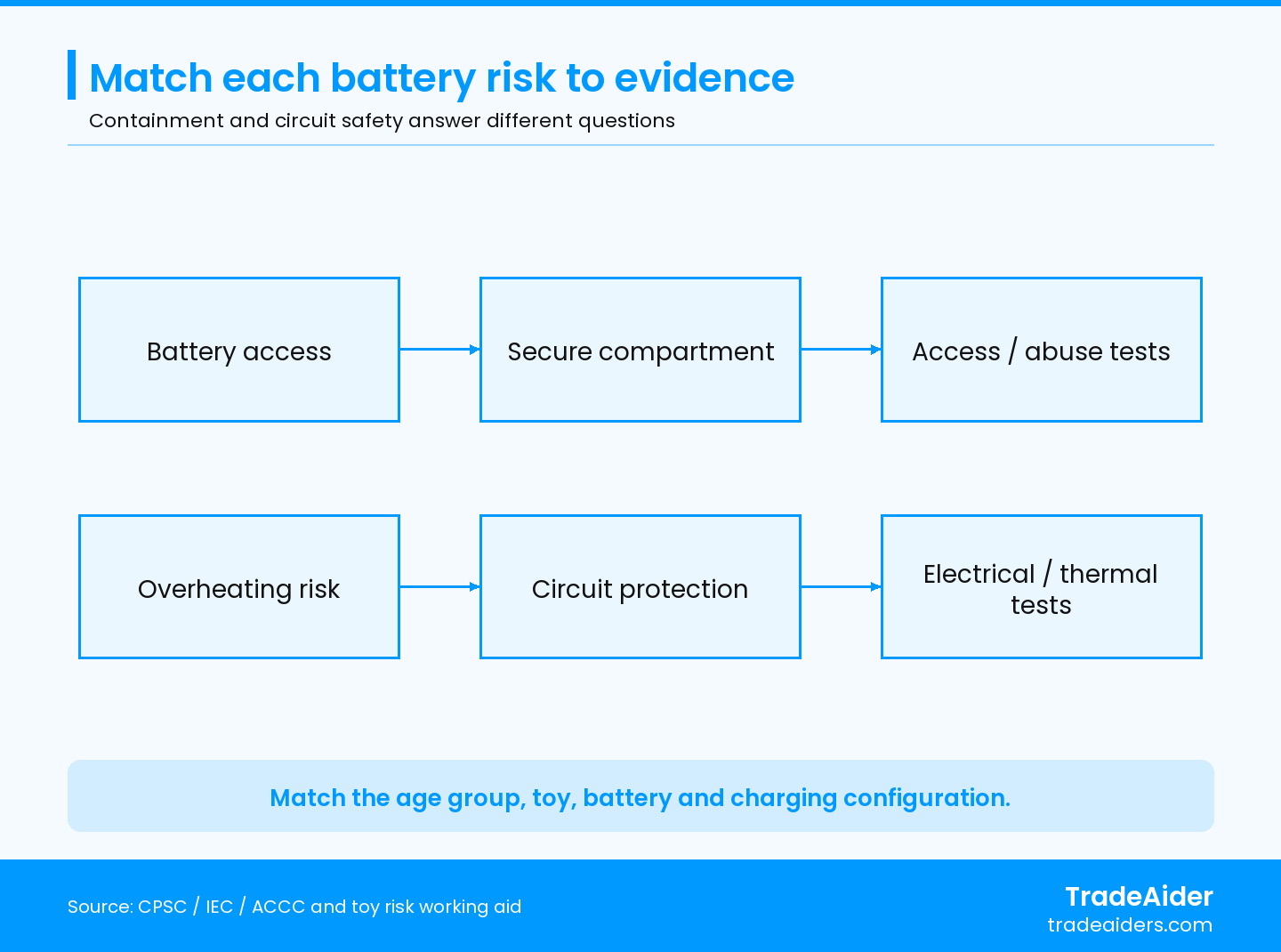
Buyer working aid. Select the actual controls and tests for the toy’s age group, battery and charging configuration.
Illustrative assessment of a changed battery-door design
In this hypothetical assessment, a toy has a revised battery door that closes with its specified screw, but its new inner edge traps a wire. The door appears secure during the initial check. Inspection finds an indentation in the insulation. This is an illustrative example without measured client results.Stop the affected trial and enter the finding in the wires row and changed-design row. Identify the door and harness revisions, preserve photographs and ask the technical owner to assess the insulation, clearance and routing. Keep the affected samples identified while the supplier corrects the design or assembly process.Verification should address containment and the electrical conditions affected by the change, using relevant tests and criteria. If the available record contains only a successful functional run and no applicable heating criterion, assign that gap to the technical owner and keep acceptance pending. Repeating a functional run would leave the safety-evidence question open.
Connect the safety plan to the finished toy order
For TradeAider pre-shipment inspection, the order quantity is 100% complete and at least 80% packed for export. Agree the toy references, sampling and feasible checks before the visit. Observations can connect the sampled product, battery arrangement and instructions to the approved order references. Record equipment limitations and any required test evidence that remains outstanding.
Inspect during use and act on warning signs
Follow the instructions and check the battery compartment, casing and charging accessories before use, after damage and during battery replacement. Look for a loose cover, cracks, corrosion, leaking cells or damaged insulation. Keep a damaged toy away from children and arrange the manufacturer’s remedy before returning it to play.
Respond to heat, smoke and battery damage
USFA advises stopping use of lithium-ion batteries when there is unusual odor, color or shape change, excessive heat, leakage or odd noises. These warning signs need prompt action. Keep children away and follow the manufacturer’s safe-response guidance. USFA battery warning signs
For a lithium-ion battery fire, USFA advises evacuating and calling emergency services instead of attempting to extinguish it. Call from a safe location. Avoid carrying a smoking or burning toy through the home or handling its battery. Let trained responders manage the fire. USFA emergency guidance
Before resuming use after a battery fault, obtain the manufacturer’s assessment and appropriate remedy.
Get urgent help for suspected battery ingestion
ACCC advises immediate action and hospital emergency assessment when button-battery swallowing or insertion is suspected. Seek urgent medical help and follow local emergency or poison-service instructions. Keep new and used button batteries out of children’s reach. A child may be unable to explain what happened, so waiting for a clear account or symptoms can delay help. ACCC button-battery safety advice
If readily available, give the medical team the toy model and battery identification. Another adult can keep other children away from the product and remaining cells. Obtaining product information should never delay urgent assessment.
Report the product concern after immediate safety needs
In the US, SaferProducts.gov is the public portal to report and search consumer-product safety complaints. Notify the seller and manufacturer as well. Record the model, battery information and incident circumstances, keeping photographs when safe to obtain. Prioritize emergency care and personal safety before collecting evidence. SaferProducts.gov reporting portal
For brands, connect the complaint to the relevant toy revision, battery arrangement and supplied instructions. Assign a product-safety owner to review whether other units may be affected and what corrective action is needed. Preserve the incident record with the investigation and follow-up.
Arrange safe retirement and battery collection
EPA bases battery-disposal guidance on chemistry and local collection options. Its guidance directs lithium-ion and other rechargeable batteries, coin/button cells and lithium single-use cells away from household trash and municipal recycling bins to appropriate separate collection. Contact the manufacturer for damaged lithium-battery handling instructions. Alkaline disposal options vary locally, and EPA recommends recycling or checking with the waste authority. EPA household-battery guidance
Check whether the battery is designed for user removal. Where it is not, arrange an appropriate whole-device collection route. Keep retired toys and spent cells away from children. Obtain handling and acceptance instructions before transporting a damaged battery, and use emergency services for an active fire hazard.
Discuss checks for your toy order
Send TradeAider the toy and order information you already have, the factory, destination, timing and concerns. Include available specifications, sample references and reports. We can discuss a suitable inspection scope, references and feasible checks, with a report of the agreed checks, findings and limitations. Contact our team to discuss your order.
FAQ
Does a warm battery compartment mean the toy is unsafe?
Warmth alone cannot establish whether a toy meets its temperature requirements. A technical judgment needs measured results under defined conditions and the applicable criterion. Caregivers should act promptly on unusual heat or other warning signs and follow the manufacturer’s instructions rather than judge compliance by touch.
Can an older-age label solve a battery-access problem?
An age label needs to reflect the toy’s actual intended users and play characteristics. Review the age assessment and applicable access requirements when the design changes. In the home, keep a toy with compromised battery containment away from children, including younger siblings who may share the play space.
Can tape replace a damaged battery-door fastening?
Use the manufacturer’s approved repair or replacement for a damaged fastening. Household tape cannot establish that the repaired construction performs like the assessed design. Keep the toy out of children’s use until its containment is properly restored and any related damage has been addressed.
مقالات ذات صلة

نمِ عملك مع خدمة TradeAider
انقر على الزر أدناه للدخول مباشرة إلى نظام خدمة TradeAider. الخطوات البسيطة من الحجز والدفع إلى تلقي التقارير سهلة التشغيل.