
- معلومات عنا

- خدماتنا
- صناعتك
- الموارد
- الأخبار والمدونة
GB and NI product compliance breaks down when a factory treats the destination as one UK artwork choice. The safer operating model is to build a controlled market pack for each destination: identify the product-sector route first, then keep its documents, operator information, instructions, artwork revision, SKU, and carton allocation together. A mark visible on the product is only one field in that pack; it is not a release decision on its own.
The Split-Market Decision at a Glance
A product sold into both markets needs a destination-specific route, a matching document set, and a lot record that tells the factory which artwork and instructions belong to which SKU. That simple chain prevents a common failure: correct-looking goods are packed under an untraceable destination version, leaving nobody able to show which market record belongs to the cartons at dispatch.
- Market: decide whether the goods are for separately controlled GB or NI allocations before approving packaging.
- Sector: use the current official row for the actual product type; a common marking pattern is not a universal rule.
- Version: bind the route, declaration reference, operator details, instructions, and artwork revision to one destination SKU.
- Inspection boundary: inspect observable facts against the approved market pack, then hold only the defined carton range that does not reconcile.
Choose the Market Before You Choose the Mark
Great Britain means England, Scotland, and Wales, while Northern Ireland follows a separate route under the Windsor Framework for relevant manufactured products. The GB market overview confirms the geographic boundary, and the NI route guidance explains the separate manufactured-product route. The distinction matters before a designer opens the label file, because the buyer must first determine which market rule set and accountable owner apply to the product version being prepared.
Current product-safety guidance says product-specific provisions can apply differently in GB and NI. Put the destination at the start of the purchase-order, artwork, and packing-list workflow so a late label change does not become a late route decision.
Map the GB and NI Route by Product Sector
The current government sector table distinguishes GB routes that commonly allow UKCA or CE from NI routes that commonly require CE or CE with UKNI, but the exact row depends on the product sector. Here, UKNI means the Northern Ireland indication used with an EU conformity marking when a notified body carries out the specified assessment route. Use the table to begin the route check, then read the applicable sector guidance before locking the product and carton artwork.
For example, electrical equipment, toys, and other regulated categories can appear to follow a familiar pattern, yet sector exceptions and assessment conditions can change the answer. This comparison is an operational handoff, not a substitute for the applicable sector row.
| Control point | Great Britain | Northern Ireland | Factory and inspection handoff |
|---|---|---|---|
| Route starting point | Confirm the product-sector GB route. | Confirm the applicable NI route under the sector rule. | Record destination and route owner before artwork approval. |
| Typical marking lane | UKCA or CE where the current sector rule allows it. | CE, or CE with UKNI in the specified assessment route. | Compare the approved mark artwork with sampled goods and packs. |
| Supporting records | Technical file and declaration for the GB product route. | Technical file and declaration for the NI product route. | Reference the correct document version in the inspection scope. |
| Identification and instructions | Check the applicable operator and product-identification information. | Check the NI version of applicable operator information and instructions. | Treat each approved text or artwork revision as a destination record. |
| Release boundary | Release only the carton range tied to the GB record. | Release only the carton range tied to the NI record. | Hold the identifiable affected range when the records diverge. |
Based on this comparison, the practical rule is not “choose a label for the UK.” It is “choose a market route for this product, then protect the version trail until the cartons leave the factory.”
Great Britain Uses a UKCA-or-CE Decision Lane
Current GB guidance describes UKCA and CE routes for relevant products and says the manufacturer remains responsible for the technical file, declaration, identification details, and marking. The current GB route guidance establishes that responsibility, while the Fast-Track UKCA route is optional for applicable regulations. Keep that nuance with the compliance owner; an inspector can verify the approved pack and reference documents, but should not decide which regulatory route is legally available.
For each GB SKU, freeze the route reference before the supplier prints the carton proof. If the product, instruction sheet, or operator text changes after that approval, the owner should review whether the technical record, declaration, and inspection reference need a coordinated update before release.
Northern Ireland Starts With the CE Route
For relevant NI products, CE is the usual starting point; CE with UKNI is used when mandatory third-party conformity assessment is carried out by a Northern Ireland notified body. The Northern Ireland route guidance also makes the important boundary clear: the combined mark is not used by itself.
That is why a factory instruction such as “use the NI label” is incomplete. The instruction needs the product-sector decision, the assessment-path owner, the approved mark artwork, and the linked technical record. If any one of those fields is unresolved, pause the affected NI version rather than copying the GB packaging as a shortcut.
Run Separate Document Lanes Before Artwork Approval
The technical file, declaration, economic-operator details, instructions, marking artwork, and product identifiers should be controlled as a destination-and-version pack rather than as disconnected supplier files. A route decision has little value if the document name on a carton proof cannot be traced to the same product version that a buyer approved.
Start with a one-line market-pack register for every destination SKU. It should name the market, product-sector route owner, Declaration of Conformity reference, technical-file reference, artwork revision, instruction version, operator-information owner, and carton-range convention. A Declaration of Conformity is a formal manufacturer statement that identifies the product and applicable legislation. The register does not create conformity; it makes the buyer's evidence visible to production and inspection. Where testing evidence or product-specific questions remain open, TradeAider can coordinate product testing evidence before a final artwork proof is released.
Economic-Operator Details Need the Same Destination Discipline
GB and NI guidance both place identification, documentation, monitoring, and cooperation duties on economic operators, with product-specific requirements to be checked by sector. The GB route guidance and the NI route guidance both require the responsible parties to be identified and their duties checked against the applicable product rule.
Operationally, make operator information a controlled artwork field, not a text fragment copied from an old box. The buyer should approve its source, format, destination applicability, and revision at the same time as the mark. A third-party checker can compare the presented text with the approved pack; the accountable manufacturer, importer, or other economic operator remains responsible for whether the content is legally sufficient.
Give Every Market Version a Traceable SKU and Artwork Record
A destination SKU, artwork revision, declaration reference, and defined carton range create a practical bridge between the market route and the goods presented for inspection. This is an operational control, not proof that the product conforms, but it lets a buyer isolate the actual goods affected by a mismatch instead of stopping an entire mixed shipment without evidence.
GOV.UK's traceability guidance calls for manufacturer and importer information plus a product or batch reference that can identify manufacture. Add the destination SKU and approved artwork revision to that traceability trail before production begins. A buyer can also set a pre-production version-control check to confirm that the factory's master artwork, cartons, and inspection reference point to the same market pack.
Use Inspection Checklists for Observable Corroboration
A China-side inspection checklist can compare selected products, markings, operator details, instructions, cartons, and SKU allocation against the buyer-approved GB or NI pack, but it cannot issue a conformity assessment or legal opinion. Current government business guidance places the compliance demonstration burden with manufacturers and importers and notes that product-specific provisions can differ across GB and NI. The inspection is strongest when it tests a clear version-control question: do the goods and cartons presented today match the destination record approved for this range?
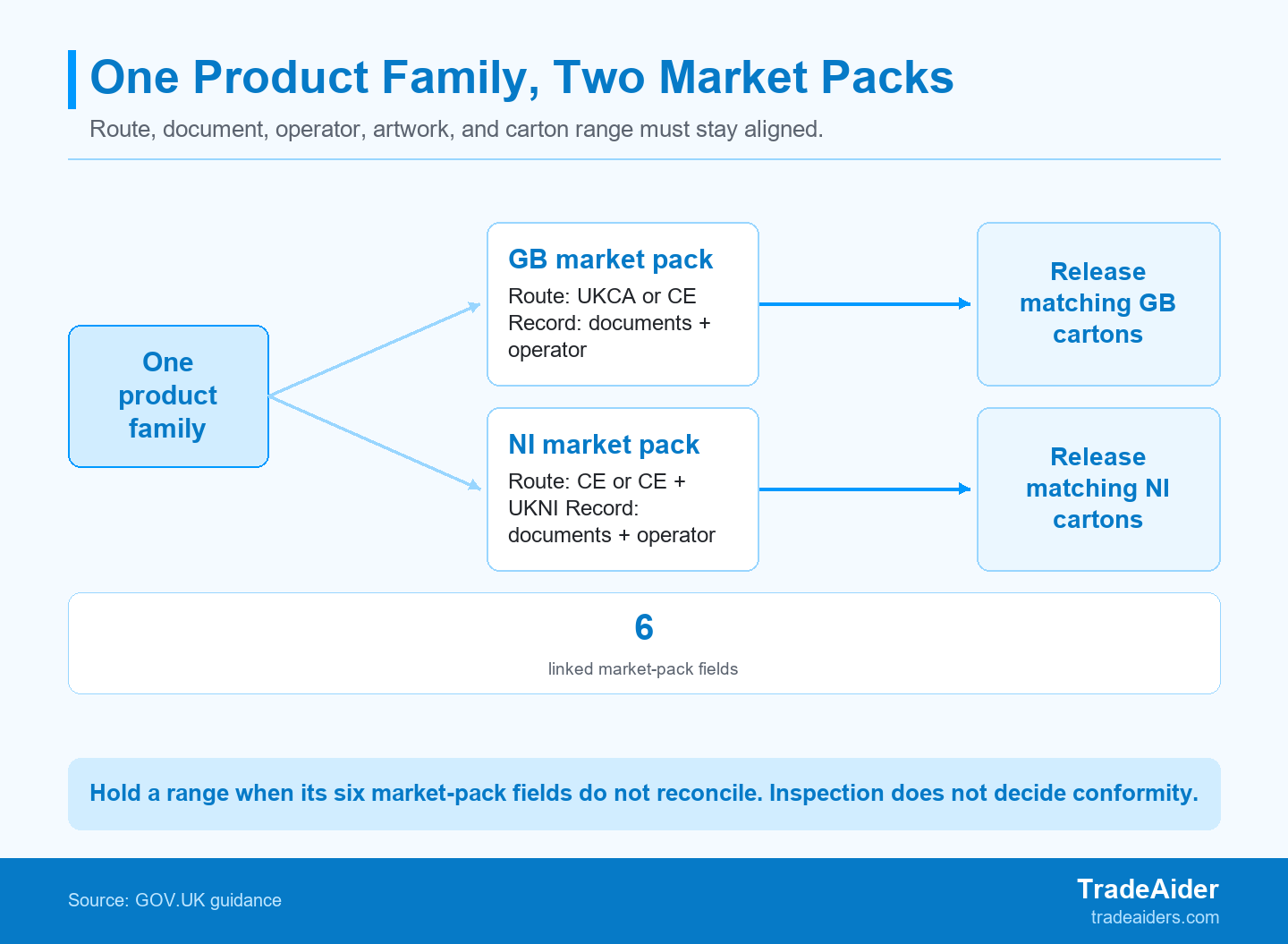
A split-market inspection can corroborate selected goods and cartons only after the buyer has tied each destination pack to a route, document reference, artwork revision, and defined range.
- Product and pack: compare sampled marking artwork, product identifiers, operator text, and instructions with the signed market pack.
- Destination allocation: check SKU suffixes, carton marks, packing-list ranges, and any pallet separation used to distinguish GB from NI goods.
- Document handoff: record the declaration and artwork references supplied by the buyer; do not ask the inspector to determine their legal adequacy.
- Exception rule: photograph and isolate the identifiable carton range when a visible field does not match its destination version.
A PSI is a pre-shipment inspection of finished goods. A PSI is conducted when 100% of the order quantity is completed and at least 80% is packed for export. For this topic, scope a destination-specific pre-shipment inspection around the approved market packs and defined carton ranges, not around a generic label check.
Illustrative Hold: One Mixed Artwork Run, Two Market Packs
In the illustrative scenario, a mixed GB/NI packaging run is held at the defined carton range until the market allocation, artwork revision, and supporting record can be reconciled. It is an operational example, not a TradeAider client case, a laboratory result, or a legal finding.
A private-label consumer-products importer in China is preparing separate Great Britain and Northern Ireland listings. The buyer has already approved two market packs because the destination routes, supporting references, and carton artwork need to remain distinguishable after packing.
The illustrative 96-carton electrical-accessory shipment uses two destination allocations. Each allocation has a destination SKU suffix, a packing-list range, an artwork revision, and a document-reference field so the factory and buyer can identify which cartons belong to which market version.
Production is complete and export packing is underway when the mixed artwork is discovered. The timing matters because correction is still possible at the carton-range level, whereas shipment release would make the allocation error much harder to reconstruct.
The factory used the NI carton artwork on 12 cartons allocated to the GB shipment. Those cartons carry a visible SKU suffix and packing-list range that separate them from the remaining GB allocation.
The buyer's NI pack references CE-route documents, while the GB pack references the approved GB route record. The conflicting artwork and record references show that the affected cartons no longer map to one destination version.
The physical product may look unchanged, but the destination allocation and attached market pack no longer describe the same defined shipment range. The risk is not solved by deciding which mark looks familiar; the buyer needs to restore one traceable relationship between route, record, artwork, SKU, and cartons.
Hold the 12 affected cartons rather than both destination allocations. That split-release decision preserves the compliant evidence trail for the unaffected cartons while preventing the mixed range from moving forward on an assumption about its intended market.
The factory isolates the marked carton range, replaces or reallocates the affected artwork under buyer approval, and updates the packing list and inspection scope with the destination SKU and revision. The buyer then confirms whether the route record and document reference still correspond to the corrected allocation.
Release the held range only when a recheck can match selected cartons to the destination SKU, artwork revision, document reference, and packing record. If that reconciliation fails, keep the range on hold and return the unresolved route question to the accountable compliance owner.
This illustrative example shows a version-control decision only. It does not say that replacing carton artwork establishes conformity, that inspection replaces testing, or that every GB and NI product follows the same marking route.
Release Only the Market Lot You Can Identify
The release rule is to hold the affected destination range when the chosen route, declaration, operator details, artwork, instructions, or carton allocation cannot be matched to the product version presented for dispatch. It is an evidence hold: a way to stop an untraceable version from moving while the responsible owner resolves the underlying issue.
Before dispatch, make one release record that lists the destination, sector route reference, declaration reference, operator-information version, artwork revision, SKU, and carton range. The record needs a clear handoff: a factory corrects the physical pack; the buyer's compliance owner confirms the route and records; the inspection scope verifies selected observable fields after correction. Use it to document the inspection acceptance standard so the factory knows which differences trigger evidence and a hold, rather than improvising at the end of packing.
If the approved market pack is ready and the buyer needs China-side observations tied to that defined range, request a GB or NI inspection scope review. The right scope states what can be observed, which version controls it, and which questions must remain with the product's accountable compliance owner.
Who Is TradeAider?
TradeAider is a quality inspection, testing, and certification service provider in China, with coverage across Guangdong, Zhejiang, Jiangsu, Shandong, and Fujian. TradeAider is an Amazon Service Provider Network (SPN) partner.
Its nationwide network of quality control specialists provides real-time reporting for scoped quality-control work.
Inspection & QA Services are offered at an all-inclusive rate of $199/man-day. TradeAider is an Amazon Service Provider Network (SPN) partner.
Frequently Asked Questions
The next step is to route an unresolved market, technical-file, or marking question to its accountable owner rather than asking an inspection report to settle it. That preserves the value of a physical check without confusing an observed mismatch with a regulatory determination.
Can one product carry both UKCA and CE markings?
Yes, a product can carry multiple markings when it complies with the relevant requirements and the markings are clearly visible, but the product sector and destination route still control what is needed. Do not add both marks as a precaution without checking the applicable GB or NI rule, the assessment path, and the approved artwork record. The product version must still match its destination documents and operator information.
Does UKNI ever appear on its own in Northern Ireland?
No, UKNI is not used on its own; it accompanies an EU conformity marking such as CE when the applicable Northern Ireland third-party assessment route requires it. The need for that combination depends on the actual product rule and assessment body route. Treat UKNI as a route-specific output, not as a general Northern Ireland label that can be added to every SKU.
Can a pre-shipment inspection prove GB or NI compliance?
No, a pre-shipment inspection can corroborate selected observable facts against the buyer-approved market pack, but conformity assessment, technical evidence, and legal responsibility remain with the accountable owners. Its practical value is different: it can show whether sampled goods, cartons, instructions, and SKU allocation match the version the buyer approved, and it can identify the carton range that needs a hold or correction.
When should an importer hold a split-market shipment?
Hold the defined destination range when its sector route, document reference, operator details, artwork, instructions, SKU, or carton allocation cannot be reconciled to the goods presented for dispatch. Do not automatically stop unaffected cartons if their market pack remains identifiable and the buyer's release process permits a split decision. The essential condition is evidence: every released carton range must map back to one approved destination version.
مقالات ذات صلة



نمِ عملك مع خدمة TradeAider
انقر على الزر أدناه للدخول مباشرة إلى نظام خدمة TradeAider. الخطوات البسيطة من الحجز والدفع إلى تلقي التقارير سهلة التشغيل.

