
- معلومات عنا

- خدماتنا
- صناعتك
- الموارد
- الأخبار والمدونة
Hair extensions are one of the most inspection-intensive categories in beauty sourcing — and also one of the most commonly misrepresented. Suppliers label non-Remy hair as Remy, blend synthetic fibers into human hair bundles, and use silicone coatings that disguise low-grade material until the first wash. For importers building brands on Shopify, Amazon, or through salon distribution, the stakes of a bad batch are high: customers post comparison photos, salons get blamed, and returns are costly to process.
A professional quality inspection conducted by an experienced China inspection company can catch the majority of these issues before your order ships. But the key word is "experienced" — generic QC checklists won't cut it for hair extensions. Professional inspection agencies customise their checklists upon client requirements, and only agencies familiar with your specific product category can build a checklist that covers its real failure modes. This guide explains the specific tests and protocols that separate a rigorous hair extension inspection from a superficial one. For a closer look at how TradeAider's inspectors are trained and deployed, visit the why TradeAider page.
Key Takeaways
- Remy authentication requires hands-on tests — including wet tangle tests and cuticle direction assessment — not just a supplier declaration.
- Weft construction quality directly predicts shedding behavior — inspectors check stitching density, double-weft confirmation, and weft edge integrity.
- Weight verification is the most commonly falsified specification — bundles advertised at 100g routinely arrive lighter without a scale check.
Why Hair Extensions Require Specialist Inspection Protocols
Most product inspection checklists are designed around physical goods where defects are visible: a scratch on a surface, a missing component, a misaligned label. Hair extensions present a different challenge: the most significant quality problems — cuticle stripping, synthetic blending, silicone masking, short-hair padding — are invisible to the eye under normal conditions and only reveal themselves through specific tests.
The hair extension industry is largely unregulated, which means supplier quality declarations carry limited weight. As independent hair quality testing experts explain, many suppliers label non-Remy extensions as Remy and sell them at premium prices. A silicone coating applied after processing can make stripped, non-cuticle-aligned hair feel smooth and lustrous in the warehouse — a feeling that disappears after two or three washes, exactly when the customer is forming their opinion of your brand.
This is why hair extension QC requires tests that go beyond visual inspection — tests that replicate actual use conditions. TradeAider's inspection approach for hair extensions covers five core areas: authentication, construction, weight, color and finish, and packaging.
Area 1: Remy Authentication Tests
Confirming that hair extensions contain genuinely cuticle-intact Remy human hair — and not acid-stripped, silicone-coated, or synthetic-blended material — requires a combination of physical tests that any competent inspection company should be able to perform on-site.
Cuticle Direction Assessment (Root-to-Tip Alignment)
Genuine Remy hair has cuticles that run consistently from root to tip in the same direction. To check this, an inspector runs fingers against the direction of growth from tip toward root — Remy hair will feel slightly resistant (like stroking against a cat's fur), confirming the cuticle is intact and directional. Non-Remy hair, with stripped or randomly aligned cuticles, feels smooth in both directions and will tangle after washing. This test takes under a minute per bundle and requires no equipment.
Wet Tangle Test
This is one of the most revealing quality tests for hair extensions and is a standard protocol among experienced quality assessors. The test involves submerging extensions in shampooed water and manipulating them to replicate washing, then rinsing and observing the behavior of the hair as it dries. Genuine Remy hair with properly aligned cuticles will remain manageable and relatively tangle-free throughout this process. Non-Remy hair — where cuticles have been inverted or stripped — will cause hairs to catch on each other and create tangles near the root area that cannot be resolved with brushing or conditioner. As one independent hair quality testing expert explains, when hair cuticles have been inverted with roots and ends at opposite ends, the hairs will creep up on each other creating a tangled knot that cannot be removed even with brushing and conditioner. This outcome immediately identifies non-Remy material regardless of what the supplier has labeled it.
Burn Test
The burn test differentiates human hair from synthetic fiber with near-certainty. A small number of strands are removed from the weft and ignited. Human hair burns slowly, produces a characteristic protein smell similar to burnt keratin, and leaves a powdery ash that crumbles easily. Synthetic hair burns with a plastic or chemical odor, melts into a hard bead, and leaves viscous residue. This test is inexpensive, quick, and definitive for detecting synthetic blending in supposedly 100% human hair extensions.
Silicone Coating Detection (White Shampoo Test)
Low-grade extensions are often coated with silicone to mimic the smoothness and luster of high-quality Remy hair. The silicone washes out after several uses, leaving rough, unmanageable hair that customers associate with the brand. To detect silicone coating, white-colored shampoo is applied during the wet wash phase of inspection. Suds that take on a pink or tinted color — or hair that immediately becomes noticeably rougher or duller after washing — indicate chemical processing and likely silicone coating. This is a simple test that inspection companies should include as standard for all human hair extension orders.
Area 2: Weft Construction Quality
The weft is the stitched or bonded base from which the hair is attached. Its construction quality directly determines how much shedding will occur during the product's lifespan — and shedding is the most common customer complaint for hair extensions across all categories.
| Construction Check | How It's Tested | Failure Sign |
|---|---|---|
| Stitching density | Visual count of stitches per inch along weft edge | Loose or irregular stitching; visible gaps at weft edge |
| Double-weft confirmation | Physical inspection of weft base — should show two sewn layers | Single weft construction where double was specified |
| Pull / tug test | Gentle traction applied to several strands near weft base | Multiple hairs release easily — indicates loose bonding |
| Weft edge integrity | Visual inspection of weft ends and edges for fraying | Loose hairs visible around weft edge before any use |
| Draw ratio | Grip test at root, mid, and tip — compare thickness | Noticeably thinner ends — indicates single-draw or fallen hair |
For weft extensions, the pull test is the most practical field assessment of construction quality. As quality assessors in the hair industry explain, on a well-constructed extension the hair will be securely sewn and shouldn't shed excessively from the weft — if an inspector comes away with more than a few loose strands from a gentle pull, construction quality is below standard.
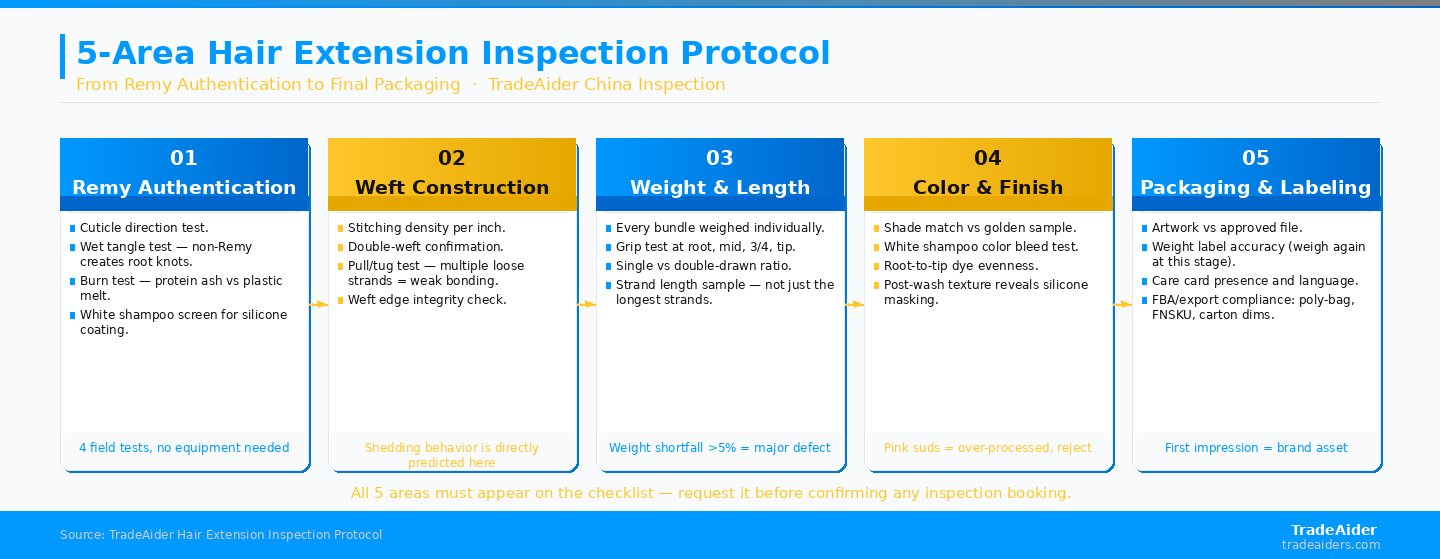
The five-area inspection protocol for hair extensions — from Remy authentication through to final packaging verification.
Area 3: Weight and Length Verification
Weight is the most commonly understated specification in hair extension orders. Bundles advertised at 100g are frequently dispatched at 90–95g — a shortfall that, across a 500-bundle order, represents a significant loss of product value. Every bundle should be weighed individually against the specification, and the distribution of weights across the sample should be recorded in the inspection report.
Length verification requires measuring a representative sample of strands within each bundle — not just the longest strands. As hair extension quality educators explain, a large proportion of short strands in a bundle indicates hair collected from fallen sources rather than a single donor — resulting in poor cuticle alignment, more tangles, and lower effective length than the stated measurement. The draw ratio check gives a practical sense of whether the bundle is single-drawn (wide range of strand lengths) or double-drawn (majority at or near the stated length).
Area 4: Color and Finish
Color matching against the approved sample (or standard shade chart) is a fundamental part of any hair extension inspection. The most important color-related check beyond shade accuracy is color bleeding. As hair extension quality guides note, a strong chemical smell may indicate over-processing — and chemically over-processed hair is the primary source of color bleed on wash. If extensions are washed with white shampoo and the suds take on color, the dye is not set properly and will transfer to consumers' clothing, pillowcases, and potentially their natural hair. Excessive color bleed is a major defect.
Inspectors should also check the evenness of color distribution from root to tip, particularly for ombre or balayage styles where the gradient transition point should match the approved reference. Uneven distribution indicates a rushed or imprecise dyeing process.
Area 5: Packaging and Labeling
Hair extension packaging is a brand asset — especially for salon brands or premium DTC labels where the unboxing experience matters. Inspectors should verify that packaging matches approved artwork, weight labels are accurate, care instruction cards are present, and the box construction is sufficient to protect the contents during transit. Crushed, dented, or poorly sealed inner packaging creates a poor first impression that no extension quality can fully overcome.
For Amazon FBA shipments, packaging must also meet fulfillment center requirements — poly-bag sealing, FNSKU labeling, and carton dimensions. TradeAider's Amazon FBA inspection service covers these compliance requirements alongside product quality checks in a single visit.
When in the Production Cycle Should You Inspect?
For hair extensions, timing the inspection correctly is important. A pre-shipment inspection (PSI) conducted when 80–100% of the order is packaged is the standard minimum. But for new suppliers or previous quality issues, adding a During Production Inspection (DPI) at the 30–50% completion mark allows you to catch systemic problems — like a supplier switching to a lower-grade hair source mid-order — before they affect the full batch. Catching a hair grade substitution at DPI typically costs a fraction of the rework or reorder required if it's found at PSI. For more on how these inspection types differ, see TradeAider's inspection standards guide.
Frequently Asked Questions
Can a third-party inspector really tell the difference between Remy and non-Remy hair?
Yes — with the right tests, definitively. The wet tangle test, cuticle direction assessment, and burn test together provide a reliable basis for distinguishing genuine cuticle-intact Remy hair from stripped or synthetic material. An inspector who only performs visual checks cannot make this determination reliably, which is why selecting an inspection company with documented hair extension experience is essential. Ask for sample checklists before booking.
What AQL level should I use for a hair extension inspection?
For hair extensions, most importers apply AQL 2.5 for major defects (excessive shedding, synthetic blending, weight shortfalls over 5%) and AQL 4.0 for minor defects (minor color variation, minor packaging issues). According to sourcing quality guides, defect prioritisation should focus on the areas most critical to product performance and customer satisfaction — for hair extensions, that means cuticle integrity and weft construction first. For high-value orders targeting the premium salon segment, tighter sampling levels (General Inspection Level III) increase the sensitivity of the inspection. TradeAider's AQL calculator can help you determine the right sample size for your order quantity.
My supplier has been reliable for two years — do I still need inspections?
Supplier consistency can change without notice, and hair extensions are a high-substitution-risk category. Material sourcing, production team changes, and cost pressures can quietly shift quality between orders even with a trusted supplier. Many importers who've had long-standing relationships with hair extension factories report quality issues appearing without warning after previously smooth orders. Periodic inspections — at minimum on every large order — protect against this. They also give you documented evidence if a dispute with the supplier arises.
Ready to inspect your next hair extension order before it ships? Schedule your inspection with TradeAider and receive a full written report — including photographic evidence of all test results — within 24 hours of the inspection date.
مقالات ذات صلة



نمِ عملك مع خدمة TradeAider
انقر على الزر أدناه للدخول مباشرة إلى نظام خدمة TradeAider. الخطوات البسيطة من الحجز والدفع إلى تلقي التقارير سهلة التشغيل.

