
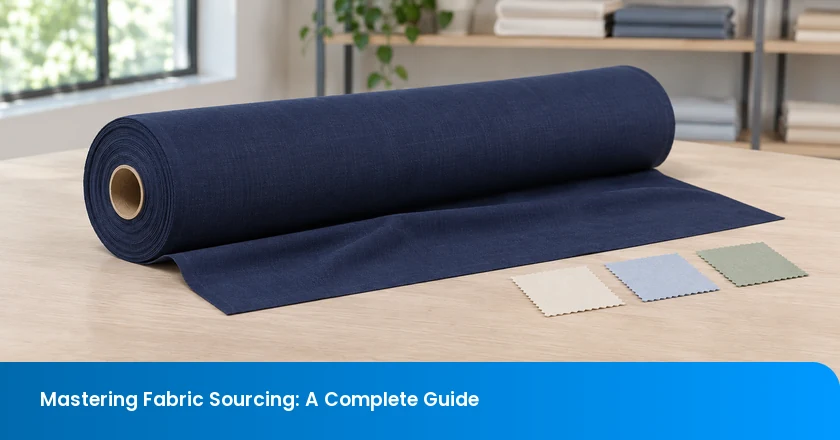
Fabric sourcing is the process of translating a product idea into suitable, evaluated and purchased fabric that can be delivered for production. It covers design requirements, market research, supplier selection, samples, cost, contracts and bulk delivery. Responsible sourcing also requires evidence for the material and sustainability claims the buyer intends to make.
Start with the finished product and its use. A fabric that looks right on a swatch may behave differently after cutting, sewing or laundering. The sourcing plan should connect what the design needs with what the supplier can make, what the samples demonstrate and what the order actually requires.
What fabric sourcing covers and why it matters
Fabric sourcing connects design, purchasing, technical and quality teams with suppliers and garment manufacturers. Designers define the intended appearance and feel; technical teams translate use and care needs into requirements; purchasing coordinates the commercial arrangement. The manufacturer needs fabric that works with the approved construction and production plan.
The choice affects appearance, comfort, durability and manufacturability, while price, usable quantity and delivery affect the business plan. “High quality” therefore needs a defined purpose. A fabric suitable for a structured shirt may be unsuitable for a stretch garment even when both are well made.
Assign an owner for the sourcing decision and identify who can approve technical changes. Keep the fabric reference and unresolved questions in a shared record. This prevents design approval, a supplier’s quotation and a later production instruction from describing different materials.
Turn the design into a fabric sourcing brief
A fabric sourcing brief turns a design idea into a comparable supplier request. Record the intended use, fabric identity, measurable requirements, appearance reference and purchasing conditions. Use the table below as a copyable starting point; the technical owner should resolve missing limits or methods before the relevant approval.
| Define | Fill in for this fabric | Why it matters |
|---|---|---|
| Use and reference | Product/use: ___; fabric code/revision: ___ | Connect the material to the finished product |
| Composition and construction | Fiber/blend: ___; woven/knit structure: ___ | Identify what is actually being quoted |
| Weight and usable width | GSM/method: ___; usable width/tolerance: ___ | Support comparable fabric and yield assessment |
| Color and finish | Color reference: ___; hand/finish/print: ___ | Define the appearance and treatment required |
| Performance and care | Checks/methods/conditions: ___; criteria: ___ | Evaluate the properties the intended use needs |
| Quantity and terms | Quantity/unit/colors: ___; minimum order quantity (MOQ)/date/terms: ___ | Establish order feasibility and comparable cost |
| Claims and records | Claim/program/scope: ___; records needed: ___ | Support the statement made about the material |
GSM means grams per square meter: fabric mass per unit area. The public scope of ASTM D3776/D3776M-20(2025) distinguishes sampling options, including a small-swatch result that need not represent its lot. Record the relevant method and sample coverage. Weight alone does not establish strength, care performance or overall suitability.
Choose fiber, construction and finish for the intended use
Select the actual fiber, construction and finish together. CottonWorks explains that resistance to air penetration can reflect construction, fiber content, chemistries or their combination. That is a useful example of why a fiber name alone cannot establish every performance property.
Natural fibers, synthetic fibers, regenerated fibers and blends give a designer different options. Compare the proposed fabrics for hand, drape, appearance, stretch and recovery, and the durability and care properties relevant to the product. A blend is not automatically better or worse than a single-fiber fabric.
Construction describes how the fabric is built; finishing describes treatments that influence its final characteristics. Ask which proposed construction and finish produced the sample. A different yarn arrangement or finish may change behavior even when the stated fiber composition stays the same.
For a garment, assess the fabric in a suitable development sample as well as by itself. Check whether it supports the intended silhouette, seams and appearance after the planned care. Use those observations to refine the specification before treating the material as ready for bulk purchasing.
Research fabrics and suppliers without treating trends as proof
Market research should produce a relevant shortlist and useful fabric alternatives. Use textile exhibitions, industry directories, supplier collections, referrals and targeted online research to find candidates. Collect swatches with the supplier, fabric code, composition, construction, finish and availability recorded.
Treat fashion forecasts, digital fabric libraries and competitor products as sources of ideas. A photograph or digital rendering cannot establish physical hand, actual construction, wash behavior or the supplier’s ability to repeat a finish. Request physical material and suitable evidence for the shortlist.
Research commercial feasibility alongside appearance. Ask whether the fabric is stocked, made to order or available only as a limited lot. Find out which colors and finishes are feasible, what development is needed and how replenishment works. An attractive sample is less useful if its quantity or timing cannot support the collection.
Compare mills, intermediaries and sourcing locations
Choose a supplier route that fits the fabric and order. Establish whether the quoting party is a mill producing fabric, a converter coordinating processing or finishing, a stockist selling available goods, or an agent coordinating the purchase. Ask which actual sites will carry out the relevant production stages and which work is subcontracted.
A stock route may suit a small launch when the available quantity and condition meet the need. Custom production may provide more control over construction or finish while requiring development, minimum quantities and a different schedule. Confirm those terms with the supplier rather than assigning fixed advantages to each route.
Local and international sourcing also require a project-specific comparison. Distance, transport, customs where applicable, communication and production access can affect cost and timing. Location does not establish that a supplier is more innovative, produces better fabric or will always deliver faster.
Use the same brief when approaching candidates. Compare how clearly each responds to material requirements, quantities, sample work and delivery assumptions. Keep alternatives whose actual offer fits the project, with the reason for any outstanding technical or commercial condition recorded.
Assess supplier capability and the meaning of certificates
Assess supplier capability against the fabric you plan to buy. Review relevant material and process experience, the proposed site, equipment and finishing route, available capacity and references for comparable work. Samples and a suitable pilot can address questions that a company profile cannot resolve.
TradeAider’s factory audit scope includes supplier information, production lines and equipment, quality management and warehousing. Define the process questions that matter to the proposed fabric so the commissioned findings can support that assessment.
Read certificates by what they cover. OEKO-TEX STANDARD 100 concerns textiles tested for harmful substances. It does not by itself establish organic or recycled content, wash performance or a complete environmental benefit. Match any supplied certificate to its article coverage and status instead of assuming that every material sold by the supplier is covered.
Keep system, article and material-claim evidence separate. A supplier’s quality-system document may help explain its management arrangements; product tests address particular specimens and properties. Use the evidence relevant to the open question rather than treating a collection of logos as a fabric approval.
Approve samples through the checks each question needs
Sample approval should identify the question being answered. A lab dip is a color submission for dyeing approval; a strike-off is a print submission. Agree the appearance reference, construction and finish, and distinguish color acceptance from performance results and later checks of bulk material.
Choose tests from the fabric’s use and likely concerns, such as dimensional change, relevant colorfastness, strength, abrasion or stretch recovery. Identify the specimen, method, conditions and acceptance criteria. A familiar method name is not enough if different preparation or care conditions would change what the result means.
AATCC’s public description of TM135 concerns fabric dimensional changes in length and width after home laundering. For a washable fabric, agree the applicable method version, laundering conditions and acceptance requirement. A color approval does not establish dimensional stability, and the method’s name does not supply a universal shrinkage limit.
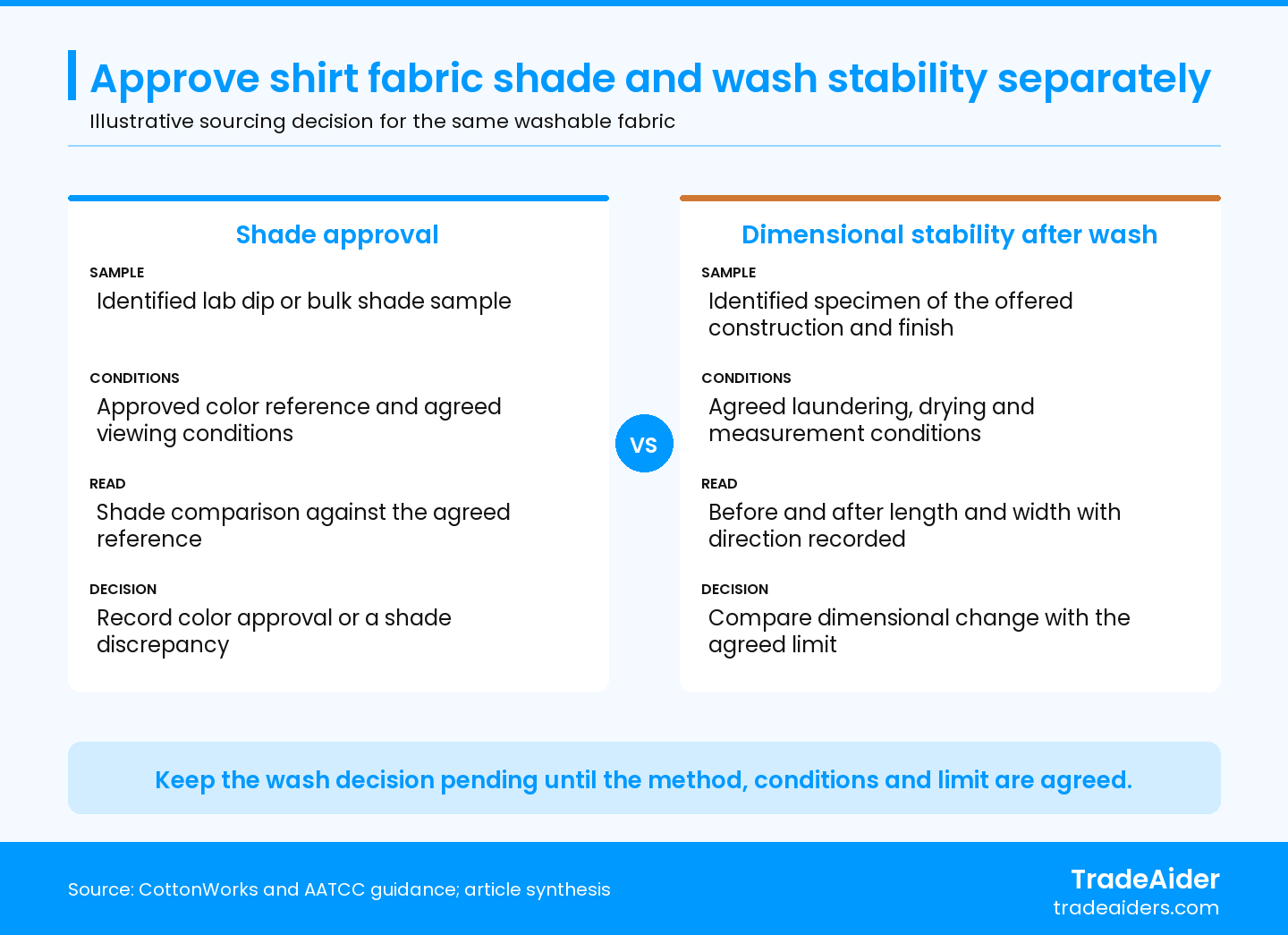
Illustrative shirt fabric. Compare shade to its approved reference and obtain separate dimensional-change evidence under the agreed laundering conditions.
TradeAider’s product testing process includes needs alignment, sample identification, implementation, review and reporting. Discuss the required fabric checks, then retain the approved references and results with their scope. Resolve an unsuitable or incomplete result before the corresponding fabric decision.
Compare fabric cost on a usable and delivered basis
Compare fabric cost using consistent units and usable material. Confirm whether the quote is per meter, yard, kilogram or another unit, and identify usable width, payable quantity and relevant yield or loss assumptions. A lower price for a narrower usable fabric may not produce a lower material cost for the garment.
Include development and setup charges, samples and testing, packing, transport, applicable import costs, payment conditions and any services needed for the purchase. Ask what is included and retain unconfirmed charges as open items. Do not compare a delivered offer with a factory-only price as though their scope were identical.
Minimum order quantity, or MOQ, is the smallest order a supplier agrees to accept. Check whether it applies to the fabric construction, color or finishing run. Compare the total commitment and leftover exposure as well as unit price. Stock availability, repeatability and delivery requirements can change which offer fits the business.
Agree the order, change rules and delivery conditions
A fabric order should describe the controlled specification and commercial arrangement clearly. Identify the fabric reference and revision, composition, construction, finish, usable dimensions, color references, quantity and unit. Include the agreed checks and acceptance basis rather than relying on “same as sample” without identifying the sample.
Agree delivery dates and responsibilities, packing, payment terms and the process for shortages, defects and disputed findings. Allocate who may approve a material, process or finish change. A revised supplier offer needs review when it changes the fabric or the purchasing assumptions.
Confirm the development and bulk schedule together: sample submissions, relevant testing, approved production inputs, production time and transport. Keep commitments consistent with the work still outstanding. If a required result or material is delayed, revisit the plan before assuming that the original delivery date remains achievable.
Connect bulk production, inspection and receiving
Bulk control connects the purchased fabric to what was approved. Retain roll and shade-lot identities, relevant production records and the agreed reference. Check the planned attributes, such as identity, quantity, usable width, weight, shade, visible defects and packing, with additional testing where the scope requires it.
TradeAider’s pre-shipment inspection includes agreed sample-based appearance, dimensions, quantity, packing and functional checks. Discuss the actual fabric order, access and equipment needs when defining the work. Current-order observations answer a different question from an earlier development test.
At receiving, reconcile the rolls, quantities and records with the order and inspect according to the agreed plan before use. Keep shade or material lots identifiable where mixing would affect production. Record discrepancies and obtain the responsible technical or commercial disposition, rather than allowing an unexplained difference to disappear into cutting stock.
Source responsibly and substantiate material claims
Responsible fabric sourcing begins with a precise claim or expectation. “Organic,” “recycled,” chemical testing, lower environmental impact and ethical production are different questions. Define which matters for the product and obtain relevant material, process and supply-chain evidence.
The official Global Organic Textile Standard (GOTS) key features cover organic-fiber requirements and applicable processing, manufacturing and trading certification, including environmental, human-rights/social and traceability elements. Match the intended organic claim to the relevant coverage and records. Do not expand it into a claim that every fabric-processing stage uses no chemicals or has no environmental impact.
Textile Exchange describes Recycled Claim Standard (RCS) and Global Recycled Standard (GRS) as third-party recycled-material and chain-of-custody standards; GRS adds processing-related social and environmental requirements. Chain of custody concerns the documented path of the certified material. Check the applicable program, scope, version and claim requirements for the order, including relevant transaction evidence, rather than assuming a supplier badge covers every fabric.
In the United States, FTC consumer guidance on bamboo fabrics explains that bamboo processed into rayon does not automatically retain the plant’s properties. Claims such as naturally antibacterial behavior or environmental benefit need supporting evidence. The feedstock name alone is insufficient to establish the finished fabric’s overall impact.
Discuss relevant chemical controls, labor expectations and destination requirements with the responsible teams. Evaluate specific practices and records instead of ranking all natural or recycled fibers as inherently best. Where a claim cannot be supported, narrow the proposed claim or choose material with suitable evidence.
Illustrative example: a shirt fabric that needs another decision
This is a hypothetical example, not client data. A brand is sourcing navy cotton woven shirting. One supplier offers a lower unit price, but its usable width and MOQ basis are unclear. The buyer completes those fields in the sourcing brief before comparing the expected fabric commitment and garment yield.
The color submission is approved. A representative fabric sample then shows dimensional change outside the agreed home-laundering criterion. The accepted shade has answered the color question; it has not resolved the wash result. The technical owner holds the affected fabric approval and discusses corrective finishing or an alternative material.
The supplier submits representative revised fabric for the relevant reassessment under the agreed method and conditions. The buyer checks the result and updates cost and delivery assumptions before committing. Bulk roll and shade-lot records remain part of the production and receiving plan even after development approval.
If the report omits sample identity, method conditions or the judgment limit, obtain that information and complete or repeat the relevant assessment before deciding. Do not fill the gap with a universal shrinkage percentage. The needed outcome is a fabric offer whose usable quantity, supported performance, price and schedule meet the approved sourcing requirements.
Before committing to a fabric order
- Translate the finished product’s needs into an identifiable fabric specification.
- Compare suitable supplier routes and usable, delivered cost.
- Keep color, performance, bulk and material-claim evidence distinct.
- Agree order, change and receiving responsibilities before committing.
Define the fabric checks for your next order
Begin a TradeAider inquiry with available fabric, product and order details, the supplier/site in China and the capability, sample-performance or batch-quality question to resolve. Share specifications or existing reports where available. Before service, agree feasible audit, testing or inspection checks, samples, methods, criteria and reporting. Contact our team to discuss a suitable scope and a report of the commissioned findings.
FAQ
Can a repeat order rely on the old approved swatch?
Confirm the current fabric and relevant changes before relying on the old approval. Ask whether composition, construction, finish, color route, production site or availability has changed, and review the evidence affected by any change. Retain an identifiable reference and current order requirements. An old approved swatch can help comparison without automatically approving a changed fabric, a new lot or indefinite replenishment.
Can leftover or deadstock fabric work for a small collection?
It can, if available quantity, condition and the lack of assured replenishment fit the plan. Deadstock generally refers to existing surplus or leftover material rather than a guaranteed repeat production program. Identify the actual lot, inspect its condition, assess relevant performance and allow for usable yield. Avoid promising future collections in the same material until additional supply is confirmed.
What should a buyer do when a fabric is discontinued?
Treat the replacement as a proposed fabric change and assess it against the original product needs. Compare composition, construction, finish, usable dimensions, appearance and relevant performance, then review garment fit or manufacturing implications where needed. Revisit the quotation, MOQ and schedule as well. A supplier’s description of “equivalent” is a proposal to evaluate, rather than permission to substitute without approval.

مقالات ذات صلة


نمِ عملك مع خدمة TradeAider
انقر على الزر أدناه للدخول مباشرة إلى نظام خدمة TradeAider. الخطوات البسيطة من الحجز والدفع إلى تلقي التقارير سهلة التشغيل.

