

For planned partial shipments, define the goods available for the inspection, the population covered by its report, and the goods leaving in each dispatch. Keep those quantities separate from the purchase-order total. One identified inspection lot may leave in several shipments, while later production may need a new inspection under the agreed plan. The useful control is a quantity ledger tied to physical carton or pallet references, with a clear follow-up action for the remaining goods.
Three decisions behind a partial-shipment inspection plan
- Identify the inspection population before selecting the sample.
- Map each dispatch to that population and preserve the identity of retained goods.
- Separate later production from previously inspected stock when planning follow-up checks.
Separate the PO, inspection lot and shipment
Acceptance sampling supports a decision about an identified lot. The National Institute of Standards and Technology, or NIST, describes random sampling for lot disposition and distinguishes that purpose from estimating the lot’s quality. A report should therefore identify the population to which its result applies. A purchase-order number alone cannot show that every unit ordered was present, accessible or represented in the inspection.
A purchase order, or PO, is the commercial order reference. An inspection lot is the defined group presented for a particular inspection decision. A sample is the selection actually examined from that group. A shipment is the physical quantity dispatched on a particular occasion. A manufacturing batch identifies a production grouping; it may help define the inspection lot, but the two labels are not automatically interchangeable.
These groups can overlap. A buyer may order a total quantity, inspect an identified finished portion and send only part of that portion on the first truck. The shipment quantity is then smaller than the report population. Alternatively, a shipment may contain goods from more than one separately identified lot. In that case, the dispatch record needs more than one report reference or an explicit account of the uncovered goods.
Agree the lot boundary before the visit: product and specification revision, factory and location, production references, quantity, packing condition and physical identifiers. Distinguish variants or production groups where their differences affect the agreed sampling or checks. Do not combine unrelated goods merely to use a larger lot-size row or divide a population after seeing the results to obtain a favorable conclusion.
TradeAider’s inspection sampling reference explains sampling in relation to a lot or consignment. Use that starting point to discuss the population and actual method. The shipping schedule answers when goods leave; it does not choose the inspection boundary or demonstrate that every planned delivery has been examined.
Confirm what is ready on the inspection date
Keep the commercial order, available inventory and service-readiness conditions distinct. A supplier’s statement that the first delivery is ready does not establish that the whole PO meets the provider’s conditions. Ask for dated quantities and physical access, then confirm the inspection stage and scope before assigning the visit. A changed description of the denominator cannot make unfinished goods complete.
For TradeAider’s Pre-Shipment Inspection, or PSI, the order quantity is 100% complete and at least 80% packed for export. The packing threshold is not a production-completion threshold. If only part of the PO has been manufactured, do not describe the entire order as PSI-ready. Ask the provider whether an appropriate in-production assignment is feasible, or agree revised timing. Do not assume an exception to the standard PSI condition.
Obtain a readiness snapshot by product and relevant variant: ordered quantity, finished quantity, packed quantity, location and quantity accessible for selection. Identify unpacked goods, work in progress and quantities stored elsewhere separately. Photographs can help explain the arrangement, but an old photograph cannot establish today’s count. Record the snapshot time so the inspection team can compare the booking information with the goods actually presented.
Access is part of the scope. If only the front row of cartons can be reached, the available selection may not represent the population the buyer intended. Agree how the factory will make the named cartons and variants accessible. If the presented quantity differs on arrival, the inspector should record the difference and obtain a scope decision instead of silently replacing the agreed population with whatever is easiest to open.
The booking and report should state whether the assignment concerns ongoing production, a defined available population or completed-order readiness. Record unavailable checks and quantities explicitly. A limited observation can still answer a useful question, but the buyer needs that limitation before using it for a shipping decision. Scheduling, access, equipment and the report recipient’s acceptance conditions need confirmation for the actual assignment.
Choose the sampling plan for the defined lot
A sampling plan includes both selection and decision rules. NIST’s description of acceptance-sampling plans distinguishes a single sample from double sampling, where a second sample contributes to a decision about the same lot. A visit to inspect later production concerns different goods. Calling that visit a “second inspection” does not turn it into the second stage of a statistical double-sampling plan.
Set the applicable standard and edition, inspection level, inspection severity, sampling type and acceptance quality limit, or AQL, where that method is used. The AQL is an index for the sampling scheme; it is not a permission to ship that percentage of defective goods. Agree defect classifications and the acceptance/rejection numbers with the responsible quality team. A commercial split date supplies none of those inputs.
Select from the population actually declared for the inspection. If the goods are divided into identified carton groups, sizes or variants, agree how selection will cover them under the chosen method. A convenient sample supplied from one accessible carton does not establish selection across every declared group. The report should retain the actual selection basis, sample quantity and any restrictions that changed the work.
Keep the lot size and the examined quantity in separate fields. Also distinguish a sampled workmanship assessment from checks with their own quantities or methods, such as specific functional tests, measurements or laboratory specimens. One report may contain several check scopes. Do not assume that the number beside the workmanship sample is also the number measured, function-tested or opened for a different check.
Use the AQL sampling calculator only after the relevant inputs are agreed, then verify the result against the selected plan. If the inspection population changes before selection, revisit those inputs. If units are added after the inspection, a larger number typed into the report cannot retrospectively create observations of the additional goods.
Build a quantity ledger without double counting
In this hypothetical 1,000-unit order, the available and identified inspection lot is 400 units: 300 ship now and 100 remain identified, while 600 units are not yet produced. The 20 examined units are a subset of the 400, not an additional quantity or a recommended AQL sample size.
Illustrative example: Assume a provider has agreed a feasible inspection scope for Lot A and issued report IR-A. Lot A consists of 40 identified cartons containing 10 units each. The example’s 20 examined units were checked nondestructively, returned in the required condition and repacked. All quantities, identifiers and the examination count are invented for explaining the ledger. No TradeAider client result, sampling-table lookup, acceptance verdict or partial-PO PSI exception is implied.
| Quantity field | Illustrative record | Relationship and report use |
|---|---|---|
| PO total | 1,000 units; agreed specification revision | Commercial obligation; not the quantity examined |
| Available and defined Lot A | 400 units; cartons A001–A040 | Population named in IR-A for its agreed checks |
| Actually examined sample | 20 units within Lot A | Subset of 400; not another 20 units to add |
| First dispatch S1 | 300 units; cartons A001–A030 | Subset of Lot A linked to IR-A |
| Retained part of Lot A | 100 units; cartons A031–A040 | Still identified within the earlier report population; condition and later requirements remain relevant |
| Future production | 600 units; not yet produced | Outside IR-A; later inspection plan remains open |
| PO balance after S1 | 700 units unshipped | 100 retained + 600 future; two different evidence states |
The reconciliation is 1,000 = 400 + 600 before dispatch, then 400 = 300 + 100 within Lot A. After S1 leaves, the unshipped balance is 700. Do not calculate the order by adding the available quantity, the sample and the shipment: those are overlapping sets. The ledger identifies coverage; it does not manufacture a pass or authorize shipment.
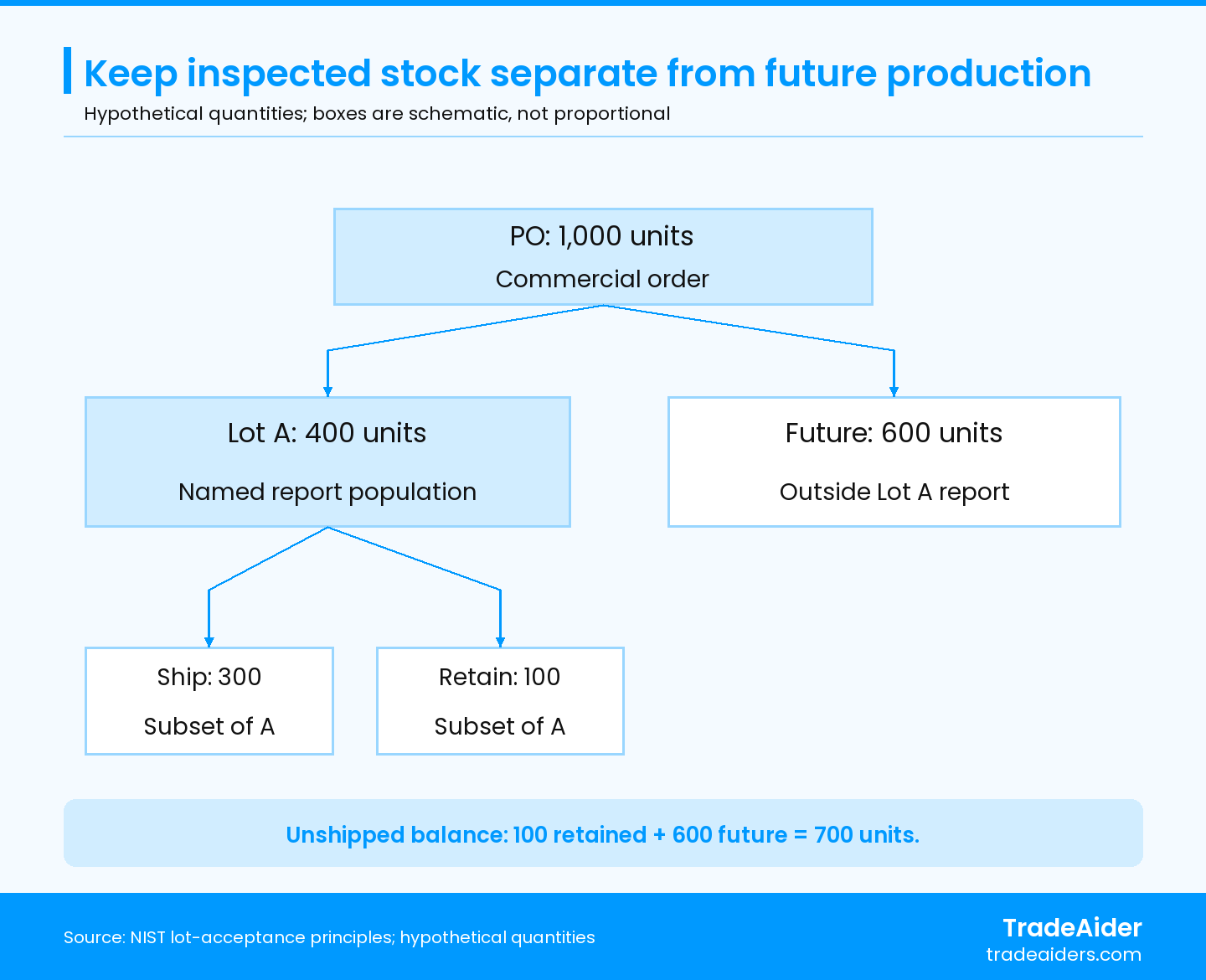
Hypothetical quantity map, not a sampling recommendation. The 300-unit dispatch and 100 retained units are subsets of the same 400-unit report population. The 600 future units are outside that report. Coverage also depends on the agreed checks and the identity and condition of the goods.
For a real order, copy these quantity fields and add the actual date, location, lot and carton references, report revision, dispatch reference and next-action owner. Mark a quantity as supplier-declared, counted or otherwise verified, with its basis. Record the actual shipment after dispatch rather than leave a planned quantity looking like a completed movement. Update the balance from that confirmed movement and any separately documented adjustments.
If cartons A031–A040 cannot be distinguished from newly produced cartons, the retained quantity is no longer demonstrably linked to IR-A. Keep it separate from the new goods, ask the factory to recover the carton and production mapping, and decide the needed verification if that mapping cannot be established. An unchanged total of 100 does not solve a missing identity link.
When forwarding a partial-shipment ledger, include the inspection report reference, inspected lot, quantity and shipment stage so the overseas buyer can match each finding to the goods it covers.
Keep goods and packing traceable between dispatches
Tie the retained goods to identifiers that remain with the physical cartons or pallets. Within the GS1 system, logistic units have individual identification through the Serial Shipping Container Code, or SSCC. A logistic unit groups goods for transport or storage. That identifier can connect goods and records; it is not itself an inspection result. Use the buyer’s agreed identification system without assuming every order must adopt GS1.
For retained goods, preserve the link between the report, storage location and carton range. Have the factory record movements and prevent substitutions from later production from being silently added to the same identified group. If cartons are split or repacked, record the old-to-new identity mapping and the new quantities. A replacement label should explain the movement rather than erase the earlier reference.
Identity and condition answer different questions. A carton may still carry the correct mark after being wet, crushed or opened. Record storage or handling events that could affect the product or packing, and tell the person deciding the next check. The earlier inspection describes the condition and checks at its stated time; it cannot show what happened after the inspector left.
Keep packing and label revisions with the retained population. A new shipping mark for the second departure may require a targeted packing check even when the product specification is unchanged. A new product component or material can raise a wider question. Name what changed and which requirement it can affect, so the follow-up request does not become a vague instruction to “check again.”
While later units are still being made, an in-production visit can address agreed process, product and packing observations before the final shipment stage. Keep those findings attached to the production actually observed. They can inform the next inspection plan and supplier action, but cannot become a final result for goods that did not yet exist or checks that were not performed.
TradeAider’s During Production Inspection services describe observations during ongoing production and a formal report. Discuss whether that stage fits the actual completion status and the questions about later quantities. Confirm the feasible scope and references before booking; a staged production schedule does not, by itself, establish provider availability or final-shipment approval.
Decide what needs a follow-up check
Plan later checks from the agreed scheme and the goods’ actual evidence state. NIST’s skip-lot sampling guidance describes a structured approach requiring demonstrated good quality, a reference plan and specified switching conditions. One earlier accepted lot is not an automatic exemption for future production. Equally, a second departure from an unchanged identified lot does not, by itself, prove that every earlier check must be repeated.
| Situation | Question to resolve | Follow-up to agree |
|---|---|---|
| New production outside the earlier lot | Which new population and readiness date apply? | Apply the agreed inspection plan to the later goods; name a new lot/report scope |
| Identified retained goods, unchanged | Do current contract, recipient and condition requirements still fit? | Review the earlier scope, storage and dispatch mapping; agree any remaining checks |
| Repacking or revised labels | Which product, packing or label requirements changed? | Define affected checks and preserve the old-to-new carton mapping |
| Loss of identity or substitution | Can actual goods still be linked to the earlier population? | Recover records or define fresh verification before claiming earlier coverage |
| Only dispatch quantity or transport reference changes | Are the selected cartons still within the named lot? | Reconcile the shipment record; do not rewrite the original inspection population |
The quality owner should state which evidence is needed before the next release decision and who supplies it. The factory provides current quantities, production references and change records. The inspection provider confirms what can be observed and reported. The buyer or designated recipient decides acceptance under the actual requirements. Keep that commercial decision distinguishable from the inspector’s findings.
In the example, the 600 future units need their own applicable inspection planning. The retained 100 need a current review of identity, condition and requirements before the next departure. If only their destination label changes, identify the affected label and packing checks. If their physical identity is lost, recover or re-establish the evidence basis instead of treating the earlier report number as sufficient.
This is normal planned follow-up, not necessarily reinspection after a failed result. If a nonconformity is actually found, address its affected population and correction separately. Avoid inventing a standard visit frequency or a mandatory repeat fee from the fact that the buyer has booked several trucks.
Match the dispatch record and brief the next visit
Reconcile each dispatch to the physical units and source inspection lots. GS1’s shipping-identification guidance distinguishes individual logistic-unit identifiers from a shipment identifier that can group multiple units. The practical lesson is to preserve the membership of the actual dispatch. A shared container or booking reference does not merge different quality populations into one inspection result.
Before loading, match the dispatch quantity and carton or pallet list to the relevant lot and report references. Record the basis of any quantity check and exceptions. An inspection report and a loading observation answer different questions: one records its agreed product checks; the other can record what was observed at loading. Neither automatically supplies observations that the other did not perform.
An initial inquiry can begin with available product, order, factory, timing and staged shipping information. Include the readiness snapshot and any existing report. List unknown criteria or missing carton records openly. A small buyer does not need to invent a sampling plan to make contact; the unresolved technical choices need an owner and agreement before execution.
Before the visit, settle the actual population, location and access, product specifications, sampling and test methods, equipment and packing references. Confirm the final report recipient, language, format and acceptance requirements. Tell the team which quantities remain outside this assignment and what event should trigger the next review, such as later production becoming ready or a confirmed packing revision.
To align the visit with the actual staged order, contact the TradeAider team with the available quantity ledger, current references and shipping plan. Ask the team to confirm the feasible inspection stage, scope and reporting requirements. The resulting agreed inspection report should make the checks performed, the population covered and the remaining limitations clear.
FAQ
Can two purchase orders share a container and one inspection result?
Sharing a container does not merge the inspection scope of two purchase orders. Keep each lot’s quantity, product references and result identifiable in the loading record. A single report file can describe multiple agreed scopes only if those scopes and findings are explicit; a common document cover is not enough. Confirm the sampling and reporting arrangement before the visit rather than infer it from consolidated freight.
What if the next shipment has a different consignee?
Confirm the new recipient’s requirements before reusing the earlier reporting and packing instructions. The consignee is the party receiving the goods. It may need a different language, report format, destination label or packing configuration. Preserve the product and lot history while recording those changed requirements. If a change affects an earlier check, ask what additional evidence the new recipient needs before the second dispatch.
Do sampled units stay in the shipment quantity?
Count them in the shippable balance only if they are returned in the required condition and remain eligible to ship. Destructively tested items, retained specimens or units damaged during examination need a separate quantity disposition. Record the removal or replacement and its inspection status. Do not silently add unexamined replacement goods to the earlier lot, or subtract every sampled unit when it was actually returned intact.
مقالات ذات صلة

نمِ عملك مع خدمة TradeAider
انقر على الزر أدناه للدخول مباشرة إلى نظام خدمة TradeAider. الخطوات البسيطة من الحجز والدفع إلى تلقي التقارير سهلة التشغيل.