
- معلومات عنا

- خدماتنا
- صناعتك
- الموارد
- الأخبار والمدونة
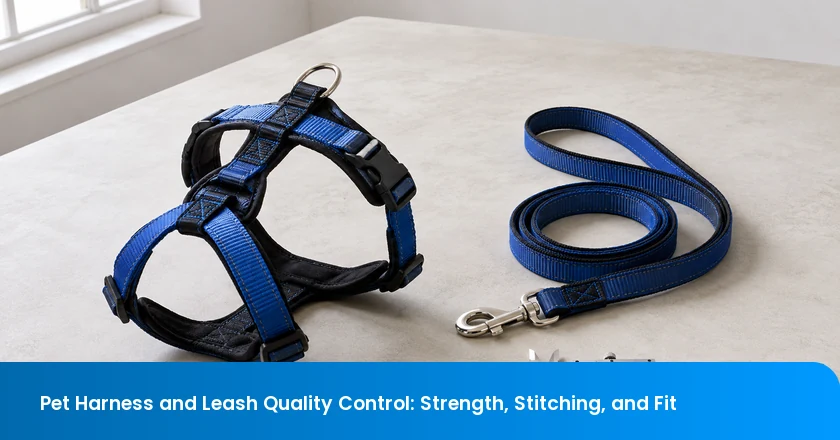
A harness can lose restraint even when its webbing and stitches do not break. A slipping adjuster, partly engaged buckle, or poorly matched hook can defeat an otherwise strong product. For pet harness and leash quality control, check the connected construction, its adjustment range, and its behavior under agreed test conditions. Use material reports to support those checks, not replace them. These checks apply to ordinary walking harnesses and fixed or adjustable webbing leashes. Vehicle restraints, lifting equipment, and retractable mechanisms need additional, purpose-specific assessment.
What Must a Harness and Leash Inspection Establish?
- Check the complete restraint assembly, then use component tests to investigate individual failure risks.
- Agree the load, duration, repetitions, fixtures, and acceptance criteria before testing. A dog-weight label does not supply those details.
- Separate broken stitching, buckle opening, and adjuster slip in the report; they call for different corrections.
- Verify hardware finish and the usable size range against approved specifications, including the instructions and labels supplied with the product.
Define the Walking Use and Claims Before Testing
Start with the intended animal, size range, attachment points, and use conditions. A harness intended for everyday walking should not acquire a lifting or car-restraint claim simply because a strap withstands a high static pull. A controlled pull and a vehicle crash involve different configurations and performance questions.
Center for Pet Safety describes its certification program as voluntary and based on independently developed safety standards for pet travel products. Its certification program information illustrates why travel-safety claims require their own evidence. This is not a mandatory certification for every walking harness, nor proof that an unlisted walking product is unsuitable for its stated use.
For the purchase specification, identify each load-bearing attachment and distinguish it from decorative rings or identification-tag loops. State whether the product is adjustable, which size chart applies, and what the care instructions permit. If the supplier proposes a performance claim, request the test basis and the exact construction covered. Have a qualified technical reviewer resolve missing limits before approval; do not improvise a universal multiplier of the animal's weight. Market-specific chemical, labeling, and consumer-product obligations also need separate review for the materials and destination.
Trace the Load Through the Finished Harness and Leash
A load path is the connected route through which pulling force passes from the leash handle to the animal restraint. Follow the handle joint, leash webbing, hook, attachment ring, sewn anchorage, and harness straps. An assembly may slip or open at an interface while its individual materials remain intact. The practical consequence is to check the approved complete construction as well as selected components.
Mark that route on photographs of the sample. Where the design has front and back leash attachments, treat them as different loading arrangements unless the technical assessment establishes equivalence. Record the strap-routing diagram and component identifiers so the factory cannot substitute a similar-looking buckle without review. Use TradeAider's inspection standard resource to organize these approved requirements into the inspection brief.
| Area | Routine observation | Evidence beyond appearance |
|---|---|---|
| Webbing | Width, damage, material identification | Representative strength and elongation results |
| Sewn joints | Pattern, overlap, missing or damaged stitches | Connection performance in the intended direction |
| Buckles and adjusters | Engagement, routing, movement | Closure retention and measured slip |
| Metal hardware | Edges, coating, hook action | Specified corrosion and structural checks |
| Sizing | Dimensions, adjustment limits, labels | Approved fit and restraint assessment |
Webbing Strength and Elongation
ASTM D6775 covers breaking strength and elongation of textile webbing, tape, and braided materials using a split-drum clamp. The public scope of ASTM D6775 describes a material test, not a universal passing load for finished pet harnesses. A report for an unsewn strip does not by itself establish the strength of a ring attachment or handle loop.
Match the report specimen to the specified material, width, thickness, construction, and relevant finish. Confirm the method edition, conditioning, test direction, and recorded result with the laboratory. Breaking strength is the force at rupture; elongation describes extension under the stated measurement conditions. Neither should be reported as an unexplained number beside the product's size label.
On the factory floor, inspect for cuts, fraying, damaged edges, inconsistent width, and poorly finished ends. Check whether the webbing passes through the approved hardware as intended. Do not infer fiber composition from color or touch. If a material or finish changes, ask whether the existing test evidence still represents it. Record that decision before consuming the replacement material in bulk production.
Stitch Paths and Sewn Attachments
Inspect structural stitching against the approved construction, and test the sewn connection when its strength matters. A tidy stitch pattern can still miss the required overlap, attach to the wrong layer, or leave the ring supported by a different route from the approved sample.
Compare thread specification, seam position, overlap length, stitch pattern, and reinforcement placement with the drawing. Look at both sides for skipped stitches, broken thread, loose loops, incomplete reinforcement, and damage around needle holes. Photograph the whole attachment before taking a close-up; otherwise a neat detail can conceal its location on the product.
During an agreed connection test, record whether the thread breaks, the webbing tears, the seam pulls out, or another part moves first. Do not summarize all four as “stitching failed.” The observed mechanism determines which construction or process needs investigation. Additional stitches should be an approved engineering change, not an automatic repair instruction.
Keep inspection responsibility separate from design approval. The factory implements the approved seam; the buyer's technical owner accepts its construction and test criteria. A visual visit should not be described as certification of an untested seam design. When appointing a separate inspection provider, confirm the agreed assignment and review the TradeAider company profile.
Buckle Security, Adjuster Slip, and Hook Closure
A buckle can remain closed while webbing slips through the adjuster, so closure and size retention need separate checks. An audible click is an engagement observation, not evidence that the full assembly retains its setting under the required conditions.
Confirm the male and female buckle parts are the specified matching pair. Check complete engagement, damaged tabs, cracks, sharp molding flash, and interference from straps or padding. Operate the release controls repeatedly according to the approved procedure and check function afterward. Where retention under load is required, the procedure must define loading direction and the pass condition. Do not use a person's body or a live animal as a test fixture.
For an adjuster, verify the threading route and compatibility with the actual webbing thickness and surface. Mark or measure a reference position before applying the specified check, then record movement rather than judging it by eye. Test the relevant adjustment settings, particularly where short remaining strap length could change retention. Report slip separately from rupture and from deliberate adjustment.
For a leash hook, examine gate closure, spring return, swivel movement, and fit with the intended attachment ring. Check that the gate returns fully without rubbing or catching. A hook that closes freely in the hand may interact differently with a thick or awkwardly shaped ring, so inspect the pairing as well as the loose component.
Static pulls, repeated loading, opening cycles, and wet-condition checks answer different questions. Include only the conditions justified for the product, with controlled fixtures and equipment suitable for the method. If the setup cannot be reproduced safely at the factory, obtain an appropriately scoped laboratory assessment instead of substituting an undocumented hand pull.
Hardware Finish and Corrosion Evidence
Inspect rings, hooks, rivets, and metal adjusters for burrs, sharp edges, cracks, flaking coatings, stains, and inconsistent finish. Pay particular attention to surfaces touching webbing or the animal. Separate cosmetic variation from an edge that could abrade a strap; they should not receive the same description or disposition merely because both appear in a finish photograph.
ASTM B117 does not specify product exposure periods or result interpretation, and salt-spray results alone rarely predict natural-environment performance. The public scope and limitations of ASTM B117 therefore do not support converting chamber hours into years of rust-free outdoor use.
Ask which component and coating were tested, how the specimen was prepared, the agreed exposure, and what counted as failure. A report should distinguish the specified acceptance criterion from a general observation of discoloration. If the purchase requirement concerns hook operation after exposure, an appearance-only result leaves that question unanswered. Identify the actual finish and component revision, not simply “silver hardware.”
TradeAider's product testing service provides a route to discuss the material, method, and reporting scope. Supply the required criteria and confirm the proposed laboratory's capability for that assignment before treating a test quotation as coverage. A corrosion test does not replace the hook's mechanical checks or establish compliance with unrelated chemical restrictions.
Sizing, Strap Routing, and Label Accuracy
Verify the usable adjustment range, not just the cut length of a loose strap. Define measurement points, buckle engagement, strap routing, and the condition in which each dimension is taken. Compare the smallest and largest approved settings with the size chart, including the remaining strap engagement and tail length required by the design.
Ruffwear provides separate shoulder-strap and girth-strap adjustment instructions for its Front Range harness. Its product-specific adjustment guide is a useful example of why one circumference reading cannot describe every adjustment. It is not a sizing rule for other brands or harness geometries.
For the inspected design, record neck or shoulder openings, chest-panel position, torso circumference, strap width, and leash length where specified. Identify the measurement points on a photograph. A “medium” label is not a measurement, and the animal's weight alone does not specify its body shape. Factory dimensional conformity supports the approved size design; it does not establish comfort or escape resistance for every animal.
Check that sewn labels, hangtags, packaging, and supplied instructions describe the same variant. Verify units and size ranges, front-versus-back attachment instructions, and any restrictions on use. Where fit validation is needed, the brand's qualified reviewer should approve the protocol and suitable forms or controlled fitting assessment. Do not improvise a live-animal pull test during routine inspection. A size discrepancy should identify both the measured deviation and the claim or instruction it contradicts.
Separate Routine Inspection From Destructive Testing
Use different plans for routine workmanship inspection and tests that damage or consume specimens. Before production, establish the qualified construction and method-specific acceptance criteria. During sewing and assembly, monitor the operations most likely to depart from that construction. At final inspection, verify the finished order and review the applicable test evidence.
NIST describes acceptance sampling as a decision about accepting or rejecting a lot, not an estimate of the quality of that lot. Its acceptance-sampling explanation helps separate a lot decision from design qualification. The AQL calculator can support routine attribute sampling once the lot size, inspection level, and acceptance quality limit are agreed; it does not set the product's breaking-force requirement.
Write separate quantities for visual and dimensional checks, operation checks, and destructive laboratory specimens. Specify how samples represent sizes, materials, hardware combinations, and production lots. Do not assume that passing a few tensile specimens statistically clears every untested variant. Record the allocation, selection method, and limitations with the results.
Classify defects before the visit using their consequence in the intended use. A sharp load-bearing edge, a non-retaining closure, and a cosmetic color difference require different attention. Suspected safety-related failures need prompt escalation to the responsible buyer or technical reviewer; a favorable aggregate defect count should not silently overrule an unresolved restraint failure.
For TradeAider pre-shipment inspection (PSI), the order quantity is 100% complete and at least 80% packed for export. The packing threshold does not permit 20% of production to remain unfinished. If essential test evidence is still outstanding, record that separately from the physical readiness of the goods and agree how it affects the shipment decision.
When Correcting the Stitching Does Not Fix the Failure
Repeated failure after a local repair is a reason to investigate the interface rather than repeat the same repair. Preserve photographs, specimen identification, setup details, and the sequence of movement. Those observations help distinguish a plausible repair from one that addresses the actual mechanism.
Illustrative Example: A Leash Handle Still Slips After Rework
A hypothetical importer plans to buy 2400 adjustable leashes. The factory submits a 24-unit pilot before bulk production; six pieces are reserved for engineering checks under an agreed procedure. All 24 pilot leashes await approval. This is an illustrative allocation, not a recommended statistical sample or a TradeAider client case.
During the check, a handle loop grows longer while its sewn overlap remains intact. The factory assumes the seam needs reinforcement and adds stronger stitching, but the repeat check still shows webbing slippage through the adjuster. Comparing the pilot with the approved component record reveals a different adjuster paired with the actual webbing. In this illustrative pilot, the extra stitching does not correct that mismatched sliding interface.
The buyer does not approve the pilot for the 2400-unit order. The technical team first reviews the fixture and threading to exclude a setup error, then restores the approved webbing-adjuster combination and updates the assembly instructions and component control record. The investigation changes from “add stitches” to “establish that this interface retains its setting.” Continued slip does not, by itself, identify the material's chemical composition or prove that every adjuster of that design is defective.
Approval depends on fresh representative pilot assemblies meeting the agreed slip and strength criteria, with adjustment retained after the specified checks. A photograph of the repaired seam is insufficient. The six reserved pieces in this illustrative example do not prescribe a sample size; a competent reviewer must determine the actual test allocation and conditions for the design. Bulk manufacture proceeds only after the revised pilot is accepted.
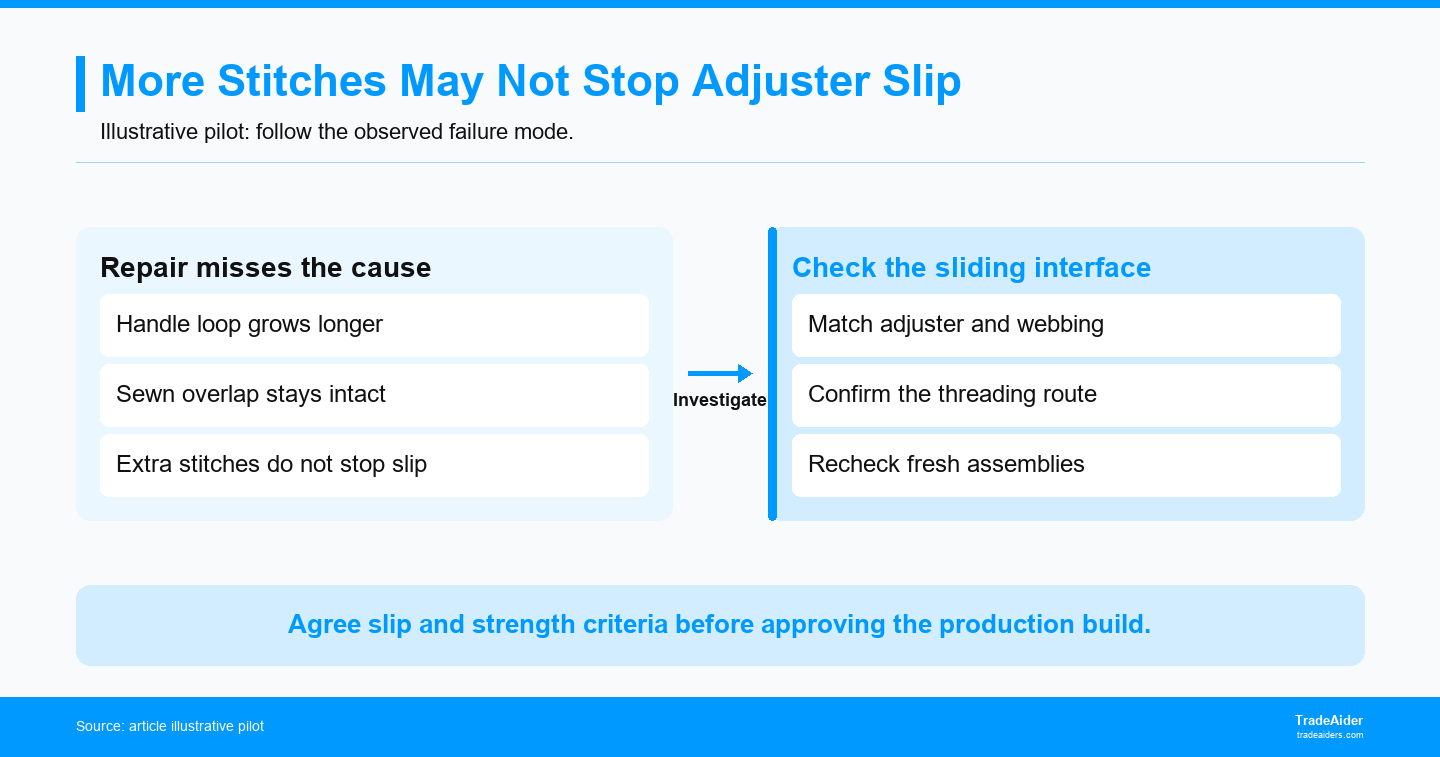
In the illustrative pilot, continued slippage calls for an interface check before more seam repair.
Prepare a Testable Inspection Brief
Give the inspection team the approved build, size limits, test methods, acceptance criteria, and reporting requirements before scheduling. Include the sample and drawings, component revisions, size chart and tolerances, order quantity, packing status, and any unresolved test questions. Identify which checks are possible on site and which require separate laboratory work.
Request findings that show the product configuration, measured result, applicable criterion, and any observed failure mode. That lets the buyer distinguish a nonconforming dimension from an unverified claim or an ineffective repair. The inspection provider reports the agreed checks; the buyer retains the decision on product approval and shipment.
Send that brief to TradeAider to confirm the feasible scope, arrange the agreed checks, and receive inspection findings against the checklist. Specialist testing remains subject to method and capability confirmation. Contact our team to arrange the inspection scope.
Frequently Asked Questions
Can the same tensile result cover every color and size?
Only when the technical justification shows that the tested construction represents those variants. Different widths, finishes, seams, or hardware combinations may change the relevant behavior. Identify the tested specimen and the variants covered by the assessment; a shared product name is not sufficient. Ask the technical reviewer which differences require additional testing.
Should test-damaged harnesses be returned to saleable stock?
No; segregate destructive-test specimens and any pieces whose condition may have been changed by testing. Label them, reconcile the quantity, and document their agreed disposal or retention as investigation samples. Keep them separate from untouched inspection samples so packing staff do not mistake a visually intact, heavily loaded specimen for an unused product.
Does a washable label require checks after washing?
If washability is claimed, define the care procedure and the performance or appearance requirements that must still be met afterward. Relevant checks may include dimensions, adjustment, coating condition, and label readability. Specify the cycles and evaluation criteria rather than treating an unspecified rinse as validation. Use the actual supplied care instructions as the starting point.
Can this checklist be used for retractable leashes?
Not as a complete checklist; retractable mechanisms introduce braking, retraction, cord, and housing hazards outside this fixed-webbing scope. Some finish and labeling checks may carry over, but they cannot qualify the reel mechanism. Define a separate product-specific assessment before applying an inspection plan intended for ordinary fixed or adjustable webbing leashes.
مقالات ذات صلة


نمِ عملك مع خدمة TradeAider
انقر على الزر أدناه للدخول مباشرة إلى نظام خدمة TradeAider. الخطوات البسيطة من الحجز والدفع إلى تلقي التقارير سهلة التشغيل.

