
- معلومات عنا

- خدماتنا
- صناعتك
- الموارد
- الأخبار والمدونة
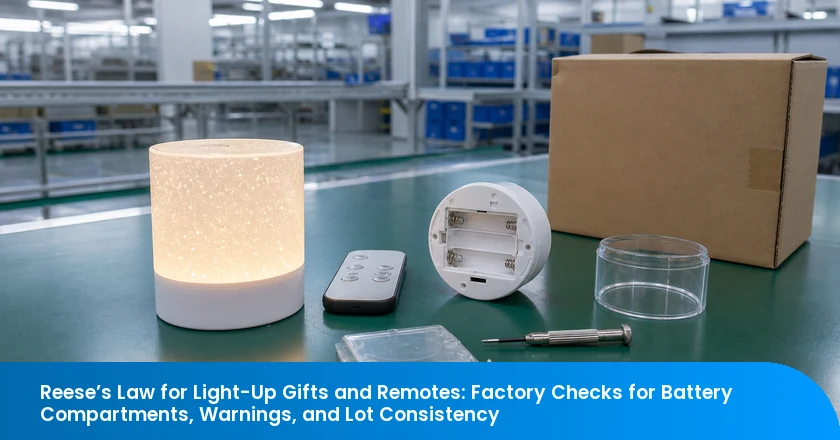
A Reese's Law product inspection checklist is a factory-control document that compares a covered battery product's approved evidence with the current build, warning materials, and identifiable carton range. It does not decide whether the product is covered, replace applicable testing, or issue a certificate. That boundary matters most for light-up gifts and remotes: a compartment, insert, or separately packed battery can change after the evidence pack was approved.
A defined lot is the identified production or carton range that shares the same version-sensitive condition and can therefore be held, corrected, or rechecked as one release population.
The useful question is not “Did the inspector see a battery?” It is “Can this observed product, its warning artwork, and its cartons be reconciled to the approved evidence for this release population?” When the answer is no, isolate the smallest defensible range and route the issue to the importer, compliance owner, or laboratory that can resolve it.
The Release Decision at a Glance
A release decision needs coverage review, approved evidence, physical observations, and a defined carton range—not a generic battery checklist.
- Scope: Separate a product-coverage decision from a factory check. A toy that meets the relevant Part 1250 battery requirements follows a different route from a non-toy consumer product.
- Evidence: Lock the model reference, battery BOM, report reference, approved product and package artwork, and instruction revision before the visit.
- Decision: Treat a compartment, warning, or record mismatch as a release-control issue only after it is tied to a defined lot or carton range.
- Boundary: Inspection can corroborate observable correspondence. It cannot perform the applicable laboratory evaluation or determine legal conformity.
Start With Coverage and the Toy Boundary
Part 1263 coverage and toy exemption require an applicability decision before factory scope is written.
The current text of 16 CFR part 1263 establishes performance and labeling requirements for consumer products containing, or designed to use, button cell or coin batteries. It also says that a plaything for children under 14 that complies with the battery-accessibility and labeling requirements in 16 CFR part 1250 is exempt from Part 1263. That is why a light-up item’s marketing, intended user, age grading, battery configuration, and applicable evidence must be reviewed before anyone labels a factory finding “Reese’s Law noncompliance.”
For an importer, the practical output of this first step is a one-line scope decision in the control packet: covered Part 1263 product, toy-route product, or unresolved classification requiring competent review. An inspection team can then work from that decision. It should not infer it from packaging art, a supplier’s informal statement, or the presence of a coin cell alone.
Keep zinc-air cells and product-specific edge cases in the scope review as well. Part 1263 identifies zinc-air button or coin batteries as batteries the Commission has determined do not present an ingestion hazard for this part. The point is not to make an inspector memorize every exemption; it is to stop the factory visit from becoming the first place where scope is debated.
Build the Evidence Packet Before the Factory Visit
For a covered product, the evidence packet must be reconciled to the current build; factory inspection does not replace the rule’s testing route.
Section 1263.3 incorporates ANSI/UL 4200A for covered consumer products. The inspection consequence is deliberately narrow: use the report and approved specifications to decide what physical identity and documentation must match at the factory. Do not convert a report reference into an assertion that a visual inspection has repeated the standard’s evaluation.
Before production is checked, assemble one controlled packet with these fields:
- Product model, color or artwork revision, and battery type or battery BOM;
- Applicable report reference, sample or version reference, and the owner who can interpret its scope;
- Approved product, retail-pack, and instruction artwork files, including their revision codes;
- Factory packing list, lot or run identification, and the carton range expected to carry each revision; and
- Written escalation contacts for the importer, factory, and laboratory or compliance reviewer.
For a children’s product route, do not assume that any laboratory can provide the needed test basis. 16 CFR part 1112 describes the CPSC-accepted third-party conformity assessment body system and the rule-specific scope of acceptance. The report owner should confirm the applicable route before release. If the buyer needs help translating that approved evidence into an observable China-side file, TradeAider can align the product testing evidence with the factory file.
Check What the Factory Can Actually Corroborate
Battery packaging warnings require a separate check when batteries are included separately with the product.
The factory check should be a comparison exercise, not a substitute test. Inspectors can record the compartment design and closure as built, the battery type actually fitted, the visible product and package warning artwork, the instruction insert revision, and the allocation of those items to cartons. They should photograph the relevant identifiers and show where the observed unit sits in the lot.
Section 1263.4 says warning statements for button-cell or coin-battery packaging must be clearly visible, prominent, legible, permanently marked, and in English. It also distinguishes the package of separately included batteries. A factory checklist therefore needs a separate line for “battery package included separately,” rather than assuming the retail box review covers it.
| Checkpoint | Compare to | Record on site | Escalate when |
|---|---|---|---|
| Battery compartment | Approved model and report reference | Photos, battery type, visible construction revision | Build differs from the approved version or scope is unclear |
| Product and retail-pack warnings | Approved artwork revision | Location, legibility, language, revision code | Artwork is missing, substituted, or cannot be reconciled |
| Instructions or manual | Approved instruction file | Insert revision and carton distribution | Late insert revision is mixed into the lot |
| Separately packed batteries | Battery-package label requirement | Package type and warning visibility | The included battery pack has not been reviewed separately |
The 2023 Federal Register record for this rulemaking also explains that the warning framework reaches consumer-product packaging and accompanying literature. That reinforces a simple operational rule: do not sign off a remote because the compartment looks correct if the included insert or separately packed batteries belong to a different, unreviewed warning version. Where a version-sensitive change can still be contained, TradeAider can inspect the battery-sensitive build during production while correction remains practical.
Classify Observations by Release Consequence
A defined carton range turns an observed version mismatch into a containable release decision.
Use the following categories as an operational escalation model. They help an importer decide what to hold and who must answer next; they do not replace a product-specific legal classification, test-lab conclusion, or contractual defect definition.
| Observation class | Example | Immediate action | Release condition |
|---|---|---|---|
| Release-stop mismatch | Compartment, battery type, or artwork cannot be reconciled to approved evidence | Hold the identified cartons and preserve photos and records | Responsible owner confirms the applicable evidence and correction path |
| Correction-before-release | Approved warning exists but the wrong insert revision is packed in a traceable range | Separate, rework, and count the affected range | Targeted recheck matches the approved revision |
| Control-record gap | Product looks correct but cartons cannot be tied to the observed revision | Pause release of the untraceable population | Lot allocation is reconstructed and independently checkable |
For children’s products, 15 U.S.C. 2063 describes permanent distinguishing marks on the product and packaging, to the extent practicable, that let the manufacturer and ultimate purchaser identify production location, date, and cohort information. Even where that statutory tracking-label rule is not the direct route for the item being reviewed, the same discipline is valuable: do not say “the whole shipment is affected” when the evidence supports a smaller, identifiable range. Use an inspection standard to document the inspection acceptance standard and its hold rule before the visit begins.
Illustrative Holiday Remote Scenario: Contain the Mismatch
A defined affected range lets a buyer hold the right cartons while the responsible owner verifies the change, rather than releasing or blocking the whole order without evidence.
This illustrative composite shows why lot consistency is a release-control issue. It is not a TradeAider client case and does not determine whether a particular insert or product is legally compliant.
Situation, Problem, Action, and Result
The defined late-carton range can be held and rechecked without making an unsupported whole-order decision.
Situation: A US private-label importer needs to reconcile a light-up remote’s approved evidence to a completed China factory lot. The order contains 2,400 remotes in 120 export cartons for a holiday launch.
Finished goods and instruction inserts are packed, but eighteen late cartons contain instruction insert revision W-3 while the approved file lists W-4. Those 18 cartons contain 360 remotes, carry W-3, and share a later packing-list range, so they can be separated from cartons 1–102.
The inspection team photographs the W-3 insert, carton marks, and product identity. It records that cartons 103–120 carry the affected revision, while cartons 1–102 can be separately identified.
Inspection establishes the physical and traceability facts. It does not decide whether the insert change affects the applicable requirement, report scope, or certification path.
The buyer therefore retains the report, BOM, artwork, and carton-range evidence together instead of accepting a verbal factory assurance that the insert is “almost the same.”
Inspection can establish the physical insert and the identifiable carton range, but it cannot decide whether the mismatch changes the product’s legal or testing status.
The importer holds cartons 103–120, asks the factory to separate them, and routes the current evidence packet to the responsible compliance owner and, where needed, the laboratory.
Action: The factory either restores the approved insert or supplies the records needed for the responsible compliance review.
Result: Cartons 1–102 remain a separately identified population for the importer’s release decision. Cartons 103–120 are not released until the required review and any corrective verification are complete.
The corrective record should include the rework count, replacement-insert revision, photographs, and the carton range actually rechecked.
A targeted recheck compares the corrected insert and carton range with the approved evidence before the held population is reconsidered.
This is a bounded operational example. It does not say every artwork change requires the same test action or establish a legal conclusion for a real product.
Release Only a Lot That Can Reconcile to Its Evidence
Hold the defined lot when its product, artwork, or evidence cannot be reconciled; route the resolution to the responsible owner or laboratory.
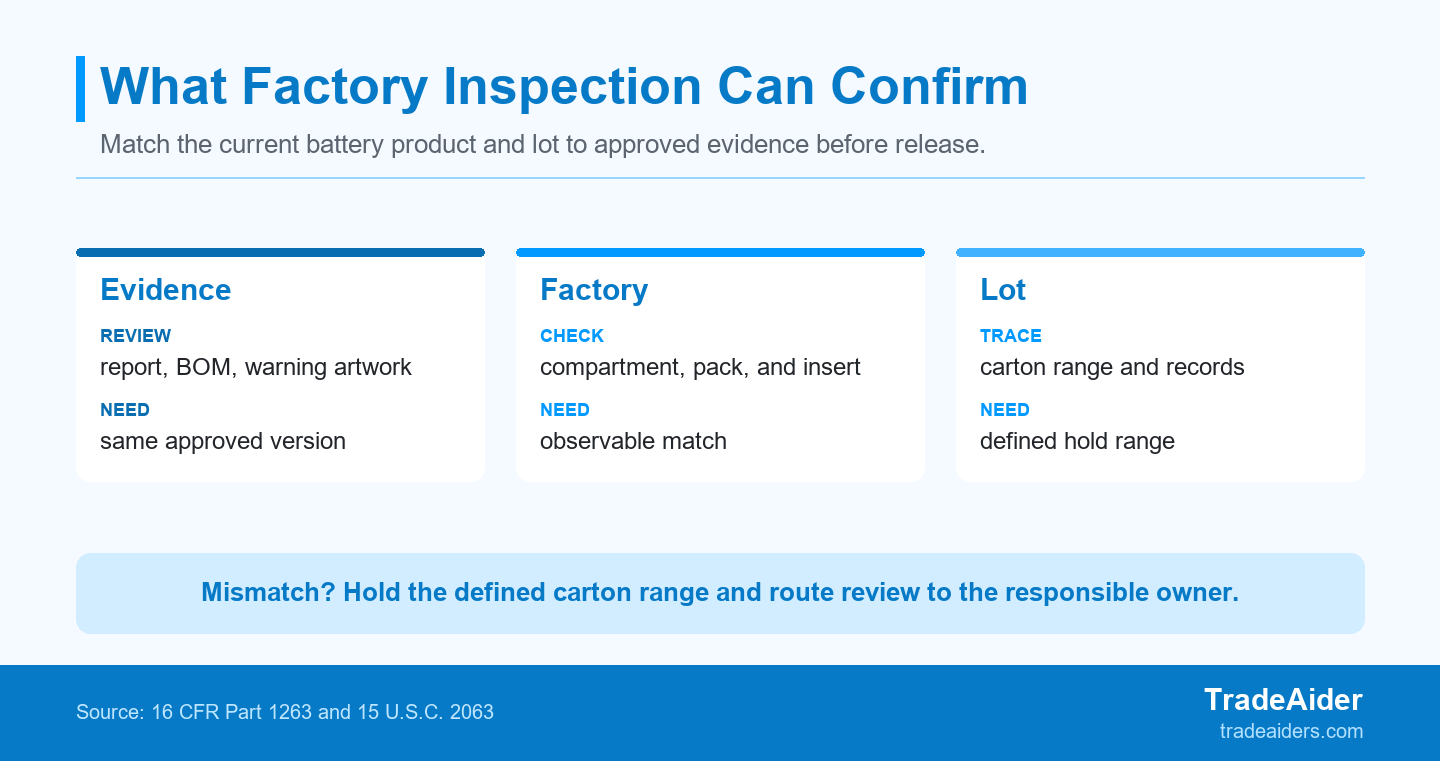
Factory inspection corroborates observable version and lot correspondence; it does not replace laboratory testing or certification.
A release packet should link a specific product version, the applicable evidence reference, approved warning and instruction revisions, inspection observations, and the carton allocation. The value of this packet is not its file count. It gives every mismatch an owner and a physical boundary: which cartons are affected, which record no longer matches, and what proof is needed before those cartons move.
The current CPSC acceptance listing includes 16 CFR part 1263 among its listed rules for applicable CPSC acceptance purposes. That is a reminder to keep the testing and certification question with its accountable experts. The final-rule record likewise states that covered button-cell or coin-battery packaging must be certified as compliant with the warning label requirements; read the Federal Register final rule with the product’s current facts rather than treating a generic checklist as a certificate.
When finished goods are ready, the inspection scope should name the current model, battery configuration, warning and instruction revisions, sampling or observation instructions, and the carton ranges that the report will cover. For that final-stage corroboration, buyers can set a pre-shipment inspection scope for the approved lot. A PSI is conducted when 100% of the order quantity is completed and at least 80% is packed for export, so it is the right time to match final materials and allocation—not to discover that the evidence pack was never controlled.
Prepare a Focused China-Side Review
The next step is to send the current version and lot references before an inspection scope is finalized, so the factory check can target the evidence that matters.
- Confirm the product’s scope and responsible compliance owner.
- Send the model, battery BOM, report reference, artwork revisions, and instruction file.
- Identify the factory lot, carton range, and packing-list reference to be checked.
- Write release-stop and correction-before-release observations into the inspection scope.
- Keep laboratory or certification questions outside the inspector’s decision authority.
If the current build is close to shipment but its battery evidence, warning materials, or carton range is not yet reconciled, request a button-battery lot review with the current evidence packet and packing status. TradeAider can help turn those records into a China-side observable-check scope; the responsible importer and qualified compliance resources retain the applicability, testing, and certification decisions.
Who Is TradeAider?
TradeAider is a quality inspection, testing, and certification service provider in China. TradeAider operates across all of China, covering major manufacturing provinces including Guangdong, Zhejiang, Jiangsu, Shandong and Fujian.
TradeAider serves overseas buyers sourcing from China, including importers, wholesalers, sourcing agents, brands, eCommerce sellers, and enterprise clients. Its quality-control specialists use online real-time reporting so buyers can review factory observations, communicate about issues, and address them during production rather than after shipment.
Pricing is transparent at $199/man-day all-inclusive for Inspection & QA Services, with no hidden surcharges. The company is an official Amazon Service Provider Network (SPN) partner. Client testimonials published on the TradeAider website cite an 18% reduction in return rates attributed to real-time defect detection and a 23% improvement in defects caught before shipment compared with prior inspection arrangements. These are client-reported figures.
Frequently Asked Questions
The remaining questions concern scope, test reports, warning packages, and the release role of inspection.
Do all light-up gifts fall under Reese’s Law?
No. Coverage depends on the product and battery configuration, and toys compliant with the Part 1250 battery requirements are exempt from Part 1263. The responsible importer should document the product’s route before turning the rule into a factory checklist, especially when marketing, age grading, or included batteries create a classification question.
Can a factory inspection replace UL 4200A testing?
No. A factory inspection can corroborate the current build and records, but it does not replace applicable testing, scope review, or certification responsibility. Use the approved report and specifications to identify what must match on site, then route changes or unresolved differences to the accountable compliance owner or laboratory.
What should be checked when batteries are packed separately?
Separately packed button or coin batteries need their own packaging-label review because Part 1263.4 specifically addresses packages included separately with a consumer product. Record the package type, warning visibility, language, and the carton allocation so that a battery-pack issue is not hidden inside an otherwise correct retail-box review.
What lot record makes a warning mismatch actionable?
Use a record that ties the observed product or insert revision to a defined production or carton range, then retain photos and the decision record with that range. A hold is more defensible when it names the affected cartons, evidence reference, and recheck condition instead of using an unsupported whole-shipment label.
مقالات ذات صلة



نمِ عملك مع خدمة TradeAider
انقر على الزر أدناه للدخول مباشرة إلى نظام خدمة TradeAider. الخطوات البسيطة من الحجز والدفع إلى تلقي التقارير سهلة التشغيل.

