
- معلومات عنا

- خدماتنا
- صناعتك
- الموارد
- الأخبار والمدونة
Textile quality control should connect appearance, performance, identity, and lot traceability to an agreed acceptance decision. A traceable lot is the identifiable group of goods tied to the same records and conditions. When that link is missing, a buyer can see a defect yet still be unable to say which cartons are safe to cut, pack, or release.
The expensive failure is usually not a loose thread, a color difference, or one bad measurement by itself. It is the decision gap behind it: a written requirement does not match the approved reference, the verification method is unclear, or the affected goods cannot be mapped. That is why a useful textile program begins before a final inspection and ends with evidence that describes the shipment actually being approved.
Textile Quality Control Must Prove More Than Visual Appearance
Start with an acceptance brief that separates four questions: Does the product look like the approved reference? Does it perform as the buyer expects? Does its fiber, label, and claim information match the market? Can the buyer identify the exact rolls, units, and cartons to which the evidence applies? A defect list is useful only after those questions have an owner, a method, and a release consequence.
For relevant U.S. sales, the FTC says textile labels must disclose fiber content, business identity, and country of processing or manufacture. Read the FTC Textile Fiber Rule. For EU sales, Regulation (EU) No 1007/2011 similarly ties prescribed fibre names and compliant labeling or marking to market availability. The practical lesson is not that every textile uses one global label. It is that label evidence belongs in the product brief before bulk packing begins.
If a team writes “same as sample” without identifying the sample version, color standard, measurement points, test conditions, and allowed variation, it has not created an acceptance rule. It has moved the argument to the factory floor. For a useful starting point, buyers can review a practical inspection-standard framework and then adapt it to the material, end use, and destination market.
- Appearance: shade, print, weaving, surface condition, workmanship, and measurement must be compared with a named reference.
- Performance: weight, shrinkage, strength, colorfastness, or other properties need an agreed method and pass rule.
- Identity: fiber, label, care, and origin information must match the product and the applicable market requirements.
- Scope: each result must state which roll, production date, carton, or finished lot it represents.
Turn Defect Names Into Testable Failure Modes
A buyer should not accept “shade issue,” “poor hand feel,” or “wrong size” as the entire quality finding. Each phrase needs a failure mode: what differs, compared with which approved reference, under what condition, across what population, and what decision follows. That turns an inspection report from a list of complaints into a tool for deciding whether to correct, hold, retest, or release.
AATCC maintains separate textile methods for color difference and dimensional change, so a buyer should name the method that fits the failure. See AATCC testing standards. “Color is acceptable” is not a complete instruction if the order needs a shade standard, a viewing condition, and a decision about variation between rolls. Likewise, “shrinkage tested” is incomplete if the buyer has not stated the fabric, laundering condition, sample source, and acceptance limit.
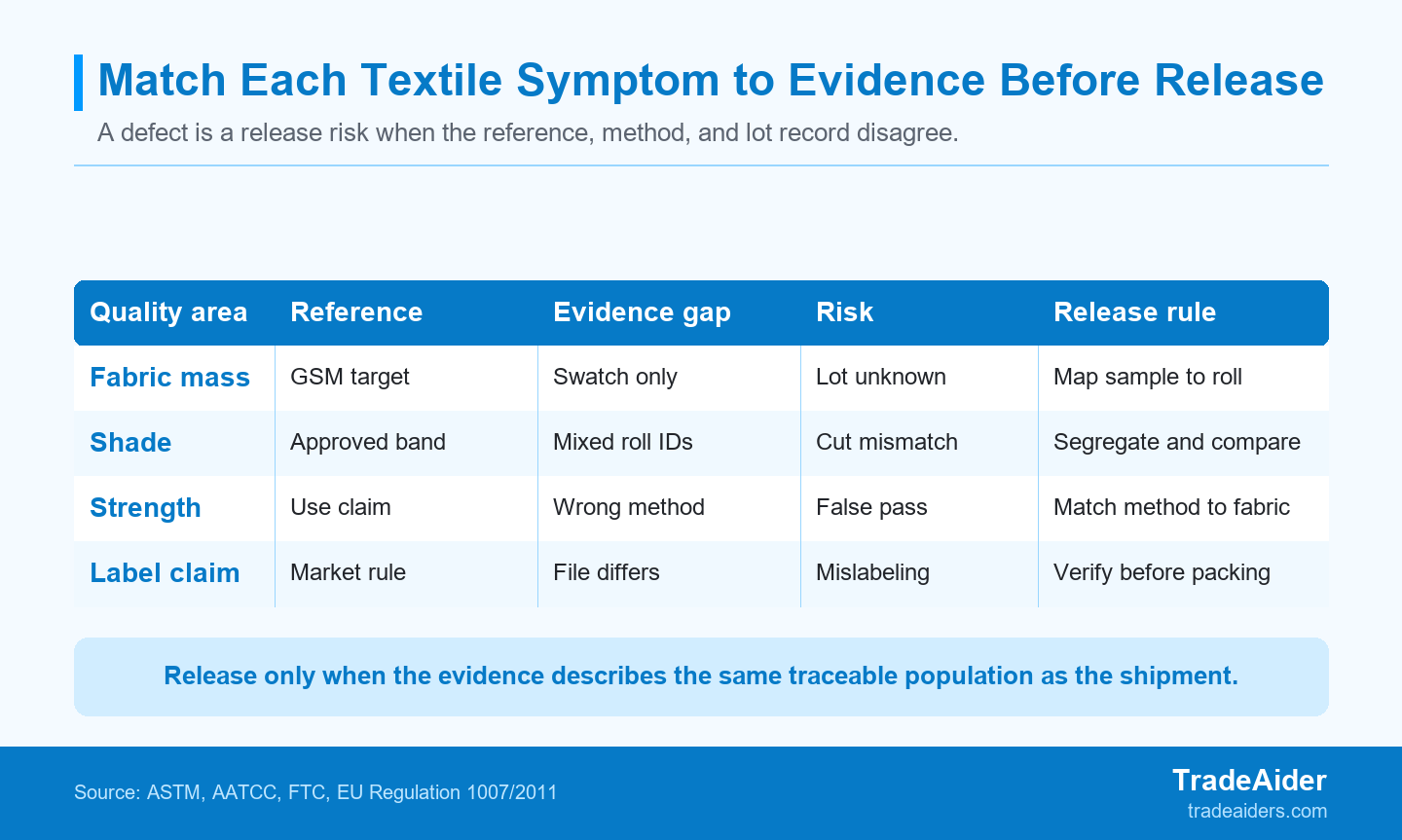
A textile symptom becomes controllable only when the reference, verification method, and lot record support the same release decision.
When a buyer cannot connect a defect to an approved reference, a test method, and a traceable lot, the safe containment scope becomes wider. That does not mean every visual difference requires a full-order hold. It means a buyer cannot safely narrow the hold to a few pieces until the evidence shows which goods share the same material, process, and exposure.
Appearance Defects Need a Lot-and-Location Record
A visible textile defect needs an approved reference, a location, and a traceable population before the buyer can define a fair hold. For shade variation, record the roll ID, cut-panel location, lighting condition, and comparison standard. For a weaving fault, record the defect type, repeat distance, fabric direction, and affected roll. For sewing or trim problems, identify the line, operation, bundle, and production window. Those details turn “fix this” into a checkable correction request.
Do not confuse a defect count with a root cause. Several short yarn defects on one roll may be a local material issue. The same defect across several rolls and days may point to a process setting, raw-material batch, or inspection escape. The release decision should follow that pattern, not the most convenient explanation.
Performance Defects Need an Agreed Method and Condition
The current AATCC manual includes TM135-2025 for dimensional changes of fabrics after home laundering. See the AATCC manual update. The named method is a useful starting point, but it is not a pass grade. The buyer still needs to define the product configuration, test condition, sample location, tolerance, and whether the result applies to a development sample, a production roll, or finished goods.
This distinction matters when a supplier shows a passing sample from a different dye lot or a small cutting from a different part of the roll. A valid report may describe that sample accurately while still leaving the bulk-order question unanswered. Match the test sample to the production population before treating a result as release evidence.
Trace the Root Cause to the Earliest Controllable Stage
The most useful corrective action is the one assigned to the earliest stage that can prevent the defect from recurring in the affected population. A late cosmetic repair may make a few sampled pieces look better, but it cannot prove that unexamined rolls, bundles, or cartons were not exposed to the same cause.
Use a simple root-cause map. Material symptoms include inconsistent fiber, fabric mass, width, surface faults, or shade between incoming rolls. Process symptoms include recurring measurement drift, seam damage, print registration issues, or uneven finishing tied to a line or shift. Post-process symptoms include packing mix-ups, label mismatch, stains, moisture, or damage after goods passed an earlier check. The corrective action should change the source of recurrence, while the verification step confirms whether it worked.
When a pattern appears while production is still active, the buyer needs evidence before the entire order is packed. A third party can use a during-production inspection checkpoint to compare active output with the approved reference, isolate the spread of the issue, and document whether the supplier’s correction has reached the line. This is not a substitute for factory process ownership; it is a way to give the buyer a current, independent decision point.
Build Controls Around Materials, Process, and Release
Pre-production approval, during-production verification, and final release each answer a different textile quality question. Combining them into one late visit makes it harder to tell whether a failure began in the material, the line, finishing, or packing.
| Checkpoint | Question It Answers | Evidence to Keep | If It Fails |
|---|---|---|---|
| Before bulk work | Are materials, trims, labels, and references aligned? | Approved sample, specification, color or construction reference | Correct before scale-up |
| During production | Has a recurring issue spread? | Line, roll, bundle, and correction records | Contain and verify the correction |
| Before release | Does the finished shipment match the accepted population? | Sample plan, final findings, carton and lot status | Approve, hold, or release conditionally |
At the first checkpoint, the practical objective is not to inspect every future defect. It is to make later comparison possible. Buyers who need an independent review of labels, packaging, workmanship references, or material readiness can ask TradeAider to set the pre-production inspection scope before output becomes expensive to rework.
Use Laboratory Tests to Confirm Risks Visual Inspection Cannot Settle
Inspection can identify visible defects, dimensional differences, labeling errors, and workmanship patterns. It cannot, by sight alone, establish every material or performance property. The right question is not “Should we test?” It is “Which product claim, use condition, or customer failure would be costly to discover after sale, and what method can answer it?”
ASTM D3776/D3776M notes that a small-swatch fabric-mass result applies to the sample and not necessarily to the lot. See ASTM D3776/D3776M. GSM, or grams per square meter, is fabric mass expressed over a defined area. If GSM is a buying requirement, ask whether the laboratory sample represents a full roll, a controlled lot sample, or only a cutting sent for evaluation. That scope changes what the result can prove.
ASTM D5034 is not recommended for knitted or other high-stretch textiles exceeding 11% stretch. See ASTM D5034. Use that limitation as a reminder to select a method that suits the construction, not merely one that appears familiar in a test list. For a performance program, document the method, conditioning, direction, sample origin, and acceptance rule together.
OEKO-TEX STANDARD 100 is a voluntary textile program that tests for harmful substances and varies its requirements by intended use. See OEKO-TEX STANDARD 100. It is one example, not a universal requirement. Chemical, flammability, and other compliance needs should be determined by the product and destination market. When a visual check cannot answer the relevant question, buyers can match a laboratory test to the product requirement before relying on a shipment decision.
Example: When a Shade Problem Is a Containment Problem
In the illustrative 2400-piece scenario, incomplete roll-to-carton records justify holding the unsupported carton until the population can be reconciled and resampled. The point is not to use one universal shade rule. It is to establish the evidence needed before a buyer narrows the affected scope.
Map the Population Before You Approve Rework
In the illustrative 2400-piece scenario, the buyer maps roll-to-carton records before approving rework or a split release. A U.S. home-textile importer buying from a China supplier has ordered a woven viscose cushion-cover order using an approved color standard. Cutting has started and 4 cartons are packed, but the release decision has not been made.
The inspection sample covers 96 pieces across multiple roll IDs. 2 roll groups show a visible shade split. One packed carton cannot be matched cleanly to a roll record. The buyer should not average those observations into a single “acceptable” result. A shade band is the agreed range of acceptable color variation; it is meaningful only when the same reference and viewing conditions are used for the relevant population.
The physical difference may be limited to two roll groups, but the incomplete carton record creates a separate evidence problem. Hold the traceable groups and the unsupported carton, separate the rolls, and reconcile the record before deciding which goods can move. This is holding and separating the affected goods while the buyer verifies the scope, not an assumption that the whole order has failed.
The supplier can compare segregated goods with the approved shade standard under the agreed viewing condition, identify the process setting or lot source, and correct the cause before rework. Release only the population with a resolved roll-to-carton map and an accepted comparison after correction. This is an illustrative scenario, not a TradeAider client case; a real decision must follow the purchase order, agreed tolerance, and product-specific method.
Release Only Against the Documented Shipment Population
A release decision should match the agreed sample plan and acceptance criteria to the documented shipment population. A shipment may pass a visual check and still deserve a hold if the tested material, approved reference, label version, or carton mapping does not belong to the same goods being released.
A release packet should state the current order quantity, finished and packed status, sample plan, defect classification, test reports required for the product, correction evidence, and any excluded or conditional population. For finished goods, an independent final check can confirm whether the inspected sample matches the agreed scope. Buyers can define the pre-shipment release check when 100% of the order is complete and at least 80% is packed for export.
Sampling does not promise that every unit is free from every flaw. It applies an agreed decision rule to a defined population. Set that rule before the visit, record the inspection level and acceptance numbers, and keep the decision tied to the actual lot. If the team needs to make the sample rule explicit, it can calculate the sampling plan before the visit and attach the result to the inspection brief.
Prepare a Textile Inspection Brief That Produces a Decision
An inspection brief produces a better release decision when it states the approved reference, lot status, sample plan, and testing needs. Attach the current specification, approved sample or shade standard, roll and carton mapping, buyer-defined defect rules, packaging and label files, and any laboratory reports or required methods. Those inputs let an inspector distinguish a correctable local finding from a problem that needs a broader hold.
TradeAider can help buyers translate those inputs into an independent inspection scope for goods produced in China. If your order is approaching production, correction, or shipment, request a textile inspection plan.
FAQs
What textile defects should be treated as critical?
Treat a textile defect as critical when it creates a safety, legal-labeling, functional, or widespread-use failure under the buyer’s agreed specification. A fiber-content mismatch, unsafe construction for the intended use, missing required label information, or a defect that makes the product unusable can be critical even when it is not visually dramatic. Define the classification before inspection so the supplier and buyer are not negotiating severity after the result appears.
Can final inspection catch every textile quality issue?
A final inspection verifies the finished lot but does not replace earlier material approval, production control, or laboratory evidence. It can reveal visible workmanship, label, packing, measurement, and sample-based quality issues in finished goods. It cannot retroactively prove that every material property was controlled throughout production, especially when the approved sample, test specimen, or lot record does not match the shipment. Use earlier checkpoints for risks that become expensive after packing.
Which textile tests belong in a buyer specification?
Choose textile tests from the product’s intended use, fiber and construction, care claim, market requirement, and the failure that would be costly to discover after sale. Common topics include colorfastness, dimensional change, fabric mass, strength, abrasion, pilling, and product-specific chemical requirements. The useful specification names the method and test condition, identifies the sample source, and gives a pass or fail criterion. A generic test list without those details leaves room for conflicting interpretations.
How should buyers handle shade variation in bulk goods?
Hold the affected lots, compare them with the approved shade standard under the agreed viewing conditions, and verify the scope before cutting or release. Start with roll, bundle, and carton records, then separate the traceable population from goods whose source is uncertain. If the difference is bounded and the evidence is complete, the buyer may make a limited decision. If records are mixed or missing, expand the hold until the population can be mapped and checked again.

مقالات ذات صلة



نمِ عملك مع خدمة TradeAider
انقر على الزر أدناه للدخول مباشرة إلى نظام خدمة TradeAider. الخطوات البسيطة من الحجز والدفع إلى تلقي التقارير سهلة التشغيل.

