
- معلومات عنا

- خدماتنا
- صناعتك
- الموارد
- الأخبار والمدونة
FCC ID verification during product inspection is a controlled comparison between a defined shipment’s observable identifiers and the evidence that describes its authorized configuration. It is not a certification decision, a laboratory test, or legal advice. For an importer, the useful question is narrower: can the finished device, its customer-facing materials, and a known carton range be reconciled to the current file before the lot is released?
A wireless product may look finished while its label artwork, radio module, firmware, manual, retail box, and approval references no longer describe the same build. That is why a final factory visit should begin with a version-controlled evidence packet, not a request to “check FCC compliance.” The inspection team records observable correspondence. The responsible compliance owner decides whether an observed difference changes the authorization, testing, or corrective path.
The Shipment-to-Grant Match
FCC ID verification during product inspection is a controlled comparison of a defined shipment's observable identifiers and evidence references; it is not a certification decision. A release candidate needs two independent matches: the evidence must describe the right current device, and the observed device must match that evidence. A visible FCC ID is only one part of that comparison. When either side is unresolved, the operational response is to hold the smallest identifiable carton range and route the decision to the owner who can assess the technical consequence. FCC equipment-authorization guidance supplies the regulatory boundary for this factory control.
- Baseline: identify whether the product’s relevant route is Certification or another FCC authorization procedure before using an FCC ID as a control point.
- Observation: compare model, label, module-related identifiers, running firmware, manual, and retail packaging with buyer-approved records.
- Containment: record the difference with the affected production or carton range; do not make a whole-order decision from one unit alone.
- Boundary: a PSI can corroborate what was built and packed. It cannot determine authorization scope, approve a design change, or verify RF performance.
Define the FCC Authorization Baseline First
An FCC ID search is relevant to Certification records, while SDoC equipment is not listed in the same public database. FCC materials also distinguish intentional radiators, which generally require Certification, from many unintentional radiators that may follow SDoC or Certification procedures. Start with the buyer’s device classification, applicable rule path, grantee or responsible-party information, and current model reference rather than assuming every electronic product should carry an FCC ID. The FCC’s equipment-authorization explanation, its description of Certification and SDoC, and its public certification-record materials set the boundary for that first decision.
For a device that is supposed to be certified, preserve the public-record reference alongside the buyer’s controlled file. Certification involves a Telecommunications Certification Body evaluation supported by test documentation, and FCC materials state that certified equipment information is posted publicly; SDoC equipment is not. That distinction prevents a factory label check from being misused as a universal database check.
The practical packet for the visit should include the current model and trade-name reference, the applicable FCC ID or documented authorization path, the relevant module or bill of materials (BOM), the firmware release reference, approved device-label artwork, approved manual and retail-pack files, and the carton-allocation record. When testing evidence is part of the packet, buyers can align product testing evidence with the factory file before an on-site check is scoped. The inspector should be able to say which file was compared, not merely that a label was seen.
Match the Physical Build to the Authorized Configuration
A PSI can compare observable build identifiers and supplied records, but cannot decide whether a configuration difference changes certification status. This boundary matters most for products with a radio module, an external antenna arrangement, multiple customer-facing model names, or a firmware-driven interface. The goal is a reproducible factory record: what product was observed, what document version controlled the comparison, and which cartons carry that same condition. FCC authorization guidance helps keep this observation role separate from the responsible party’s decision.
For certification-labeled equipment, FCC rule text says the FCC Identifier is preceded by “FCC ID” and must be legible without magnification. That does not tell the inspector every requirement for a specific device, but it does support a disciplined identity check rather than a logo-only review. The FCC’s label-rule amendment is useful for this limited identification point.
| Factory checkpoint | Compare with | Record on site | Escalate when |
|---|---|---|---|
| Exterior model and device identifier | Current model sheet and authorization reference | Device photos, label text, serial or batch marker | Identifier, model family, or visible form differs |
| Radio module and related build reference | Approved BOM or module record | Visible module marking where accessible, BOM revision, photos | Module or related component cannot be reconciled |
| Firmware display or factory release log | Approved build reference and change record | Screen capture, version log, unit and carton range | Running build differs or cannot be established |
| Device, leaflet, and retail-pack artwork | Approved artwork revision | Location, revision code, legibility, carton allocation | Customer materials do not match the controlled file |
These checkpoints are most effective when the buyer defines them before production is fully packed. If a component or artwork can still change, a buyer may choose to inspect version-sensitive electronics during production so a visible difference is identified before it spreads through export cartons.
Treat Firmware Drift as a Release Decision
FCC enforcement records illustrate that firmware can affect whether a device operates within its authorization parameters. In one record, a wireless access point was capable of operating outside the parameters of its authorization until a firmware fix was applied. That example does not create a universal rule that every firmware change requires the same response. It does show why a buyer should not describe a finished lot as matching approved evidence when the running build is unknown or different. The FCC enforcement record provides the relevant boundary.
At the factory, ask for the buyer-approved method of showing the running version: a device settings screen, a controlled factory release log, a production-programming record, or another traceable artifact. Capture that artifact with the observed unit and carton context. Do not ask the inspector to infer RF behavior from a version number. Instead, a different or undocumented build should trigger a hold and an evidence handoff to the grantee, product-compliance owner, or qualified laboratory that can decide the technical consequence.
Check Device Labels, Manuals, and Retail Packaging Together
For applicable equipment, FCC materials treat authorization, identification, labeling, and consumer information as linked marketing controls, and a logo alone is not an FCC ID. The factory comparison therefore needs the physical device, the approved label file, the manual or quick-start leaflet, and the retail box in the same review frame. An FCC marketing-rules enforcement record describes the linkage between authorization, identification, labeling, and applicable technical standards before marketing, while the FCC’s labeling advisory explains why a logo by itself is not an FCC ID.
Do not treat all packaging statements as interchangeable. The applicable rule part and device type determine what belongs on the product, what may be provided electronically, and what consumer information must accompany it. One FCC advisory discusses device labels, manuals, and “Contains FCC ID” labeling for relevant modular-transmitter situations. Verify the approved requirement for the actual product rather than copy generic wording.
Classify Differences by Their Release Consequence
A defined finding record converts a visible difference into a bounded release decision. It should name the current product or artwork reference, the observation, the evidence packet used, the affected unit or carton range, and the owner who must respond. The classification below is an operational escalation model. It is not an FCC legal taxonomy and should never replace a product-specific compliance assessment. The FCC’s authorization overview is the regulatory boundary, rather than this operational model.
A valid FCC ID is recorded in the Commission's publicly accessible Equipment Authorization System database. Where the factory file uses that record, retain the exact identifier with the finding rather than a partial label reference. The FCC’s public-record materials provide that lookup boundary.
| Observation class | Example | Immediate action | Release condition |
|---|---|---|---|
| Release-stop mismatch | FCC ID, current model, module-related reference, or firmware cannot be reconciled | Hold the identifiable cartons and preserve the comparison evidence | Responsible owner reconciles the configuration and records the decision |
| Correction-before-release | Approved leaflet or retail-pack revision exists, but a traceable carton range carries another version | Separate, correct, and count the affected range | Targeted recheck matches the approved customer-information file |
| Control-record gap | Product appears consistent but the relevant firmware or carton allocation cannot be tied to the observed build | Pause release of the untraceable population | Lot allocation and evidence references are reconstructed and checkable |
Buyers should document the configuration inspection standard before the visit, including which difference requires a photo, which one requires a carton-range hold, and who receives the escalation. That makes the report usable as a handoff rather than a collection of isolated observations.
Illustrative Speaker Scenario: Stop a Build Drift From Spreading
A defined affected range permits a limited hold while the responsible owner reviews build drift. The following illustrative composite demonstrates the operational sequence; it is not a TradeAider client case and does not determine an FCC authorization outcome. FCC authorization guidance explains why the scenario stops short of an authorization conclusion.
Situation, Problem, Action, and Result
A defined late-carton range can be held and rechecked without making an unsupported whole-order decision. The FCC’s firmware enforcement record provides the technical boundary for this illustrative handoff.
Situation: A US private-label importer is preparing a Bluetooth speaker for a nationwide launch and needs the finished China lot to match the approved evidence pack.
Problem: The defined affected scope is 24 cartons, 480 speakers, cartons 157–180.
The order contains 3,600 speakers in 180 export cartons. Twenty-four cartons contain 480 speakers and carry firmware build FW-3.2.7, while the buyer’s approved release record identifies FW-3.2.5.
Finished goods, retail boxes, quick-start leaflets, carton labels, and device settings are available for a pre-shipment review. Cartons 157–180 can be separately identified.
The device screen and factory release log show FW-3.2.7 in cartons 157–180, while the approved file identifies FW-3.2.5.
The observed exterior model, FCC ID artwork, module marking, retail box, and quick-start leaflet otherwise match the buyer’s supplied current file.
Inspection can establish the build difference and defined carton range, but it cannot decide whether the firmware change alters the applicable authorization or test evidence.
Action: The evidence package is routed for responsible technical review rather than treated as a factory certification decision.
The importer holds cartons 157–180, asks the factory to separate them, and routes the build record and captured observations to the responsible compliance owner and, where needed, the laboratory or grantee.
Result: Cartons 1–156 remain separately identified; cartons 157–180 are not released until the configuration difference is resolved and the held range is rechecked.
The factory either restores the approved build or supplies the controlled change information requested for responsible review. The corrective record keeps the rework count and carton range together.
A targeted recheck records the resolved firmware display and confirms whether the held carton range is the range actually corrected or still held.
This is a bounded operational example. It does not say that every firmware update needs a new FCC filing, testing action, or whole-order hold.
Release Only the Cartons That Reconcile
Hold the smallest identifiable carton range when its device, firmware, label, packaging, or evidence reference cannot be reconciled. The release rule is simple: an approved authorization baseline and a current observed build must point to the same product version, while the carton record identifies the units to which that conclusion applies. A label photo without a controlled evidence reference is incomplete. A report reference without a current build record is incomplete. A correct-looking device without a defined population is incomplete. FCC authorization guidance keeps the release decision distinct from an authorization determination.
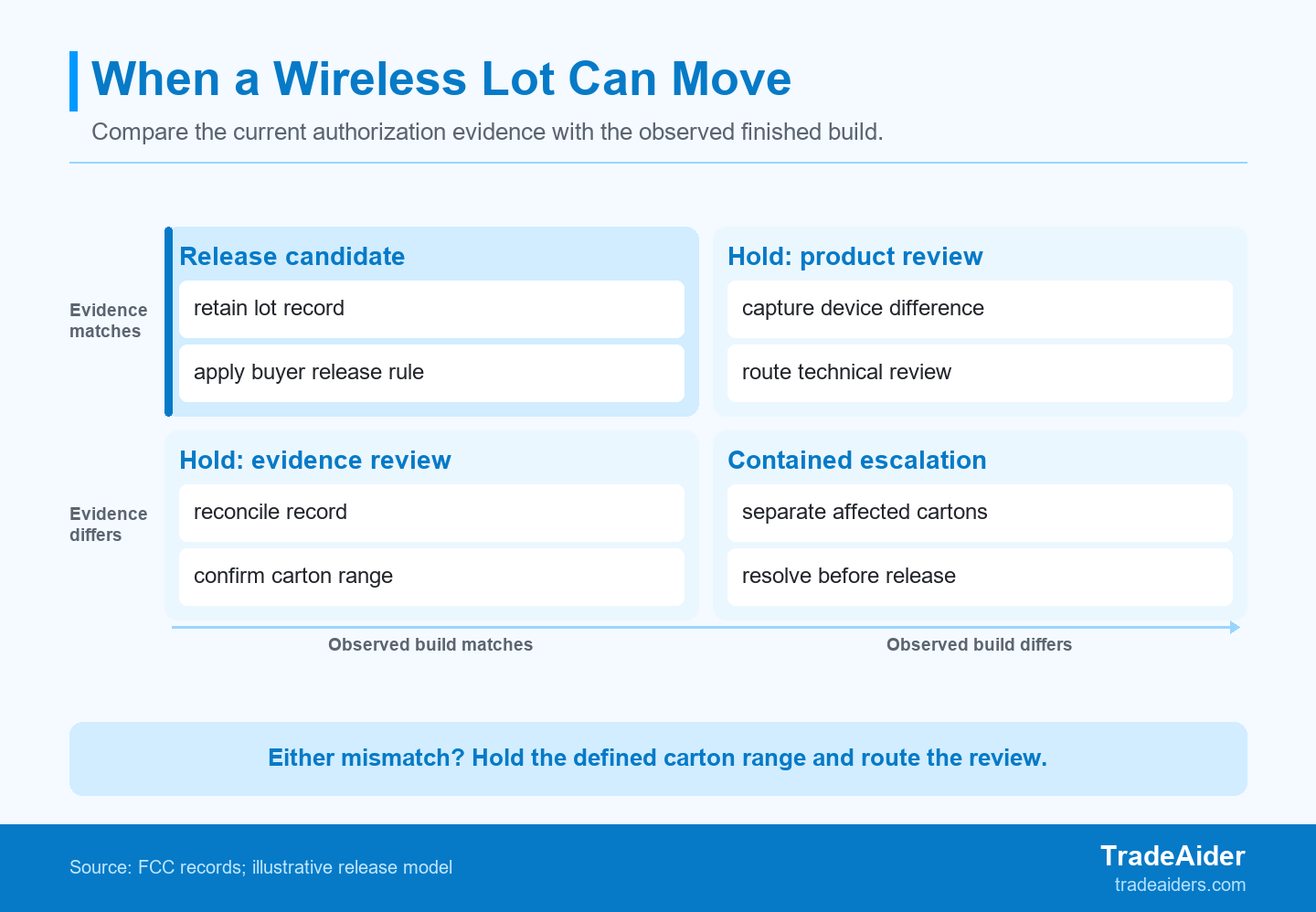
A defined lot becomes a release candidate only when both the record and the observed build reconcile; otherwise, hold the affected range for review.
Pre-shipment inspection means a final quality-control visit conducted when 100% of the order quantity is complete and at least 80% is packed for export. At that point, the inspector can capture a specific device condition and connect it to an export population. The buyer can then set a pre-shipment inspection scope for the approved build that names the versions to compare, the evidence to retain, and the release owner. The inspection report should state an observable conclusion such as “build and customer information match the approved packet for cartons 1–156,” not an unsupported certification conclusion.
Prepare a Focused China-Side Wireless PSI
A useful China-side PSI scope names the current evidence packet and the defined shipment population before the visit. Send the product model and trade name, the FCC ID or documented authorization path, approved label and packaging artwork, module or BOM reference, firmware release reference and display method, manual or quick-start file, and carton allocation. State which owner receives a mismatch and whether the factory may rework, separate, or hold the relevant cartons. FCC authorization guidance supports retaining the applicable procedure with the inspection packet.
FCC documentation explains that an FCC Identifier includes a Commission-issued grantee code and a product code selected by the grantee. Where an FCC ID is part of the packet, that structure helps the buyer preserve the complete identifier rather than a partial label reference. The FCC’s grantee-code guidance provides the identification detail.
That packet lets an inspector collect evidence that is meaningful to the importer’s decision without pretending to perform a laboratory or authorization review. If the order is approaching export readiness and the files can be supplied, request a wireless-device PSI review.
Who Is TradeAider?
TradeAider provides quality inspection, testing, and certification services in China. TradeAider is a quality inspection, testing, and certification service provider in China. Its inspection and QA service coverage includes Guangdong, Zhejiang, Jiangsu, Shandong, and Fujian, with $199/man-day all-inclusive for Inspection & QA Services. TradeAider also provides testing services for Hardline, Softline, E&E, and Industrial products. The service does not replace the responsible party’s FCC authorization decision.
For buyers that need China-side evidence collection before a release decision, TradeAider can compare the agreed packet with the observable production lot and report the differences for responsible review. Learn more about TradeAider as an Amazon Service Provider Network (SPN) partner. Client-reported results include an 18% reduction in return rates and a 23% improvement in defects caught before shipment; those outcomes are client-reported and are not a general guarantee.
Frequently Asked Questions
A valid record search and visible label do not by themselves release a finished wireless lot. The remaining questions focus on the limited, evidence-based role of a factory inspection. FCC authorization guidance provides the regulatory boundary for those answers.
Does a visible FCC ID prove a wireless product is ready to ship?
No. A visible FCC ID is only one identity signal and does not by itself confirm that the finished device, firmware, materials, and records match the authorized configuration. Compare it to the buyer’s current controlled evidence, observe the relevant build details, and identify the cartons covered by that observation. The responsible compliance owner still decides whether the authorization path is satisfied.
Can a pre-shipment inspection verify FCC RF performance?
No. A pre-shipment inspection can corroborate observable configuration and lot facts, while RF performance and authorization consequences require the responsible technical and compliance process. The visit can capture the running firmware, label, exterior model, packaging, and carton allocation. It cannot reproduce the laboratory measurements or make an FCC Certification or SDoC determination.
Which firmware evidence should accompany a wireless PSI?
Provide the approved build reference, the method for displaying the running version, the relevant model or module reference, and the owner who can review a difference. Also provide the factory release log or other controlled record that ties the observed version to a defined production or carton range. That combination lets the report distinguish a documented current build from an unexplained drift.
What lot information makes a wireless mismatch actionable?
Use a carton range or production cohort that ties the observed version to the units actually affected, then retain images and the responsible owner’s decision with that range. A useful record states the product identity, evidence revision, observation, carton range, and next action. If the affected units cannot be separated from the rest of the order, the release boundary must be reconsidered before export.
مقالات ذات صلة



نمِ عملك مع خدمة TradeAider
انقر على الزر أدناه للدخول مباشرة إلى نظام خدمة TradeAider. الخطوات البسيطة من الحجز والدفع إلى تلقي التقارير سهلة التشغيل.

