
- معلومات عنا

- خدماتنا
- صناعتك
- الموارد
- الأخبار والمدونة
AQL, or acceptable quality limit, matters because it turns a finished lot into a controlled sampling decision, but it should never be confused with a promise that every unit in the shipment is defect-free. The practical answer is to inspect the risks that can still be changed, record the evidence that proves conformity, and decide whether to release, hold, sort, rework, test, or reinspect before the shipment moves beyond buyer control.
Key Takeaways
- AQL means acceptable quality limit: it defines a sampling-based tolerance level for a lot, not a promise of zero defects.
- The 2026 ISO update matters: ISO 2859-1:2026 is the current AQL-indexed sampling reference for lot-by-lot attribute inspection.
- Severity comes first: critical, major, and minor defects usually need different AQL levels and different release consequences.
- AQL needs context: mixed lots, hidden risks, safety issues, and known process changes may require targeted checks or testing beyond normal AQL.
What Does AQL Acceptable Quality Limit Mean?
AQL means acceptable quality limit: the maximum average defect level considered acceptable for a sampling plan over a series of lots. In buyer language, it is a way to decide whether a defined shipment lot should be accepted or rejected based on inspected samples and agreed defect rules.
ISO 2859-1:2026 is now the current international standard for AQL-indexed sampling schemes for lot-by-lot inspection by attributes. ISO describes the 2026 edition as the third edition and notes that it replaced the 1999 edition and amendments. That is a meaningful update for importers still relying on old AQL explanations.
ASQ explains that acceptance sampling plans provide sample sizes and acceptance or non-acceptance criteria. It also separates attribute data, such as the number of defects, from variable measurement data, such as length or weight. Most final random inspections use AQL for attribute-style defect decisions.
AQL is useful because most importers cannot inspect every unit in a normal shipment. Instead, the buyer defines the lot, chooses the inspection level and AQL, classifies defects, inspects a random sample, and then accepts or rejects the lot based on the acceptance number.
Why Buyers Should Care About AQL
Buyers should care about AQL because it makes quality tolerance explicit before the inspection starts. Without AQL, a supplier may argue that a few defects are normal, while the buyer may feel the whole shipment is unacceptable. With AQL, the decision rule is visible before anyone sees the result.
NIST describes acceptance sampling as a middle path between no inspection and 100 percent inspection, where a random sample from a lot supports a decision about the lot. That is the practical reason buyers care: AQL gives structure to a decision that otherwise becomes emotional, inconsistent, or supplier-controlled.
The business value is not statistical elegance. It is a cleaner release conversation. AQL helps the buyer decide whether visible defects are below the agreed threshold, whether the lot should be held, whether sorting is needed, or whether the inspection should be repeated after correction.
AQL also helps buyers avoid two opposite mistakes. The first mistake is overreacting to a few minor defects that were already inside the agreed tolerance. The second mistake is accepting a lot with too many major defects because the supplier says the problem is normal. AQL does not remove judgment, but it gives judgment a documented boundary.
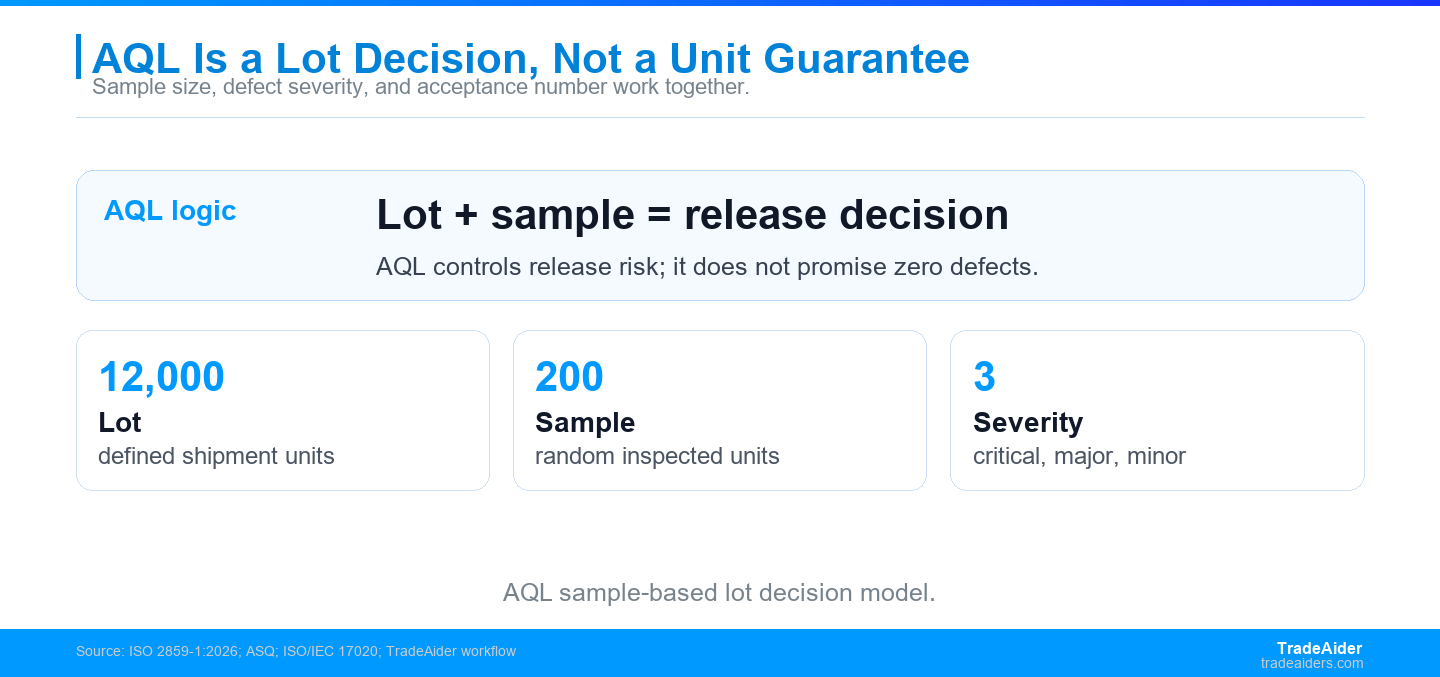
AQL turns a defined lot and defect severity rules into a sample-based release decision, but it does not guarantee that every unit is defect-free.
AQL is a lot decision, not a product promise
If a sample passes, the buyer has evidence to release the lot under the selected plan. That does not prove every unit is good. If a sample fails, the buyer has evidence to hold the lot, but the next action still needs judgment: sort, repair, replace, test, reinspect, or cancel.
If 200 units are sampled from a finished lot, the result supports a decision about that lot under the selected plan. It does not prove that every unit is defect-free. Buyers who treat AQL as a guarantee usually choose weaker release rules than buyers who treat it as controlled risk.
Acceptance numbers must be tied to severity
AQL only works when defects are classified before the inspection. Critical defects usually have zero tolerance. Major defects may affect use, saleability, safety perception, or customer complaints. Minor defects may be cosmetic but still limited. The same defect count can lead to different decisions if severity changes.
The same number of defects can mean different decisions when severity changes. A lot with one critical safety issue may fail even when minor cosmetic marks are below the limit. That is why the defect list must be agreed before sampling starts. Severity also prevents post-inspection bargaining because the consequence is attached to the defect class, not to whoever argues loudest.
How AQL Sampling Works in a Buyer Inspection
AQL sampling normally starts with the lot size. The buyer or inspector then chooses an inspection level, which leads to a sample size code and sample quantity. The selected AQL level and defect class then produce an acceptance number and rejection number. The inspector checks the random sample, counts defects by severity, and compares those counts with the limit.
NIST lot acceptance sampling guidance describes a lot acceptance sampling plan as both a sampling scheme and a set of rules for decisions such as accept, reject, or take another sample in some plans. This matters because the table alone is not the plan. The plan also includes how the lot is defined, how random samples are pulled, and what action follows a fail result.
In a TradeAider Pre-Shipment Inspection, AQL is normally used when the order is 100 percent completed and at least 80 percent packed for export. That readiness matters because the inspected sample should represent the finished shipment. If production is still incomplete, the AQL result may represent only part of the order.
| AQL Element | Buyer Question | Inspection Evidence | Risk If Weak |
|---|---|---|---|
| Lot size | What shipment is represented? | Finished quantity and carton map | Sample may not represent the order |
| Inspection level | How much evidence is needed? | General or special level choice | Too little or too much inspection |
| Defect severity | How serious is each defect? | Critical, major, minor definitions | Subjective pass/fail argument |
| Acceptance number | Where is the release limit? | AQL table result | Decision changes after the fact |
| Random sample | Were units selected fairly? | Carton spread and sample list | Best-carton bias |
| Action rule | What happens after fail? | Hold, sort, repair, reinspect | Report does not drive action |
What AQL Does Not Prove
ISO/IEC 17020:2026 describes inspection as determining conformity with requirements. AQL can support that determination for defined, observable attributes, but it cannot prove every requirement. It does not replace lab testing, factory process control, supplier qualification, regulatory document review, or 100 percent inspection when the risk demands it.
ISO 9001 is also a useful boundary because quality management is broader than final sampling. AQL can help with lot acceptance, but the supplier still needs controlled processes, documented requirements, corrective action, and improvement. A buyer who uses AQL without process discipline may catch some defects late while allowing the same root cause to repeat.
AQL is weakest when the lot is mixed, the defect is hidden, the product has safety-critical functions, the supplier changed a component late, or the buyer already knows one subgroup may be risky. In those cases, AQL can still be part of the plan, but it should be combined with targeted checks, testing, or earlier inspection.
AQL needs a clean lot definition
A lot should be coherent enough for a random sample to represent it. If one shipment includes different production dates, factories, colors, sizes, materials, or supplier components, the inspector should record subgroup information and the buyer may need targeted checks. AQL is not magic; it depends on what the sample represents.
The sample can represent the lot only if the lot is defined. A mixed shipment with two production dates, three colors, or a late supplier component may need subgroup visibility. Without that map, the buyer can pass an average lot while missing the weak pocket inside it.
Scenario Estimate: Why AQL Controls Risk But Does Not Eliminate It
Assume a 12,000-unit lot and a 200-unit sample. If the buyer chooses a major-defect AQL and the observed count stays within the acceptance number, the lot may be released under the plan. That does not mean the other 11,800 units were inspected. It means the buyer has accepted a defined sampling risk.
This is why AQL should be paired with severity rules and risk context. For a low-risk cosmetic defect, sampling may be enough. For a safety issue, a critical defect, or a hidden material claim, AQL alone is not the right proof. The buyer may need testing, 100 percent sorting, or a hold until the risky subgroup is isolated.
Calculated from the AQL scenario, a 12,000-unit lot sampled at 200 units is still a lot decision, not a 100 percent screen. Calculated from a 1.5 percent major-defect level, the buyer is setting a risk tolerance before seeing the goods. With 3 severity classes, the same sample can pass minor defects and fail critical defects. With 2 subgroups inside one order, a mixed lot can hide one weak subgroup if the buyer reads only the average result. After one failed PSI, a reinspection should verify corrected risk rather than repeat the same blind sample.
Where TradeAider Fits
TradeAider uses AQL as one part of the inspection decision, not as a stand-alone slogan. Buyers can use the AQL calculator to prepare sample expectations, then align the plan with product files, severity definitions, and shipment readiness. For finished goods, PSI can apply AQL to visible defects, function checks, packaging, labels, and quantities.
For importers, AQL should also connect to import and customer compliance discipline. CBP basic importing guidance frames compliance as a shared responsibility for the importing and exporting community. That does not make AQL a customs tool, but it does mean inspection records, labels, product identity, and release decisions should support the buyer's due-diligence file.
When the risk is earlier than final shipment, PPI or DPI may protect the buyer better than waiting for AQL at the end. When the risk is hidden, product testing may be needed. The practical rule is simple: use AQL for lot-level visible defect decisions, and add the right control for anything AQL cannot prove.
If a buyer is unsure whether a normal AQL inspection is enough, the question to ask TradeAider is not simply which AQL level to choose. It is whether the risk is visible, countable, lot-based, and representative. If yes, AQL can support the release decision. If no, the inspection plan may need extra sampling, targeted subgroup checks, reasonable-care documentation review, testing, or a hold until the supplier closes the evidence gap.
- Define the lot before choosing the sampling plan.
- Set separate AQL levels for critical, major, and minor defects.
- Confirm finished quantity and packing readiness before PSI.
- Use targeted checks for changed materials, colors, lines, or subgroups.
- Treat pass or fail as the start of buyer action, not the end of quality management.
Frequently Asked Questions
What is AQL acceptable quality limit?
AQL, or acceptable quality limit, is a sampling-based quality threshold used to decide whether a defined lot should be accepted or rejected. It sets the maximum average defect level considered acceptable under the selected sampling plan, inspection level, lot size, and defect severity rules. Buyers use it to make release decisions without inspecting every unit.
Does AQL mean zero defects?
No, AQL does not mean zero defects and does not guarantee every unit in the shipment is good. It supports a lot-level decision based on a random sample. Critical defects may still have zero tolerance, while major and minor defects are judged against the agreed AQL levels. Buyers should treat a pass as controlled sampling evidence, not a perfect-product promise.
Why did AQL change in 2026?
The important 2026 update is that ISO 2859-1:2026 became the current third edition for AQL-indexed lot-by-lot inspection by attributes, replacing the 1999 edition and amendments. Buyers should use current references when discussing AQL sampling with inspection partners and suppliers, especially when suppliers still cite older AQL explanations. Current terminology reduces avoidable disputes before inspection day.
When should importers use AQL sampling?
Use AQL when the lot is defined, the defects are observable, the sample can represent the shipment, and the buyer needs a practical accept/reject decision. Do not rely on AQL alone for hidden safety, chemical, performance, or compliance claims that require testing or document proof. AQL works best when the release rule is agreed before inspection starts.

مقالات ذات صلة


نمِ عملك مع خدمة TradeAider
انقر على الزر أدناه للدخول مباشرة إلى نظام خدمة TradeAider. الخطوات البسيطة من الحجز والدفع إلى تلقي التقارير سهلة التشغيل.

