- معلومات عنا

- خدماتنا
- صناعتك
- الموارد
- الأخبار والمدونة
MIL-STD-810H: Environmental Engineering Considerations and Laboratory Tests
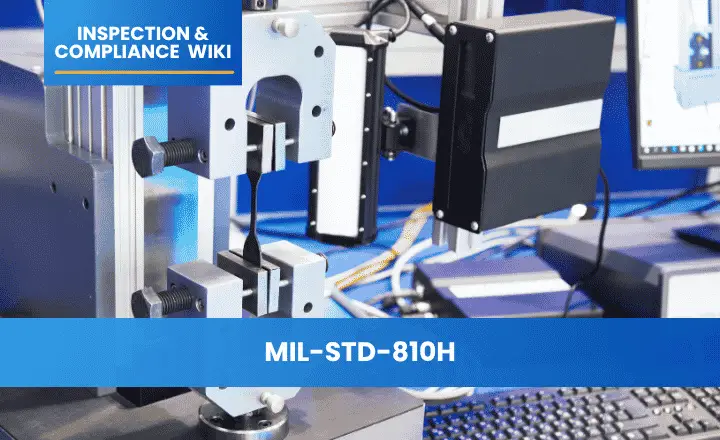
MIL-STD-810H, titled Environmental Engineering Considerations and Laboratory Tests, is the latest revision of the US Department of Defense (DoD) military standard defining environmental design and testing parameters for equipment intended for defense and commercial applications. Serving as the international benchmark for ruggedized electronics, consumer tech (e.g., smartwatches, rugged laptops, outdoor cameras), industrial machinery, and automotive hardware, MIL-STD-810H evaluates how equipment resists environmental stressors encountered throughout its operational lifecycle.
While MIL-STD-810H is a commercial and defense standard rather than a mandatory federal law, declaring "MIL-STD-810H Compliance" allows consumer brands and OEM manufacturers to substantiate durability claims, withstand extreme operational conditions, and access commercial B2B procurement markets.
Core Environmental Test Methods in MIL-STD-810H
MIL-STD-810H comprises 29 distinct laboratory test methods (Method 500.7 through Method 528.1). Commercial electronics and industrial hardware focus on key mechanical, thermal, and atmospheric exposure methods:
| Test Method | Environmental Hazard | Test Apparatus / Chamber Setup | Primary Evaluation Objective |
|---|---|---|---|
| Method 516.8 (Shock / Drop) | Physical drops, handling shocks, ballistic impact | Transit drop mechanism onto 2-inch plywood over concrete (26 total drops from 48 inches / 122 cm) | Verify structural housing and internal circuit board resistance to operational drops |
| Method 514.8 (Vibration) | Vehicle transport, aircraft, and operational vibration | Electro-dynamic shaker table applying sine and random vibration profiles | Identify resonant frequencies and prevent component loosening or solder joint cracking |
| Method 503.7 (Temperature Shock) | Rapid ambient temperature transitions | Dual-zone climate chamber switching between extreme heat (+70℃) and extreme cold (-30℃) | Test glass, seals, and PCB substrates against thermal expansion cracking |
| Method 509.7 (Salt Fog) | Coastal corrosion, salt spray exposure | Salt spray chamber atomizing 5% sodium chloride (NaCl) solution at 35℃ for 48-96 hours | Measure corrosion resistance on metallic plating, hinges, and exposed connectors |
| Method 506.6 (Rain / Blowing Rain) | Driving rain, wind-blown spray | Rain tower with wind generators blowing water at velocities up to 18 m/s | Assess water ingress protection across casing seams, gaskets, and port covers |
Testing Flexibility, Tailoring, and Commercial Self-Declaration Rules
Understanding how MIL-STD-810H functions requires recognizing its core engineering principle—tailoring:
- No Blanket "MIL-STD-810H Certification": The US DoD does not issue official MIL-STD-810H certificates. Instead, manufacturers select ("tailor") specific test methods, exposure durations, and severity levels relevant to their product's intended operational environment.
- Tailoring Documentation: To avoid misleading marketing, brands must explicitly declare which specific test methods (e.g., "Tested to MIL-STD-810H Method 516.8 Procedure IV") were conducted and passed by an accredited third-party laboratory.
- Procedure IV (Transit Drop Test): The most common commercial drop standard under Method 516.8 requires dropping a unit 26 times across all 8 corners, 12 edges, and 6 flat faces from a height of 48 inches (122 cm) onto plywood over concrete while evaluating functional operation.
Rugged Design Engineering and Component Protection
Achieving MIL-STD-810H compliance requires specific structural and electrical design features on the assembly line:
- Enclosure Protection & Seals: Utilizing overmolded Thermoplastic Polyurethane (TPU) bumpers, recessed display glass (Gorilla Glass), and molded silicone O-rings to absorb drop energy and seal out moisture.
- Internal Structural Frame: Securing heavy internal batteries and display assemblies to magnesium alloy chassis frames using shock-absorbing elastomeric dampeners.
- Conformal Coating & Port Protection: Coating printed circuit boards (PCBs) with hydrophobic conformal coatings and equipping external USB/charging ports with sealed rubber tethered plugs.
Practical Module: On-Site Verification & QC Practice
Quality control inspectors conducting Pre-Shipment Inspections (PSI) on ruggedized electronics or industrial gear must execute the following field checks on the factory floor:
Step 1: Enclosure Integrity and Rubber Gasket Audit
- Inspect outer protective TPU bumpers, port covers, and battery compartment latches for snug fit, zero flash molding defects, and proper gasket seating.
- Verify that waterproof membrane seals over microphones, speakers, and barometer vents are un-punctured and securely glued.
Step 2: Sample Drop and Functional Re-Check
- Perform a modified field drop check on selected sample units from 48 inches (122 cm) onto a plywood-covered rigid floor surface following the corner-edge-face orientation sequence.
- Power on the device immediately post-drop and perform a 100% functional audit: touchscreen response, camera focus, speaker output, wireless connectivity, and battery contact stability.
Step 3: IP Seal Ingress & Salt Fog Test Report Audit
- Review third-party ISO 17025 laboratory test reports to confirm that the exact hardware revision undergoing mass production matches the test samples validated in the MIL-STD-810H report.
- Verify that factory IPQC (In-Process Quality Control) includes air leak testing (vacuum pressure decay) on 100% of assembled waterproof housings prior to final packing.
Verify Quality Before Shipment: Rigorous On-Site AQL Inspections.Don't risk transit damage, crushed master cartons, or Amazon FFP warehouse rejections. Verify packaging integrity, carton drop performance, and barcode readability through our transparent, on-site inspection services. ➔ Get a Free Inspection Plan
Frequently Asked Questions (FAQ)
Q1: Does a product need to pass all 29 methods to claim MIL-STD-810H compliance?
No. MIL-STD-810H explicitly mandates tailoring. A manufacturer chooses only the specific test methods relevant to the product's use case (e.g., a rugged tablet may undergo Method 516.8 Drop, Method 514.8 Vibration, and Method 501.7 High Temperature).
Q2: What is the difference between MIL-STD-810G and MIL-STD-810H?
MIL-STD-810H (released in 2019) is the updated revision replacing MIL-STD-810G. Key changes include revised vibration profiles, updated temperature shock transition times, stricter laboratory calibration rules, and enhanced guidance on tailoring test procedures to real-world environments.
Q3: How does MIL-STD-810H relate to IP Ratings (e.g., IP67 or IP68)?
IP Ratings (IEC 60529) focus strictly on ingress protection against solid dust and water immersion. MIL-STD-810H covers a much broader range of mechanical and environmental hazards, including physical drop shock, vibration, salt fog corrosion, thermal shock, and solar radiation.
Q4: Is an official government agency required to certify MIL-STD-810H test results?
No. MIL-STD-810H testing for commercial products is conducted by independent ISO 17025 accredited testing laboratories. Importers maintain these laboratory test reports in their technical files to substantiate marketing claims.
Q5: What causes electronic devices to fail the MIL-STD-810H Transit Drop Test?
Common failure modes include cracked display glass, sheared internal plastic mounting bosses, battery disconnection due to mechanical terminal flexing, solder ball fatigue on BGA chips, and seam separation along outer casing joints.
References
[1] US Department of Defense. MIL-STD-810H: Environmental Engineering Considerations and Laboratory Tests[S]. Washington D.C.: Department of Defense, 2019. https://quicksearch.dla.mil/
[2] International Electrotechnical Commission. IEC 60529 Degrees of Protection Provided by Enclosures (IP Code)[S]. Geneva: IEC, 2020. https://www.iec.ch/
[3] American National Standards Institute. ANSI/ASQ Z1.4 Sampling Procedures and Tables for Inspection by Attributes[S]. Milwaukee: ASQ. https://asq.org/
Reference Notes
- MIL-STD-810H establishes standardized engineering guidelines and laboratory test procedures for evaluating environmental resistance in military and commercial hardware.
- IEC 60529 provides complementary international standards for evaluating enclosure ingress protection against solids and liquids.
- ANSI/ASQ Z1.4 provides statistical sampling methods used during quality control inspections to select representative units for drop and physical testing.
Related Knowledge Base
Textile Labeling Regulations: Fiber Content and Care LabelingCarton Drop Testing: ISTA and Amazon FFP Packaging StandardsISO 14001:Environmental Management Systems for FactoriesISO 13485ASTM F963: Standard Consumer Safety Specification for Toy SafetyPackaging and Drop Test Standards (ISTA 3A)Laboratory Testing Standards (LTS)
TradeAider