
An Australia-bound wireless device is not ready to release simply because the factory can show an RCM logo in artwork. The real handoff question is whether the physical model, its radio and power configuration, the applicable Australian pathway, and the supporting records all describe the same build. A logo can be copied quickly; a reliable release decision depends on reconciling those details before cartons leave the factory.
That distinction matters most when a buyer is handling private-label earbuds, speakers, trackers, wireless chargers, or connected accessories. A late firmware note, changed charger, revised label, or model suffix can break the link between paperwork and goods without creating an obvious cosmetic defect. Factory verification is valuable here because it can make the mismatch visible, not because it can determine a product's legal status.
The RCM Is a Supply Signal, Not a Factory Checkmark
The RCM is a single mark used across two independent schemes, so its presence does not collapse ACMA and EESS applicability into one factory check. Official EESS RCM guidance establishes the two-scheme context. In plain terms, the Regulatory Compliance Mark (RCM) is a mark used in Australian regulatory arrangements; it does not tell a buyer which obligations apply to a particular device or whether its current factory build matches the records held for supply.
Factory verification can confirm the physical model, marking route, carton range, and supplied evidence version; it cannot decide the legal scheme, certify a product, or replace the Responsible Supplier's obligations. The useful question for the factory is therefore practical: “Which exact version is in these cartons, and can we trace it to the approved evidence and marking instructions?”
- Match the model code and radio configuration to the current evidence index, not merely to a report title.
- Keep ACMA and electrical-safety questions separate until the market owner has assessed the actual product.
- Hold any changed build until its carton range and evidence version can be identified.
- Assign the market assessment, factory proof, physical observation, and ship decision to named owners.
Separate ACMA Requirements From EESS Electrical-Safety Obligations
For the ACMA side, the buyer should record the current equipment-rule path and evidence owner before treating a factory file as release-ready. Wireless functionality is a reason to ask precise questions about the device and its current configuration; it is not a reason to let a factory infer the answer from a previous shipment or a label proof.
EESS explains that an ACMA declaration on the national database is independent of electrical-safety matters, so ACMA and EESS are separate scheme decisions. Its Responsible Supplier Declarations guidance makes that separation explicit. This is why a buyer should keep two clear questions in the release file: what needs assessment for the device's communications function, and whether the product has a separate electrical-safety scope. Pre-production inspection planning is the sensible time to collect the declared model, market owner, power arrangement, and approved artwork, before production locks a configuration that is hard to trace later.
| Buyer question | What the factory can show | What still needs market-owner confirmation |
|---|---|---|
| Does the device have a radio-function pathway to assess? | Model code, hardware version, firmware reference, antenna or module identifiers | Applicable rule path and current records for that exact configuration |
| Does electrical-safety scope need separate review? | Rated voltage, power path, charger or adapter details, intended-use description | Whether the product is in scope and which evidence or registration route applies |
| Can this packed range release? | Carton codes, artwork revision, build window, physical samples | Whether the evidence still maps to that range after any change |
ACMA: Treat Radio Functions and Product Changes as Evidence Triggers
A factory evidence check should identify the current equipment-rule path and the exact model to which the provided records relate; it should not infer testing scope from a generic report title. The Radiocommunications Equipment (General) Rules 2021 are in force, with a current compilation dated 16 January 2026. Start with the buyer's declared selling model, then compare the physical unit, module or firmware reference, power arrangement, and artwork revision against the evidence index. If the report names only a family while the goods carry a later suffix or changed module, record that gap for the market owner instead of treating it as a paperwork formatting issue.
A material version change requires a current evidence review because the buyer otherwise cannot establish that the submitted records still describe the physical device being released. The trigger is not every drawing correction. It is a change that can affect identity: a radio module substitute, firmware that changes wireless behaviour, a revised battery or charger path, or a different route for applying the mark. That approach prevents a common timing error—approving cartons with evidence that was valid for an earlier build but has not been reconciled to the current one.
Verify the Marking Route on the Actual Device or Approved Alternative
EESS says RCM authorisation resides with the Responsible Supplier and describes marking location and dimensional rules under AS/NZS 4417.1 and AS/NZS 4417.2. Its marking guidance is the reference for that boundary. For a factory check, compare the approved route—not a generic logo file—with the actual device, pack, and accompanying instructions. Photograph the mark in context, retain the relevant artwork revision, and flag any placement or legibility difference to the owner responsible for the market decision. Also compare the location with the approved artwork for the exact model, not a photograph from a related SKU. A legible logo on the wrong device, package, or document route is still a release question that needs the market owner's confirmation.
EESS: Classify the Electrical-Safety Scope Before You Inspect the Shipment
EESS defines in-scope electrical equipment by voltage and whether it is designed or marketed for household, personal, or similar use. Its compliance steps set out that scope and the Level 1, Level 2, and Level 3 structure for in-scope equipment. A wireless device can therefore carry an ACMA question and an electrical-safety question at the same time. The factory does not need to make the classification, but its files should make the decision possible: rated input, charging method, supplied adapter, intended-use copy, and the exact device model should be easy to locate.
EESS describes Level 1, 2, and 3 equipment categories and says the relevant safety standard used in registration must be current. Its EESS FAQ provides that classification context. Do not turn those categories into a factory shortcut. Instead, use them to ask whether the product owner has identified the appropriate level and whether the evidence list is current for the declared model. The physical inspection can then focus on confirming the features that make that mapping meaningful.
Keep the Responsible Supplier and Factory Roles Distinct
EESS says the Responsible Supplier for in-scope equipment is the Australian or New Zealand based entity that imports or manufactures it for supply, not an overseas factory acting alone. Its equipment-registration guidance identifies that local supply role and states that Level 2 and Level 3 equipment registration is mandatory. Here, “Responsible Supplier” means the local entity with supply-side responsibilities where they apply. The factory's role is different: it should provide controlled build facts, artwork records, and access to the finished product.
The factory handoff should identify the Responsible Supplier and the evidence location for the declared model before the buyer treats the shipment as a defined release population. EESS's Level 1 guidance also states that the Responsible Supplier holds the evidence and makes it available to regulators when needed. If a supplier provides a certificate, declaration, or registration reference, record who supplied it, which model it names, and which carton range it is intended to cover. That creates an auditable handoff without asking the inspection team to make a regulatory approval.
Build a Factory Evidence Pack Around One Exact Model
A factory evidence pack is useful only when its model, radio configuration, power path, marking route, document version, and carton range can all be reconciled to the goods being released. Treat it as a one-page-to-one-build map, not a folder of loosely related PDFs. The buyer should be able to start with a carton code and work back to the model, artwork, key configuration, and evidence owner without guessing.
For most wireless consumer-device orders, the minimum practical pack includes a product identity sheet, model and version register, approved label artwork, power and charger specification, evidence index, carton coding map, and a change log. The same list should identify which file is controlled by the market owner and which physical detail can be checked at the factory. TradeAider's during-production inspection checkpoints can make late hardware, power, or marking changes visible while the factory can still separate an affected range from a clean one.
| Evidence item | Physical cross-check | Release implication if it does not match |
|---|---|---|
| Model and version register | Device label, firmware reference, carton code | Do not assume the submitted file covers the packed build |
| Power and charger record | Rated input, supplied adapter, charging-port configuration | Ask the owner to reassess the current evidence mapping |
| Approved marking artwork | Placement, legibility, size, device or package route | Hold the affected artwork range for owner confirmation |
Use a Change Trigger Before Releasing a Previously Tested Version
A material change to radio configuration, power or charger configuration, or marking route is a release trigger because it can break the link between the evidence package and the physical model. This is a buyer operating rule, not a statement that every change has the same regulatory consequence. Its purpose is narrower: stop a version mismatch from being hidden inside a finished shipment.
Use one material change as a reassessment trigger rather than treating a revised artwork or factory note as proof that the original evidence remains applicable. The three identity layers make the reasoning visible: wireless function, power path, and marking route. If one layer changes, the buyer should ask the market owner whether the evidence still matches before authorising release. Inspection-standard criteria can then define the physical observations needed to check the confirmed route.
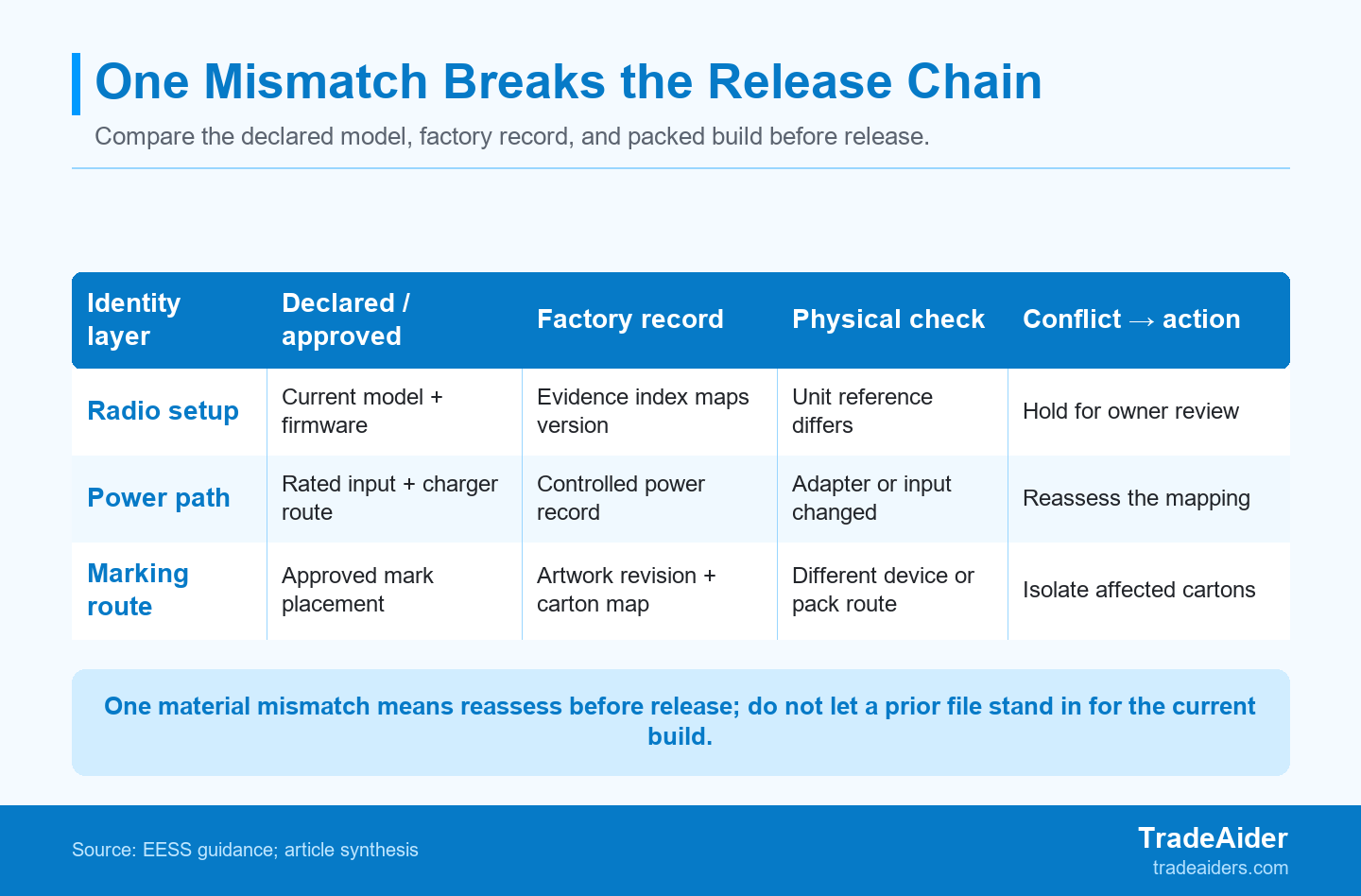
A shipment can move forward only when radio, power, and marking details reconcile to the same current model and carton range.
Record the Change Against a Defined Carton Range
The change register should connect the affected model, change date, implementation point, and carton range before a buyer treats any subset as independently releasable. “Carton range” simply means the identifiable group of packed cartons made after, before, or during the change. A date alone is weak evidence when production windows overlap; the factory should add batch, shift, or carton identifiers that let the buyer isolate the correct physical range. Record whether the change started at a defined shift, after a rework instruction, or during a mixed packing window. That small detail determines whether a buyer can retain a mapped subset or must treat the whole run as unresolved.
Check the Corrected Population, Not the Prior Sample
A verification sample must come from the corrected mapped population, because a sample from the prior build cannot establish the state of the changed range. Once the affected cartons are identified, select samples across that range and compare the visible model, marking route, and relevant configuration record. A clean sample from the earlier version is useful history, but it cannot close the question created by the change. The sampling instruction should name the corrected carton range and the build identifiers to record, so a later reviewer can see that the observation relates to the version the buyer intends to ship.
Illustrative Scenario: Repeated Version Drift Escalates the Release Decision
In the illustrative scenario, repeated evidence-to-build mismatches across a wireless-device order turn a local document correction into a containment and escalation decision. The point is not that a single document error is automatically a supply failure; it is that repetition across production windows changes the buyer's release decision from correction to controlled isolation.
Contain the Affected Range Before Asking for Verification
An Australia-market buyer is preparing a private-label wireless accessory order. The illustrative order contains 2,400 (2400) devices packed in 120 cartons across three model-coded production windows. Factory packing is complete, but the evidence pack has not been reconciled to the latest build register.
Three cartons from two production windows show a firmware reference absent from the current evidence index. The mismatch repeats after an earlier version-note correction, so it cannot be treated as one isolated carton error. Only 40 of the 120 cartons have a complete model-to-evidence mapping in the current factory register.
The affected range can be verified only after the buyer isolates it, rebuilds the model-to-evidence mapping, and confirms the corrected physical population. A repeated version mismatch makes the problem a containment trend, not a one-carton paperwork error, because the buyer cannot establish a clean evidence population. The buyer pauses release for the affected model and isolates the 80-carton range tied to the two disputed windows; the 40 mapped cartons remain separately identified only if their mapping is complete.
The corrective action is to rebuild the register with the current model identifier, radio configuration, power path, marking route, and carton range, then obtain confirmation of the evidence status from the market owner. The verification gate comes after that step: select physical samples from each corrected range and compare the device, mark, and carton mapping with the reconciled register before defining the final scope. That is where a pre-shipment verification scope becomes meaningful.
This is an illustrative operating example, not a TradeAider client case and not an ACMA or EESS compliance approval. The buyer loses time by isolating the range, but avoids releasing 80 cartons whose evidence identity cannot yet be established. The remaining limitation is important: only the relevant market owner can confirm whether the records remain suitable for supply.
Release Only When Ownership, Evidence, and Physical Build Agree
A release check is reliable only when market assessment, factory evidence, physical observation, and commercial authorization are explicitly assigned and reconcile to the same product version. This is not a branded scoring model; it is a simple handoff sequence that exposes ownership gaps before a shipment turns them into a market-entry problem.
- Market owner: confirm the current ACMA and, where relevant, EESS assessment route for the declared product.
- Factory: provide the controlled model, version, power, marking, and carton-range records for the actual build.
- Verifier: compare the agreed physical identifiers and marking route with the documented release population.
- Buyer: authorise shipment only after mismatches are resolved or the affected range is clearly isolated.
When the evidence pack and production range are available early, TradeAider can help turn them into an observation-ready scope without claiming to approve the product's regulatory status. That scope identifies what can be observed on the device, package, carton, and controlled production record, as well as the limits of what an inspection can establish. For a specific model and carton range, request a wireless-device inspection plan.
Frequently Asked Questions
Does an RCM logo prove a wireless device is ready to sell in Australia?
No, an RCM logo is not a stand-alone factory proof that the particular wireless-device model is ready for supply. The applicable ACMA and, where relevant, EESS obligations, records, registration, and product identity still need to match. Treat the logo as one visible part of a broader supply record. Before release, confirm that the physical model and carton range can be reconciled to the current owner-held evidence.
Do ACMA compliance levels match EESS risk levels?
No, ACMA compliance levels and EESS electrical-safety risk levels are separate classifications, so a buyer should not infer one from the other. The actual device and applicable rules still need checking. A wireless function, voltage, charger arrangement, intended use, and current product version can each affect the questions the market owner needs to assess.
Can a factory apply the RCM for the Australian importer?
A factory can implement approved marking instructions, but the Responsible Supplier and applicable scheme requirements determine who is authorised and responsible for supply-side compliance, registration, and evidence. The buyer should ask the factory to show which controlled artwork was applied and to which build range, while keeping ownership decisions with the appropriate local entity.
What change should trigger a new evidence review before shipment?
A material change to the declared radio configuration, power or charger configuration, or marking route should trigger reassessment because it may break the link between the existing evidence package and the goods being released. Record the change against a defined carton range, then verify the corrected range rather than relying on a sample from an earlier version.
Related Articles



Grow your business with TradeAider Service
Click the button below to directly enter the TradeAider Service System. The simple steps from booking and payment to receiving reports are easy to operate.

