
- About Us

- Our Services
- Your Industry
- Resources
- News & Blog
A baby play yard inspection checklist is a set of release checks that decide whether a packed order can ship, not a general look at the frame and the mesh. The checks that decide release are the ones a set-up pass tends to hide: whether every top rail actually locks, whether the mesh and its attachment hold, whether the floor carries the load, whether the mattress sits with no gap, and whether the labels and tracking marks are complete. Those five systems fail in different ways, so each one needs its own check, its own method and its own record, and the buyer needs to know which results come from the visit, which from a laboratory and which from the mark on the product.
What This Play Yard Checklist Decides
The rail lock is proven by applying load to each locked rail, not by the click; a false latch holds visually and can release under load.Mesh openings and attachment are checked on site, while mesh strength and attachment strength need a laboratory result.The floor and corner posts are structural checks, and the mattress check is about the gap between the pad and the sides.The label must carry the durable product marks, the tracking data including the batch or run number, and the registration card.
What a Play Yard Inspection Must Establish
A baby play yard pre-shipment inspection has to establish five release conditions before a packed order ships: the rail locks hold and do not falsely latch; the mesh and fabric stay attached; the floor carries the load; the mattress fits with no gap; and the required labels and marks are present. A pre-shipment inspection is a final check of a completed, packed order before it leaves the factory, so it can confirm workmanship, measurements and function on site, but it can only confirm a strength or a chemical claim when a laboratory result backs it. That difference decides which checks run during the visit and which need a laboratory or a supplier record.
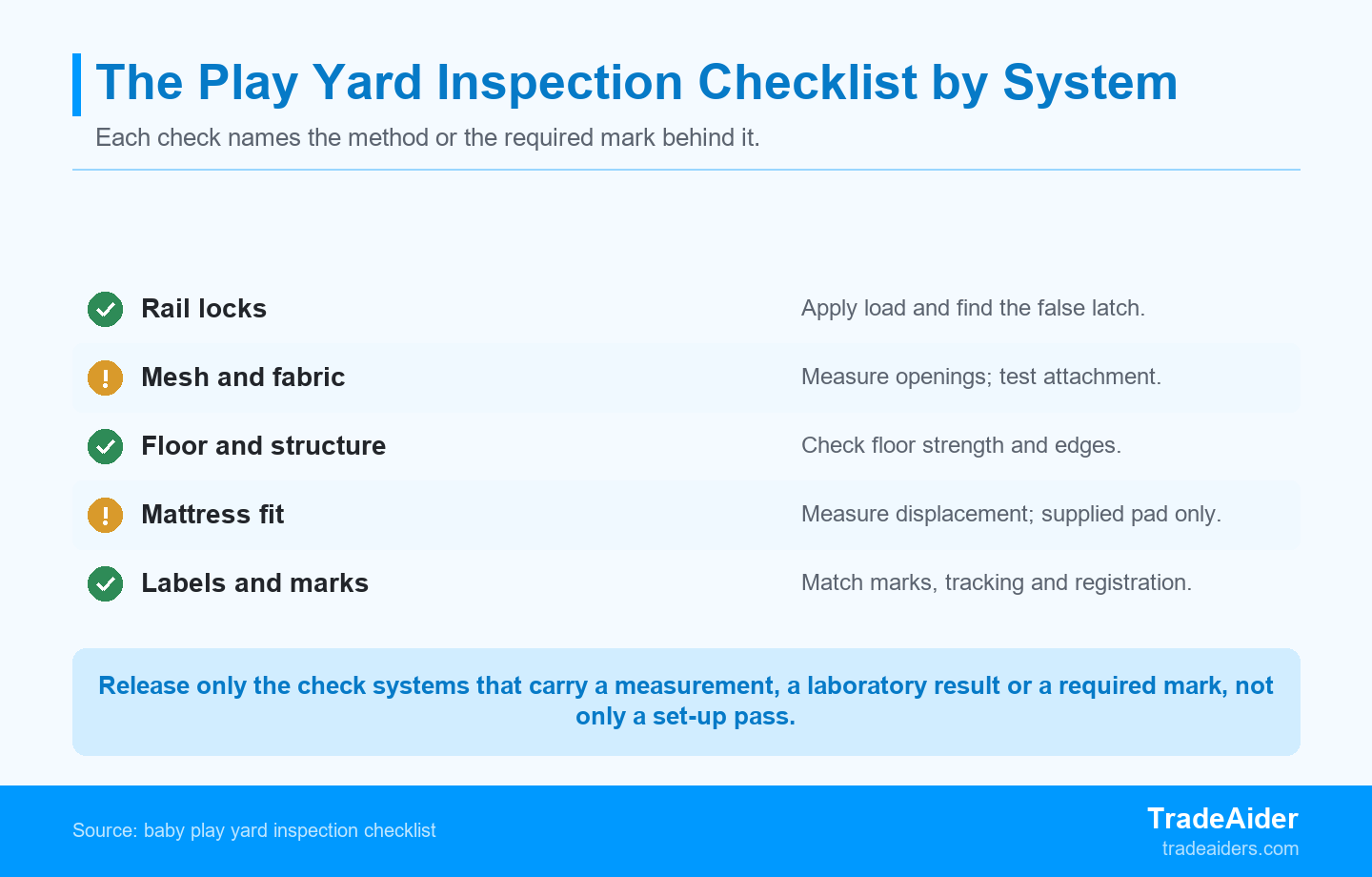
Each play yard check system carries its own method or required mark, from the rail-lock load check to the tracking label.
The scope also has a boundary worth setting before the visit. A play yard is a framed enclosure that includes a floor and has mesh or fabric sides, and it is made for a child who cannot climb out and is less than 35 in (890 mm) in height; inflatable products are not covered. In the United States the mandatory rule is 16 CFR Part 1221, which requires each play yard to comply with ASTM F406 as incorporated by reference, and a play yard that carries a bassinet attachment must also meet the requirements for that accessory. Keep the product specification separate from the method used to check it. The inspection-standard guidance sets out the same split between a product specification and the method used to check it.
Rail Locks and Folding Mechanisms
The rail locks are the first release condition because the top rails hold the enclosure open and upright. A rail that locks only partially can hold visually and release under load, which is a fall and entrapment risk, so the check sets the unit up and works through every lock and hinge rather than trusting one. The same mechanism is what folds the unit for travel, so the folding latches and the corner joints are part of the same check.
The rail-lock check is not a preference; it follows the standard. ASTM F406, which 16 CFR Part 1221 makes mandatory for US play yards, lists latching and locking mechanisms among its general requirements and adds performance requirements for top rail configuration and top rail to corner post attachment. Naming those elements in the brief turns a rail that will not stay locked into a documented defect rather than an opinion.
Setting Up, Locking and the False-Latch Check
A click is not proof of a full lock. ASTM F406 includes a locking mechanism test and a false-latch test, so the check sets the unit up, confirms every rail and hinge, and then applies load to each locked rail to see whether it releases. A rail that holds under load has passed the check; a rail that pops free has falsely latched. The load check is the difference between hearing the click and knowing the rail is locked. Record the result per rail rather than per unit, because a single unit can pass on one rail and fail on another, and the factory needs to know which joint to correct.
Top Rail Configuration and Corner-Post Attachment
The rail is checked for shape and attachment as well as for the lock. ASTM F406 sets top rail configuration and top rail to corner post attachment as performance requirements, so the inspection confirms that each rail has the required shape and that it stays fixed to the corner posts when load is applied. A rail that flexes the wrong way, or a corner joint that moves, is a requirement failure rather than normal wear, and it is the finding that lets the enclosure deform in use. Check the joint on every corner, and note whether the movement comes from the rail, the joint or the fastener, because that decides whether the factory reworks the rail or the assembly.
Mesh and Fabric Integrity
The mesh and fabric are the sides of the enclosure, so a torn panel, an over-large opening or a weak attachment is the failure that lets the check matter. The inspection looks at the mesh openings, the panel tension, the upper and lower edges where the mesh is sewn to the fabric, and the corner attachments that hold the panel to the frame. A panel that looks clean can still fail on opening size or attachment strength, so the visual check is paired with the requirement behind it.
The mesh check has named performance requirements behind it. ASTM F406 sets a height of sides requirement, a side deflection and strength requirement, and a mesh/fabric assembly requirement that covers the sewn assembly, seam strength and mesh attachment strength. That is why a side panel that pushes in too far, or a seam that pulls apart, is a requirement failure rather than a cosmetic one.
Mesh Openings, Strength and Attachment
The mesh check splits into requirements with different evidence. ASTM F406 sets mesh opening, mesh strength and mesh/fabric attachment strength as separate requirements with their own test methods. An inspector can measure the openings and check the attachment by hand on site, but a strength or attachment strength value comes from the laboratory method named in the specification. The brief should say which part runs during the visit and which part waits for the report, and when the check is sampled, the sample size and the accept and reject numbers come from the AQL sampling calculator. Size the sample with the AQL sampling calculator before the visit, and set the accept and reject numbers from the acceptable quality limit.
Floor Support and Structural Strength
The floor carries the child and the mattress, so it is a structural check rather than a cosmetic one. The inspection looks at the floor panel and its support, the corner posts and the openings and gaps around them, and any sharp edge, point or protrusion the standard lists, and it confirms the top rail covering material. A floor that flexes or a corner post that is loose is the finding that matters, because it decides whether the enclosure stays sound in use. The check is not limited to the panel surface. The inspector presses the floor to confirm it does not flex beyond the specification, lifts the unit at the corners to see whether a joint moves, and checks the edge of every opening for a sharp burr or a gap the general requirements bound. The top rail covering material is confirmed at the same time, because a covering that splits or peels exposes the frame and the fasteners underneath. When a floor or a corner fails, the finding is recorded against the standard’s clause rather than described as loose, so the factory receives a requirement to correct rather than an opinion.
The floor is a structural element under the same mandatory standard. 16 CFR Part 1221 requires compliance with ASTM F406, which sets floor strength and top rail covering material as performance requirements and lists corner posts, openings, protective components and protrusions among its general requirements. The floor strength check is a load requirement, not a bounce test, and the corner-post and opening checks look for the gaps and edges that the general requirements bound. Once the full structure, the mesh panels and every rail lock pass, the packed unit is then confirmed at the point of shipment, which is what the pre-shipment inspection checks on a completed, packed order.
Mattress Fit and Vertical Displacement
The mattress check is about the gap, not the pad. The mattress must sit on the floor structure and fit the sides with no gap, so the inspection checks how far the mattress can be lifted, which is its vertical displacement, and confirms that only the mattress supplied with the play yard is in the box. A thicker aftermarket mattress is the common finding, and it is the one that creates the entrapment gap the requirement targets.
The mattress check is built on a real requirement. ASTM F406 includes a mattress vertical displacement test, and the rule that incorporates it describes how the test works, so how far the mattress can be lifted from the floor structure is measured rather than felt. The standard also requires a play yard with a separate mattress that is not permanently fixed in place to carry a warning to use ONLY the mattress or pad provided by the manufacturer, because a thicker or looser pad sits away from the sides and creates the gap the requirement is written to prevent.
Labels, Tracking Marks and Registration
The label is both a legal document and a traceability record. A durable infant or toddler product such as a play yard must be permanently marked with the manufacturer or importer name, US contact information, the model name or number and the date of manufacture, and the same information must appear on the packaging. It must also carry a tracking label with the production location and date and the batch or run number, and a postage-paid product registration card attached to the product so the maker can reach buyers if the product is recalled. The durable-product mark is required by 16 CFR Part 1130, and the tracking data by the Consumer Product Safety Act.
The tracking label is the traceability mark. Section 14(a)(5)(A) of the Consumer Product Safety Act, added by section 103 of the CPSIA, requires a children's product to carry permanent, distinguishing marks on the product and its packaging that let the buyer ascertain the manufacturer or private labeler, the location and date of production, and the cohort information such as a batch or run number. A label that names the maker and the model but omits the batch or run number fails the traceability purpose, because the unit cannot be tied back to its production run.
The label check sits beside the chemistry and certification check. Under CPSIA, paint on a children's article must not exceed 0.009 percent (90 ppm) lead, a specified phthalate is prohibited above 0.1 percent in a plasticized component part, and the product must meet the lead content requirements in section 101 of the CPSIA. Because a play yard is a children's product, samples must be tested by a CPSC-accepted third-party laboratory and covered by a Children's Product Certificate, so the release file should hold the report and the certificate, not just a label photo.
Illustrative Example: A Rail That Did Not Lock
An illustrative order shows how the checks work together. The unit sets up cleanly and the sample looks correct, but one sampled rail clicks without fully locking, the mesh attachment at a corner pulls away under light hand tension, and the tracking label omits the batch or run number. The point of the example is that a clean set-up can hide three different failures, each with its own evidence. The provider that runs the load, attachment and mark checks is described in TradeAider's company background.
What the Buyer Changes After the Findings
The buyer holds the batch and escalates from sorting to a correction. The factory adjusts the rail locking mechanism and re-seats the mesh attachment, then re-marks the tracking label with the batch or run number. Release waits on the re-run: load is applied to each locked rail, the mesh attachment is re-tensioned, and the mark is compared with the CPSIA requirements, with the load result and the mark review kept in one file.
An importer orders 6,000 mesh-sided baby play yards for the US market across two runs of 3,000, with a foldable top rail, a fitted floor pad and a required tracking label. The factory meets the headcount of the order and every sample sets up, but one sampled unit's top rail is not fully locked, the mesh attachment at a corner is weak, and the tracking label lacks the batch or run number. The sample play yard passed a visual set-up, so the buyer expects the bulk order to behave the same way and does not ask for a load check or a mark review.
The top rail of one sampled unit clicks into place but releases when load is applied to the rail, which is a false latch rather than a full lock. The mesh attachment at one corner pulls away from the frame with light hand tension, and the factory cannot show a mesh attachment strength result for the production lot.
A clean set-up hid a rail that falsely latched, a weak mesh attachment and an incomplete tracking mark, so the failure only appeared when load was applied to the rail, the attachment was tensioned, and the label was compared with the CPSIA requirements. Hold the batch, escalate from sorting to a rail-lock and mesh-attachment correction, and require the tracking label to be re-marked with the batch or run number before re-inspection. The buyer also holds the 1,900 units built on the affected rail and mesh setting.
The factory adjusts the rail locking mechanism and re-seats the mesh attachment, and re-marks the product and packaging tracking labels with the batch or run number. Re-apply load to each locked rail and re-tension the mesh attachment on the corrected sample, and compare the re-marked tracking label with the CPSIA requirements, keeping the load result and the mark review in one file. An illustrative inspection example, not measured client data, a supplier rating, or a compliance result.
Turning the Checklist Into an Inspection Brief
The checklist becomes usable when it is written into an inspection brief. The brief names the play yard model, the destination market, the required labels and marks, the rail-lock, mesh, floor and mattress checks, the checks that run on site and the ones that need a laboratory, the sampling plan and the evidence the buyer will keep. Sent with the model and the destination list, it lets the provider agree which checks run where and confirm the reporting deliverable.
| Check system | Method or evidence | Who holds the record |
|---|---|---|
| Rail locks | Load applied to each locked rail; false-latch result | Inspector |
| Mesh and fabric | Openings measured on site; strength and attachment in the laboratory | Inspector and laboratory |
| Floor and structure | Floor strength and edge checks against the standard | Inspector |
| Mattress fit | Vertical displacement and supplied-mattress check | Inspector |
| Labels and marks | Marks, tracking data and registration card against the rule | Buyer and supplier |
The table is the brief in miniature: each row is a system, the method that makes it measurable, and the party that keeps the record, so a release decision can point at a document rather than a memory. Set the sample size and the accept and reject numbers for the order first, then confirm which checks run on site and which go to a laboratory. To scope the work for a specific play yard model, contact TradeAider to scope your play yard inspection.
Frequently Asked Questions
Is a baby play yard the same as a non-full-size crib?
No, and the distinction decides which standard the order is checked against. Both products fall under ASTM F406, but a play yard has non-rigid mesh or fabric sides and is regulated as a play yard at 16 CFR Part 1221, while a non-full-size crib is a separate durable-infant category with rigid sides and its own mandatory rule. Inflatable play yards sit outside the play yard regulation altogether. For a buyer, the practical consequence is that a play yard inspection follows the mesh/fabric and side-deflection requirements rather than the rigid-side crib requirements, and any bassinet attachment is checked against the bassinet standard as well.
Can an inspector confirm the mesh strength on site?
Only partly, and the split is the point. An inspector can measure the mesh openings and tension the attachment by hand during a visit, but mesh strength and mesh/fabric attachment strength are laboratory test methods, so the pass or fail value comes from a report. A complete plan uses both: the on-site check catches a visibly torn panel, an over-large opening or a loose corner, and the laboratory result proves the strength claim that the product specification and the standard depend on.
How is the mattress fit and vertical displacement checked?
The mattress is checked for vertical displacement and for a snug fit on the floor structure with no gap at the sides. ASTM F406 includes a mattress vertical displacement test and requires a play yard with a separate, non-fixed mattress to warn that only the supplied mattress or pad should be used, so the inspection measures how far the mattress can be lifted and confirms that the packed unit contains the specified pad. An aftermarket mattress is the common finding, and it is the one that opens the entrapment gap the requirement targets.
What labels must a US play yard carry?
A US play yard must be permanently marked with the manufacturer or importer name, US contact information, the model name or number and the date of manufacture, and the same information must appear on the packaging. It must also carry a tracking label with the production location and date and the batch or run number, and include a postage-paid product registration card attached to the product. The tracking data is what lets a recall reach the specific production run, so a label that names the maker but omits the batch or run number does not meet the requirement.
Related Articles

Grow your business with TradeAider Service
Click the button below to directly enter the TradeAider Service System. The simple steps from booking and payment to receiving reports are easy to operate.

