
Bath toy acceptance starts with what the design is supposed to do with water. Water entering a squirter is expected; water entering a product sold as sealed may be a defect. The harder question is whether a customer can empty and dry the toy using its supplied instructions. A dry-looking exterior or a working squeak does not establish either outcome.
This bath toy quality inspection checklist covers water traps, drainage, squeaker retention, paint, small parts and drying. For importers, those are connected buying decisions: does the construction support the care claim, do components stay attached after the specified wet use, and does the chemical evidence cover the actual materials? Solid, sealed hollow, fillable and openable toys need different checks for their age group and destination.
Bath Toy Inspection Checklist for Finished Goods
Commission the six checks for identified production toys and the approved construction. Include the care instructions and the required wet-conditioning, mechanical and laboratory work in the plan. Keep dry, wet and destructively examined conditions distinct so a result from one stage is not presented as evidence from another.
CheckInspection actionJudgment referenceWater trapsIdentify cavities, openings and seams; run the specified water exposure.Expected ingress for the design and any water remaining in inaccessible pockets.DrainageFollow the stated orientation and emptying sequence; observe residual water.The approved drainage method, observation interval and residual-water criterion.Squeaker retentionInspect the attachment and recheck after specified wet, squeeze and mechanical tests.Applicable retention requirements, with no unintended component release.PaintInspect printing and apply the specified wet-rub or coating checks.Approved appearance and durability, plus separate applicable chemical evidence.Small partsAssess supplied accessories and parts released during the required tests.The prescribed cylinder procedure and product's applicable age requirements.DryingApply the care procedure under recorded conditions and check interior moisture.The stated drying claim or agreed method; surface dryness alone is insufficient.
Keep the fill method, squeeze sequence, water conditions, drain position and elapsed observation time with the result. Where a numerical limit or cycle count is required, obtain it from the applicable method or approved specification before the visit. Do not convert an unperformed check into an assumed pass.
Distinguish Intended Filling from Unintended Water Entry
A water trap is a pocket that retains water after the intended emptying procedure. Internal ledges, hollow feet, raised outlets and seams can leave different pockets even when the main cavity drains. The buyer needs to know where water remains and whether that conflicts with the design and care claim, rather than simply whether the toy contains a hole.
Check that the water exposure represents the claimed use. Passive floating and squeezing under water can fill the same cavity differently. Deliberate filling of a squirter is not evidence of an ingress defect; unintended entry into a sealed design is a separate finding.
Interior moisture deserves attention because appearance outside does not describe conditions inside. Eawag's 2018 bath-toy research examined biofilms, or communities of microorganisms attached to surfaces, inside used flexible toys and toys exposed under controlled conditions. It identified contributions from the plastic materials and bath-water contamination. Those findings explain the inspection interest in internal surfaces; they are not a defect-rate estimate for every new bath toy.
Residual sounds or water from an unintended seam can justify closer examination, but neither identifies a microorganism or predicts a health outcome. Keep the observation tied to the exposure and emptying procedure rather than turn a drainage concern into an unsupported microbiological claim.
If the design cannot be examined internally without damage, agree how selected samples will be opened or otherwise examined. Photograph the original condition first. Cutting open a toy can reveal a hidden pocket, but the altered sample cannot then demonstrate the drainage performance of the intact retail product.
Can the Customer Empty the Toy as Instructed?
Drainage acceptance should reflect the stated tilting, squeezing or opening actions. If the customer needs an improvised tool or an unmentioned step, the result does not demonstrate the supplied care procedure. Record the residual condition in the intended drain position, using the agreed interval and criterion.
Under gravity alone, water below an outlet can remain in a cavity in that orientation. A visible opening therefore does not prove that the toy empties. Check whether the care instructions place the opening at a useful low point, require squeezing, or provide access by opening the product. These actions change the water path and should be tested as instructed, rather than silently added by the inspector.
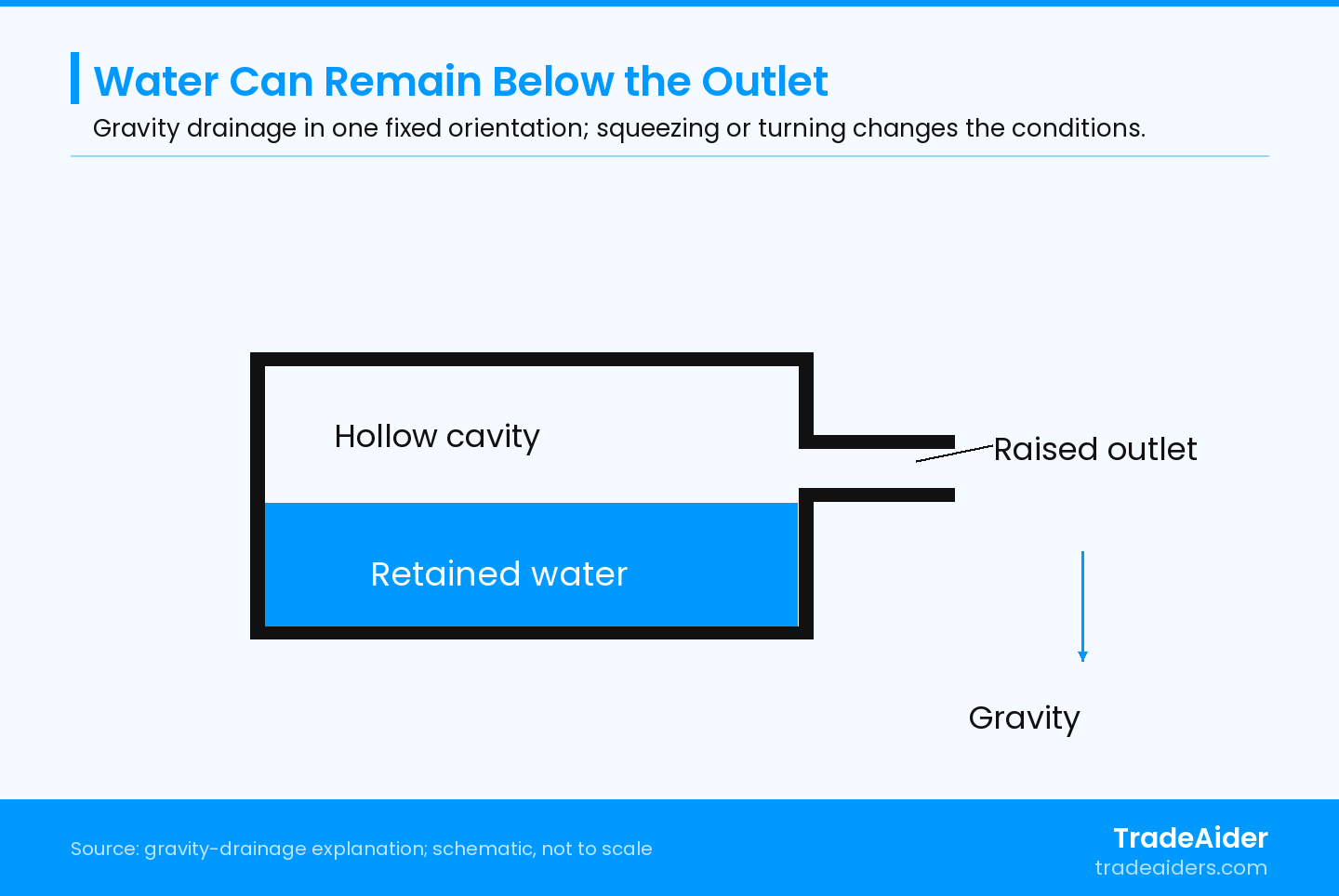
Schematic, not a product drawing or test result. The blue area illustrates water below the outlet in one fixed orientation under gravity alone. Actual squeezing, turning and opening instructions must be evaluated separately; no volume or drying time is shown.
For toys that open for cleaning, check opening, access and reassembly as separate functions. Look for rims or inserts that retain water after the main shell empties. Confirm that the parts return to the intended fit and that repeated opening does not create a loose closure or damaged edge under the specified test conditions.
A dry-versus-drained mass comparison can support the agreed assessment, but the difference is a net mass increase, not an automatic measurement of one trapped pool. Exterior film, absorbed water and measurement uncertainty can affect it. If the care claim requires an internally dry toy, obtain evidence for that outcome rather than rely on weight alone.
Do not drill a larger drain hole or remove a squeaker to make a retail sample empty unless that modification is explicitly part of a separate investigation. Such a result describes the modified item. It does not establish that the product being shipped meets its drainage requirement.
A Working Squeak Does Not Establish Insert Retention
A squeaker is the insert producing sound as air passes through it. Compare its approved attachment with the supplied toy and require the relevant result after wet conditioning and the specified mechanical sequence. Clear sound is a function result, not evidence that the insert will remain attached.
Run the specified wet conditioning and squeeze sequence, then examine the insert and its opening again. Look for migration, looseness, tearing, loss of seating or a changed sound. Record whether the issue appears while wet, after drying or after another mechanical test. The condition can matter when the supplier tries to reproduce it.
For U.S. toys, 16 CFR 1250.2 incorporates the applicable provisions of ASTM F963-23, subject to the stated exclusions. Identify the requirements and test methods relevant to the toy's construction and intended age. A factory squeeze demonstration does not replace the applicable squeeze-toy, small-object or other mechanical assessment.
Retention results need the applicable fixture, force, duration and sequence, not a pull value borrowed from another category. Confirm separate specimens where the method requires them; cumulative damage from unrelated tests can otherwise obscure what the result means.
Collect any released squeaker and identify the toy it came from. Examine the remaining opening and any torn plastic as well as the insert. A replacement insert that fits a damaged hole does not resolve why the original assembly released a part.
Paint and Printing: Separate Durability from Chemical Compliance
Appearance, wet-use durability and chemical compliance need separate results. For paint and printing, inspect the approved decoration before and after the defined exposure for peeling, tackiness, transfer or cracking. A coating can retain its color while lacking the required material evidence, or meet a chemical requirement while physically peeling.
A wet-rub result is meaningful only with its method attached. Identify the rubbing material, liquid, force, cycles and assessment criteria. Soap, cleaning products and temperature should match the approved procedure. An informal wipe can reveal a concern, but it cannot substitute for a controlled coating-durability result.
Physical durability and chemical compliance answer different questions. U.S. 16 CFR part 1303 addresses lead in paint and similar surface coatings. The limit is 0.009 percent, equivalent to 90 parts per million, by weight of the total nonvolatile content or dried paint film. A coating that survives rubbing has not thereby been shown to meet that chemical limit.
Match the laboratory evidence to the coating, colors and underlying materials actually supplied. A colored polymer is not necessarily a separate paint film, and different materials can need different chemical assessments. Do not describe an unpainted toy as free of all chemical requirements simply because the surface-coating rule is not the applicable test for its body material.
After the agreed cleaning exposure, inspect the toy for changes beyond decoration: softened attachment areas, distorted closures and rough or damaged surfaces may affect later use. Document the condition observed, then investigate the material or process rather than assuming every change has the same cause.
Small Parts: Include Squeakers, Closures and Test Fragments
The small-parts assessment should include the relevant supplied accessories and released squeakers, plugs, closures, decorations or fragments. Link each component to its original toy and test stage. An intact animal too large for the cylinder does not establish the result for an insert that separates during the required sequence.
For U.S. products within its scope, 16 CFR part 1501 addresses small-parts hazards in toys and other articles intended for children under three. The cylinder procedure examines whether an item fits entirely in any orientation without compression, including applicable components released by the required use-and-abuse tests. The size of the intact duck does not establish the result for its detached squeaker.
A small-parts result needs the prescribed cylinder procedure and the identity of the supplied or released component. A ruler or familiar-object comparison cannot stand in for it. Keep safety-related release findings separate from the count of ordinary cosmetic defects.
Review the age grading and destination requirements rather than assuming that adding a warning resolves a released component. Where a safety-related part separates, obtain the relevant technical assessment and corrective action. A good overall appearance or an acceptable count of ordinary cosmetic defects should not be used to dismiss that finding.
Does the Care Procedure Support the Drying Claim?
A drying claim needs a defined starting wet condition and the actual care procedure, with orientation, ventilation, temperature, humidity and observation interval identified. Otherwise two apparently different drying results may simply describe different preparation or storage. Agree the conditions and a way to examine the relevant interior before booking.
CDC guidance for early care settings distinguishes cleaning, sanitizing and disinfecting. For certain nonporous objects, it advises checking the manufacturer's suitable sanitizing method and allowing items to air dry completely before storage or use. This is care-setting guidance, not a bath-toy acceptance test or approval to boil, bleach or machine-wash every material.
Check whether the supplied instructions are practical for the design. If they call for rinsing the inside, can water reach the relevant surfaces and then leave? If they call for opening the toy, can it be opened and reassembled as intended? Photograph inaccessible wet areas and any mismatch between the written procedure and the supplied construction.
A dry exterior does not establish a dry interior. Look for liquid at low points and moisture around inserts, rims and closures after the specified interval. If mass is monitored, keep handling and weighing conditions consistent; an apparent plateau alone does not prove that every internal surface is dry. Use an agreed internal examination when the claim requires evidence the exterior cannot provide.
Keep short-term drying findings separate from a mold-resistance or antimicrobial claim. A factory observation does not reproduce prolonged household use or establish microbiological performance. If the product makes such a claim, obtain the relevant substantiation and specialist assessment instead of expanding the meaning of a successful drain check.
Hypothetical Example: The Outside Dries but a Foot Stays Wet
Suppose a hollow bath animal floats normally, makes its intended sound and releases most of its water when squeezed. After the instructed drying sequence, its exterior looks dry. A permitted internal examination of a separate sample reveals a pool in a low foot cavity that sits below the outlet in the stated storage position.
In this hypothetical example, the finding concerns the water path and drying procedure, not a measured mold result. Ask the supplier to address the construction or instructions, then repeat the agreed fill, emptying and drying sequence on the corrected product. Inspect the relevant cavity again. Demonstrating a stronger squeak or wiping the outside would not verify that correction.
Choose the Follow-Up That Matches the Failed Check
Keep the observation specific enough to determine the next action:
- Residual water or poor drying: Identify the pocket, outlet, orientation and interval. Verify the revised product or care procedure under the same agreed conditions.
- Released insert or fragment: Preserve the part and damaged toy. Investigate the attachment and obtain the required mechanical and small-parts reassessment.
- Coating or material concern: Separate the observed durability failure from chemical-test coverage and check the corrected materials against the applicable requirements.
TradeAider's inspection standard explains sampling and customer-specific checks. Agree the bath-toy methods, necessary equipment and treatment of findings before the visit.
For pre-shipment inspection, the order quantity is 100% complete and at least 80% packed for export. Supply approved samples, construction details, care instructions, destination artwork and relevant laboratory reports so the finished goods can be compared with the ordered product.
Contact TradeAider to agree the inspection scope and the conditions needed for the factory checks. Request findings tied to identifiable toys and test stages, with specialist chemical or microbiological evaluations arranged separately where needed.
Frequently Asked Questions
Can a hole-free bath toy be assumed to stay dry inside?
No. A nominally closed toy can still have a seam, closure or assembly defect that admits water under its specified exposure. Confirm the intended construction and test it without adding openings. If an internal examination is needed, perform it on designated samples after recording the intact condition. A hole-free description alone is not evidence that every production unit is sealed or internally dry.
Should drain holes be judged only by their measured diameter?
No. Diameter is only one feature of the drainage path. Location, internal shape, assembly obstruction and the required operating position also matter. Compare the opening with its drawing, then carry out the functional emptying procedure. A correctly sized opening in the wrong position can still leave a pool, while an intentional valve or insert may need its own operating sequence.
Is a new chemical report needed whenever a printed color changes?
The effect of the change needs assessment; a new report should not be assumed either necessary or unnecessary without that review. Identify the changed formulation, supplier and existing test coverage, then ask the responsible technical reviewer or laboratory what evidence remains applicable. A visually similar color does not establish chemical equivalence, and an old report should not be extended to an unverified material by changing the sample description.
How should toys used in water tests be handled before repacking?
Follow the agreed sample-disposition procedure, including adequate drying and separation of altered or damaged pieces. Keep sample identities and account for any loose inserts or fragments. Do not immediately seal wet toys back into retail packaging. Where a sample was cut open or otherwise destructively examined, retain it as test evidence rather than returning it to saleable stock or treating it as an intact replacement.
Related Articles
Grow your business with TradeAider Service
Click the button below to directly enter the TradeAider Service System. The simple steps from booking and payment to receiving reports are easy to operate.