
- About Us

- Our Services
- Your Industry
- Resources
- News & Blog
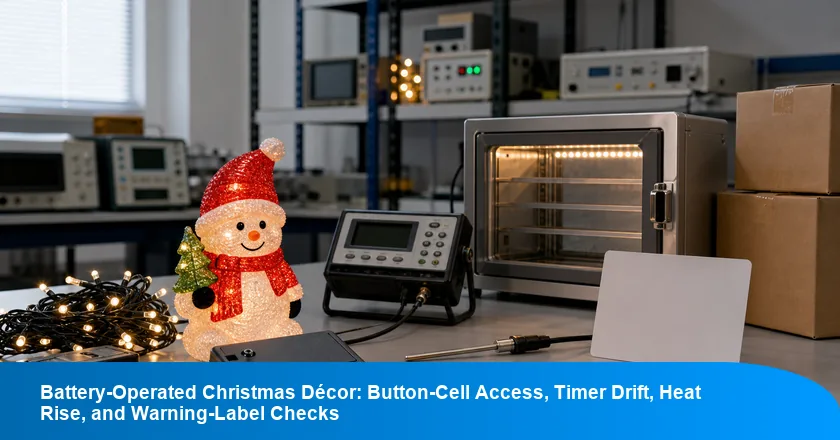
Battery-operated Christmas décor can pass a quick power-on check and still be the wrong product to release. A changed battery door, timer board, warning insert, or master-carton label can leave the functional sample and shipment record pointing to different revisions.
A useful battery operated Christmas decoration inspection therefore starts by routing the product for its destination and intended use, then joins battery access, function, safety information, and carton identity to one release decision. This checklist separates what a field inspection can observe from the evidence and formal assessment the selected market route may require.
A Battery Decoration Pass Starts With the Right Release Unit
The release unit is the documented battery décor configuration in its packed lot, not a generic powered sample. In practical terms, that unit joins the approved battery bill of materials, battery-door drawing, timer-board revision, selected light mode, warning artwork, instruction sheet, retail pack, and traceable carton range.
Call this joined evidence a release packet: a decision record that lets a buyer decide whether a specified packed lot can move. It prevents a good-looking sample from clearing a population whose door, cell type, artwork, or carton identification has changed. When any one of those elements cannot be connected to the sampled configuration, define the affected range before deciding whether it needs a hold, recheck, or correction.
- Approve configurations, not appearances: verify the physical unit against the records that identify it.
- Route before grading: destination and intended use give battery findings their proper context.
- Observe against an agreed window: timer and heat checks need buyer-approved conditions and acceptance criteria.
- Release joined evidence: product, warning, function, correction, and carton records should point to the same packed lot.
Route the Product Before Calling a Finding Critical
The destination and intended use determine the evidence route; a factory inspection does not replace conformity assessment or legal advice. US Part 1263 addresses performance and labeling for covered consumer products with button or coin batteries; the EU General Product Safety Regulation sets its own safety, documentation, and information responsibilities; and UK guidance addresses secure compartments and warnings for button- and coin-battery goods.
A market-and-product route is a simple decision record that connects the sales destination and intended use to the evidence path. Record it before the inspection plan is issued. For example, identify whether the decoration contains button or coin cells, whether it is marketed as a plaything, which retail presentation and languages are intended, and which version of the battery compartment is packed. This is the point to align the approved BOM and warning artwork through pre-production inspection planning, rather than asking a final inspection to resolve an undefined route.
Use a Market-and-Product Route Map
The US plug-connected seasonal-lighting definition does not by itself route a battery-operated decoration, because battery-operated products are excluded from that particular scope. Part 1120 defines that stated seasonal-lighting scope. That is a scope boundary, not a conclusion that no other requirement can apply.
Use a simple map that names the product configuration in one column and the destination-market questions in another. The map is a buyer operating tool, not a global compliance standard. It makes it clear which evidence must travel with a particular retail version and which questions require specialist review.
| Destination | Route question | Evidence to align before release | Inspection boundary |
|---|---|---|---|
| United States | Is the product covered by a button- or coin-battery rule, and is it marketed as a toy? | Battery-door version, warnings, instructions, and intended-use record | Do not borrow a plug-connected lighting route for a battery product. |
| Australia | Does the item fall within the mandatory standard for button or coin batteries? | Applicable compliance evidence and the released compartment construction | A field check records the observed revision; it does not certify a test. |
| United Kingdom | Which product route and safety information apply to the offered configuration? | Product, pack, and instruction warnings matched to the relevant version | Use the applicable route, not a universal label template. |
| European Union | What importer and product-safety documentation follows the final market route? | Technical file, safety information, and product identity | Inspection evidence supports, but does not replace, the selected route. |
| Canada | Does the released consumer product present a safety concern requiring escalation? | Function observations, product identity, and corrective evidence | Do not convert the general law into an invented timer or heat limit. |
Battery Access Is a Product-and-Revision Check
Battery access must be checked on the exact released revision, including its cell type, door construction, and fastener condition. A secure-looking door on a development sample does not establish the condition of a different door drawing, screw length, latch geometry, cell holder, or packed retail version.
Start with the physical identity: record the model, batch or date code, battery chemistry and designation, door revision, fastener type, and the retail pack that carries the unit. Then observe whether the compartment closes as designed, whether the specified fastening feature is present and engaged, whether the cell is retained in its intended position, and whether the polarity markings match the approved battery information. TradeAider can structure those observations as an agreed field record. Photograph both the exterior and opened state where the buyer’s scope allows it. If a corrective change is still in production, use during-production inspection coverage to verify the changed configuration before full pack-out makes the issue expensive to isolate.
Inspect the Battery Door Against the Approved BOM
For covered Australian consumer goods containing button or coin batteries, suppliers must demonstrate compliance before supply and the compartment must be secure. Australian mandatory-standard guidance explains the covered-scope requirement. That statement applies only to its covered scope; it does not turn an on-site observation into a formal compliance result.
For every sampled configuration, compare the approved BOM and drawing to what is in hand. The field record should state the intended cell type, observed door material and geometry, fastener or latch condition, polarity mark, cell retention, accessible loose-cell risk, and whether the physical unit matches the approved retail version. Treat a missing fastener, substituted door, unapproved cell size, damaged latch, loose cell, or inconsistent marking as a configuration finding first. The severity and release action then follow the route, the buyer’s criteria, and the evidence available for that exact product.
Timer Drift and Heat Rise Need Buyer-Defined Acceptance Windows
Timer drift and heat observations need a buyer-approved functional specification; there is no universal field-inspection limit asserted here. Define the selected light mode, battery condition, start time, observation duration, ambient conditions where relevant, allowed timing window, and the escalation path before the test begins.
Timer drift is the measured difference between approved timer behavior and the observed cycle. Record the scheduled start and stop, actual start and stop, mode selected, unit identity, battery state, and any interruption or reset. For heat, retain the operating condition and location of the observation, then note heat, odor, discoloration, deformation, battery leakage, flicker, shutdown, or instability without relabeling a simple field observation as laboratory proof. If the planned route calls for further evidence, arrange product testing coordination rather than extending a site check beyond its method.
Run the Function Check as a Repeatable Observation
Canada's general consumer-product safety law prohibits supply of a consumer product that is a danger to human health or safety; it does not create a universal timer-drift limit. Section 7 of the Canada Consumer Product Safety Act provides the general prohibition. The limit, method, and escalation point still need to come from the applicable product route and approved functional specification.
A repeatable observation begins with a written test card. Identify the sample, battery condition, switch position, selected mode, expected cycle, start time, and reviewer. At the specified checkpoints, record what happened rather than compressing it into a bare pass or fail. When a result is abnormal, preserve the unit, separate the traceable population it represents, and compare the observation with the approved functional criteria. This creates an auditable handoff to the buyer, laboratory, or compliance lead without claiming a global heat or time threshold.
Warnings and Instructions Must Match the Physical Product
Warning artwork, instructions, battery type, and the physical product must match the released configuration and target-market route. The comparison should not stop at approved PDF artwork: inspect the unit, its retail pack, the instruction sheet, and the carton range actually prepared for dispatch.
Make the check version-specific. Confirm the product name and model, battery designation, polarity information, door-related instructions, warnings, destination languages, artwork revision, insert revision, barcode or SKU, and any pack-out note that affects identity. A correct warning on an earlier door drawing is still a mismatch if the released physical product has moved to another configuration. Use an inspection-standard reference to agree how those mismatches are classified and what evidence is needed to clear them.
Compare Artwork, Instructions, and Battery BOM Side by Side
UK guidance advises clear and prominent warning labels on a button- or coin-battery product, its packaging, and the instructions or manual. The UK product-safety guidance is route-specific guidance, not a global warning template.
Put the BOM, door drawing, retail artwork, instruction sheet, and sample photo into one review set. Ask four close questions: does the product contain the battery described; does the door shown or described match the physical door; are the warnings present in every expected location; and can the carton range be tied to that exact artwork revision? Record the answer beside the unit and carton identity. This side-by-side method catches stale inserts and wrong-language packs before a seasonal delivery spreads them across a mixed shipment.
Illustrative Scenario: a Revision Conflict Narrows the Hold
The illustrative hold is based on an unresolved product-artwork-carton revision conflict, not an assumption that every pack is defective. It shows how a buyer can contain the uncertain population while preserving a separate, traceable range for review.
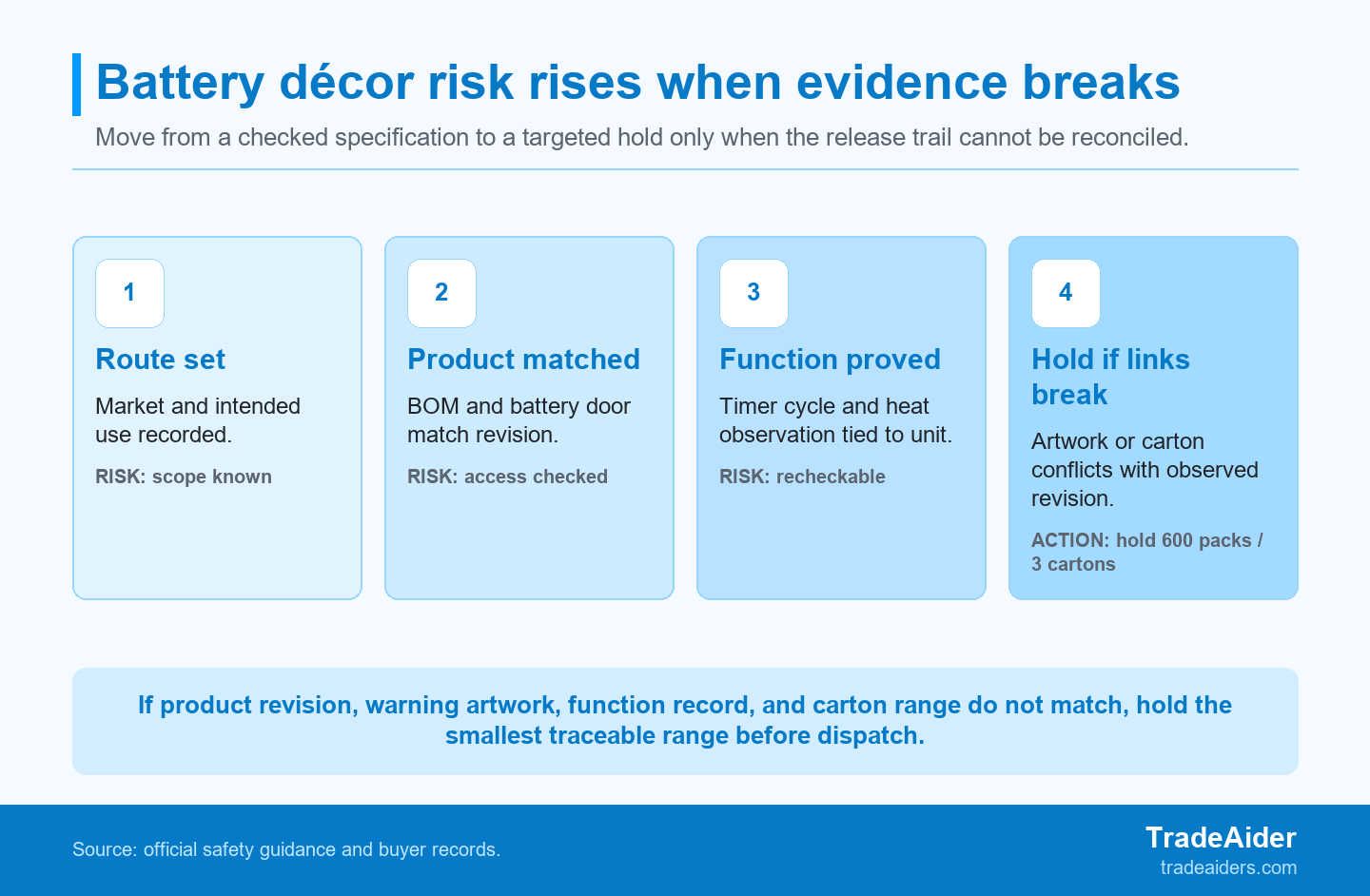
A targeted hold is justified when the physical revision, warning artwork, functional record, and carton range cannot be reconciled; the illustration holds 600 packs in 3 uncertain cartons.
Separate, Reconcile, and Recheck Before Release
The held carton range is released only after the product revision, artwork, functional record, and carton identity can be reconciled. In this illustrative case, the team separates the cartons, reconciles battery-door and timer-board revision IDs, replaces the incorrect inserts, and rechecks the corrected pack version.
The verification gate is deliberately narrow: the product, warning artwork, function record, and carton label must identify the same configuration. If they do, the buyer can make a documented release decision for that rechecked range. If they do not, keep the scope contained and escalate the unresolved route or evidence issue. The point is traceable correction, not an unsupported assurance about the whole shipment.
A private-label importer is preparing a battery-operated tabletop village for US, UK, EU, Canada, and Australia listings. The buyer needs a release decision that keeps the selected market route, physical configuration, and retail warning evidence connected before seasonal dispatch. The illustrated lot contains 4,800 retail packs across two timer-board revisions and 24 master cartons. The records identify a 600-pack range across 3 master cartons whose revision stickers need extra reconciliation. Pack-out is complete and the product is scheduled for seasonal dispatch. The other cartons remain physically separate, but the affected carton labels do not yet resolve the timer board, battery door, and insert to one documented configuration.
A sample with the revised timer board has a warning insert printed for the earlier battery-door drawing. The physical unit and the printed safety information therefore do not identify the same released version. Three cartons in one range contain mixed revision stickers, so the inspected timer result cannot be assigned to each pack. This is a carton-identity problem as well as a document-version problem. The defect is not only an artwork issue: the product revision, warning evidence, and carton identity no longer resolve to the same release population. The rest of the lot does not automatically share that uncertainty because its cartons retain separate, traceable identities.
Hold the 600 packs in the three uncertain cartons; keep the remaining traced range separate while the buyer checks the market route and revision records. The hold is limited to the population whose identity cannot yet be reconciled. Separate the cartons, reconcile battery-door and timer-board revision IDs, replace incorrect inserts, and recheck the corrected pack version. Retain photos and the revised carton identification with the correction record.
Release the held range only after the product, warning artwork, function record, and carton label identify the same configuration. A recheck must use the restored configuration and the buyer-approved functional window. This is an illustrative composite, not a client case or a statistically derived sampling rule. Actual containment follows the buyer’s records, agreed criteria, product route, and destination-market requirements.
Hand Off a Battery Décor Release Packet Before Peak Dispatch
A release packet should join the market route, battery BOM, approved artwork, functional criteria, corrective evidence, and carton range before final inspection. A complete packet tells the reviewer which configuration to sample, which behavior to observe, which information to compare, and where a finding can be traced.
Before the inspection date, provide the destination list and intended-use statement; approved sample or photo set; BOM and battery-door revision; retail artwork and instructions; timer and functional acceptance window; selected light modes; known corrections; carton marks; and the pack-out range. A defined Pre-Shipment Inspection scope can apply that packet to the finished population. If the configuration is complex or a late revision has changed the evidence, set the field record before seasonal dispatch.
share a battery décor inspection brief when you need the checks, documents, and affected carton range agreed before the visit.
Who Is TradeAider?
TradeAider provides quality inspection, testing, and certification service context in China and publishes approved client-reported outcomes with qualification. Buyers sourcing in Guangdong, Zhejiang, Jiangsu, Shandong, Fujian and other regions can review the TradeAider background when they need a defined inspection scope for battery-operated seasonal goods.
For Inspection & QA Services, TradeAider states a $199/man-day all-inclusive rate. Client-reported outcomes include an 18% reduction in returns and 23% of defects caught before shipment; these are client-reported figures, not universal results for every battery décor program, supplier, or destination market.
TradeAider also provides testing services, covering Hardline Products, Softline Products, Electrical & Electronic Products, and Industrial Products, enabling buyers to manage quality control and testing needs within a single service framework.
Provider support can structure fieldwork and reporting, but it does not replace the product-specific conformity or legal assessment required for the destination market.
Frequently Asked Questions
Does Battery-Operated Christmas Décor Always Need Toy Testing?
No: a Christmas decoration enters a toy route only when its intended and marketed use meets the relevant destination-market criteria. Toy requirements depend on intended use and marketed status, not merely on being decorative or battery-powered. US Part 1263 distinguishes the covered button-battery route, and Part 1250 applies applicable ASTM F963-23 provisions to toys. Other battery-product obligations may still apply.
What Timer-Drift Limit Should an Inspection Use?
Use a written, buyer-approved time window that names the selected mode, battery condition, observation period, variation, and escalation action. The buyer-approved functional specification supplies the timer acceptance window. This approach records a repeatable result without claiming that a generic safety rule supplies a universal field-inspection timer limit.
Can a Field Inspection Prove Heat Compliance?
No: an on-site functional check can capture unusual operating signs, but it cannot determine whether every formal heat requirement has been met. A field inspection can flag abnormal heat, odor, deformation, or instability but cannot replace the required conformity route. Preserve the unit identity and conditions, then escalate the observation through the agreed product and market route instead of declaring a laboratory conclusion from a site observation.
Which Records Should Travel With a Released Lot?
A released lot needs one readable record that lets a later reviewer connect the safety route, sampled configuration, correction, and carton range. The released lot record should keep market, product, function, warning, correction, and carton evidence joined. Add the sample identity, date, inspection result, and decision owner so a later reader can see which configured population was released and which evidence supported that decision. Keep these items as one packet throughout dispatch.
Related Articles



Grow your business with TradeAider Service
Click the button below to directly enter the TradeAider Service System. The simple steps from booking and payment to receiving reports are easy to operate.

