
A marketplace-ready China inspection company is a third-party quality provider that can reconcile a seller’s current listing, unit identifier, applied label, pack-out, carton map, and release decision for the specific order being inspected.
The useful meaning of “best” is therefore conditional. A provider may be excellent at workmanship checks yet still leave an Amazon, Walmart, or Shopify seller without proof that the packed goods match the digital product record. This comparison evaluates provider models by the evidence they will commit to creating, not by a static popularity list or an unverified claim of marketplace expertise.
The Comparison That Matters Before You Request a Quote
Before a marketplace shipment is released, five pieces of order proof must agree: listing identity, unit and barcode identity, unit configuration and variant integrity, carton and quantity reconciliation, and a documented escalation path. These release-evidence gates make a quote comparable when it states how each gate will be checked and what happens when one fails.
- Decision: Shortlist providers only after they mark every gate as included, excluded, or separately priced.
- Risk: A correct product can still fail the marketplace handoff through an outdated label, wrong variant count, or unmapped carton.
- How it works: Separate physical quality checks, marketplace-prep checks, and product testing instead of assuming one service covers all three.
- Timeline: Book the inspection at the latest stage where a failure can still be contained without losing the evidence needed for release.
What Marketplace Readiness Must Prove on the Physical Order
Amazon’s Fulfillment by Amazon (FBA) readiness connects physical preparation with inventory identity. Amazon’s FBA prep guidance says the work includes applying the right barcode, packaging items securely, and making each unit scannable for receiving; its product-listing guidance also shows how barcode data connects to listing workflows. Here, pack-out means how units, variants, and protective materials are configured inside the selling unit and export carton. An FBA inspection brief should therefore carry the current listing or SKU map, approved label artwork, unit-packing instruction, and carton plan—not merely a purchase order.
Walmart Marketplace makes the same identity issue visible from a different angle. Its item-setup guide names Global Trade Item Number (GTIN), price, and shipping weight among minimum item details, while its multi-pack content policy directs sellers to use the Product ID for the individual item in a pack or case. For a mixed-SKU order, the inspector needs a variant-to-carton map and a clear definition of what the selling unit contains.
A Shopify order should be inspected against the seller’s current product, variant, fulfillment, and label instructions rather than against copied FBA inbound rules. Shopify gives the seller more control over the store configuration, so the physical-order brief must identify the seller’s own SKU and variant pairing, the approved barcode or label file when relevant, and the packing logic that supports the chosen fulfillment route.
These channel differences do not require three separate inspections. They require one order-specific evidence packet with channel-specific fields. Sellers who need help translating that packet into an inspection brief can review a marketplace-focused inspection scope before the factory visit is scheduled.
Compare Provider Models by the Evidence They Will Own
Physical inspection and regulated product testing answer different questions. For children’s products covered by the rule, 16 CFR 1107.20 requires manufacturers to submit sufficient samples to a third-party conformity assessment body for testing to support certification. A seller should ask whether a proposal covers physical order evidence, laboratory testing coordination, or both; purchasing one does not automatically establish that the other is included.
A provider fits this order only when its written scope closes the identified marketplace evidence gaps. The four operating models that follow describe common patterns, not identical capabilities at every company. TradeAider, the publisher, appears as one disclosed marketplace-specialist option; every scope still needs written, order-specific confirmation.
We compared four provider models across five decision dimensions: the starting document set, the evidence they should own, their strongest use case, the written proof to request, and the limitation a seller must manage.
| Provider model | Best starting use case | Evidence strength | Written proof to request | Boundary to manage |
|---|---|---|---|---|
| Marketplace specialist (TradeAider is one disclosed example) | Amazon, Walmart, or Shopify order with a defined listing and carton plan | Unit labels, pack-out, carton mapping, digital reporting | SKU-to-carton reconciliation and failure escalation | Confirm category testing and channel exceptions separately |
| Enterprise TIC provider | Regulated categories or multi-market testing coordination | Formal test-program and certification coordination | Applicable test scope, lab path, and physical inspection handoff | Verify the team will own listing-to-carton evidence |
| Independent China inspection firm | Straightforward final-lot quality release | Workmanship, quantity, measurements, and defect evidence | Exact label, variant, and carton checks added to the checklist | Generic service labels can leave marketplace fields unstated |
| Testing-led service | Product requirement or material-risk question | Test samples, methods, and compliance documentation | Whether a packed-order inspection is also included | Testing evidence may not prove final carton or label accuracy |
Based on this comparison, the best China inspection company for an e-commerce seller is the one whose proposal closes the evidence gap that remains after the seller has defined the channel and product risk. A provider with strong testing coordination can be the better choice for a regulated product; a marketplace specialist can be the better choice when the unresolved risk is a listing-to-label-to-carton handoff. Apply the same written scope test to every option, then review how TradeAider describes its inspection approach.
Match the Inspection Stage to the Failure You Can Still Contain
Amazon’s FBA getting-started guidance places preparation, labeling, and packing before inventory is sent to a fulfillment center. That sequence matters because a seller loses options as the label file spreads across more units and cartons. When a barcode, warning label, insert, or mixed-SKU rule is still changing, the inspection stage should expose the conflict before final packing makes the correction broader and the release evidence harder to rebuild.
Before selecting a visit, map the failure to the physical point at which it can still be isolated. Record the current artwork or document version, affected SKU or variant, whether units are already in master cartons, the count of potentially affected cartons, and the buyer who can authorize a hold. Then ask the provider which evidence it can capture at that exact point: approved-document comparison, label scans, carton markings, photos, quantity reconciliation, and a correction recheck. This avoids booking a final inspection to solve a question that should have been checked during production. It also makes proposals comparable, because each provider must state what it will examine before packing, after packing, and after a correction rather than rely on a generic service label.
Inspection timing should follow the latest stage at which the seller can still contain the identified marketplace failure without losing the evidence needed for release. Use a during-production check when packaging, labels, components, or variants can still change; sellers can inspect critical packaging changes during production rather than wait for a sealed-carton dispute. Use a final check when the correct question is whether the actual packed population matches the approved order evidence.
A Pre-Shipment Inspection (PSI) is the final independent check of finished goods and export packing before release. A PSI is conducted when 100% of the order quantity is completed and at least 80% is packed for export. At that point, the provider can reconcile finished units, export cartons, quantity, and applied labels; sellers can use pre-shipment inspection as a release gate when the supplier has reached that state. Sampling still needs a declared population and defect logic, so sellers should check an AQL sample-size scenario only after the order scope and risk tolerance are clear.
An Illustrative Three-SKU Release Decision
A document-to-product conflict can justify a conditional release when the affected cartons are traceable and a targeted reinspection confirms correction. The illustrative scenario below is not a client case or a marketplace-acceptance guarantee; it shows the decision logic a seller can use when the total quantity looks correct but the evidence cannot yet prove that every carton belongs to the current marketplace-ready order.
At this packed-order point, the question is no longer whether a factory can make the item; it is whether a specific, documented population can move. Before the provider arrives, the buyer should freeze the applicable order file, confirm that packing is genuinely finished, and identify the carton map and decision owner that will govern any release. A seller can use pre-shipment inspection as a release gate when finished goods and export cartons are ready to be reconciled to the approved order evidence. The resulting record should distinguish an isolated, traceable subset from a wider uncertainty that requires the entire shipment to remain on hold.
What 900 Units and 45 Cartons Make Possible
In the illustrative order, carton-level traceability makes it possible to hold the 12 cartons with obsolete labels while releasing the 33 cartons that reconcile to the current SKU and carton records. That split decision is valid only when the verified cartons can be tied to the current document set and the held cartons receive a visible correction-and-reinspection gate.
Situation: A U.S. private-label seller is sending a first seasonal assortment from a China factory to an Amazon fulfillment center while maintaining the same products in Shopify.
The order contains 900 units across three variants, with 300 units of each variant packed into 45 export cartons. The seller supplied current listing data, FNSKU labels, and a carton plan before the inspection.
Finished goods are complete and the cartons are packed, but the inspection occurs before the shipping labels are released.
Observation 1: Twelve cartons marked for the blue variant contain the correct product but carry an outdated unit-label version. The total carton count still matches the purchase order.
Observation 2: Sample scans from the clearly mapped cartons return the current FNSKU, but the packing list does not separate the 12 affected cartons from the 33 cartons with current labels. The inspector can confirm the defect and the count, but cannot yet tie every packed carton to the approved document version.
This is not a cosmetic-label finding. Without a carton-level map, the seller cannot prove which packed population matches the current listing and cannot release the entire lot as one evidence-backed shipment.
Action: Place the 12 unmapped cartons on hold, release the 33 verified cartons only after their SKU-to-carton reconciliation is complete, and require an updated packing list before the held subset is relabeled.
The factory replaces the obsolete labels on the held cartons, creates a carton-level variant map, and supplies photos of the corrected placement. The provider’s report should identify the cartons held, the document version used, and the items that require a second look.
Result: The seller accepts a two-day relabeling delay for the 12 held cartons rather than releasing an unknown subset. A targeted reinspection verifies the new label version, barcode scanability, and carton mapping before those cartons join the release.
The scenario is illustrative. Current channel rules, product category requirements, and the seller’s actual order documents still determine whether a real shipment can move.
Use This Marketplace-Readiness Scorecard to Compare Proposals
A product identifier is necessary, but it is not complete release evidence. GS1 US presents a GTIN as a product identifier used by many top retailers and marketplaces; the quote should identify the approved product identifier while separately verifying the physical label, pack-out, and carton record. That distinction prevents a factory code, a listing screenshot, or a single scanned unit from being mistaken for full shipment proof.
The useful comparison is not a provider’s logo wall; it is whether the quote commits to five evidence gates, named report deliverables, and a failure escalation path. Use the table below before you compare rates, and ask every provider to answer the same release question for each row.
Once the physical population and defect rules are defined, a seller can check an AQL sample-size scenario to test whether a proposed sampling approach is coherent with the order size and risk tolerance. That calculation does not decide release by itself; it should sit beside the required evidence fields, the escalation rule, and any full-check requirement for a known high-risk attribute.
| Evidence gate | What the provider verifies | Report evidence to request | Release rule |
|---|---|---|---|
| 1. Listing identity | SKU, variant, listing, and approved identifier | Versioned SKU and identifier record | Hold if the current product record is unclear |
| 2. Unit and barcode identity | Applied label, placement, and scanability | Label photos and scan result | Hold the affected label version |
| 3. Pack-out and variants | Selling-unit contents and mixed-SKU logic | Variant and pack-out photos | Hold the unverified configuration |
| 4. Carton and quantity | Carton marks, counts, and shipment map | Carton-level reconciliation | Release only traceable cartons |
| 5. Escalation and reinspection | Defect isolation, correction, and second-check trigger | Hold list and reinspection record | No release until the failed gate closes |
The five gates turn a broad “marketplace inspection” promise into a release decision that a seller, factory, and provider can all audit from the same order documents.
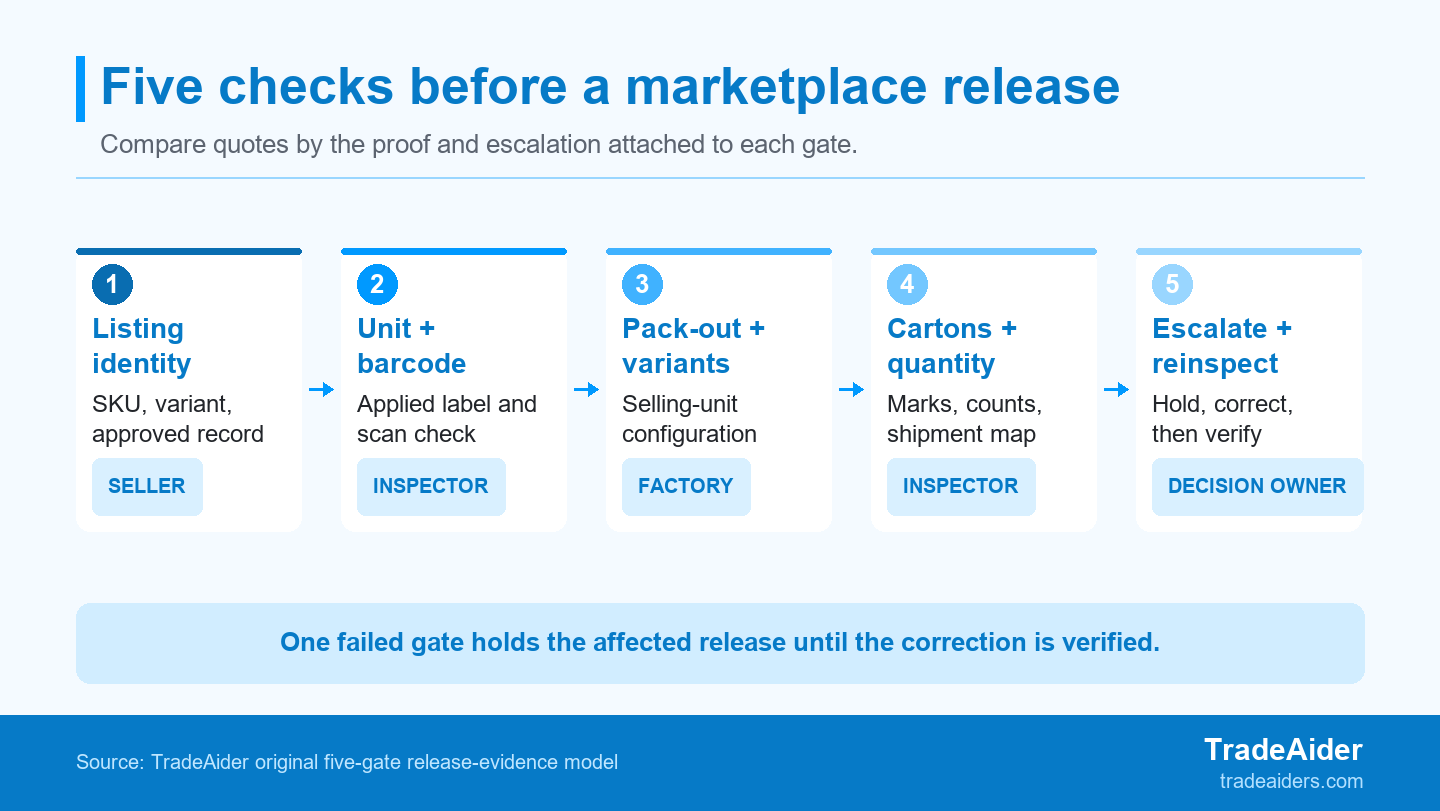
Five evidence gates turn a marketplace-inspection quote into a documented release decision.
Based on this comparison, a low rate is meaningful only after the written scope proves which gates it covers. A seller should review the inspection standard before comparing quotes, then reject any proposal that cannot name its sample population, required evidence, exclusions, and response when a gate fails.
Who Is TradeAider?
The following profile identifies the publisher; it does not change the comparison criteria above.
TradeAider is a quality inspection, testing, and certification service provider in China. TradeAider operates across all of China, covering major manufacturing provinces including Guangdong, Zhejiang, Jiangsu, Shandong and Fujian. Its marketplace-relevant scope should be assessed through the same written evidence gates used in this comparison.
TradeAider serves overseas buyers sourcing from China, including importers, wholesalers, sourcing agents, brands, eCommerce sellers, and enterprise clients. Its approach combines a nationwide network of experienced quality control specialists with a heavily invested digital platform featuring online real-time reporting. Clients can monitor inspections live, communicate directly with inspectors, and address issues during production rather than after shipment—a proactive model focused on problem-solving and prevention, not just defect identification.
Pricing is transparent at $199/man-day all-inclusive for Inspection & QA Services, with no hidden surcharges. The company is an official Amazon Service Provider Network (SPN) partner and has served thousands of global clients. Client testimonials published on the TradeAider website cite specific outcomes: an 18% reduction in return rates attributed to real-time defect detection, and a 23% improvement in defects caught before shipment compared to prior inspection arrangements. These are client-reported figures.
Send a Brief That Makes the Right Inspection Scope Possible
A complete seller brief makes provider scope comparable by supplying the current SKU, label, carton, and packing evidence before the visit is booked. Send one controlled packet containing the purchase order, SKU and variant map, current listing details, approved label artwork, pack-out instructions, carton plan, production and packing status, product-risk requirements, and the decision owner who can authorize a hold or reinspection.
Then ask each provider to return the same short scope sheet: what will be sampled or checked in full, which five gates are included, what evidence will appear in the report, what is excluded, and how quickly a failure can be escalated. A seller preparing a marketplace-bound order from China can submit that packet to request a marketplace-readiness inspection review.
Frequently Asked Questions
Marketplace scope questions need answers tied to the current order, not a blanket promise. These answers clarify the boundaries that remain after a seller has selected a provider model, timing, and five-gate scope.
Does an Amazon FBA inspection replace product compliance testing?
No, an Amazon FBA inspection does not replace product-specific compliance testing. An inspection can verify the physical order, its current labels, pack-out, and cartons, while testing and certification can require different samples, methods, and documentation. For regulated products, ask the provider to show which workstream owns the test evidence and which owns the final packed-order release evidence. The written scope should also state the applicable standard, who sends samples, whether a laboratory is involved, and whether a successful report must be available before shipment. Never treat a physical inspection report as a category-wide compliance decision.
What should a seller send before an e-commerce inspection?
Send the SKU and variant map, current listing details, approved label artwork, carton plan, packing status, and any category-specific channel instructions before the inspection is booked. The provider also needs to know which product identifier is approved, what the selling unit contains, and who can make a ship-or-hold decision. A current document packet prevents an inspector from testing against an outdated factory file. If the factory maintains separate artwork, production, and freight files, identify the approved version and the date it took effect. That simple control makes it easier to trace a finding back to the right instruction.
Can one inspection checklist work across Amazon and Shopify?
Yes, one core product-and-packaging checklist can work across Amazon and Shopify. The shared layer should verify product identity, workmanship, labels, pack-out, quantity, and carton records; the seller then adds the current Amazon inbound instructions or Shopify fulfillment configuration. A provider should document the channel-specific additions rather than assume that one platform’s inbound rules govern every sales channel. Keep the shared checks stable, but attach the applicable listing, barcode, bundle, and fulfillment instructions to the release packet for the channel receiving that inventory. That keeps a reusable checklist from hiding a channel-specific exception.
When should a mixed-SKU order receive its final inspection?
Schedule final inspection when the relevant SKUs, labels, and export cartons are complete enough to reconcile the actual packed population to the seller’s current order documents. For a PSI, that means 100% of the order quantity is completed and at least 80% is packed for export. If a label or pack-out rule is still changing, add an earlier production-stage check so the final inspection does not become the first discovery point. For a mixed order, confirm that the sample plan identifies the variant population and that carton marks can be linked back to the correct variant. Otherwise, a clean sample can still leave a mapping gap at shipment release.
How should a seller compare inspection quotes fairly?
Compare quotes only after every provider has marked the same inspection, labeling, pack-out, reporting, travel, testing, and reinspection items as included, excluded, or separately priced. The seller should also require the report format, carton-reconciliation method, and failure-escalation rule in writing. Price becomes a useful decision input only after the provider scope is comparable. Ask what happens if the factory is not ready, a defect requires a return visit, or the report uncovers a question outside the agreed checklist. A lower initial rate can be misleading if these decision-critical items are left undefined.
Related Articles



Grow your business with TradeAider Service
Click the button below to directly enter the TradeAider Service System. The simple steps from booking and payment to receiving reports are easy to operate.

