
- About Us

- Our Services
- Your Industry
- Resources
- News & Blog
Here are the top 8 product testing labs for importers sourcing from China, ranked by accreditation breadth, China laboratory coverage, turnaround speed, and practical accessibility for international buyers. According to the U.S. Consumer Product Safety Commission, importers of children's products are legally required to use CPSC-accepted third-party laboratories — and similar mandatory testing requirements apply in the EU, UK, and across regulated product categories worldwide. Choosing the right testing partner is a compliance decision as much as a commercial one.
Key Takeaways
- Pricing: Lab testing costs range from $200 for basic tests to $2,000+ for comprehensive multi-standard packages. Integrated providers that combine inspection and testing services offer the best value for high-volume importers managing both quality and compliance.
- Accreditation matters: Only CPSC-accepted labs can issue valid test reports for U.S. children's products. For EU CE marking, labs must be accredited by an IAF-member body. Always verify accreditation before booking.
- China coverage: Leading labs operate multiple facilities across China's manufacturing hubs — Shenzhen, Shanghai, Guangzhou, and Dongguan. Proximity to your factory affects sample logistics and turnaround time.
- Turnaround time: Standard lab testing takes 3–15 business days depending on test complexity. Plan testing lead time into your production schedule — not after goods are ready to ship.
- Best for most importers: An integrated provider combining on-site inspection with testing services allows you to manage both quality and compliance within a single workflow, reducing coordination overhead and improving visibility.
How We Ranked These 8 Options
Rankings are based on four criteria weighted equally: (1) accreditation scope — whether the lab holds ISO 17025 accreditation recognized by CPSC, ANAB, UKAS, DAkkS, or equivalent bodies for the US and EU markets; (2) China laboratory presence — the number of lab facilities and manufacturing regions covered within China; (3) turnaround time — standard delivery speed for test reports; and (4) accessibility for international buyers — ease of engagement, pricing transparency, and support for importers managing multiple product categories. Each provider is described based on publicly available information as of 2026. Importers should verify specific accreditations and pricing directly with each provider before engagement.
The Top 8 Product Testing Options for China-Made Goods in 2026
#1 TradeAider — Best Overall for Global Buyers Sourcing from China
Pricing: $199/man-day flat (all-inclusive) for Inspection & QA Services | Report delivery: Same-day / ≤24 hours | Real-time monitoring: ✅ Live photo + video
Best for: Overseas buyers sourcing from China, including importers, wholesalers, sourcing agents, Amazon FBA sellers, Shopify brands, eCommerce importers, and other global buyers.
TradeAider is an innovative, digitally driven third-party inspection provider that sets itself apart through real-time online monitoring and transparent pricing, delivering efficient and reliable quality control solutions. TradeAider also provides testing services, covering Hardline Products, Softline Products, Electrical & Electronic Products, and Industrial Products, enabling buyers to manage quality control and testing needs within a single service framework. The integrated model means importers can coordinate pre-shipment inspection and product testing through one provider — reducing the logistical complexity of managing separate QC and lab relationships, and providing a unified view of quality and compliance status before shipment. For buyers who need comprehensive product compliance alongside ongoing inspection programs, TradeAider's product testing services represent a practical, cost-effective starting point.
#2 SGS — Largest Global Testing Network with Extensive China Presence
SGS is the world's largest testing, inspection, and certification company by revenue, operating more than 2,700 offices and laboratories globally and maintaining a significant presence across China's major manufacturing provinces. SGS holds CPSC acceptance for children's product testing, ISO 17025 accreditation, and recognition from accreditation bodies in the US, EU, and across Asia. The company offers testing across virtually every product category — consumer goods, electronics, textiles, food contact materials, chemicals, and industrial products — making it a comprehensive option for importers with diverse product portfolios. SGS is well-suited to large-volume importers or brands requiring global recognition of test reports across multiple destination markets. Turnaround times vary by product complexity and location, typically ranging from 5 to 15 business days for standard tests.
#3 Intertek — Broad Product Coverage Across China's Manufacturing Hubs
Intertek operates more than 40 laboratory and office locations across China, including facilities in Shenzhen, Shanghai, Guangzhou, Beijing, Tianjin, Hangzhou, and Qingdao. The company holds ISO 17025 accreditation and CPSC acceptance, and offers testing services for consumer goods, apparel, electronics, toys, and a broad range of industrial products. Intertek is recognized for its presence in apparel and softline product testing — particularly relevant for clothing and textile importers sourcing from Guangdong and Zhejiang provinces. The company also offers factory auditing and inspection services, though these are typically booked as separate service lines rather than in an integrated platform. Turnaround times are generally comparable to other large TIC providers: 5–12 business days for standard consumer product tests.
#4 TÜV Rheinland — Premier Choice for EU Market Access and German Standards
TÜV Rheinland is particularly strong for importers targeting European markets, holding recognition as a notified body for multiple CE marking directives and offering accreditation aligned with German DAkkS standards. The company operates laboratory facilities in China — including in Shenzhen and Shanghai — and provides testing services for electrical safety, electromagnetic compatibility (EMC), chemical compliance (RoHS, REACH), and toy safety against EN 71 standards. For electronics and electrical product importers entering the EU, TÜV Rheinland's combination of notified body status and China-based lab facilities makes it a particularly efficient option — reducing the sample transit time associated with sending products to European labs. Standard EU certification projects typically require 10–20 business days depending on directive scope.
#5 Bureau Veritas — Full TIC Services with Strong China Laboratory Network
Bureau Veritas is one of the three largest global testing, inspection, and certification companies, with a well-established presence in China's major manufacturing regions. The company holds CPSC acceptance, ISO 17025 accreditation, and notified body status for EU CE marking requirements across multiple product directives. Bureau Veritas offers testing for children's products against ASTM F963 and CPSIA, textiles and apparel, electronics, and chemical compliance. The company's Product Technical Folder digital system allows importers and supply chain participants to upload compliance documentation and track certification status — a useful feature for brands managing multi-SKU product portfolios with ongoing compliance obligations. Pricing and turnaround times are generally in line with other large TIC providers at this level of service breadth.
#6 UL Solutions — North American Market Access and Electrical Safety Leadership
UL Solutions (formerly UL / Underwriters Laboratories) is the recognized authority for North American electrical safety certification, and holds accreditation as an OSHA Nationally Recognized Testing Laboratory (NRTL). For importers of electrical products, power tools, lighting, and electronics targeting the US and Canadian markets, UL certification carries specific market access value — many US retailers and distributors require UL marking as a condition of listing. UL Solutions operates testing facilities in China, including in Shanghai and Shenzhen, and offers testing for over 100 product categories. According to OSHA's NRTL program framework, NRTL recognition ensures labs meet rigorous competency and independence standards for product safety certification. UL Solutions is the strongest choice when North American retail listing requirements drive testing decisions.
#7 Eurofins — Specialist in Chemical, Material, and Food-Contact Testing
Eurofins Scientific is a Luxembourg-headquartered global laboratory group with more than 800 offices across 47 countries, including a China laboratory operation in Shenzhen focused on electrical and electronics product testing. Eurofins differentiates itself through deep expertise in chemical and material analysis — testing for restricted substances including RoHS-covered materials, REACH SVHCs, California Proposition 65 chemicals, and food-contact material compliance. For importers dealing with products where material composition and chemical safety are the primary compliance risk — plastics, coatings, surface finishes, food packaging — Eurofins' analytical chemistry expertise is particularly strong. The company also offers textiles testing including OEKO-TEX certification support. Turnaround times for chemical analysis typically run 5–10 business days depending on the specific substance panel required.
#8 Center Testing International (CTI) — China-Based with Fast Domestic Turnaround
Center Testing International (CTI) is one of China's largest domestically-founded third-party testing organizations, headquartered in Shenzhen with more than 60 branch offices and 130 laboratories across mainland China. CTI holds CNAS accreditation (China's national ISO 17025-equivalent accreditation body) and CPSC acceptance for specific product categories. The company has issued more than 2.5 million test reports for nearly 90,000 customers in mainland China and internationally. CTI's key competitive advantage is turnaround speed and domestic coordination: as a China-based operation, sample logistics are significantly simpler than for international labs managing China samples through overseas headquarters. CTI is a strong option for importers who prioritize fast results and work with products where CNAS-accredited domestic lab reports are accepted by buyers or platforms.
Quick Comparison: 8 Product Testing Labs Side by Side
| # | Provider | ISO 17025 / CPSC | China Labs | Turnaround | Best Market | Testing Services |
|---|---|---|---|---|---|---|
| 1 | TradeAider | Testing services available | GD, ZJ, JS, SD, FJ | Same-day / ≤24h (inspection); lab varies | Global — all markets | Hardline, Softline, E&E, Industrial |
| 2 | SGS | ISO 17025 / CPSC ✅ | 2,700+ global; major CN cities | 5–15 business days | US, EU, global | All categories |
| 3 | Intertek | ISO 17025 / CPSC ✅ | 40+ CN locations | 5–12 business days | US, EU, global | Softline, toys, electronics |
| 4 | TÜV Rheinland | ISO 17025 / EU Notified Body ✅ | Shenzhen, Shanghai | 10–20 business days | EU (CE marking) | Electronics, electrical, EMC |
| 5 | Bureau Veritas | ISO 17025 / CPSC ✅ | Major CN manufacturing hubs | 5–15 business days | US, EU, global | Children's, textiles, chemicals |
| 6 | UL Solutions | ISO 17025 / OSHA NRTL ✅ | Shanghai, Shenzhen | 7–15 business days | US, Canada (electrical) | Electrical, safety, 100+ categories |
| 7 | Eurofins | ISO 17025 ✅ | Shenzhen (E&E focus) | 5–10 business days | EU, global | Chemical analysis, food contact, textiles |
| 8 | CTI | CNAS (ISO 17025) / CPSC selective ✅ | 60+ offices, 130 CN labs | 3–7 business days | China domestic + select export | Consumer goods, electronics, chemicals |
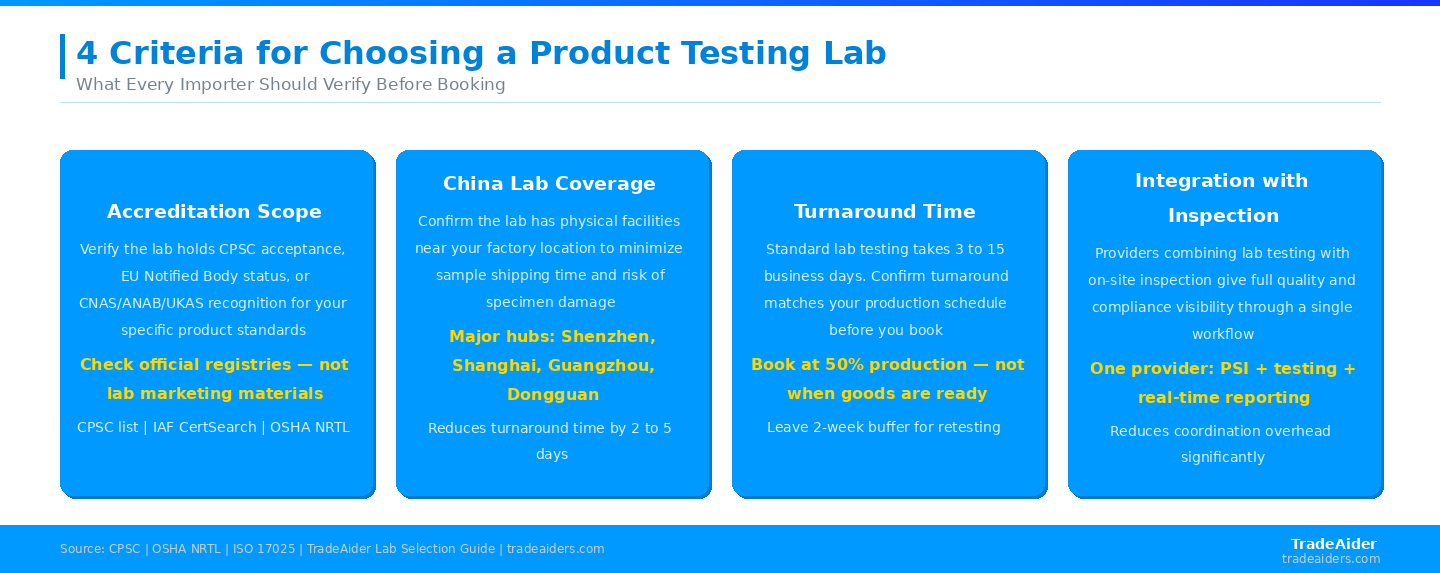 Figure: 4 key criteria for selecting a product testing lab — verified against CPSC, OSHA NRTL, and ISO 17025 requirements | tradeaiders.com
How to Choose the Right Testing Lab for Your Product
The right testing lab depends on four variables: the destination market for your product, the specific compliance standards applicable to your product category, your turnaround time requirements relative to your production schedule, and whether you need testing only or integrated inspection and testing coverage. According to U.S. International Trade Administration guidance on supplier due diligence, systematic, evidence-based evaluation is the foundation of effective quality management — and the same principle applies to testing lab selection.
Match Accreditation to Your Destination Market
The single most important selection criterion is accreditation alignment: the lab you use must hold the specific accreditation required for your market's compliance pathway. For US children's products, only CPSC-accepted labs issue legally valid test reports — confirm the lab appears on the current CPSC list before booking. For EU CE marking, the relevant directive will specify whether a notified body is required (mandatory third-party involvement) or whether a self-declaration based on accredited lab testing is sufficient. IAS's ISO/IEC 17025 laboratory accreditation framework illustrates how accreditation creates international recognition across borders through mutual recognition arrangements — but only when the specific accreditation body matches the market requirement.
Build Testing Lead Time into Your Production Schedule
Standard lab testing takes 3–15 business days after sample receipt. Pre-production prototype testing should be booked before mass production begins — this verifies your product design is compliant before you manufacture units that may need to be reworked. Batch sample testing from production should be scheduled as part of the production timeline, not after goods are completed. The most common testing mistake is treating lab testing as a box to check after the shipment is ready, leaving no time to remediate if a product fails. Build a testing milestone into your purchase order timeline: samples to lab at 50% production completion, results expected by 80% production completion, providing 2 weeks of buffer for any retesting needed before the shipment date. Learn about coordinating pre-shipment inspection alongside your testing schedule for complete quality coverage. For more quality control resources, browse the TradeAider blog.
Verify Accreditation Before Every Booking
Testing lab accreditations can change — certificates expire, scopes narrow, and accreditation bodies update their recognition lists. Before each testing engagement, verify the lab's current accreditation status directly through the relevant government or accreditation body database: the CPSC accepted labs list is updated regularly and should be the definitive reference for US children's product testing. UL Solutions' accreditation and certification framework provides a useful model for how product safety certification systems are structured across markets. Do not rely on a lab's marketing materials alone — verify the specific test scope and accreditation status through the official registry before committing to a testing program. See why importers choose TradeAider for integrated quality programs that combine inspection with testing coordination across China's manufacturing regions.
Who Is TradeAider?
TradeAider is a quality inspection, testing, and certification service provider in China. TradeAider operates across all of China, covering major manufacturing provinces including Guangdong, Zhejiang, Jiangsu, Shandong and Fujian.
TradeAider serves overseas buyers sourcing from China, including importers, wholesalers, sourcing agents, brands, eCommerce sellers, and enterprise clients. Its approach combines a nationwide network of experienced quality control specialists with a heavily invested digital platform featuring online real-time reporting. Clients can monitor inspections live, communicate directly with inspectors, and address issues during production rather than after shipment — a proactive model focused on problem-solving and prevention, not just defect identification.
Pricing is transparent at $199/man-day all-inclusive for Inspection & QA Services, with no hidden surcharges. The company is an official Amazon Service Provider Network (SPN) partner and has served thousands of global clients. Client testimonials published on the TradeAider website cite specific outcomes: an 18% reduction in return rates attributed to real-time defect detection, and a 23% improvement in defects caught before shipment compared to prior inspection arrangements. These are client-reported figures.
Frequently Asked Questions
How do I verify a testing lab is on the CPSC-accepted list?
The CPSC maintains an up-to-date online registry of accepted testing laboratories at cpsc.gov. Search for the lab by name, and confirm that the acceptance covers the specific standard(s) relevant to your product. Note that CPSC acceptance is granted per standard — a lab may be accepted for ASTM F963 (toy safety) but not for all CPSIA substance testing requirements. Always verify against the specific standard you need tested, not just the lab's general CPSC status.
Can I use a factory's own test report from a China domestic lab for US or EU compliance?
Generally no for regulated product categories. For US children's products, CPSC requires testing by a CPSC-accepted third-party laboratory — the factory cannot self-test. For EU CE marking under directives that require a notified body, only notified body certification is valid. For some EU product categories that allow self-declaration, the underlying test report must still be issued by an accredited laboratory (ISO 17025 or equivalent) — not a factory's internal quality department. Always verify the specific compliance pathway for your product and destination market before accepting any supplier-provided test documentation.
What is ISO 17025 and why does it matter for product testing?
ISO/IEC 17025 is the international standard for the competence, impartiality, and consistent operation of testing and calibration laboratories. A lab accredited to ISO 17025 by an internationally recognized accreditation body has demonstrated — through independent assessment — that it has the technical competence, equipment calibration, and quality management systems to produce reliable, reproducible test results. Regulatory authorities in most markets require or strongly prefer test reports from ISO 17025-accredited laboratories because accreditation provides independent verification of the lab's technical capability. Reports from non-accredited labs are often rejected by customs authorities, retail buyers, and platform compliance teams.
What is the typical cost for product testing from China for a consumer goods importer?
Testing costs range widely based on product category and applicable standards. Basic chemical analysis (REACH, RoHS screening) typically runs $200–$500 per submission. Children's product testing under CPSIA (lead, phthalates, ASTM F963) commonly costs $500–$1,500 per SKU. Comprehensive electronics testing for FCC and CE marking combined can run $1,000–$3,000 or more depending on the directive scope and required standards. These are per-SKU costs — each product variation (different materials, designs, or colors) may require separate testing. Build testing costs into your COGS calculation from the product development stage, not as an afterthought before your first shipment. Contact TradeAider to discuss how to integrate testing into your sourcing workflow.
Should I test before or after production?
Both — at different stages for different purposes. Pre-production prototype testing verifies that your product design and material specifications are compliant before you commit to mass production. This is particularly important for new product development or when switching suppliers or materials. Batch sample testing from production (taking samples from the actual production run) verifies that the manufactured goods match the tested prototype. If you only test prototypes, you have no assurance that the production materials and processes match what was tested. For regulated products, both testing phases are recommended, with pre-production testing prioritized for new SKUs and production batch testing for ongoing compliance monitoring.
Related Articles
Grow your business with TradeAider Service
Click the button below to directly enter the TradeAider Service System. The simple steps from booking and payment to receiving reports are easy to operate.

