
- About Us

- Our Services
- Your Industry
- Resources
- News & Blog
A single approved piece and a clean marketing photo are not evidence that a blanket order is ready to ship. Blanket and throw quality control means checking six things before an order ships: size and dimensions, weight, shade and color, surface condition, fiber and care labels, and packing. Size, weight and shade only mean something when the finished unit is measured against the buyer's specification and the sealed sample. The acceptance decision is not whether the blanket looks right, but which record is still open.
Decisions to Set Before Blanket Inspection
- Measure the agreed points on the finished blanket and state whether the tolerance applies to cut size or finished size.
- State the weight basis and judge shade against the sealed sample under controlled light, grouped by dye lot.
- Keep surface, label and packing evidence with their own owners instead of treating a clean factory visit as proof of all three.
What a Blanket and Throw Quality Control Plan Must Cover
A blanket and throw quality control plan covers six check families: size and dimensions, weight and GSM, shade and color, surface pilling and shedding, fiber and care labels, and packing. Each family answers a different complaint and produces a different record. Treating the six as one look-and-fold check hides which result the buyer holds when a customer reports a short blanket, a drifted shade or a shedding surface.
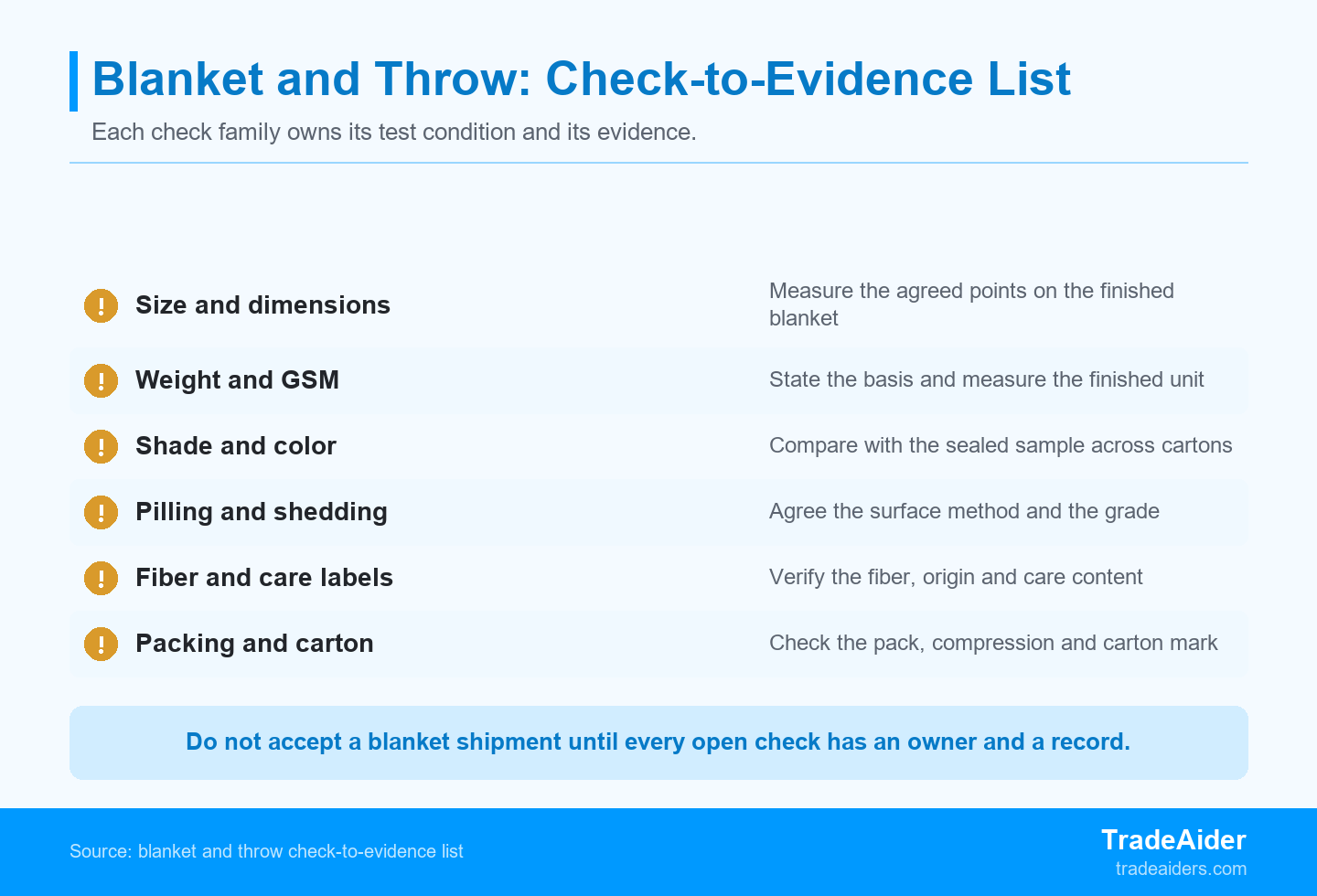
Each blanket and throw check family produces its own evidence, from a finished-size measurement to a fiber content label.
A blanket or throw is a regulated textile product rather than an unregulated soft good. In the United States, the Textile Fiber Products Identification Act rules require a label listing the fiber content, the country of origin and the identity of the responsible business, and bedding including blankets, afghans and throws is named as covered. In the EU, Regulation (EU) No 1007/2011 requires the fiber composition. That is why the plan treats labels as a separate evidence family rather than a workmanship detail. Before sharing the specification and a sealed sample, it is reasonable to review TradeAider's company background.
| Check family | Test condition | Evidence owner |
|---|---|---|
| Size and dimensions | The agreed points on the finished unit against the buyer's tolerance. | Factory measurement record |
| Weight and GSM | The stated weight basis measured on the finished unit. | Factory measurement record |
| Shade and color | The finished unit against the sealed sample under controlled light, by dye lot. | Factory comparison record |
| Pilling and shedding | The agreed surface method and acceptance grade. | Laboratory test report |
| Fiber and care labels | Fiber content, origin, dealer identity and the care instruction. | Buyer file and factory label record |
| Packing and carton | Retail pack, compression, barcode and carton mark against the specification. | Factory packing record |
Read the table as a division of labor. The factory can measure size and weight and record the shade comparison, while the surface grade, the fiber analysis and the label file are answered by a laboratory or the buyer's own documents. The buyer then tracks which family still has an open record.
Fix the Specification and Sealed Sample Before Inspection
A blanket check only means something when the buyer has fixed the model and construction, the fiber composition, the measurement points and tolerances, the weight basis, the sealed shade sample and the destination markets. The sealed sample is part of the test condition, not a courtesy the factory can substitute. When the buyer leaves these open, two facilities can each report a pass while testing different products.
Put the inputs in writing before the visit: the model and construction, the fiber composition, the measurement points and the tolerance for each, the weight basis, the sealed shade sample reference, whether the tolerance governs cut size or finished size, and the destination markets. A factory that receives only a photo and a target price will check whatever piece is on the line.
The Blanket Inspection Record: What to Write Down
A blanket inspection record should log the unit and carton identifier, the measured size points, the measured weight and its basis, the shade reference and dye lot, the surface result and the label and packing observations for each sampled unit. Log each reading against the specified value rather than writing a single OK for the unit. The record is what lets a reviewer see a trend instead of an opinion.
Record the model and the sealed-sample reference at the top, then, per unit, capture the carton number, the measured size points, the weight and its basis, the shade comparison and dye lot, the surface observation, and the label and packing result. Keep the raw readings with the report, and agree the defect categories and the sample size before the visit using the AQL calculator.
Size and Dimensions: Cut Size Versus Finished Size
Size is checked by measuring the agreed points on the finished blanket and comparing them with the buyer's tolerance, and the specification must say whether the tolerance applies to cut size or to the finished size after washing and finishing. A blanket relaxes, shrinks or stretches through those processes, so a cut-size number and a finished-size number describe different products.
Define where the tape runs, such as full length on the centerline and width at the widest point, and measure the same points on every sampled unit. Then decide which size the tolerance governs: a cut-size number is set before washing and finishing, while a finished-size number is what the customer measures at home, and a finishing allowance in the low single-digit percent can move a finished length outside a tight cut tolerance. Where the buyer cares about shrinkage, add a wash-and-measure step. Sample across cartons rather than one folded piece, because a repeated short measurement in one carton is a finding the buyer can act on before the goods ship.
Weight and GSM: What the Buyer's Number Really Measures
Weight is checked against the basis the buyer actually specified. The fabric mass per unit area and the finished piece weight are different numbers, so a factory can pass one while missing the other. State which basis the tolerance applies to, then measure it on the finished unit.
GSM means grams per square meter, the mass per unit area of a fabric. It describes the fabric a blanket is made from, not the weight of the finished blanket, which also depends on the size, the binding and the moisture. A GSM figure and a finished piece weight can therefore move in opposite directions on the same order.
A measured size or weight needs a stated tolerance and a calibrated instrument before anyone can call it right or wrong. NIST Handbook 44 publishes specifications, tolerances and other technical requirements for weighing and measuring devices, including fabric-measuring devices. That framework governs commercial devices rather than blankets, but the principle transfers: state the tolerance and the method, and note the instrument, before you judge a measurement.
State the basis, and both where both matter. Ask for the method and the sample area used, because a GSM taken from a small swatch and one taken from the finished blanket are not the same measurement. Weigh on a calibrated balance, record whether the sample was conditioned or weighed as received, and note the units. If the factory reports only piece weight, ask for the conversion it used instead of accepting the number printed on the pack.
Shade and Color: Judge the Piece, Not the Screen
Shade is judged by comparing the finished blanket with the sealed sample under controlled lighting and by grouping units by apparent dye lot. A screen, a marketing photo or a single unit is not a reliable color reference. Dye lots and viewing light each shift the perceived color, so the check has to fix the reference and the light before it can call a shade acceptable.
Fix the reference and the light before the comparison. The sealed sample is the reference, while a screen, a printed catalogue and a phone photo each render color differently. Compare the finished blanket with the sealed sample under a controlled daylight-equivalent light, and put units from different cartons side by side rather than checking each on its own. A light booth keeps the comparison repeatable; ordinary factory lighting is often warm-toned and hides the difference.
Group by dye lot and cross-check across cartons. Where the factory dyes in several lots, ask for the lots to be tagged and recorded, then compare units from each lot with the sealed sample, because a unit that looks acceptable alone can look wrong beside a second lot. Keep the tolerance with the buyer: the specification should name the reference and, where the buyer uses one, an acceptable color-difference limit. Confirm the readiness condition and the sample drawn across cartons when arranging the pre-shipment inspection service.
Pilling, Fuzzing and Shedding on the Surface
Pilling, fuzzing and shedding are surface results that depend on the fiber, the yarn, the finish and the test method, so the buyer should agree the method and the acceptance grade rather than judge by feel alone. A surface that feels smooth on a new sample can pill or shed after the abrasion and washing a customer applies, so the check often needs a laboratory test as well as a visual one.
Agree the method, not just the look. Pilling is the formation of small fiber balls on a fabric surface from rubbing, and shedding is the loss of loose fiber from that surface. Screen the surface on site, where the inspector can rub it, look for early pilling and loose fiber, and note the appearance after a wash, then grade it in the laboratory against the agreed abrasion or tumble method. Where the buyer sells on a no-pill or low-shed claim, that claim should rest on the method and the grade, and the approved sample should be the same construction and finish that will ship.
Fiber Content, Country of Origin and Care Labels
In the United States, the Textile Fiber Products Identification Act rules require a blanket or throw to carry a fiber content label, the country of origin and the identity of the responsible business, and bedding including blankets and afghans and throws is named as covered. The fiber names and percentages are listed in descending order of predominance, and fibers below five percent are disclosed as other fiber rather than by name.
The fiber label is a legal disclosure, while the care instruction follows the destination rule and the buyer's specification. Under EU Regulation (EU) No 1007/2011 the fiber composition is required for textile products on the EU market. In the United States, the care labeling rule covers textile wearing apparel and certain piece goods, and the approved care-symbol system follows the FTC's own care-symbol guidance rather than the ISO symbols used in Europe. A home textile such as a blanket is not covered by the same US care label mandate, so the buyer should still require a care instruction that names the washing and drying the finished product tolerates.
Check the label against the product, not just for its presence: compare the fiber content and percentages with the actual composition and the approved artwork, verify the country of origin and the responsible-business identity, and check placement, spelling and durability. Keep the fiber label and the care instruction as separate line items.
Packing, Compression and Carton Protection
Packing is checked as a quality attribute. The retail pack, the compression or roll, the barcode and the carton mark must match the buyer's specification so the blanket arrives in saleable condition. Vacuum compression and carton compression change the product a customer receives, so a packing defect can erase a correct size and shade result.
Check the pack the customer receives, not only the carton. Confirm the retail pack or roll, the insert or band, the barcode and the carton quantity against the specification, and check that the compression or vacuum pack follows the agreed method and recovers to the intended loft. Count the carton quantity, verify the shipping mark, and photograph any compression, creasing or moisture damage.
Turning the Checks Into a Pre-Shipment Inspection
The checks become an inspection when a sample is selected by an acceptance sampling plan, each unit is measured and compared with the sealed sample, and every observation is recorded against the buyer's specification. Individual checks answer a single question; a sampled, recorded plan answers the shipment question. Agree the sample size, the measurement points and the defect categories before the visit, so a finding has a defined consequence.
Sampling plans and defect classes set the frame. TradeAider's inspection-standard guidance follows ISO 2859-1 (ANSI/ASQC Z1.4-2003), the acceptance quality limit (AQL) method, and classifies defects as critical, major and minor. The buyer still owns the product-specific acceptance criteria, including the size tolerance and the shade and surface rules, and should not treat the sampling plan as a product limit.
TradeAider schedules pre-shipment inspection (PSI) when the order quantity is 100% complete and at least 80% packed for export. The packing threshold does not mean production is partly complete. For a blanket, that readiness matters because the shade, surface and label checks need finished, packed units from several cartons, so an inspection planned before packing is complete will only produce a partial record.
Match the method to the check: workmanship and the measurement checks use the sampled units, while a surface grade or a fiber analysis needs its own sample and laboratory scope. Report uncompleted checks as coverage gaps so the buyer can decide whether to hold the shipment, run more checks or accept the remaining risk.
Illustrative Example: A Shade and Size Mismatch Caught Before Shipment
In an illustrative order of 8000 fleece blankets for the US and EU markets, the buyer approves a sealed shade sample, a length and width tolerance on the finished unit and a fabric GSM before production. The lot runs in several dye lots and is cut, sewn and washed before packing, and the buyer agrees to measure a sample across cartons against the sealed sample. The first-piece sample and the marketing photos look correct, so the buyer assumes the lot is consistent. Units from the first cartons measure within tolerance and match the sealed sample, but units from 2 later cartons group into a visibly warmer shade than the sealed sample under controlled light, and their finished lengths measure below the stated tolerance after washing even though the cut-size record was within tolerance.
A single approved piece and a marketing photo hid both the shade drift and the finished-size shortfall, because the shade shifted with the dye lot and the size shifted with washing and finishing. Hold disposition on the sampled cartons, ask the factory for the dye-lot grouping and the finishing and cutting records, and do not extrapolate a lot failure rate from the sample.
The factory regroups the affected dye lots and corrects the cutting allowance so the finished size meets tolerance, then rebuilds and re-labels the affected cartons. The buyer approves the corrective action, and the corrected cartons are measured again against the sealed sample with fresh readings. Confirm the finished size and the shade before any release; resealing and showing one acceptable piece would not complete that verification.
This is an illustrative sampled exercise, not an AQL sample size, a measured defect rate or proof that all 8000 units fail. The release decision also depends on the surface and label evidence, which this scenario does not test. The record shows a trend in the sampled cartons; it does not describe the whole order.
What to Send for a Scoped Blanket Inspection Plan
Send the blanket model and construction, the fiber composition, the measurement points and tolerances, the weight basis, the sealed shade sample and the destination documents so the checks, the record and the evidence owners can be agreed before production ends. Include the label files, the packing method, the number of units to sample and any open surface, colorfastness or fiber-analysis questions.
Ask TradeAider to confirm which observations can be completed during the factory visit and which need a laboratory or a different arrangement. Agree a report that links each sampled unit to its size readings, the shade comparison and photographs, with uncompleted checks and document mismatches identified. Send the specification and the open questions for scope confirmation: Contact TradeAider to plan your blanket and throw inspection.
Frequently Asked Questions
What size tolerance should a blanket or throw meet?
There is no single legal blanket size tolerance, so the buyer's specification sets the acceptable deviation and the check measures the agreed points against it. State whether the tolerance applies to cut size or to the finished size after washing, and name the measurement points and the instrument. If the buyer has not set a tolerance, agree one before the visit.
How do I check shade on a blanket order?
Compare finished units with the sealed sample under controlled daylight-equivalent lighting, group them by apparent dye lot and cross-check units from different cartons rather than one piece. Screens and printed photos are not references because they render color differently. Record the comparison against the buyer's color-difference limit, if one exists.
Is a GSM number enough to confirm a blanket's weight?
No, because fabric GSM and finished piece weight are different measurements, so the specification must say which one is required and the check must use that basis. GSM describes the fabric, while finished piece weight also depends on the size, the binding and the moisture. If the buyer needs both, specify both and record the method and the units for each.
Do blankets and throws need a fiber content label?
Yes in the United States, where the Textile Fiber Products Identification Act rules cover bedding and afghans and throws, and in the EU, where Regulation (EU) No 1007/2011 requires the fiber composition. The US label also carries the country of origin and the responsible-business identity. Confirm the care instruction separately, because the US care labeling rule is scoped to wearing apparel rather than home textiles.
Related Articles

Grow your business with TradeAider Service
Click the button below to directly enter the TradeAider Service System. The simple steps from booking and payment to receiving reports are easy to operate.

