
- About Us

- Our Services
- Your Industry
- Resources
- News & Blog
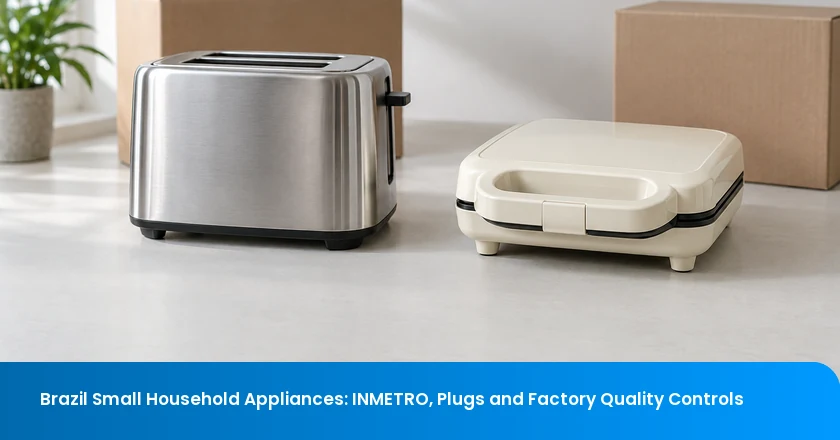
For small household appliances bound for Brazil, confirm the applicable certification route and then verify the exact voltage variant, plug, Portuguese information, and packed goods. Two appliances can share a housing and brand while requiring different electrical supplies. Even when both designs are certified, a packing mistake can send the wrong version to a customer. Factory quality controls should therefore preserve model and voltage identity from the approved specification through the final carton allocation.
Release the Correct Appliance Variant, Not Just a Certified Name
Product certification does not by itself establish that the right voltage variant is inside each shipping carton.
- Determine the regulation for the exact appliance and intended use.
- Verify certification through the appropriate body and official records.
- Separate single-voltage versions from genuine dual-voltage designs.
- Check plug configuration, Portuguese information, and actual pack contents.
- Keep variant identity intact when goods are sorted, repacked, or allocated.
The regulatory references were checked in September 2026. Confirm product-specific applicability with the Brazilian importer and the responsible certification body before locking the production specification. The factory checks below help a buyer evaluate the shipment; they do not replace the applicable conformity assessment.
Identify the Applicable INMETRO Regulation
INMETRO is Brazil’s National Institute of Metrology, Quality and Technology. Its household-appliance rules should be applied to the described product, rather than to a broad marketing term such as “kitchen electronics.”
INMETRO identifies the appliances within Portaria 148/2022 in Table 1 of its Annex III.
Use the intended household or commercial function, construction, capacity, and electrical characteristics to resolve the classification. Give the certification body the real technical description and the variants you intend to order. A supplier’s statement that another customer previously imported a similar-looking product does not establish the route for this design.
Product exceptions matter. INMETRO’s current fan guidance distinguishes household table, wall, and pedestal fans under Portaria 299/2021, residential ceiling fans under Portaria 465/2021, and other fans under Portaria 148/2022. The ceiling-fan route uses a supplier declaration, while the other described routes use certification. A general appliance checklist should not erase that distinction.
Record the applicable rule and the product description behind the decision. Keep any exclusions or additional requirements visible beside the model schedule. If the factory later changes the intended use or adds a materially different variant, ask the responsible party to revisit applicability before treating the old answer as sufficient.
Work with an Accredited Brazilian Certification Body
INMETRO directs applicants under Portaria 148/2022 to a product certification body accredited by INMETRO and established in Brazil.
This body is commonly called an OCP, from the Portuguese term for a product certification body. Check that its accreditation scope covers the relevant appliance work, then agree the application and assessment requirements with it. The authority of a certifier and the availability of a commercial factory inspector are separate matters; one appointment should not be allowed to stand in for the other.
Request the certificate and its model coverage, together with the accepted references needed to identify the ordered configurations. Resolve differences in manufacturer, factory, model designation, or electrical version with the applicant and OCP. Keep their answer with the purchase file so the factory does not have to interpret a vague statement that “the series is covered.”
For physical quality checks, assess the inspection provider’s relevant service scope and reporting approach. The buyer needs observations tied to goods and specifications, while certification decisions remain with the appropriate parties. Provider background is available in TradeAider’s company profile.
Check Certification Without Inventing a Registration Requirement
INMETRO states that Portaria 148/2022 does not require product registration.
Do not make a separate INMETRO object-registration number a universal release condition for appliances under this rule. That would confuse two different administrative concepts. Equally, the absence of that registration requirement does not remove certification or any other applicable import obligation. Where another product-specific rule applies, check its own provisions instead of extending this answer to every electrical product.
For certification checks, INMETRO directs buyers to Prodcert, its certified products and services system. Follow the official lookup guidance and compare the result with the certificate and ordered model. Check the issuer, scope, and current standing with the responsible parties when a record is incomplete or unclear. A familiar manufacturer name alone does not connect the record to a particular voltage version.
Keep the verification date and the exact documents reviewed. Do not infer that an unavailable search result proves noncompliance, or that a historical record proves current acceptance. Ask the applicant or OCP to resolve the specific gap and preserve the response. This leaves a usable decision record rather than a folder of screenshots with uncertain relevance.
Separate Single-Voltage and Dual-Voltage Models
A matching plug shape does not establish an appliance’s voltage capability.
Mechanical connection and electrical rating answer different questions. Separate a model sold in a 127 V version and a 220 V version from a single appliance designed for dual-voltage operation. The term bivolt means dual voltage; confirm the documented operating range and whether the design requires user selection. Do not translate a supplier’s “available in both voltages” into a claim that every unit operates at both.
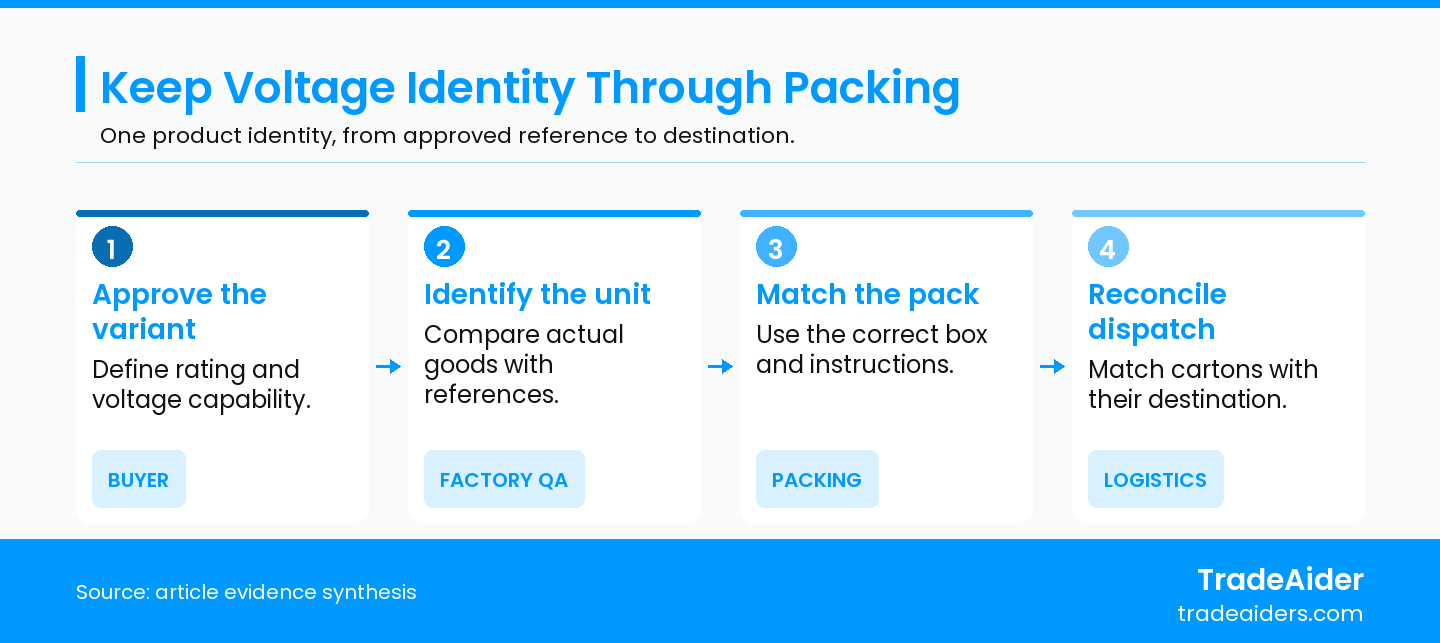
Carry the exact voltage variant through each packing and dispatch handoff.
Build the purchase schedule around the exact variant. Record the factory model, buyer model, rated voltage or range, frequency, power or current, plug specification, and approved instruction revision. Include any required selector position and its handling instructions. The technical owner should settle those details before inspection staff are asked to judge the finished goods.
| Ordered configuration | Evidence to compare | Packing distinction | Unacceptable inference |
|---|---|---|---|
| Single-voltage 127 V | Accepted specification and actual unit rating | Dedicated variant and box identity | Same housing means dual voltage |
| Single-voltage 220 V | Accepted specification and actual unit rating | Separate allocation from the 127 V version | A matching plug makes the variants interchangeable |
| Dual-voltage design | Documented range and selection method | Correct operating instructions and designation | The word bivolt proves automatic switching |
| Unclear designation | Resolved model and technical references | Hold allocation until identity is established | Use a new sticker to conceal uncertainty |
TradeAider’s inspection-standard resource can help organize the inspection categories. Supply the approved variant details alongside it: a generic functional check cannot settle an unresolved rating. Electrical verification should use an agreed safe method, appropriate equipment, and competent personnel; do not connect an unidentified unit to a different supply simply to see whether it works.
Carry the same identity into the retail pack and carton record. A barcode is useful only if its underlying model mapping is correct. If both voltage versions share an order-level code, add the controlled variant reference needed to distinguish them. Do not rely on carton color or product appearance as the sole allocation control.
Check Plug Class and Current Rating Separately
INMETRO explains that the choice of two or three plug pins depends on insulation class, not current rating.
The same official guidance distinguishes 10 A and 20 A plug ratings. Check the pin configuration and the current rating as separate fields against the accepted product specification. The fact that a plug has three pins does not tell the buyer that every other requirement is satisfied, and a two-pin plug is not automatically a defect.
Ask the technical owner to identify the appropriate insulation class and plug-and-cord assembly for the certified construction. Inspect visible markings, configuration, condition, and the connection to the appliance against that reference. Do not authorize removal of an earth pin, substitution of a convenient cord, or another physical alteration merely to make a product fit a particular socket.
Keep the plug check distinct from voltage identification. A socket fit observation cannot establish that the motor, heating element, or electronics correspond to the ordered rating. If the unit label and approved file conflict, record the discrepancy and stop the affected allocation until a competent technical review establishes the true configuration.
A replacement cord or plug also needs controlled review. Record the part identity and the reason for the proposed change, then obtain the appropriate technical disposition. A buyer’s commercial approval of a lower-cost component is not evidence that the revised assembly remains within its accepted product scope.
Approve Portuguese Information and the Physical Pack
INMETRO states that household appliances must provide technical information and instructions in Portuguese.
Have the responsible technical and language reviewers approve the information for the actual appliance. A Portuguese translation can still describe the wrong controls, accessory set, voltage-selection method, or maintenance procedure. Give each approved file a revision identity and connect it to the correct model, so the packing team can distinguish a valid master from an obsolete translation.
A digital link alone is insufficient under INMETRO’s published manual guidance: the manual must be printed and accompany the product or be printed on its packaging. Check the actual delivered format. A working QR code can provide supplementary material, but should not be treated as proof that the required printed information is present.
Compare the unit label, retail box, printed instructions, and order description together. If the box says dual voltage but the unit is a single-voltage version, the inconsistency changes what the customer may reasonably do with the appliance. Resolve the actual design and approved wording before choosing a correction; changing a rating sticker is not a legitimate way to turn one electrical design into another.
Retain photographs that connect the opened retail pack to the inspected unit and its carton origin. Record the visible model, rating, manual revision, and box designation in the same evidence set. If packaging is later replaced, link the corrected artwork and allocation to that change rather than leaving the original photographs as the only record of what will ship.
Inspect the Finished Order by Voltage Variant
TradeAider describes its pre-shipment inspection service readiness as 100% of the order complete and at least 80% packed for export.
Agree access to each ordered variant and identify any packing work that will occur after the visit. An order containing several voltage versions needs an inspection scope that makes those versions visible. If one variant is absent, report the limitation; observations on another version should not silently become evidence for goods that were unavailable.
Plan checks for workmanship, dimensions, functional operation, accessories, labels, and packaging against the approved purchase requirements. Electrical tests need a defined method, competent personnel, suitable equipment, and agreed acceptance criteria. Document unavailable tests and unresolved findings. A short functional demonstration cannot establish all safety properties or replace the OCP’s assessment.
Record inspected-unit identity and carton origin, particularly where the variants look alike. Compare the observed rating with the pack designation and the intended allocation before closing the carton. This catches an error that a general overview photo or an order-level quantity count may miss.
Define who can authorize correction and release. The factory must identify and correct the affected goods; the inspector records and verifies within the agreed scope; the buyer evaluates commercial disposition while the appropriate body resolves certification questions. Keep any held cartons physically identifiable so a schedule change does not accidentally return them to the loading set.
Illustrative Example: Two Certified Variants in a Mixed Pallet
In this illustrative example, a Brazilian importer orders 720 toasters: 360 rated 127 V and 360 rated 220 V, allocated separately for distribution. Both variants have accepted certification references and are packed for dispatch. A 60-unit pallet is reopened at a packing station. Inspection then finds cartons on that pallet whose contents do not match the voltage shown on their boxes. Station records and independent reconciliation identify the affected pallet and separately confirm the remaining cartons.
In this illustrative example, the buyer holds the traceable mixed pallet and considers the separately verified cartons for release.
The defect concerns allocation, even though the two designs are certified. Correcting box contents requires establishing each unit’s true identity first. The verified records support a limited hold in this example; the pallet boundary is not assumed merely because that is where the first mismatch was found.
The factory sorts the identified pallet by actual unit identity, places each toaster into its correct approved pack, and rebuilds the destination allocation. It does not change the unit’s voltage label to agree with whichever box is available. If a unit’s construction or rating cannot be established, that unit remains unresolved for the technical owner.
Before the corrected pallet joins dispatch, recheck unit-to-box identity, quantities, and distribution records. If reconciliation shows mixing beyond the original pallet, expand the hold. The AQL calculator supports acceptance quality limit (AQL) sampling parameters for a defined lot; a passing sample alone cannot prove the boundary of a mixing event. This example gives no measured defect rate or universal sample size.
Reconcile Corrected Cartons with Their Destination
INMETRO says conformity identification must appear on the appliance and its packaging for products covered by Portaria 148/2022.
Use the accepted marking references when checking corrected packs. Repacking can resolve a variant mismatch while introducing an artwork error, missing identification, or an obsolete instruction sheet. Verify the resulting retail pack as a whole instead of checking only the item that originally failed.
Reconcile the final model quantities and carton identities with the invoice, packing list, and destination allocation. Where some goods remain held, make that exclusion explicit in loading instructions. A replacement carton should be connected to the accepted contents before it enters the released set; matching the overall order count is not enough when the voltage split has changed.
Keep the technical references, certification verification, inspection findings, corrective records, and final allocation together. The release owner should be able to identify which units and cartons a decision covers and what remains outstanding. Certification status, physical quality, and destination accuracy each need a resolved answer; one successful check cannot close an unrelated open item.
Brief TradeAider on the Actual Variant Risks
An inspection brief should identify the ordered voltage variants, approved references, and unresolved packing questions.
Send the model schedule, voltage and plug specifications, accepted label and Portuguese manual files, retail-box artwork, order quantities, and packing status. Include repacking history, earlier discrepancies, and any carton group already under control. State the comparisons the inspector should make and identify electrical or certification questions that still need the responsible technical party’s answer.
TradeAider can use that briefing to confirm the visit’s scope, timing, and feasible factory checks. Request findings and photographs connected to the inspected variants and cartons, with any access limitations stated clearly. That gives the buyer evidence for a specific correction or shipment decision while preserving the role of the Brazilian certification process.
Contact our team to arrange the inspection.
Frequently Asked Questions
Does a foreign certificate replace Brazilian certification?
Do not treat a foreign certificate as a substitute for the required Brazilian product certification. Give the existing reports and certificate to the responsible OCP so it can determine their relevance to the applicable assessment. The useful question is what evidence and work remain for the exact Brazilian model, rather than whether a familiar overseas mark appears on the supplier’s brochure or carton.
Can a gift set use the certificate for only one appliance?
Do not assume that one appliance’s certificate covers every powered item in a gift set. List each included appliance and ask the OCP to confirm the relevant scope and presentation requirements. Distinguish those items from non-powered accessories rather than demanding identical documentation for everything in the box. The retail bundle should preserve each appliance’s model identity, voltage information, and applicable instructions.
What if inspected goods remain in storage before dispatch?
Review what changed during storage before relying on the original findings. Check for water exposure, damaged cartons, opened packs, substitutions, or handling that could affect the inspected condition. Confirm that the goods remain identifiable as the original inspected lot. Agree additional checks for the actual changes and exposure; an unchanged model number does not show that the goods stayed in the same physical condition.
Must every small appliance carry an energy-efficiency label?
Do not apply an energy-efficiency label requirement to every small appliance without checking its product-specific regulation. A safety certificate and an energy-efficiency designation address different requirements. For a product covered by an efficiency program, have the applicant confirm the applicable evidence and artwork for the ordered variant. Do not copy an efficiency label from a similar-looking model, or assume another product’s exemption applies.
Related Articles

Grow your business with TradeAider Service
Click the button below to directly enter the TradeAider Service System. The simple steps from booking and payment to receiving reports are easy to operate.

