
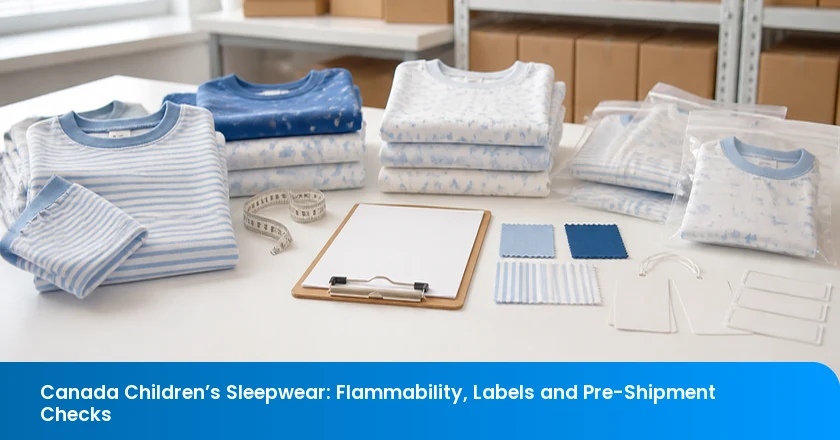
For Canada children’s sleepwear, flammability evidence becomes useful only when it identifies the actual garment, the current label revision, and the cartons being released. A supplier PDF can look complete while still describing an earlier fabric, a different fit, or an untraceable production period. The practical pre-shipment question is therefore not “Do we have a report?” but “Which finished goods can this evidence honestly support?”
Classify the Garment Before You Order Evidence
- Classify the actual sleepwear style before accepting a test route.
- Match the evidence to the current fabric, construction, and wearable elements.
- Lock the approved label and fibre statement to that same build.
- Release only cartons that factory records can identify.
For Canada, a garment in the regulator’s 0 through 14X size range that is made, imported, advertised, or sold for sleeping or related activities can be within the Children’s Sleepwear Regulations, and a label saying otherwise does not by itself settle the classification. Health Canada’s current guidance also notes that a garment resembling sleepwear can remain in scope despite its label. That makes design, presentation, and intended use part of the evidence file, not just merchandising decisions.
The release file should classify each garment or wearable component before testing is ordered because Health Canada applies different flammability requirements to tight-fitting and loose-fitting sleepwear. The regulator’s classification guidance makes the product distinction the starting point. This is a buyer-side control rule, not a laboratory conclusion: it prevents a report from being treated as universal before the product category is settled. TradeAider can compare the agreed visible style details with the buyer’s evidence packet, but it does not issue a laboratory conclusion or regulatory approval.
Why Style Changes the Evidence Path
A buyer should document the intended use, garment style, fit, size label, and any wearable component before accepting a flammability route, because those attributes determine whether the finished item is being evaluated under the right Canadian sleepwear pathway. Health Canada’s route distinction is why those physical facts need to be recorded before a report is accepted. Put them on the approved style sheet and require the supplier to flag any change in fabric, cuffs, attached layers, closures, or the way a set is sold. Photograph the approved sample beside its label and record the style code, because an unlabeled sample image is difficult to reconcile with a bulk-carton record later. A material certificate without that product identity is background information, not a release record.
Build the Flammability File Around the Actual Style
Health Canada explains that tight-fitting sleepwear is less likely to contact an ignition source than loose-fitting sleepwear, while loose-fitting designs have more stringent flammability requirements. The distinction is operationally important: a wide nightgown, loose robe, or loose set cannot be cleared by calling it a pyjama set in the purchase order. Record the approved fit photos and measurements with the purchase-order style code so a revised pattern is not silently carried into the earlier evidence route.
For loose-fitting children’s sleepwear, the Regulations require an average char length for five specimens of no more than 178 mm and no more than one specimen with a full 254 mm char length when tested under the regulatory method. The Health Canada guideline is the right starting point for the applicable Canadian requirements; it also makes clear that testing is the reliable way to confirm compliance. Ask the laboratory to describe the tested construction and material scope, not merely the product family.
Do not use a claimed flame-retardant treatment as a shortcut. A treatment does not remove the flammability requirement, and treated loose-fitting sleepwear has additional product and care-labelling conditions. Where a treatment is claimed, the buyer should hold the treatment declaration, care wording, and applicable test evidence in the same controlled revision packet.
When the file is unclear, review product-testing evidence before production release to define the missing evidence rather than asking a final inspector to infer a laboratory result from the fabric’s appearance.
Do Not Use a Tight-Fit Assumption for a Loose Design
A buyer should keep a two-piece set, a wearable addition, or a changed component inside the same release file only after its actual style and evidence path have been checked against the Canadian sleepwear criteria. The Canadian fit pathways make that boundary material rather than cosmetic. A loose overshirt added to a close-fitting sleeper is not a harmless styling change. It can change the question the factory and laboratory must answer, so the approved sample photos, measurements, and construction notes should travel with the evidence request. If the supplier names a set by one SKU, also list each wearable part beneath that SKU; this gives the laboratory and inspector a common basis for referring to the same product.
Record Each Wearable Element Before You Combine the Evidence
When a set can be worn together or separately, the buyer should record which garment or wearable element each report and label statement covers before treating the set as one Canadian release decision. The regulator’s garment-specific criteria explain why a set name alone is not enough. This second check follows the fit decision: first confirm the route for each wearable item, then list the exact items covered by the report. That sequencing prevents an approved top from being used to imply coverage for an unreviewed bottom, robe, hood, or attachment. It also makes carton sampling more meaningful, because the inspector can compare the physical contents with a defined component list instead of a generic set description.
Treat Labels as Product-Control Evidence
Health Canada’s tight-fitting design pathways use numeric size labelling as one of the criteria; a non-numeric size alone is insufficient for the listed infant, polo-pyjama, sleeper, and hospital-sleepwear examples. The same Health Canada guidance explains those category-specific labelling criteria. Keep the approved size table with the label artwork and sample measurements; an unapproved size revision can change the classification evidence, not only the consumer presentation.
A Canadian consumer textile label needs fibre information and dealer information, and fibre names and fibre-related information are generally required in both English and French; fibres at 5% or more by total fibre mass must be declared by generic name and percentage. The Competition Bureau’s textile labelling summary provides the federal labelling baseline. This is why the label proof should be compared with the current bill of materials instead of copied from a sample-order worksheet.
The Textile Labelling Act prohibits false or misleading representations about a consumer textile article or textile fibre product, so the factory label, packaging copy, and approved fibre specification must match. The Act makes that a release-control issue, not a translation-polish issue.
| Control | What to compare | Hold trigger |
|---|---|---|
| Style file | Fit, garment type, wearable elements | Bulk design differs from approved scope |
| Textile label | Fibre statement, dealer information, bilingual fibre wording | Label and current bill of materials conflict |
| Classification label | Numeric size where the tight-fitting pathway requires it | Size statement no longer supports the approved path |
| Treatment claim | Claim, care wording, and relevant evidence revision | Claimed treatment is absent from the controlled file |
Based on this comparison, the label is not a final artwork check. It is a visible identifier that must remain consistent with the technical build that the evidence covers. Before bulk cutting, pre-production label and specification checks can turn that controlled packet into an agreed factory reference.
Lock the Label Revision to the Tested Build
A production label should be released only when its fibre statement, size information, treatment statement where applicable, and artwork revision match the exact build represented in the buyer’s current evidence packet. Canada’s textile-labelling baseline gives the label comparison a defined reference point. Use a revision code on the approved PDF, the factory’s trim card, and the inspection brief. Keep the obsolete artwork visibly withdrawn from the factory’s label station, because two similar revisions are difficult to distinguish from finished-goods photos alone. Before bulk cutting, turn that controlled packet into an agreed factory reference.
Add Accessible Trims, Prints, and Attachments to the Check
For Canadian children’s clothing and clothing accessories, each accessible part is subject to a 90 mg/kg total lead limit, which makes buttons, snaps, zipper pulls, prints, and other accessible attachments a separate evidence question from the base fabric. Health Canada’s lead guidance expressly includes sleepwear and attachments among the examples. Add these parts to the component map and compare them with the physical samples during production and final inspection.
The decision is not “test everything twice.” It is “do not let a base-fabric file hide a changed accessible part.” If a snap, print, zipper pull, or decorative attachment changes supplier, material, coating, or colour system, record the change and decide whether the existing evidence still describes that part.
Use Four Release Locks Before Finished-Goods Approval
A Canada-bound sleepwear release is defensible only when style classification, test scope, label revision, and carton identity all point to the same finished-goods population. Health Canada’s style-based requirements are the regulatory foundation for that first release lock. A release lock is one required connection between the approved product, evidence, label, and cartons. If any lock is broken, the right response is a defined hold and a request for the missing link, not a blanket pass or an unbounded rejection.
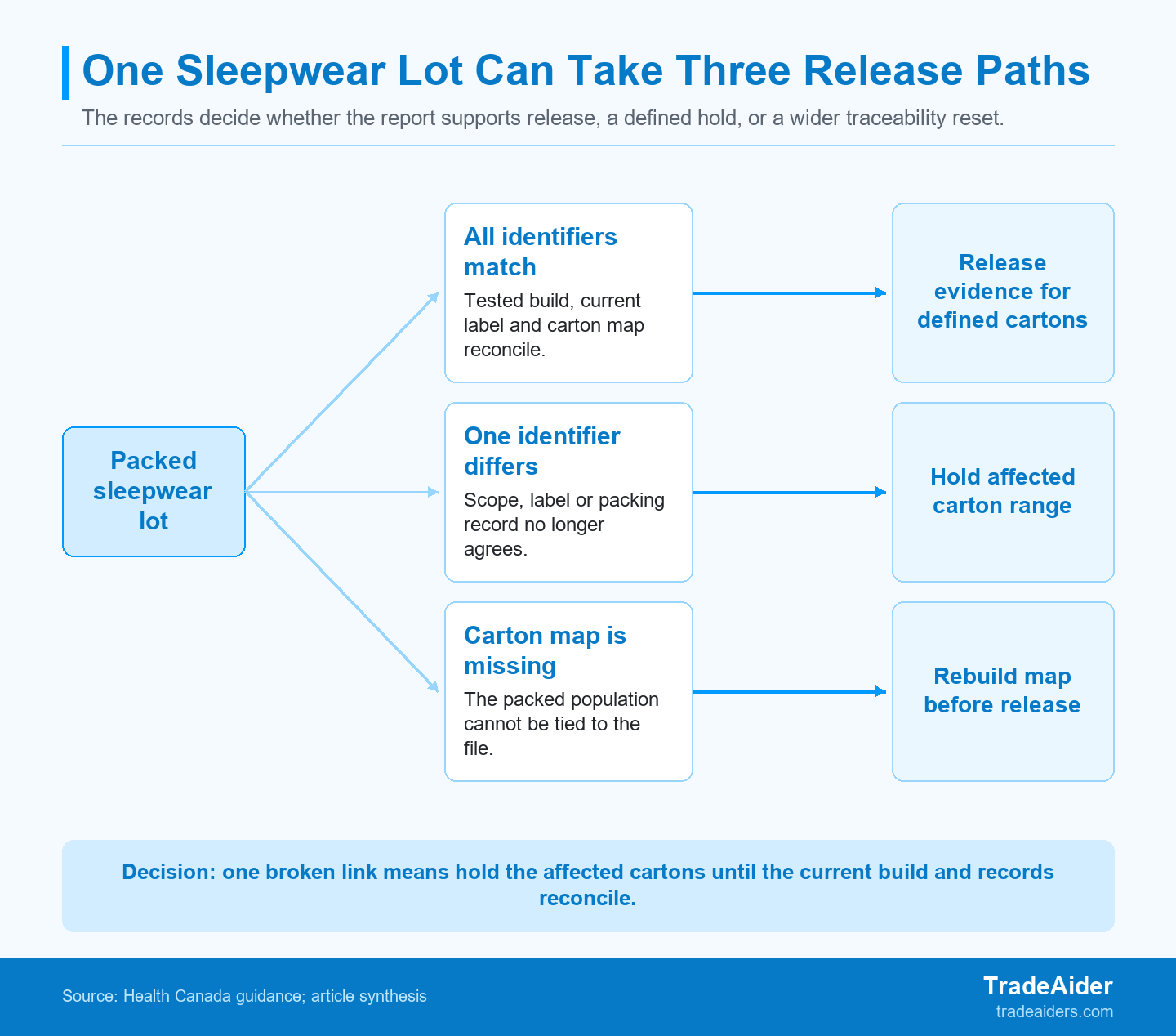
A Canada-bound sleepwear lot can use a report for release only when its build, label, and carton records still reconcile.
Health Canada’s targeted 2023–2024 project found 3 recalls and 2 stop sales among 20 tested imported sleepwear products, but the agency states that its targeted, small sample is not an overall market-compliance rate. That enforcement summary is a reminder to build traceability before goods are mixed in staging, not a statistical prediction of a supplier’s failure rate.
Use during-production change-control checks when a fabric, trim, construction, label, or packing method changes while the factory can still isolate the affected work. It is usually less costly to rebuild a component and carton ledger then than after multiple production periods are mixed.
Turn the File Into Observable Pre-Shipment Checks
A pre-shipment inspection can reconcile visible style, size labels, trim identity, packaging, and carton records against the approved evidence file, but it cannot create a laboratory flammability conclusion. The Canadian requirements are tied to the product route and test evidence, which a visual inspection cannot replace. The inspection brief should say what to compare, which documents are current, which cartons are in scope, and what discrepancy stops release.
For final random inspection, TradeAider’s working condition is that the order quantity is 100% complete and at least 80% packed for export. Use inspection-standard acceptance criteria to convert the Canadian evidence file into observable checkpoints: label placement and legibility, garment style, component identity, packing marks, carton quantities, and the agreed treatment of deviations.
Illustrative Scenario: A Fabric Change With Mixed Cartons
When the factory cannot separate a changed loose-fitting nightgown fabric from completed cartons, a valid report for the original fabric does not define which cartons are safe release candidates. Canada’s product-specific sleepwear route is the reason a fabric change cannot be abstracted away. In this illustrative order, a Canadian importer has 3,600 nightgowns in 180 cartons, an approved label, and evidence for the original fabric.
After a fabric shortage, the factory substitutes fabric during a second finishing period and then stages both periods together. It cannot map the substitute material to a carton range. The original report and label file therefore no longer identify every finished nightgown, even if the original paperwork remains valid for the first production period.
The importer holds the SKU rather than releases a guessed subset, separates remaining output, rebuilds the fabric-to-carton ledger, and obtains the applicable evidence for the changed build. Release can be reconsidered only when the current evidence, visible garment, current label, and defined cartons match. This is an illustrative procurement scenario, not a TradeAider client result.
A Practical Canada Sleepwear Release Checklist
A final release brief should state the product classification, applicable evidence, current approved label, visible checks, carton range, and hold trigger before the finished-goods inspection begins. The Canadian sleepwear framework supplies the technical boundary; the release brief connects it to the shipment actually on hand. Give the same brief to the supplier, laboratory contact, and inspector so a discrepancy has one owner and one escalation route.
- Confirm the sleepwear classification for every wearable item in the SKU.
- List the current fabric, construction, trim, and report scope.
- Approve the exact label revision and compare it with the bill of materials.
- Define the carton range the records actually identify.
- State whether any mismatch means recheck, retest, segregation, or hold.
The useful deliverable is a defined inspection brief and exception record, not an unsupported compliance promise. If the garment is packed and those inputs are defined, request a Canada-bound sleepwear pre-shipment inspection.
Frequently Asked Questions
Does a “not for sleepwear” label avoid Canada’s rules?
No. Health Canada says a label alone does not exempt a children’s garment that is made, marketed, or likely to be used for sleeping or related activities. Review the actual design, fabric, presentation, and intended use before relying on the label. Compare the marketing images and product description with the approved factory sample, then save that comparison with the classification decision. If the product can reasonably be treated as children’s sleepwear, keep the classification decision and supporting product information in the Canadian release file.
Can a tight-fitting cotton pyjama set use the loose-fitting test?
No. The product must first be classified under the applicable Canadian criteria. Tight-fitting and loose-fitting sleepwear have different flammability pathways, so the laboratory scope and report description must match the exact garment style rather than a generic pyjama label. A change in cuffs, fit, or added loose layers should trigger a review of whether the existing route still applies. The useful control is to issue the laboratory a style sheet, measurements, construction notes, and current component list—not only a broad product name.
What should be checked on the Canadian textile label?
Check the approved label against the finished garment’s current fibre composition, generic fibre names, percentages, bilingual fibre-related information, dealer information, and any size or treatment statements that affect the sleepwear classification or regulatory conditions. Confirm that the sample drawn from a finished carton carries the same artwork revision that appears in the technical file and packing instruction. The factory should provide that same revision to the finished-goods inspection brief so a visual mismatch has a documented escalation route.
Can a pre-shipment inspection prove flammability compliance?
No. An inspection can confirm whether the observed build, labels, trims, packaging, and carton records match the agreed evidence packet. It cannot replace the applicable laboratory evidence or make a regulatory determination about the product. Use inspection to test the identity and traceability of the goods, then escalate an evidence mismatch to the appropriate laboratory or compliance review. It should be briefed as a comparison task with defined documents and carton ranges, rather than as a visual substitute for a laboratory test.
When should a Canada-bound sleepwear shipment be held?
Hold the affected goods when the style classification is unresolved, the flammability report covers a different build, a current label conflicts with the specification, an accessible trim lacks the needed evidence, or the factory cannot identify the affected carton range. A targeted hold is useful when the records define a narrow population; a wider hold is safer when mixed production removes that boundary. Record the reason, the affected style and carton range, and the evidence required to lift the hold, so the supplier does not treat a corrective action as a blanket clearance.
Does a flame-retardant treatment replace the flammability requirement?
No. A flame-retardant treatment does not remove the flammability requirement, and treated loose-fitting sleepwear has additional label and care-instruction conditions. Health Canada’s guideline explains that the label and care instructions are part of the treatment conditions. Keep the declared treatment, approved care copy, and evidence for the actual production build in one revision-controlled packet.
Related Articles
Grow your business with TradeAider Service
Click the button below to directly enter the TradeAider Service System. The simple steps from booking and payment to receiving reports are easy to operate.

