
To check a US children's product tracking label, start with a selected physical product and its retail package, read their marks, and retrieve the production information behind them. The useful result is a documented connection to the responsible firm, manufacturing source, production date and cohort—the batch, run or other identifying production group. A familiar product code alone does not establish that connection. Keep the actual marks, their meaning, the supporting factory record and paired photographs together, then investigate any missing or conflicting link.
Three links a tracking-label check must preserve
- The physical product and the retail packaging actually checked.
- The mark's decoded source, production date and cohort.
- The retrieved production record and photographs supporting that relationship.
Confirm the US scope and the responsible firm
US children's products are subject to a tracking-mark requirement. US Consumer Product Safety Commission (CPSC) guidance defines the category as consumer products designed or intended primarily for children 12 years of age or younger; the stated classification factors matter, rather than an age label alone. CPSC’s tracking-label guidance requires visible, legible, permanent distinguishing marks on the product and its packaging to the extent practicable. Those marks must make the required source and production information ascertainable.
For an overseas-made product, CPSC places responsibility for ensuring tracking-label compliance on the importer of record. A purchasing agent can coordinate the factory’s files, but should identify the responsible importing firm and the person who can explain the production information. Do not let “the supplier handles labels” become the only answer when a consumer or regulator needs to identify a source.
Separate the identification tasks at the outset. A stock keeping unit, or SKU, identifies a commercial product or variant within a business’s system. A purchase order identifies a buying transaction. Neither necessarily distinguishes production at different factories or during different runs. A tracking system can incorporate these references, but it must still reach the required production information.
Fix the product model, approved artwork and packing configuration before comparing marks. The inspection reference guide can help organize the agreed product and packaging references for a factory visit. The importer’s compliance owner should first resolve the applicable category and labeling requirements; the inspector needs those references to make a meaningful physical comparison.
Check what the product and packaging must make ascertainable
Assess all relevant permanent marks together; the information does not have to occupy one new, separate label. CPSC's tracking-label policy permits suitable existing marks and does not prescribe a universal code format. Its tracking-label FAQ distinguishes a product mark expected to last through the useful life of the product from a disposable-packaging mark durable enough to reach the consumer. Code use and any departure from product or packaging marking remain subject to the applicable conditions.
| Information to make ascertainable | What the buyer should request |
|---|---|
| Responsible firm | Manufacturer/importer or private-labeler identity and a usable route for inquiries |
| Production location | Country, city and state or province as applicable; a specific factory source must remain identifiable |
| Production date | Actual month/year or supported production period, with the code explanation if encoded |
| Cohort information | Batch, run or other characteristics that distinguish the relevant production |
| Source detail | Additional information needed to identify the specific source, linked to the underlying records |
CPSC says month and year satisfy the production-date requirement and recognizes a date range when production spans a period. For disparate components assembled or gathered into one package, its guidance uses the assembly or packaging date in that context. Do not apply that specific explanation to justify replacing every manufacturing date with the export shipping date. Ask what event the supplier’s date field actually describes.
If the required information is encoded, a consumer must have a usable route to obtain it. CPSC's code-and-website example also requires identification of a manufacturer, importer or private labeler so someone without internet access knows whom to contact directly. An internal database that only an unnamed factory employee can interpret does not answer that consumer-facing question.
For textile-type products, CPSC rejects hangtags and adhesive labels as permanent tracking marks; the textile label needs durability for the expected lifespan under the care instructions. A packaging sticker and a sewn-in product label therefore need separate consideration. Agree any applicable permanence evaluation and reference; a clear photograph at inspection records present legibility, not useful-life durability.
"To the extent practicable" requires a reasoned product-specific decision. CPSC recommends a written record of the reasons and relevant supporting research when a firm decides it cannot mark the product or packaging. A product-side limitation does not automatically remove the packaging duty. All required information plainly visible through clear packaging is a separate condition under which additional outer-package marking is unnecessary.
Connect each code to a retrievable production record
Retrieve the meaning of an actual mark before accepting a supplier's batch explanation. The CPSC policy's discussion of cohort information does not require every manufacturer to invent a new lot-number system. It calls for reasonable means to ascertain detailed production information and distinguish relevant factory, time, component or other material differences. A buyer can apply that principle by asking the record owner to retrieve the production entry reached by the observed code.
A code key is simply an explanation of what the characters or identifiers mean. Obtain its controlled revision and owner, then use it with the relevant production record. A key might explain the plant, month and run, while the production entry supplies the factory identity, actual dates and associated work order. A decoding legend without a retrievable entry is only half the connection.
For example, a supplier may use one printed string on the product and a longer string on the retail box. Compare the decoded facts rather than demand character-for-character equality without understanding the system. Conversely, identical strings do not settle the question if a code was reused across unrelated factories or the supporting record describes different goods. Define how each mark reaches compatible production information for the product being checked.
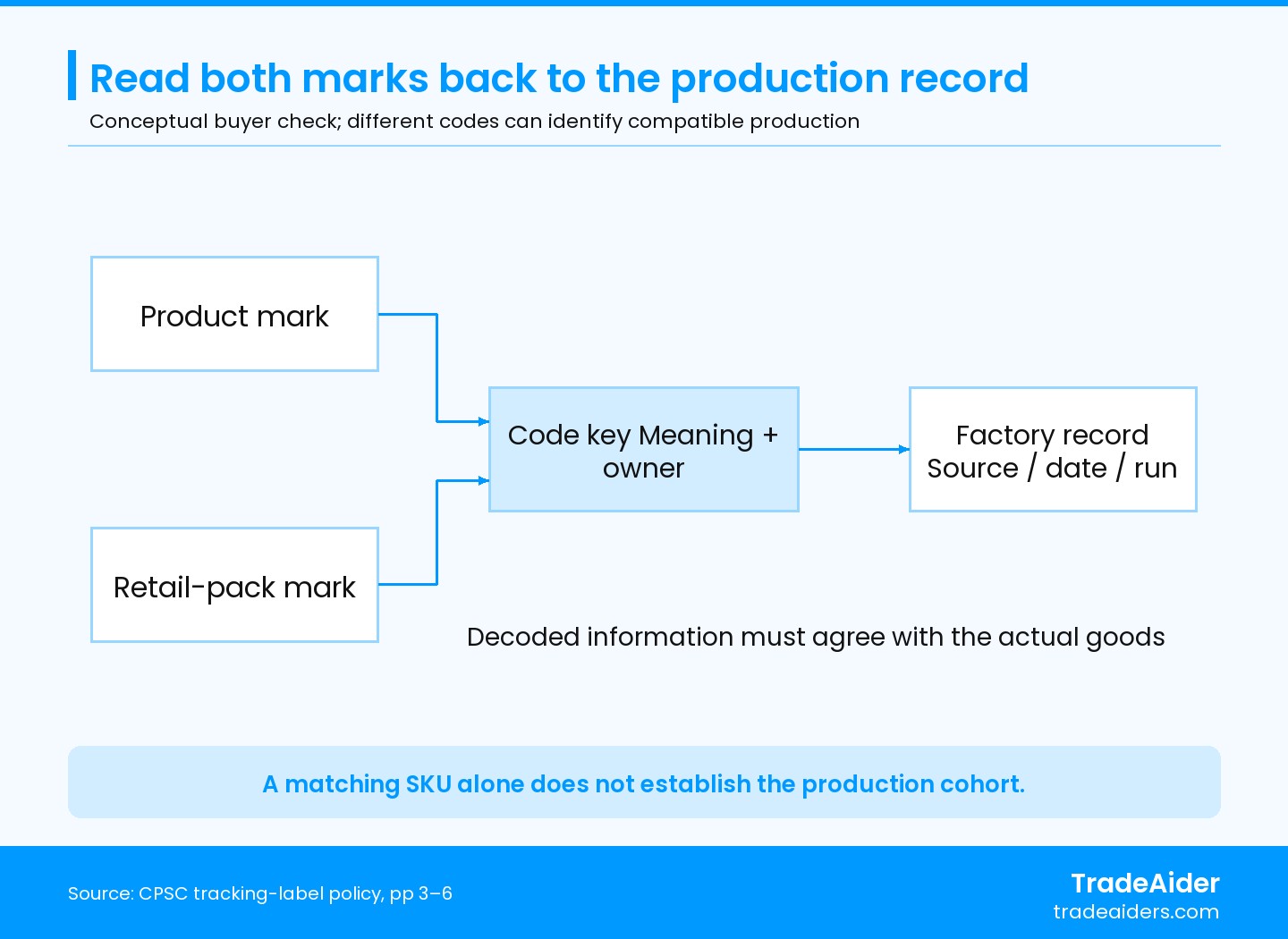
Conceptual lookup check. Product and retail-package marks may use different formats, but their decoded production information must be compatible with the actual goods. The code key and factory record are separate from a safety certificate.
The record set can be simple: a controlled spreadsheet with stable references may be more usable than a screenshot from an unexplained system. Ask for the production entry, relevant work-order or assembly reference, source location, date period and cohort meaning. Where component differences matter to distinguishing production, retain the relevant component references. These are practical retrieval requests, not a claim that CPSC mandates one enterprise system or this exact worksheet.
Test the lookup with the information available to the eventual report user. Can that person retrieve the explanation later, identify who supplied it and understand an obsolete code after a system update? Keep the record reference and the version supplied for review. A live screen shown during a call is useful context, but it leaves a gap if nobody retains a usable reference to the underlying entry.
Use a product, packaging and batch-record checklist
Use one checklist entry for a selected product and its associated retail package, preserving the actual marks before interpreting them. Record what was observed, what the code key says, and which production record supports the answer. A matching SKU is a starting identity check; it does not by itself establish the cohort. The following worksheet can be copied into the buyer’s inspection brief.
| Comparison | Fill in the actual evidence | When the answer is missing or different |
|---|---|---|
| Product mark | Sample ID: ___; location on product: ___; exact mark: ___; close photo: ___ | Record absent or unreadable information; preserve the product context |
| Associated retail package | Same sample ID: ___; package mark: ___; package photo: ___ | Check the actual product/package pairing before assuming a printing error |
| Decoded meaning | Code-key revision: ___; firm: ___; place/date/cohort: ___ | Request the explanation and consumer inquiry route; retain unknown fields |
| Production record | Record ID/revision: ___; actual source/date/run: ___; product reference: ___ | Ask the record owner to reconcile conflicting production facts |
| Population represented | Order/SKU: ___; identified production groups: ___; sampled carton references: ___ | Keep unexamined groups explicit; investigate whether the affected scope is identifiable |
| Disposition and follow-up | Finding/photo IDs: ___; owner: ___; required action: ___; recheck reference: ___ | Leave the decision pending until the named reviewer records the outcome |
Take a context photograph showing where the mark sits, followed by a close image that preserves every character. For a retail package, link the package image to the selected product’s sample identifier. Keep enough identifying context to distinguish similar variants. A folder of detached close-ups may show readable labels while making it impossible to tell which box or item each image belongs to.
Transcribe confusing characters as uncertain rather than quietly changing them. Ask for another view or the physical item when a mark could be read in more than one way. Keep the observed transcription separate from the supplier’s explanation. That separation helps the buyer see whether the issue is poor legibility, a wrong mark, an outdated code key or an incorrect underlying production entry.
Agree how samples will cover the named production groups and packing configurations. An acceptance quality limit (AQL) forms part of an agreed sampling plan for defect checks. The AQL sampling calculator supports discussion of a defined lot and sampled defect assessment; it does not create a tracking-label exemption or make an unexamined cohort identifiable. If targeted label checks are added to routine sampling, have the report distinguish their scope and results.
Resolve conflicting marks without rewriting the evidence
When marks or records conflict, preserve the original observations and determine which goods are affected before changing the evidence. The buyer needs to know whether the problem lies in the product mark, the retail-package pairing, the code explanation or the production record. A correction should restore a supported relationship; editing a spreadsheet until its fields match a photograph does not establish what was actually made.
Illustrative example: Consider a hypothetical children’s fabric accessory sold under SKU KITE. The selected product carries code F7-2610-R2, while its retail package carries F7-2610-R1. The supplied key identifies plant F7, October 2026 and separate production runs R1 and R2. Both factory entries exist, but the shared SKU and month cannot establish that this package belongs with this product. These identifiers are invented for this example, not a prescribed label format or TradeAider client data.
Enter both strings, the sample identifier, paired photos and both record references in the worksheet. Ask the factory’s packing and production owners to explain the pairing. If records support an R2 product packed in an R1-marked retail package, the buyer can define the affected packing scope and arrange a controlled correction. If the actual production identity is still uncertain, changing the box label first would hide the unresolved question.
After a supported correction, compare newly selected product/package pairs with the approved references and production entries, and retain the recheck evidence. Keep the original finding and the corrective record linked. The responsible buyer decides the disposition using the confirmed scope and applicable requirements; this example does not predict a regulator’s decision or make a few corrected samples proof of the whole order.
If the supplier cannot separate affected packing from other goods, expand the investigation rather than declare the visible mismatch isolated. Repacked returns, leftover printed packaging and combined production runs can break a once-correct relationship. Ask what records or physical segregation can establish the boundary. A full-order check, sorting or another response may need to be agreed when that boundary cannot be demonstrated.
The factory remains the source of its production records, and the importer’s responsible reviewer should be named to resolve questions the observed goods and supplied files cannot answer.
Define the factory inspection and its limits
Define a factory inspection as agreed observable comparisons and reporting within the actual sample scope. It does not replace the applicable testing and certification described in CPSC’s Children’s Product Certificate guidance. A Children’s Product Certificate, or CPC, addresses compliance with applicable children’s product safety rules; a photograph and a decoded tracking mark do not provide that testing basis.
CPSC also states that the tracking-label requirement itself does not require assessment by a third-party CPSC-accepted laboratory, and a tracking-label citation is not required on a CPC. Keep that distinction in the brief. Requesting a “tracking-label certificate” from the inspector can obscure the task that is actually needed: compare the supplied references, record the physical marks and identify unresolved differences.
At the factory, specified checks may include label presence and placement, legibility, comparison with approved text, product/package pairing and the supporting references made available. Clarify whether the inspector can access the code key and production entries, or whether an importer’s reviewer will perform the decoding separately. If access is unavailable, the report should say so instead of presenting the relationship as verified.
Keep observation and supplier explanation distinct in the report. “Product code reads R2” is an observation. “Factory states R2 was the October run” is an attributed explanation. “Record PR-___ supports that date and source” adds a document comparison. These statements carry different evidential weight, and the report recipient should be able to follow which step was completed.
Agree equipment, on-site methods and any applicable marking-durability checks in advance. A visual visit should not silently become an unspecified useful-life test. Similarly, photographs can record a mark’s present condition, while the responsible firm still needs a basis for the mark’s expected permanence and any practicability decision.
TradeAider's pre-shipment inspection service is a relevant stage for discussing finished-goods and packing observations. Pre-Shipment Inspection, or PSI, takes place when the order quantity is 100% complete and at least 80% packed for export. Confirm the requested label comparisons, record access and photo links in the agreed scope; the packing threshold does not mean production may still be incomplete.
Send a usable tracking-label brief before inspection
Send a brief that identifies the goods, mark references, code access, production-record owner and reporting expectations. Also check whether the product category adds obligations beyond tracking marks. CPSC’s durable infant or toddler product labeling guidance separates tracking information from additional labeling and consumer-registration requirements. A tracking-label worksheet should therefore remain one part of a category-specific file, rather than stand in for all required warnings, registration materials or safety evidence.
For an initial inquiry, available product and order information is enough to start identifying the scope. State the product type, factory, destination, quantity and planned timing, and list the references that are still missing. A first-time importer or small purchasing agent should not need to invent technical answers to make contact. The outstanding questions should become named preparation items for the appropriate owner.
Before execution, provide the approved product-mark and retail-package references, the current code key, and access to the relevant production entries. Identify the product models, variants, production groups and packing arrangements to be examined. Tell the team where the marks should be found and which paired photographs and record references the report must preserve. Include any documented practicability decision for the responsible reviewer to assess.
Name the final report recipient and confirm the required language, format and acceptance conditions. A brand’s internal team, a distributor and a marketplace may ask for different supporting material; establish the actual request rather than assuming that one report will be accepted everywhere. Agree how the inspector will record an inaccessible file, unreadable mark or conflicting pairing, and who can decide the response while the goods remain identifiable.
Give each unresolved item a next action: obtain a missing code explanation, retrieve a referenced entry, clarify the physical pairing or arrange the supported correction and recheck. Preserve the item’s status until the responsible reviewer records the outcome. This makes the report usable without asking the inspector to infer manufacturing facts that neither the supplied records nor the observed goods establish.
To discuss the planned label and packing checks, contact the TradeAider team with the available order details, approved references and remaining questions. The scope discussion should settle the required observations, evidence access and reporting limits before the visit, so the resulting findings can be used by the named decision owner.
FAQ
Must every piece in a children’s block set carry a tracking mark?
Not necessarily. CPSC’s multipart-product FAQ describes circumstances where marking one block or a reusable storage box or bag can satisfy the on-product requirement, depending on the product. Do not treat that example as permission to leave separately sold items unidentified. Review the set’s actual construction and use, and retain the relevant product and packaging marking decision.
Do children’s socks need an attached tracking label?
CPSC says children’s socks do not need an attached tracking label, while the packaging must still carry the required tracking information. This is a specific hosiery example in the agency’s guidance. It does not make a removable hangtag a permanent product mark for every textile item, or remove the need to identify the responsible firm and production information for the socks.
Is a small handmade business exempt from tracking labels?
No. CPSC provides no exemption based on business size. A small maker can consider its existing identification and recordkeeping practices instead of assuming it needs an elaborate new numbering system. The practical question remains whether the required source and production information can be determined. Preserve the component purchase and production references needed for that answer, and assess any marking limitation on its actual product-specific basis.
Related Articles



Grow your business with TradeAider Service
Click the button below to directly enter the TradeAider Service System. The simple steps from booking and payment to receiving reports are easy to operate.