
Real-time inspection reporting is visibility during the inspection that can support a response before the final report is issued; same-day PDF delivery alone does not establish that capability. Compare whether each update carries a time, a physical reference, an action owner, and a final result.
For importers buying inspection services in China, the useful comparison is not who promises the quickest PDF. It is whether the reporting workflow can turn a finding into an evidence packet that supports a hold, correction, verification, or release decision while the relevant people can still act. The platform should make the connection between the shipment on the floor and the record on the screen clear enough to test.
What Does Real-Time Reporting Mean in a China Inspection?
A provider's real-time claim should be judged by whether it can show a live update linked to time, physical scope, owner, and final result. In practical terms, the buyer needs to know when the evidence was captured, which SKU, sample, or carton it concerns, who must respond, and what was eventually decided. A photo in a chat thread may be fast, but it is not yet a complete working record.
- Ask to see one material finding move from capture to signed final report.
- Require identifiers that tie images and comments to the relevant item, sample, or carton.
- Confirm who can comment, who can change status, and what remains available after the visit closes.
A real-time evidence chain is a live update linked to its capture time, physical reference, decision owner, and final result. This is a buyer comparison definition, not a legal classification of software. It keeps the discussion focused on decision usefulness: can the record help the buyer limit the affected scope, direct a correction, and check what was done before a shipment is released?
What Makes a Live Update Decision-Grade?
NIST SP 800-53 identifies core audit-record content: event type, time, location, source, outcome, and associated identities. The NIST audit-record control concerns information systems, not inspection portals, but it offers a useful record-design reference: a buyer should be able to reconstruct the order of a material finding, comment, correction request, and closure rather than rely on isolated screenshots.
FDA's drug CGMP guidance defines an audit trail as a secure, computer-generated, time-stamped record that reconstructs the creation, modification, or deletion of an electronic record. Here, an audit trail is a history that lets a buyer see the sequence and closure of updates. This is drug CGMP guidance, not a mandatory rule for ordinary consumer-goods inspection platforms; it is a high-standard reference for asking whether a record can show how it changed. The FDA explains this definition in its data-integrity guidance.
For an importer, a decision-grade real-time evidence chain links the capture time, the item or carton reference, the person responsible for the next action, and the final hold, correction, or release decision. Traceability is a link from a finding to the particular item, sample, or carton. Together, these fields prevent a visible issue from becoming an unanswerable question later: “Which goods were affected, and what happened next?”
Start with a short field test. Open a finding and ask the demonstrator to show its original capture time, reference code, images, buyer comment, action owner, status history, and final signed-report entry. If one of those steps exists only in email, another app, or a person’s memory, record that boundary in the proposal. The tool may still suit a simple order, but its response path is different from an integrated evidence record.
How Should Importers Compare Reporting Workflows?
Report-after-visit, shared-file, and live-portal workflows create different evidence and response boundaries, so an importer should compare a demonstrated process rather than a feature label. The categories below are illustrative workflow models, not rankings or claims about every provider. A provider can combine modes, and availability must be confirmed for the current order.
For marketplace orders that need this type of evidence path, review the reporting scope alongside e-commerce quality solutions. Then use the same sample finding in each demonstration. The comparison should cover what the buyer sees while the visit is active, how the physical reference is recorded, how a comment is assigned, and how the final report closes the record. That method prevents a polished dashboard from hiding a weak handoff.
| Workflow model | During-visit visibility | Physical-reference test | Comment and action test | Final-report boundary |
|---|---|---|---|---|
| Report after visit | Usually after the inspection closes | Check the final report's sample and carton references | Confirm who receives corrective questions after the visit | The report is the main record |
| Shared files and messages | Potentially quick, but spread across tools | Ask how a photo is tied to the order and carton map | Check whether owner and closure are preserved | Final report may need manual consolidation |
| Live portal | Status can be visible while work is active | Open the photo record and locate the exact SKU, sample, or carton | Follow a comment to its assigned action and closure | Confirm export, access, and signed-report treatment |
| Order-specific TradeAider workflow | Client materials describe real-time online reporting | Ask to demonstrate the buyer's required evidence fields | Confirm roles, escalation, and current-order scope | Confirm final report, export, retention, and permissions in writing |
Based on this comparison, the live-portal label alone does not decide the outcome. Choose the workflow that can demonstrate the evidence path needed for the shipment, then write any unavailable handoff into the inspection scope. This is especially important when a buyer must make a limited hold decision rather than wait for a general report.
NIST SP 800-92 frames log management as a process to develop, implement, and maintain rather than a single final file. Its log-management publication concerns security logs, not inspection-company service requirements. The limited lesson here is to evaluate capture, review, export, and later retrieval as one workflow rather than treating a final PDF as the whole system.
Client-approved TradeAider materials describe a digital platform with real-time online reporting that allows clients to monitor and communicate during production. The buyer should still request a demonstration of the current order's evidence fields, access roles, escalation route, and final-report handoff. See TradeAider's service approach.
What Should a Provider Demonstrate Before You Compare Price?
The strongest provider demonstration follows one de-identified finding from its initial status through evidence, buyer comment, assigned action, resolution, export, and final signed report. Ask for a routine example, not a perfect slide. The buyer should be able to pause at every handoff and ask what data was entered, who can see it, who changed it, and whether the same record appears in the final document.
A useful demonstration therefore has four handoffs: capture the finding, clarify the buyer's request, correct the relevant goods, and close the evidence record. The diagram below shows the questions that should survive each handoff.
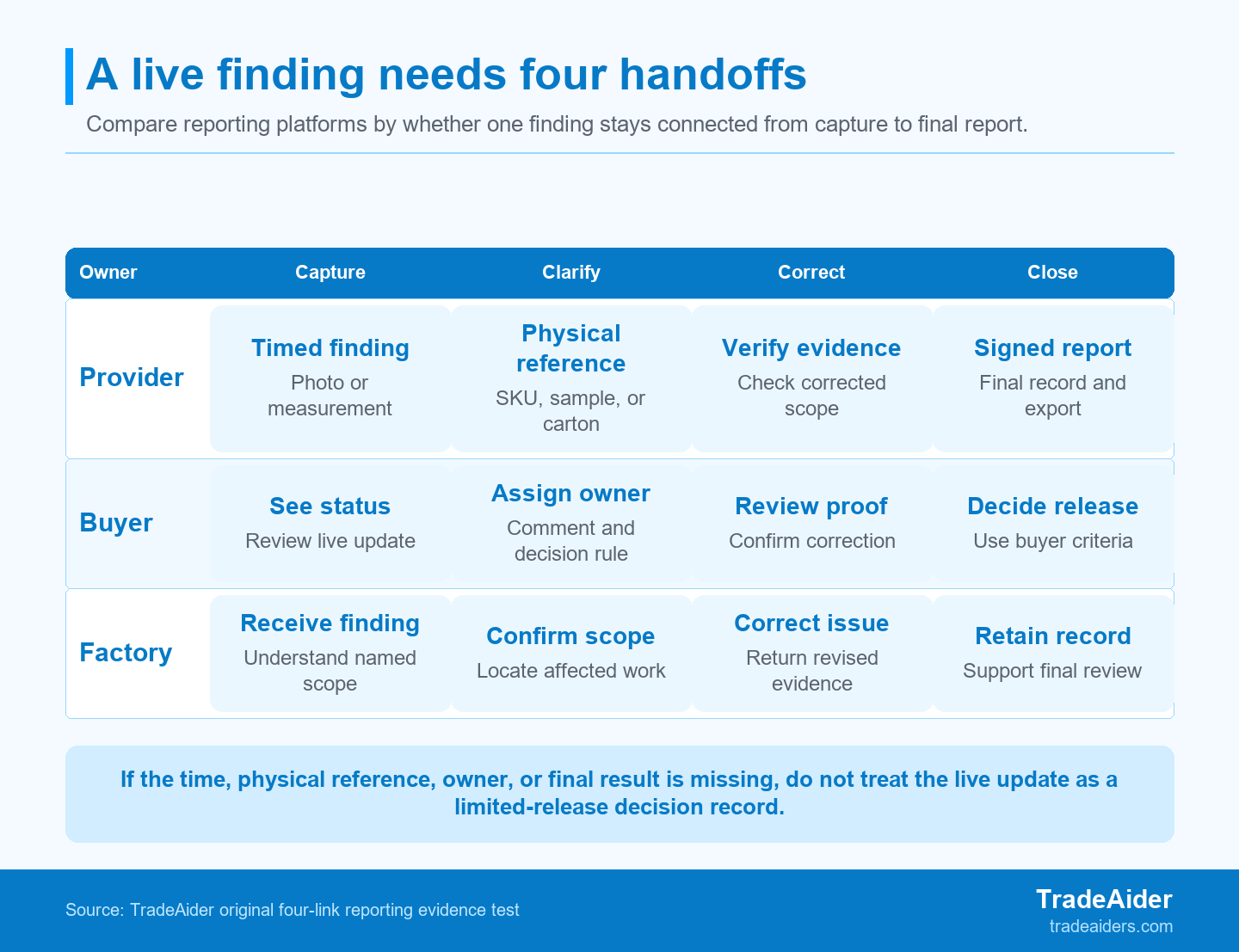
A reporting platform is useful when one finding stays traceable through every owner and into the final signed report.
NIST's federal profile includes capturing event information with timestamps and complying with an audit-log retention period. The NIST event-awareness material is a security reference, not a consumer-product portal mandate. It gives importers a grounded reason to ask exactly what time is recorded and how long a provider can retrieve the record after the order is completed.
- Open the finding. Does the screen show the order, inspection stage, capture time, severity, and linked photos or measurements?
- Locate the goods. Can the demonstrator move from the screen to a SKU, batch, sample, carton number, or other buyer-approved physical reference?
- Send and own a comment. Can the buyer add a question, can the factory or provider see it, and is one named role responsible for the next action?
- Close and export. Can the record show the correction, verification evidence, final hold/correction/release decision, export format, signed report, retention term, and access permissions?
Score each point as demonstrated, unavailable, or separately scoped. A provider may reasonably limit an integration, a language setting, or access to a specific role. The important point is to make the limit visible before the quotation is compared. A written scope can then state which fields are mandatory for material findings and which updates are for awareness only.
When Does Live Reporting Change the Inspection Plan?
The value of a live update is highest when the buyer can still isolate, correct, or verify the affected work before the final shipment scope is fixed. That makes earlier visibility more useful when packaging, labels, inserts, or assembly details may still change. At final inspection, a live update is often most valuable for identifying the exact packed scope and deciding whether a targeted verification is possible.
Match the platform request to the production moment. Before or during production, the buyer may need a prompt to stop an incorrect label version from spreading further. During packing, the buyer may need a carton map and photo references to separate a corrected variant from an unresolved one. At final inspection, the buyer may need evidence that supports a release, a hold, or a follow-up check. The provider should confirm the actual timing; no reporting tool can create a correction window that production has already closed.
If the question concerns product performance, chemical limits, or a market-specific requirement, keep that evidence separate from the inspection portal. Testing may require a different evidence path, sample plan, and report type. The reporting brief should say how those records will be referenced together without presenting an inspection update as a substitute for required testing.
Illustrative Scenario: When a Live Alert Expands the Hold
Why the 10:42 Alert Was Not Enough
An importer must decide whether a late printed-insert change requires a broad hold or a limited recheck. This illustrative scenario is an example, not a TradeAider client case.
The 600-unit shipment is packed in 30 export cartons across two variants, with a buyer-supplied current insert revision and carton map.
All cartons are sealed and staged for final release review.
At 10:42, the platform displays a photo of an insert with an older revision, but the photo record contains no carton number, SKU, or pack-out reference.
The buyer can see the alert and add a comment, yet the record cannot show which of the 30 cartons contains the affected variant or whether the photograph came before or after the packing change.
NIST notes that application logs can record errors with timestamps, which establishes timing but does not by itself identify the physical scope of an issue. The first point appears in NIST SP 800-86; the scope conclusion is an inspection decision inference. A timestamp tells the buyer when the alert appeared. It does not establish which cartons contain the old insert.
In the illustrative 600-unit shipment, a 10:42 live photo without carton or SKU references requires all 30 cartons to be held because no smaller affected scope can be verified. The buyer holds all 30 cartons rather than releasing 24 on an assumption. The one-day delay is the illustrative cost of missing traceability, not a claim about a real shipment.
The factory supplies the current insert revision and repacks the affected variant. The provider records new photos against carton references and assigns the buyer's comment a resolved status. The correction is now linked to a physical map instead of an unlabelled image.
A targeted verification checks the corrected carton references, confirms that both variants match the current buyer files, and attaches the result to the final signed report before release is reconsidered. The check should also state what was rechecked and what remained outside the verified scope.
This scenario is illustrative. Actual release still requires the buyer's acceptance criteria, any applicable testing evidence, and the current shipment documents. The lesson is not that every alert requires a full hold; it is that an untraceable alert prevents the buyer from proving a smaller hold is safe.
What Should You Put in the Reporting Brief?
A reporting workflow can be scoped only when the importer supplies the shipment reference, physical map, decision owner, required evidence fields, and intended final-report audience before booking. Put those items in the request for quotation, along with the inspection stage, buyer acceptance rules, named contacts, correction deadline, and any document versions that the finding must be checked against.
- Shipment reference: purchase order, factory, planned inspection date, and stage of production.
- Physical map: SKU or variant list, batch identifiers where relevant, sample plan, carton map, and pack-out references.
- Evidence fields: required photo angles, measurements, timestamp, reference code, severity, and comment history.
- Decision path: who can request a hold, who approves a correction, and who makes the final release decision.
- Record boundary: final-report format, signature, export options, access roles, retention period, and retrieval process.
If the question concerns product performance, chemical limits, or a market-specific requirement, keep that evidence separate from the inspection portal. A product-testing service may provide a different evidence path, sample plan, and report type. The reporting brief should say how those records will be referenced together without presenting an inspection update as a substitute for required testing.
NIST's baseline reviewer calls for retaining audit records for a defined period and ensuring long-term records can be retrieved. Its baseline-reviewer material is an evidence-design reference, not a specified retention rule for an inspection provider. Ask the provider to state the current retention and retrieval terms that apply to the order instead of assuming historical evidence will remain accessible.
Send the brief before the demonstration, then compare the demonstrated workflow against it line by line. If the shipment is time-sensitive, include the latest date by which the buyer needs a material finding, a response, and verification evidence. When the order references are ready, ask TradeAider to review the reporting scope.
Choose the Evidence Path Before the Rate
An importer should compare the written evidence path before the headline rate, because a low price cannot repair a missing reference, owner, or final-report boundary after the visit starts. Compare the demonstrated path for the current shipment, record the exceptions in writing, and then decide whether the response window and evidence record fit the buyer's release process.
Who Is TradeAider?
TradeAider is a quality inspection, testing, and certification service provider in China. Its coverage includes major sourcing provinces such as Guangdong, Zhejiang, Jiangsu, Shandong, and Fujian, serving buyers, importers, wholesalers, sourcing agents, brands, eCommerce sellers, and enterprise teams. Its company profile states its Amazon Service Provider Network (SPN) partner status.
TradeAider describes a nationwide network and a digital platform with real-time online reporting so clients can monitor, communicate, and address production issues during the process. Platform access, evidence fields, and escalation steps should be confirmed for the shipment at hand.
Pricing is transparent at $199/man-day all-inclusive for Inspection & QA Services. Client testimonials published by TradeAider cite an 18% reduction in return rates and a 23% improvement in defects caught before shipment; these are client-reported figures, not a prediction for every order.
Frequently Asked Questions
Reporting-platform questions should be resolved against the current shipment scope and written buyer requirements. The answers below help frame the request, but they are not legal, testing, or release approvals.
Is same-day report delivery the same as real-time inspection reporting?
No, same-day delivery can be useful, but it does not give the buyer visibility and an action path while the inspection is active. Ask whether the buyer can view a material finding, comment on it, identify the affected physical scope, and receive an updated status before the final signed report is issued. Confirm the actual timing and access rules in the written scope.
What should an online inspection report show for each material finding?
An online inspection report should show the finding, capture time, physical reference, evidence, owner, current status, and final hold, correction, or release decision for each material issue. The physical reference may be a SKU, sample, batch, carton, or another buyer-approved identifier. Require the provider to demonstrate how that reference appears in both the live record and the final signed report.
Can an importer make a ship-or-hold decision from a live dashboard?
A live dashboard can support a ship-or-hold decision only when its evidence matches the buyer's written acceptance rules and identifies the relevant shipment scope. It cannot replace a product specification, required test result, or the buyer's release authority. If the record does not identify the affected goods, the buyer may need to hold a broader scope until a correction and verification restore traceability.
When should a buyer request a platform demonstration?
A buyer should request a platform demonstration before comparing final prices or booking dates, while the provider can still show how the proposed workflow handles the buyer's evidence fields. Provide one realistic order example and follow it from capture through final report. Then put any limits on timing, access, exports, retention, and escalation into the written order scope.
Related Articles


Grow your business with TradeAider Service
Click the button below to directly enter the TradeAider Service System. The simple steps from booking and payment to receiving reports are easy to operate.

